How I Found My Husband Again After He Became the Man I Feared
For years, I believed that love was a series of bright, effortless moments—the kind of love that exists in the golden hour of a wedding photograph. I remember my wedding day with Julian. We were younger then, radiating a kind of happiness that felt invincible. Julian was a builder, a man of grit and strength who shaped houses out of raw wood and stone. He was the kind of man who carried the scent of pine and hard work, whose laugh could fill a room, and whose arms felt like the safest place on earth.
But life has a cruel way of dismantling what we build. One afternoon, under a sun that seemed far too bright for tragedy, Julian fell. He fell from the height of his strength into a world of silence and sterile hospital corridors. The man who came home to me months later was not the man I had married. He looked like Julian, he had Julian’s eyes, but they were vacant, filled with a cold, jagged anger that I didn’t recognize. For months, I lived with a stranger—a man who offered me only silence and bitterness in exchange for my devotion. This is the story of how our world broke, and how, in the wreckage, we found a different kind of love.
The Day the Sky Fell: A Telephone Call That Changed Everything
It was a Tuesday, a day so unremarkable that I can still remember the mundane details of the morning—the way the sunlight hit the kitchen table, the taste of my coffee. Julian had kissed me goodbye, his hands rough and warm against my cheek, and headed to the construction site. He was a man of the heights, walking beams and scaffolding with the grace of someone who truly belonged in the sky.
Then the phone rang.
The voice on the other end was professional yet laced with a practiced empathy that chilled me to the bone. A woman from the hospital. She spoke of an accident, a fall, a distance so great that the body shouldn’t have survived it. I remember the world tilting. I remember my hands shaking so violently I could barely grip the steering wheel as I drove, my heart hammering a frantic rhythm against my ribs: Please let him be alive. Please let him be alive.
At the hospital, the air smelled of antiseptic and old sorrow. The doctor’s face was a mask of grim news. Julian was alive, yes, but the builder of houses was broken. He would never walk again. When I finally walked into his room, the beeping of the monitors felt like a countdown to a life I didn’t know how to live. Julian lay there, his eyes open and fixed on the ceiling. I took his hand—it was limp, a ghost of the strong hand that had built our life. I whispered that everything would be okay, but as he looked at me, his eyes filling with silent, drowning tears, I knew I was lying.
Living with the Ghost: The Weight of the “New” Julian
Coming home wasn’t the victory I hoped it would be. I had spent weeks preparing—buying a hospital bed, installing ramps, and clearing paths for the wheelchair. I wanted to create a sanctuary, but instead, I created a prison for his pride. The first time I helped him from his chair to the bed, I saw the flicker of something dark in his eyes. It was shame.
The silence began to grow like a weed between us. I would cook his favorite chicken and rice, the aroma filling our small kitchen, but he would push the plate away, his jaw tight. I would play the old songs we used to dance to, hoping to spark a memory of the “old” Julian, but he would bark at me to turn them off. He stopped telling his funny stories. He stopped asking about my day. He spent his hours staring out the window at a world he could no longer touch, his reflection in the glass looking like a man who had already passed away.
I became his nurse, his cook, and his shadow, but I was no longer his wife. Every time I touched him to help him wash or dress, he would recoil or look away, as if my kindness was a reminder of his helplessness. I started crying in the bathroom with the water running so he wouldn’t hear me. I was 34 years old, living in a house full of furniture, yet I felt more alone than if I were in an empty desert.
The Shadow in the Bottle: When Silence Turned to Shouts
The anger didn’t stay quiet for long. It found a voice in the bottom of a bottle. I started finding them everywhere—tucked under the bed, hidden behind the towels in the bathroom, nestled in the dark corners of the closet. Julian began to drink to numb the phantom pains in his legs and the very real pain in his soul.
The alcohol stripped away whatever remained of his restraint. The man who used to hold me with such tenderness was replaced by a man who used his words as weapons. “You don’t understand!” he would roar, his face turning a terrifying shade of red. “You’re just staying because you feel sorry for me! Just go! Leave me!”
His words cut deeper than any physical injury could. He accused me of wanting to leave him, of being a “bad wife,” of staying out of pity. I would retreat to the bedroom, sitting on the floor with my back against the door, listening to the sound of his wheelchair pacing the hallway like a caged animal. I lied to my friends. When they called to ask how he was, I’d force a smile into my voice and say, “He’s getting better. We’re doing fine.” I was too ashamed to tell them that my husband had become a monster of grief and gin.
The Breaking Point and the Promise Kept
There were nights when I packed a bag. I would sit on the edge of the bed, looking at the suitcase, imagining a life where I didn’t have to walk on eggshells, a life where I didn’t have to breathe in the sour scent of alcohol and resentment. I imagined a life where I could smile again. It was a beautiful, seductive dream.
But then, I would remember the wedding vows. In sickness and in health. I had stood before God and our families and promised to stay. I realized that love isn’t just a feeling you have when things are easy; it’s a decision you make when things are impossible. Julian was drowning, and even though he was trying to pull me under with him, I couldn’t let go of the rope.
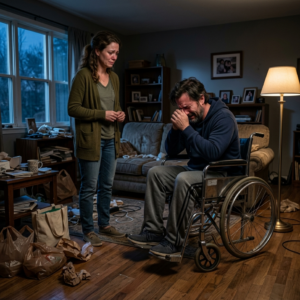
Then came the night when the storm finally broke. I walked in from the grocery store and heard a sound that stopped my heart. It wasn’t shouting. It wasn’t the sound of a glass breaking. It was a man sobbing. I found Julian in the living room, his head in his hands, his body shaking with a profound, soul-deep agony. I stood by him, paralyzed, until he looked up at me with eyes that were finally, blessedly, Julian’s eyes again. “I am sorry,” he whispered.
The Long Road Back: Building a New House from the Rubble
That “sorry” was the first brick in our new foundation. For the first time since the fall, he talked. He told me how much he hated his body, how useless he felt, and how the shame of needing me was more painful than the injury itself. He confessed that he drank because he couldn’t bear to face the man in the mirror. I sat on the floor by his chair, and we cried together—a messy, loud, ugly crying that cleared the air of months of toxic silence.
The recovery wasn’t instant. There were still bad days, days where the urge to drink was a physical itch, days where the anger flared. But we had a new rule: we talk. We took the bottles to the trash together. I started telling him when his words hurt me, and he started listening. He found a new passion in drawing, sketching the trees in the park and, eventually, sketching me.
We went to the park every day. I would push his chair, and we would sit under the old oak tree, watching the birds and feeling the sun. It wasn’t the life we planned. He would never build another house with his hands, and I would never again be the carefree woman I was at twenty-five. But as he sat there, looking at me with a smile that actually reached his eyes, he whispered, “Thank you for staying.” And in that moment, I realized that we hadn’t just survived; we had built something stronger than any house he had ever made. We had built a love that knew how to survive the fall.
Deep Reflection: What Love Really Means
Margo and Julian’s journey is a stark reminder that the “happily ever after” of our dreams is often forged in the fires we never wanted to walk through. We often mistake love for a lack of conflict, but true love is the courage to stay in the room when the shouting starts and the grace to forgive when the “sorry” finally comes. It’s about seeing the person beneath the pain and realizing that sometimes, the most heroic thing you can do is simply refuse to leave.
Call to Action: Have you ever had to fight for a relationship that seemed broken beyond repair? How do you find the strength to stay when the person you love becomes a stranger? Share your stories of resilience and hope in the comments. Let’s support one another in the messy reality of love.
Disclaimer : This content may be created by AI for entertainment purposes. Any resemblance to real persons, events, or places is coincidental.






