Billionaire’s Fiancée Kicked Apart the Maid’s Toddler’s Block House—Then the Billionaire Slapped Her
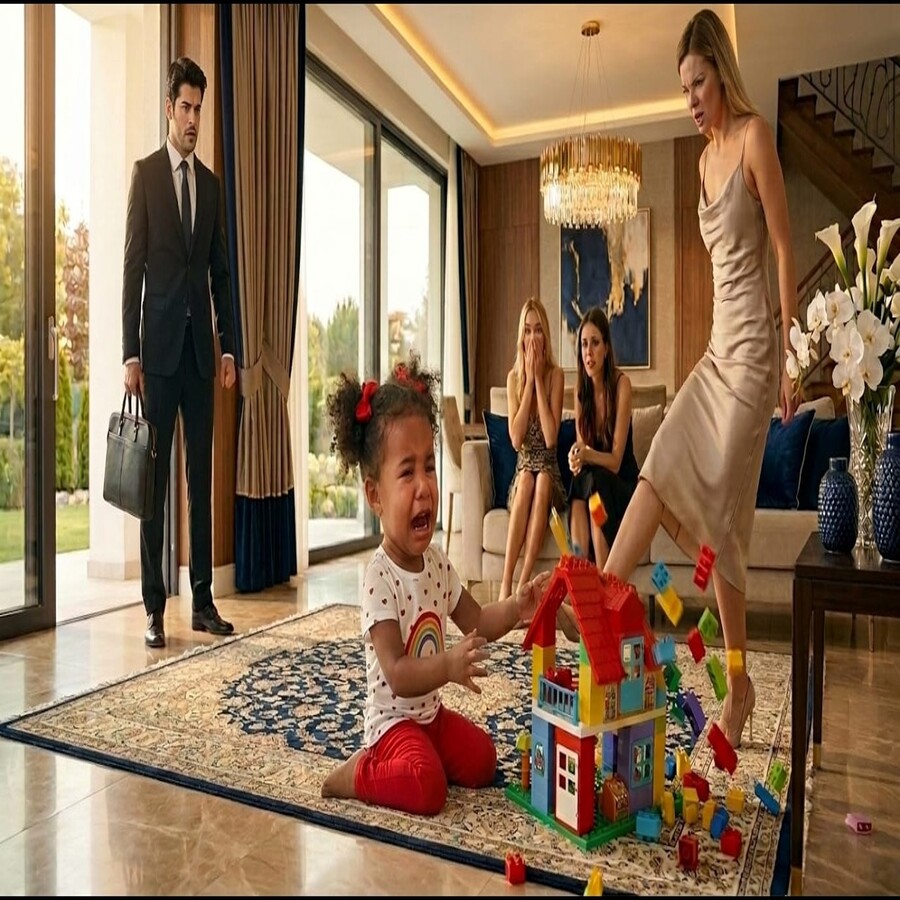
Nobody expected a two-year-old’s toy to change everything.
Maria Gonzales had worked as a housekeeper for the Whitfield estate in Greenwich, Connecticut for six years. She was quiet, hardworking, and fiercely devoted to her daughter, Lily, a curly-haired toddler with a laugh that could light up the darkest room.
Maria’s employer, Daniel Whitfield, was a self-made billionaire who’d built a tech empire from nothing. He was firm in business but soft-hearted at home, especially when it came to Lily, who had practically grown up running through the halls of his mansion while her mother worked.
“Uncle Danny!” Lily would squeal every time he walked through the door, arms outstretched.
Daniel always scooped her up, no matter how exhausted he was from a sixteen-hour day closing deals. There was something about her innocent joy that reminded him of a simpler time. Before money, before fame, before Isabella.
Isabella Marsh hadn’t always been this way.
Years ago, when Daniel first met her, she was a struggling art teacher with paint-stained hands and a laugh that felt real. She used to volunteer at homeless shelters on weekends. She used to say things like, “Money doesn’t change who you are, Daniel. Only weak people let it.”
But that was five years and one engagement ring ago.
Somewhere between the private jets, the Hamptons summer homes, and the endless circle of socialite friends—women like Victoria Chen and Amanda Cole, who measured a person’s worth by their zip code—Isabella had changed.
Slowly, quietly, like a stain spreading through fabric until the original color was barely visible. She started correcting Daniel’s staff in sharp, clipped tones. She began referring to Maria as “the help” instead of by name. And Lily, sweet, harmless Lily, became in Isabella’s eyes an embarrassment. A reminder that not everyone in Daniel’s orbit came from money.
“Why does that child’s toy box need to be in the main hallway?” Isabella had snapped just last week, gesturing to a small wooden dollhouse Daniel had bought for Lily’s second birthday.
It wasn’t extravagant—hand-painted, with little red shutters and a tiny garden. But Daniel had picked it out himself. He’d spent an entire Saturday afternoon in a small toy shop just to find the right one.
“She’s a kid, Isabella,” Daniel had said, trying to keep his voice patient. “Kids leave toys around.”
“She’s the housekeeper’s kid,” Isabella corrected, her voice cold. “There’s a difference.”
Daniel had let it go that day. He always let things go. He told himself Isabella was just stressed about wedding planning, about her mother’s constant interference, about keeping up appearances for their families. He told himself the woman he fell in love with was still in there, buried under pressure and expectation.
He didn’t know how wrong he was about how deep that burial went.
That Thursday afternoon started like any other.
Maria was in the laundry room folding towels, half listening for Lily’s laughter down the hall—a habit every working mother develops, an ear always tuned to her child’s voice even from another room.
Lily was in the living room sitting cross-legged on the Persian rug, completely absorbed in her dollhouse. She’d been building it up all morning, carefully placing tiny plastic furniture inside, humming a tune from her favorite cartoon, occasionally clapping her hands when a piece fit just right.
Victoria and Amanda were seated on the couch nearby, sipping champagne and discussing wedding seating charts. Isabella stood near the window in a cream silk dress scrolling through her phone, barely paying attention to the toddler nearby until Lily’s humming became too loud for her taste.
“Can someone quiet that child down?” Isabella muttered, not lifting her eyes from her screen.
“She’s just playing,” Amanda said with a small laugh, waving it off. “She’s harmless.”
But something in Isabella had already snapped that day. Her mother had called that morning criticizing the wedding venue. A designer had messed up her dress alterations. And now, the sight of this little girl laughing, carefree, unaware of the invisible lines Isabella had drawn around her world, felt like one more thing crawling under her skin.
She walked over, her heels clicking against the marble.
“Isabella?” Victoria asked, sensing the shift in mood.
Isabella didn’t answer. She stood over Lily, staring down at the little dollhouse with something like disgust.
“You know,” she said quietly, almost to herself, “this doesn’t belong here.”
Lily looked up at her, confused, still smiling. Too young to understand tone, too innocent to sense danger.
And then, without warning, Isabella’s foot came down.
The dollhouse shattered sideways. Little plastic blocks and furniture scattered across the rug, bouncing off the coffee table leg, skidding under the couch.
Lily froze for a half second, the way children do right before the shock turns into sound. And then the crying began—loud, broken, devastated.
“Isabella, what are you doing?” Victoria shot up from the couch, hand flying to her mouth.
But Isabella wasn’t finished. She kicked again, scattering more pieces, her voice rising with something that sounded almost like satisfaction.
“Maybe now someone will remember whose house this actually is.”
What none of them realized, what Isabella in her moment of cruelty completely failed to notice, was the tall figure standing silently in the doorway behind her. Briefcase still in hand, having just walked in from a business trip three hours early.
Daniel Whitfield had seen everything.
Daniel had never raised his hand to anyone in his life.
Today, that was about to change.
For three full seconds, nobody in the room noticed him. Isabella was still standing over the wreckage of the dollhouse, her chest rising and falling with the heat of her own anger, seemingly unbothered by the sound of a two-year-old sobbing at her feet.
Victoria and Amanda were frozen on the couch, champagne glasses forgotten in their hands, eyes wide with shock.
Maria came running from the laundry room, her heart already pounding before she even reached the living room. A mother knows her child’s cry, knows the difference between a scraped knee and a broken heart. This was the second one.
“Lily!” Maria dropped to her knees, gathering her daughter into her arms, running her hands over her small shoulders, checking for injury even as her eyes darted toward the shattered dollhouse. “Baby, are you hurt? Are you okay?”
Lily buried her face in her mother’s shoulder, her small body shaking with sobs.
“She’s fine,” Isabella said dismissively, waving a hand as though brushing away a fly. “It’s just a toy.”
That was when Daniel finally stepped forward. His voice, when it came, was low and controlled. The kind of control that was far more frightening than shouting.
“It’s just a toy,” he repeated.
Isabella turned, and for the first time, real surprise flickered across her face. “Daniel, you’re home early. I didn’t hear you come in.”
“Clearly.”
His eyes moved from her to the wreckage on the floor, to Lily’s tear-streaked face, to Maria kneeling protectively over her daughter. Something in his expression had gone very still, very cold. The same look he wore in boardrooms right before he ended a business deal that had wronged him.
“Daniel, it’s not what it looks like,” Isabella started, straightening her dress, already reaching for damage control. “The child was being loud, and I simply moved the toy out of the—”
“I watched you kick it, Isabella.” His voice cut through hers like a blade. “I watched you kick it twice, while she was still sitting there.”
Victoria and Amanda exchanged a glance, both suddenly finding great interest in the pattern of the rug.
Isabella’s jaw tightened. Something almost like shame passed behind her eyes, but it vanished as quickly as it came, replaced by the practiced defensiveness she’d built up over years of never being told no.
“You’re overreacting,” she said. “It’s a piece of plastic. I’ll buy the kid ten new dollhouses if that’s what this is about.”
“This was never about the dollhouse.” Daniel’s voice rose, the control finally cracking. “This is about who you’ve become. Do you hear yourself?”
“Daniel—”
“She has a name, Isabella. Her name is Lily, and her mother has worked in this house for six years, taking care of things, taking care of you, while you looked down on her like she was furniture.”
“Daniel.”
“I gave you everything,” he continued, something raw in his voice now, something that had clearly been building for far longer than this one afternoon. “A ring, a future, my trust. And this whole time, you’ve been turning into someone I don’t even recognize.”
Isabella’s cheeks flushed red. Embarrassment and anger warring across her face. She glanced at Victoria and Amanda, aware suddenly that she was being humiliated in front of an audience, and that awareness seemed to ignite something reckless in her.
“Maybe I’ve changed because you dragged me into this world,” she snapped. “You think it’s easy being surrounded by people who whisper about whether I’m good enough for you? You think it’s easy pretending like I belong in rooms where everyone already has three houses and old money? I didn’t choose to become hard, Daniel. This life made me hard.”
For a moment, something almost like sympathy crossed Daniel’s face. A flicker of the man who remembered the paint-stained art teacher he’d fallen in love with. But then his eyes drifted back to Lily, still trembling in her mother’s arms, small hands still clutching a single surviving block from her destroyed dollhouse.
“This life didn’t make you hard,” he said quietly. “It gave you an excuse.”
Isabella opened her mouth to respond, and that was when she made her second mistake of the afternoon.
“Get her out of here,” she said, gesturing at Maria and Lily as if they were an inconvenience to be swept aside. “I don’t want to look at either of them right now.”
The room went silent.
Daniel crossed the space between them in three long strides, and before Isabella even registered what was happening, his hand connected with her cheek. A sharp, clean slap that echoed off the marble floors and high ceilings of the grand living room.
Victoria gasped audibly. Amanda’s champagne glass slipped from her fingers, shattering against the coffee table. Isabella’s hand flew to her face, her eyes wide with shock, tears springing up almost instantly.
“You don’t get to talk about a child like that in my house,” Daniel said, his voice shaking now with barely controlled fury. “Not Lily. Not anyone. Do you understand me?”
Isabella stared at him, speechless.
Maria, still holding her sobbing daughter, looked up at Daniel with an expression caught somewhere between gratitude and fear.
“Mr. Whitfield, please, it’s all right. I can just—”
“No.” Daniel said, his voice softening only slightly as he turned to her. “It’s not all right. None of this has been all right for a long time. I just didn’t want to see it.”
He knelt down, ignoring his expensive suit against the marble floor, and gently reached out toward Lily. She flinched at first, then recognized him, her small hand reaching for his in a gesture of pure childhood trust that made something in Daniel’s chest tighten painfully.
“I’m going to buy you the biggest dollhouse in the whole city,” he whispered to her. “I promise.”
Behind him, Isabella stood frozen, cheeks still red, friends staring at her in stunned silence, engagement ring suddenly feeling heavier on her finger than it ever had before.
She had no idea that this humiliation was only the beginning.
Three days passed, and the mansion felt different. Heavier. Quieter. Like a held breath waiting to be released.
Isabella had retreated to the guest wing, too proud to apologize, too shaken to pretend nothing had happened. Daniel had thrown himself into work, staying late at the office, unable to look at the spot on the rug where the dollhouse had shattered without feeling something twist in his chest.
Maria continued her duties as though nothing had changed, though Daniel noticed she kept Lily close now, no longer letting her play freely in the main rooms. That small, quiet adjustment—a mother protecting her child from a house that had turned unsafe—bothered him more than he expected.
He found himself thinking more and more about the woman Isabella used to be. The art teacher with flour on her sleeves from baking with her students’ families. The woman who once gave her coat to a homeless man outside a restaurant in December, standing in the cold in just her sweater for the rest of the night because she said he needed it more than she did.
Where had that woman gone?
It was on the fourth night, while searching for a spare passport in Isabella’s old desk, that Daniel found the envelope.
It was tucked beneath a stack of old sketchbooks, yellowed slightly with age, addressed simply to Isabella in handwriting he didn’t recognize. Something about the way it had been hidden—folded twice, pushed to the very back corner of the drawer—made his stomach tighten with unease.
He knew he shouldn’t open it. He told himself that for almost a full minute, standing there in the dim light of the study, envelope in hand. But three days of watching his fiancée become someone he didn’t recognize had eroded whatever restraint might have stopped him.
He opened it.
Inside were letters, nearly a dozen of them, spanning almost five years. And as Daniel read through them, sitting slowly down into the desk chair, the truth began to unravel like a thread pulled from old fabric.
The letters were from Isabella’s mother, Diane Marsh, and they told a story entirely different from the one Isabella had always presented.
“You need to remember why we’re doing this,” one letter read. “Men like Daniel Whitfield don’t marry women like us for love alone. He needs a wife who understands how to move in that world. Stop being so soft. Soft women get left behind.”
Another, dated almost two years earlier: “I saw the way you looked at that maid’s daughter yesterday, like you actually cared. Isabella, we didn’t come this far—after everything your father lost, after everything we sacrificed—for you to throw it away by being sentimental. Compassion doesn’t pay bills. It doesn’t secure inheritances. Harden up.”
Daniel’s hands trembled slightly as he read further. Letter after letter painted the same picture. A mother who had spent years systematically pressuring her daughter to abandon the very qualities that had made Daniel fall in love with her in the first place.
Diane Marsh, it became clear, had lost the family’s fortune years earlier due to her late husband’s failed investments, and she had pinned every hope of restoring their status on Isabella’s marriage.
“Victoria and Amanda are the right kind of friends,” another letter read. “Stay close to them. Learn from them. They’ll teach you things I never could. How to be the kind of woman these people respect. Kindness, like yours, was fine when we were struggling. It’s a liability now.”
The final letter, dated just two months ago, was the most damning of all.
“I know it’s hard watching yourself change, but Isabella, listen to me. You cannot let anyone see weakness, especially not staff. If Daniel sees you as soft, as ordinary, he’ll wonder why he’s marrying you instead of someone from his own world. Being harsh isn’t cruelty, it’s survival. This is the price of the life we’ve fought for.”
Daniel sat in stunned silence, the letters scattered across the desk in front of him. He thought about the woman who had kicked apart a toddler’s dollhouse, the venom in her voice, the coldness in her eyes, and for the first time he saw it not as who Isabella truly was, but as a mask she’d been coached, pressured, and manipulated into wearing for years.
It didn’t excuse what she’d done. He kept telling himself that over and over as the shock settled into something more complicated. Cruelty was still cruelty regardless of its origin. Lily’s tears had been real. Maria’s humiliation had been real.
But somewhere beneath five years of poison, there might still be the woman who gave her coat away in the snow.
Before Daniel could process the full weight of what he’d discovered, he heard footsteps in the hallway and looked up to see Isabella standing frozen in the study doorway. Her eyes locked on the letters spread across the desk. Her face draining of all color.
“Daniel,” she whispered. “Those aren’t—you shouldn’t have—”
“Sit down, Isabella,” he said quietly. “I think it’s time we talked about your mother.”
She didn’t move. Her eyes filled with tears. But this time, Daniel couldn’t tell if they were tears of guilt, relief, or fear of finally being seen.
“How long?” he asked. “How long has she been telling you to become this person?”
Isabella’s shoulders began to shake. And for the first time in longer than either of them could remember, the mask cracked completely.
“Since the day you proposed,” she whispered. “She said if I didn’t change, I’d lose everything. She said kindness like mine would make people walk all over me in your world. I didn’t want to become this, Daniel. I swear I didn’t. But every time I tried to push back against her, she reminded me what we lost. What she sacrificed. I felt like I owed her my whole life.”
Tears streamed down her face now, and for a moment the coldness that had defined her for years seemed to melt away entirely, leaving behind someone smaller, more frightened, more human.
“That doesn’t make it okay,” Daniel said gently but firmly. “What you did to Lily, what you’ve done to Maria for years—that’s not your mother’s fault. That was your choice every single time.”
“I know,” Isabella sobbed. “I know it was me. I hated myself every time, and I did it anyway because it was easier than fighting her, easier than fighting for who I used to be.”
The room fell silent except for her crying. Outside the study window, the sun was beginning to set over the estate, casting long golden shadows across the very hallway where days earlier a little girl’s laughter had been silenced by cruelty.
Daniel didn’t know in that moment if what he was witnessing was true remorse or simply the panic of someone caught. But something told him the real test wasn’t in what Isabella said next. It was in what she would do tomorrow, and the day after that, and every day for the rest of her life.
Words are easy. What Isabella did next would prove whether she meant them.
The morning after the letters were discovered, Daniel called off the wedding.
He didn’t do it out of cruelty or spite. He did it because he realized somewhere in the long sleepless hours of that night that he could not build a marriage on a foundation he didn’t yet understand. He needed to know if the woman crying in his study was the real Isabella finally breaking free or simply a performance calibrated for survival.
“I’m not ending things because I don’t care about you,” he told her that morning, standing in the same living room where the dollhouse had been destroyed days earlier. The pieces had since been cleaned up, though a single tiny plastic block remained wedged beneath the couch, missed by cleaning.
“I’m ending the wedding because I need to see who you become when nobody is telling you who to be.”
Isabella, red-eyed and hollow from a sleepless night of her own, nodded slowly. “What am I supposed to do now?”
“That’s not a question I can answer for you,” Daniel said. “But I think you already know where to start.”
She did know. And it terrified her.
That afternoon, Isabella drove to Maria’s small apartment across town—a modest two-bedroom she shared with Lily in a working-class neighborhood forty minutes from the estate. It was the first time Isabella had ever been anywhere near where her staff actually lived, and the drive alone forced her to confront just how disconnected she’d become from the reality of the people she’d spent years dismissing.
Maria answered the door with visible surprise. Lily peeking out from behind her legs, small and wary.
“Mrs. Marsh,” Maria started, still using the formal address out of old habit.
“Please don’t call me that,” Isabella said, her voice shaking. “I don’t deserve it. I came because I need to apologize. Not because Daniel asked me to. Because I need to say this myself.”
Maria said nothing, waiting. Her arms instinctively moving to a protective position in front of her daughter.
“What I did to Lily’s dollhouse was cruel,” Isabella continued, tears already forming. “There’s no excuse for it. I was cruel to you for years, and I let myself believe it didn’t matter because of who you were versus who I thought I was becoming. I was wrong. I was so wrong, and I am ashamed of who I let myself become.”
Lily, sensing the emotional shift though not understanding the words, cautiously stepped out from behind her mother. She looked up at Isabella with the pure, unguarded curiosity only children possess.
“You broke my house,” Lily said simply. Her small voice cutting through the tension more effectively than any adult words could have.
Isabella crouched down slowly, bringing herself to Lily’s eye level. “I did. And that was wrong of me. I’m very sorry.”
Lily studied her for a long moment, the way children do when deciding whether to trust an apology. Then, unexpectedly, she reached into her pocket and pulled out the single surviving plastic block from the destroyed dollhouse—a small blue window shutter she’d apparently kept as a keepsake.
“You can have it,” Lily said, holding it out. “If you say sorry, you can have it.”
Isabella’s composure finally shattered completely. She took the small piece of plastic in her palm as though it were made of gold, tears falling freely now.
“Thank you,” she whispered. “I promise I’m going to make this right.”
Maria, watching the exchange, felt something in her chest loosen slightly. Not forgiveness, not yet, but perhaps the first crack of possibility toward it.
“Actions matter more than words,” Maria said quietly. “I’ve heard a lot of apologies in my life from people who didn’t mean them. I hope yours is different.”
“I intend to prove that it is,” Isabella said, “starting today.”
Over the following weeks, word began to spread through Daniel’s social circle about what had happened. Not through gossip, but through Isabella’s own actions.
She quietly withdrew from the social committees run by Victoria and Amanda—the same ones that had spent years reinforcing her worst instincts. She began volunteering twice a week at a community center in the same neighborhood where Maria lived, teaching free art classes to children whose families couldn’t afford private lessons.
She personally rebuilt Lily’s dollhouse, not by simply buying a replacement, but by learning woodworking from a local craftsman and constructing one herself, spending nearly six weeks perfecting every small detail, down to hand-painted red shutters that matched the original.
The hardest confrontation came when she finally called her mother.
“I won’t be treating people that way anymore,” Isabella said, her voice steady despite the way her hands trembled. “Not Maria, not Lily, not anyone. I understand you were trying to protect me from losing everything, but I nearly lost myself instead, and that’s a price I’m not willing to keep paying.”
Diane Marsh’s response was cold, dismissive, full of warnings about wasted opportunities and inevitable regret. But for the first time in five years, Isabella hung up the phone without absorbing a single word of it as truth.
Daniel watched all of this unfold from a careful distance, neither rushing back into the relationship nor abandoning hope entirely. He needed to see consistency, not a single dramatic gesture.
It was nearly three months later, on a quiet Sunday afternoon, when he found Isabella sitting on the floor of the living room—the same living room where everything had fallen apart—playing dollhouse with Lily. Completely unbothered by her expensive dress touching the rug, laughing genuinely at something the little girl had said.
Maria stood nearby, watching with an expression of cautious warmth, no longer flinching at Isabella’s presence in the room.
That was when Daniel finally understood.
This wasn’t performance. This was transformation.
Six months after the dollhouse shattered across that marble floor, Daniel Whitfield stood in the same living room watching a very different scene unfold.
Lily, now two and a half, sat cross-legged on the rug, carefully arranging furniture inside a beautifully handcrafted dollhouse—the one Isabella had built with her own hands. Beside her sat Isabella herself, sleeves rolled up, hair pulled back simply, utterly unrecognizable from the woman who had once kicked that same toy across the floor.
“Miss Isabella, can the mommy doll go in the kitchen?” Lily asked, holding up a small plastic figure.
“Of course she can,” Isabella said, smiling in a way that reached her eyes completely. “Mommies belong wherever they want to be.”
Maria watched from the doorway, a small stack of folded towels in her arms, no longer feeling the need to hover protectively. Trust, she had learned, could be rebuilt slowly and perfectly through consistent action rather than grand gestures.
It had taken months of watching Isabella show up again and again in small, unglamorous ways. Driving Lily to preschool when Maria’s car broke down. Sitting with her during a fever at two in the morning when Daniel was traveling. Never once treating these acts as charity or performance, but simply as what decent people do for each other.
Daniel had proposed again three weeks earlier. Not with the same extravagant ring or the same fairy tale certainty, but with something more honest.
“I’m not asking you to marry me because I’ve forgotten what happened,” he told her. “I’m asking because I’ve watched you become someone who deserves a second chance. Not because you’re perfect, because you’re trying every single day to be better than the person your circumstances almost turned you into.”
Isabella had cried then, the same way she’d cried in Maria’s doorway months earlier. But this time, the tears felt like relief rather than shame.
“I still think about that day,” she admitted to Daniel one evening, sitting on the porch overlooking the estate’s gardens. “The way Lily looked at me right after. I don’t think I’ll ever forgive myself completely.”
“Maybe you’re not supposed to forgive yourself completely,” Daniel said. “Maybe carrying a little of that weight is what keeps you from ever becoming her again.”
Isabella’s relationship with her mother remained distant and strained. Diane refused to acknowledge that anything about her guidance had been harmful, insisting instead that Isabella had simply gone soft and would regret it eventually.
But for the first time in her adult life, Isabella found she could hear those words without absorbing them as gospel truth. She had built something more important than her mother’s approval—a version of herself she could actually respect.
The wedding, when it finally happened that autumn, looked nothing like the extravagant affair originally planned. Instead, it was small, warm, and intentional.
Victoria and Amanda were not invited. Their friendship, Isabella had come to realize, had never been about genuine connection, only mutual reinforcement of the worst version of herself.
Maria and Lily, however, sat in the front row. Lily, now old enough to understand a little more, wore a small flower crown and carried a tiny basket of petals down the aisle, beaming with pride at her important job.
When she reached the altar, she paused, looked up at Isabella in her wedding dress, and whispered loud enough for the front rows to hear:
“You look pretty, Miss Isabella. Like a good guy now.”
The entire gathering laughed softly through tears, and Isabella knelt down right there in her wedding dress to hug the little girl who had, in her own small and unknowing way, given her the chance to become someone worth loving again.
This story reminds us of something we often forget in a world obsessed with status and image.
People are not born cruel. They are shaped by pressure, by fear, by the voices that convince them kindness is weakness. But just as easily as someone can be pulled away from their true nature, they can find their way back to it if they’re willing to do the hard, unglamorous work of change.
True redemption isn’t measured by a single apology or a dramatic gesture. It’s measured by what someone does when no one is watching, when there’s nothing to gain, and when the easier choice would be to stay exactly who they’ve become.
To anyone who has felt themselves slipping away from who they used to be under pressure from family, society, or fear of not being enough—it’s never too late to choose differently. It’s never too late to remember that kindness was never a weakness. It was always your strength.
Disclaimer : This content may be created by AI for entertainment purposes. Any resemblance to real persons, events, or places is coincidental.