“You Don’t Deserve A Celebration!” Fiancée Smashed The Maid’s Toddler’s Birthday Cake
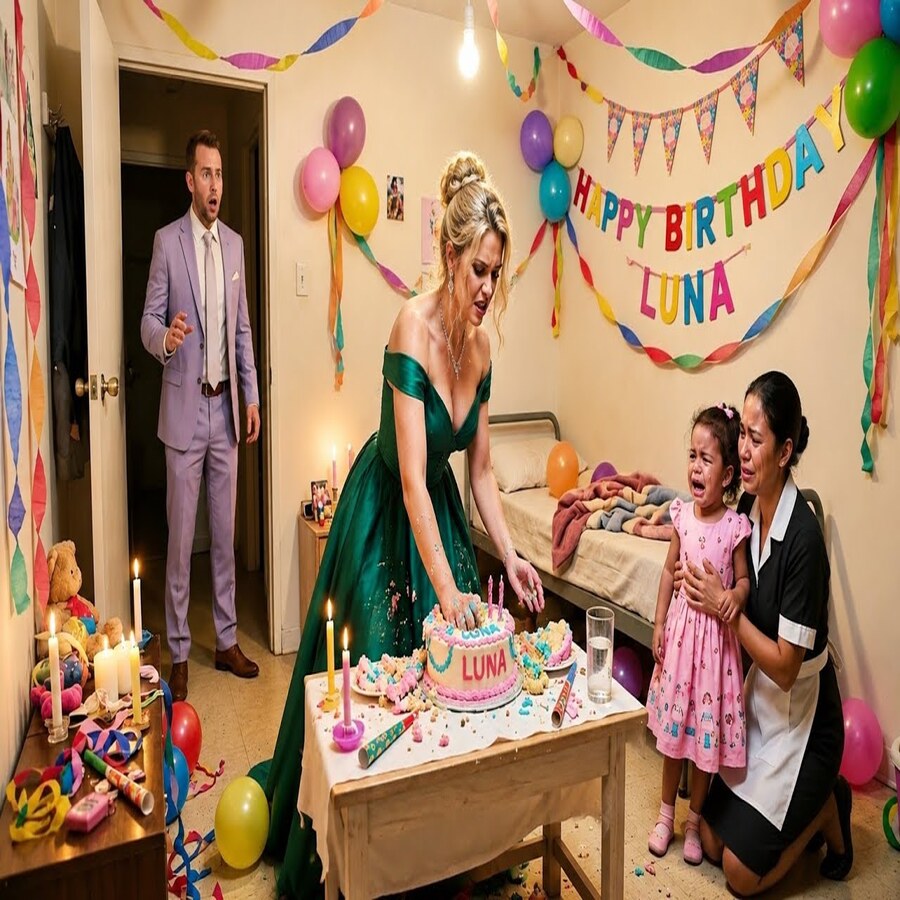
Her name was Luna.
And she had just turned three.
Some children are born into softness, into warm nurseries and lullabies and arms that are always ready. Some children are born into something harder. But that doesn’t mean they are loved any less.
Luna was the kind of child that made strangers smile without even trying. Round cheeks, tiny button nose, dark curly hair that her mother always tied up in two little puffs on either side of her head. She had just learned to run properly. That wobbly, full-speed toddler run where her whole body committed completely.
She laughed at everything. She was afraid of nothing except the drain in the bathtub, which she was absolutely convinced was alive. She didn’t know what poverty meant. She didn’t know what class meant. She didn’t know that the house she lived in wasn’t really hers or that the room she slept in with her mama was smaller than the closet of the master bedroom upstairs.
She just knew her mama’s arms. And to Luna, those arms were the whole world.
Her mother’s name was Amara.
Amara was twenty-six years old, though she looked older. Not in an ugly way, but in the way that hard work and love and worry age a person around the eyes. She was slender and quiet and moved through the Castellano house like water. Always present, never intrusive, always anticipating what was needed before anyone asked.
She had been working as a live-in maid for the Castellano family for four years. Since before Luna was even born. She had arrived at this job pregnant, desperate, and alone. Mr. Castellano, a decent man, a fair man, had looked at her situation and against the advice of his household manager, had offered her the position and a small room at the back of the house.
“Everyone deserves a chance,” he had said simply.
Amara had never forgotten those words. She worked twice as hard as anyone to prove she was worth that chance. She woke at five in the morning. She cooked. She cleaned. She laundered. She polished. She organized. She did it all with a quiet dignity that commanded invisible respect.
And when Luna came, small and loud and hungry and perfect, Amara did all of it with a baby on her back.
Luna grew up in that house. She knew every corner of it. She knew which step on the staircase creaked. She knew not to touch the expensive vases in the hallway. She knew that the kitchen was the warmest room and the best place to be on a cold morning. The older housekeeper, Rosario, adored her completely. Sneaking her small biscuits and teaching her the names of flowers in the garden.
It was a small life. But it was full.
And now, Luna was turning three.
Amara had been planning it for months. Not something big. Not something expensive. Just something real. Something Luna could feel in her bones. The way a child feels truly, completely celebrated.
Amara had saved carefully from her salary. Small amounts set aside. Enough for balloons, a little banner, some sweets for a few neighborhood children, and one special thing.
A cake.
Luna had a favorite cartoon character. A little animated moon fairy named Luna. Same as her. She had seen the character once on a phone screen and had pointed and shrieked, “Mama, that’s me! That’s Luna!” With such pure delight that Amara had laughed until she cried.
So Amara had ordered a Luna cake. Round and white with a painted crescent moon and tiny silver stars. The name Luna written in soft, glittering script across the top. She had paid for it in installments, a little each week to the baker at the market. She picked it up that morning, carrying it on the bus with both hands, holding her breath for forty minutes like she was transporting something sacred.
Because she was.
The cake sat on the little table in the back patio. Surrounded by six colorful balloons and a handmade paper banner.
Luna saw it and went completely still. Her little mouth dropped open. Her eyes went huge. Then she turned to her mother and said in her small, serious, three-year-old voice:
“Mama, it’s me.”
And Amara picked her up and held her so tight. It was the best moment of her year.
It lasted exactly fourteen more minutes.
Happiness, when it is fragile, can feel almost dangerous. Like holding a soap bubble. Beautiful, weightless, and one breath away from gone.
The back door of the Castellano house opened.
Vivian stepped out onto the patio. She was dressed to go out somewhere. Silk blouse, tailored trousers, oversized sunglasses pushed up on her head like a crown. She was thirty-four, elegant, and effortlessly intimidating. She had been engaged to Mr. Castellano for three months.
In those three months, she had redecorated two rooms, replaced the household schedule, and made it quietly, clearly known that things were going to be done her way now.
She had never spoken directly to Luna. Not once.
She looked at the patio. At the balloons, the banner, the cluster of small children from the neighborhood. At Rosario standing near the speaker. At Amara holding Luna on her hip.
Her expression moved through several things very quickly. Surprise. Irritation. Something harder underneath.
Rosario stepped forward with a warm smile. “Miss Vivian, it’s little Luna’s birthday today. Just a small thing in the back here. It won’t disturb—”
“I can see what it is,” Vivian said. Her voice was perfectly calm. That particular kind of calm that is actually colder than anger.
She walked toward the table slowly. Her heels clicked against the stone patio. The children fell quiet. The music playing from the little speaker suddenly felt intrusive. Too cheerful for the atmosphere that had descended.
Luna was still in Amara’s arms. She looked at Vivian with her big round eyes. Curious, unafraid. The way very small children look at the world before the world teaches them to be cautious.
Vivian stopped at the table. She looked at the cake. She looked at it for a long time. And something shifted in her face. Something that had nothing to do with a cake. Nothing to do with a three-year-old girl. Nothing to do with balloons or banners or any of this.
It was something old and private and ugly. Rising up from somewhere deep. Wearing the mask of the present moment.
“This is a staff area,” she said. “Not a party venue.”
Amara’s arm tightened around Luna. “I apologize, Miss Vivian. It is only for an hour. Mr. Castellano was informed.”
“Mr. Castellano is not here.”
Vivian’s eyes moved from Amara to Luna. Slowly. Deliberately. “And this child—” the way she said those two words made Rosario flinch. “Does not need a party like this. This is excessive. This is inappropriate. You are staff. This is a place of work.”
The patio was completely silent. Luna didn’t understand the words. But she understood the tone. Children always understand tone before they understand language. Her little face scrunched. Her lip wobbled.
And Vivian looked down at her. At this tiny three-year-old girl in a second-hand white dress with silver ribbons in her hair.
And said the words that would echo in every person present for the rest of their lives.
“You don’t deserve a celebration.”
Then Vivian reached out and pushed the cake off the table.
The cake hit the stone patio floor. The sound it made was soft. Almost gentle. Which was somehow worse than if it had been loud.
White fondant cracked open. The crescent moon broke in half. Silver stars scattered. The name Luna, written in that careful glittering script, split right down the middle.
And Luna watched it happen.
Her three-year-old mind could not process what had just occurred. She had been looking at that cake with pure wonder thirty seconds ago. Her name had been on it. Her moon. Her stars.
And now it was on the ground. Broken. Ruined. And a tall woman was standing over it, and the air felt very wrong, and her mama’s arms had gone rigid like stone.
Luna looked at the cake on the ground. Then she looked up at her mama’s face. And what she saw there was something that broke every single adult witness in that garden.
It was not anger. It was not tears, not yet. It was the face of a mother absorbing pain so her child wouldn’t have to. A controlled, deliberate, agonizing stillness. The kind that costs everything.
Amara set Luna down very carefully. She straightened. She looked at Vivian, and in a voice so quiet it was almost a whisper, she said:
“You just broke my daughter’s birthday cake.”
“I don’t know what you expected,” Vivian said. “You overstepped. Significantly. A party in this house for the maid’s child? This isn’t—”
“She is three years old.” The words fell like stones in still water. “She is three years old. And she has never asked this family for a single thing. Not once in her life. She lives quietly. She plays quietly. She is three years old, and today is her birthday, and I paid for that cake myself with my own money. And you—” Her voice cracked. Just slightly. Just for a second. “You broke it.”
Vivian straightened her silk blouse. “I suggest you remember your position in this household.”
Everyone turned.
Luna had crouched down beside the broken cake on the ground. Her little hands, those tiny, perfect three-year-old hands, were hovering over it like she thought she could fix it somehow. Like if she concentrated hard enough, the pieces would come back together.
Then she looked up at Vivian with those big dark eyes.
And she asked in a small, serious, pure voice that only very young children have before the world teaches them that some questions are too honest to ask out loud:
“Why did you break my moon?”
Rosario pressed her hand over her mouth. One of the neighborhood mothers turned away.
Vivian said nothing. She turned, walked back across the patio, and went inside. The back door clicked shut behind her.
Luna sat beside her broken cake on the ground. Still waiting for an answer that wasn’t coming.
Every story has a layer underneath the story. And sometimes the thing hiding beneath the surface is so enormous, so unexpected, that it rewrites everything you thought you understood.
This is where everything changes.
What no one in that garden knew, what Vivian did not know, what even Rosario did not know, was something that Mr. Castellano had been carrying alone for four years. A secret that had been sitting in a locked drawer in his private office. In a manila envelope with a single document inside. A DNA test.
Mr. Castellano had had a relationship, brief, painful, complicated, twenty-seven years ago. Before his first marriage, before his business, before everything. A young woman he had loved and lost. They had separated before he ever knew she was pregnant. She had raised the child alone. Never reaching out. Too proud and too hurt to ask anything from anyone.
That woman was Amara’s mother.
Which made Amara his daughter.
Which made Luna—this tiny three-year-old girl sitting beside her broken birthday cake—his granddaughter.
He had discovered this through a distant relative who had made contact two years before Amara ever showed up looking for work. He had been trying to verify it quietly. Carefully. Terrified of being wrong. Terrified of upending lives.
When Amara arrived at his door, pregnant, alone, with his own eyes and his own jaw and his own way of holding very still when she was thinking, he had known before the test confirmed it.
He had given her the job not out of charity. He had given her the job because she was his child. And he did not know yet how to say it. And he was ashamed that he did not know. And the shame made him wait longer. And the longer he waited, the more impossible it felt to speak.
But he had been watching. He had been watching Amara work every day with dignity and grace. He had watched Luna grow from a newborn to a wobbly walker to a full-speed, laughing, moon-obsessed three-year-old.
He had been building the courage to tell the truth.
He was supposed to come home that weekend. He was supposed to sit Amara down and show her the document and say, “I think you are my daughter. I have missed everything, and I am sorry, and I want to fix it if you’ll let me.”
He had been one day away.
Then his phone rang. Rosario, hands shaking, voice barely steady, told him what Vivian had done.
There was a long silence on the line. Then Mr. Castellano said, “I’m coming home.”
His car pulled through the gate forty minutes later.
Mr. Castellano walked through the back door of his own house and stopped.
The patio was quiet now. The neighborhood children had gone home. The balloons were still tied to the chairs, drifting softly in the late afternoon breeze. Cheerful and heartbreaking at the same time. The banner still hung: “Happy Birthday Luna.”
And on the ground, still there because no one had had the heart to clean it up yet, was the broken cake.
Amara was sitting on the patio steps with Luna in her lap. Luna had cried herself to exhaustion and was now half asleep against her mother’s chest. One small fist curled under her chin. Her silver ribbons coming loose.
Amara was holding her daughter and staring at nothing. And her face was the face of someone who has made a decision but hasn’t said it out loud yet. She was going to leave. She had already decided. Quietly, the way she made all her decisions. Without drama, without announcement.
She would pack their things tonight. She would find somewhere to go in the morning. She did not know where yet. But she knew she could not stay in a house where her child had been told she did not deserve to be celebrated.
No salary, no security, no practical reason was bigger than that.
She did not look up when the back door opened. She assumed it was Rosario. Then she heard his voice.
“Amara.”
Something in his tone made her look up. Mr. Castellano was standing in the doorway. And he looked undone. Not in a dramatic way. In a quiet way. The way a person looks when they have been holding something enormous for a very long time, and they have finally run out of the strength to hold it.
He was holding a manila envelope.
He walked across the patio and sat down. Not in a chair, not at a distance. He sat down on the steps right beside her. And he put the envelope on his knee. And for a moment, he just looked at the broken cake on the ground.
“I should have told you,” he said, “a long time ago. I was a coward. And I am sorry.”
Amara looked at him. Confused. Guarded. He held out the envelope. She took it slowly. Opened it. Pulled out the document inside. Read it. Read it again.
The patio was absolutely silent. Except for the soft sound of Luna breathing in her sleep. And one of the balloons tapping gently against a chair.
Amara’s hands began to shake. She looked at him. He nodded slowly. His eyes were wet.
“I didn’t know about you. I didn’t know until two years before you came here. And when you showed up at my door, I knew before the test. I knew when I saw your face.” His voice broke slightly. “I am so sorry I didn’t say it sooner. I am so sorry I let you work in my house like a stranger when you were never a stranger. And I am so sorry that today happened. That she—”
He stopped. He looked at Luna asleep in Amara’s arms.
“That my granddaughter’s birthday cake is on the ground.”
The word granddaughter hit the air like something physical.
Amara pressed her fists against her mouth. And for the first time that entire terrible day, she cried.
Vivian came downstairs an hour later.
She had changed clothes. She had composed herself. She had clearly rehearsed something. An explanation, a justification, a version of events that placed her behavior in a more reasonable light. She walked toward the back patio with the particular confidence of someone who has convinced themselves they are not wrong.
She found Mr. Castellano still sitting on the patio steps. Luna had woken up. She was sitting between her mother and Mr. Castellano. This tiny three-year-old between these two adults. And Mr. Castellano was teaching her to clap a little hand-clapping game.
Luna was giggling. That full-body toddler giggle that takes over everything.
Rosario had quietly disappeared into the kitchen and come back with a small round chocolate cake. Nothing as beautiful as the Luna cake. Just a simple thing from the pantry with three candles on it. It was not the cake Amara had saved for. It was not the glittering crescent moon and silver stars.
But Luna looked at it with the same wonder. Because she was three, and she was loved, and she was here.
Vivian stopped at the door.
Mr. Castellano looked up at her. He did not say many words. He was not a man who used many words when a few would do.
“Amara is my daughter. Luna is my granddaughter. I would like you to understand what that means before we have any further conversation.”
Vivian opened her mouth. Closed it.
“The engagement,” he said quietly, “cannot continue as things stand. Not because of today alone. But because of who you showed yourself to be today. To a three-year-old child who had done nothing to you. Who asked for nothing from you. Who only wanted to blow out her birthday candles.”
He looked at Luna.
Luna, completely unaware of any of this, picked up a clump of chocolate frosting off her little cake with one finger and ate it. And grinned at Mr. Castellano with chocolate on her nose.
And Mr. Castellano, the composed, serious, private man, laughed out loud. Softly. Like something that had been locked up inside him for a long time had just found the door.
Vivian left that night. Her luggage was packed and in the driveway by morning. She did not make a scene. Perhaps because on some level she understood. Perhaps because there was nothing to say. Perhaps because she had looked at that little girl with chocolate on her nose and felt for one unguarded second the full weight of what she had done.
Or perhaps not. Some people never do.
In the weeks that followed, Luna didn’t know about any of that.
Luna knew that the man with the gray hair now read her bedtime stories. That there was a proper bedroom waiting for her and her mama upstairs. Warm and bright. That someone ordered a second Luna cake. The most beautiful one. Bigger than the first. With a whole galaxy of silver stars.
And they had a second birthday party. Just family. Just small and real and full of light.
When Luna blew out her three candles, she closed her eyes very seriously the way three-year-olds do, and made her wish. Nobody asked her what it was. But Amara, watching her daughter’s face glowing in the candlelight, round-cheeked, ribbon-haired, safe, thought she already knew.
Because some wishes don’t need to be spoken. Some wishes have already come true by the time the candles go out.
THE END.
Disclaimer : This content may be created by AI for entertainment purposes. Any resemblance to real persons, events, or places is coincidental.