When Forbidden Love Reclaims a Broken Home
The air in the hallway was thick, not just with the scent of floor wax and old wood, but with the suffocating weight of ten years of silence. For Stella, a 28-year-old woman accustomed to the hushed, predictable rhythm of a life spent among dusty bookstore shelves and solitary microwave dinners, the house she grew up in was a museum of ghosts. But on that fateful Saturday morning, the silence was shattered by the rhythmic thud of footsteps descending the stairs—footsteps she hadn’t heard in a decade.
Julian. The name alone was a bruise on her heart. He was the step-brother who had once been the quiet boy in the room across the hall, the one who read books and listened to music in a private world she was never invited to enter. He was also the young man whose departure had left a jagged hole in her teenage years, a hole filled only with the echoes of their final, devastating scream-match. Now, with their father Robert’s heart failing and the family gathered in a desperate huddle, the past and the present were about to collide in a way that would rewrite the very definition of “family.”
Chapter 1: The Return of the Ghost
The drive to her childhood home had been a two-hour meditation on anxiety. Stella had packed her bags with deliberate care, choosing clothes that acted as armor—structured, professional, designed to scream I am strong and I am happy to a man who had last seen her in tears. She remembered the coldness of Julian’s face at nineteen, the way he looked at her as if she were an intruder in his father’s house.
When she finally crossed the threshold, the sensory triggers were overwhelming. The house smelled of her mother’s flower-and-cookie perfume, a scent that usually brought comfort but now only heightened her tension. The brown sofa and blue curtains remained frozen in time, but the man sitting in the armchair was a shadow of his former self. Robert, once the vibrant center of their blended family, was pale and fragile. His voice, once a booming presence, was now a thin thread.
Then, the footsteps. Stella’s body went rigid. Julian walked into the living room, and for a heartbeat, the oxygen left the room. He was taller, his hair cropped short, his jeans and gray sweater suggesting a quiet maturity. The boy was gone; an engineer stood in his place. When their eyes met, the decade of distance vanished. His “hello” was deep and calm, while hers was a jagged shards of ice. The room, once a sanctuary, suddenly felt like a pressure cooker.
Chapter 2: The Dance of Politeness
Lunch was an exercise in strategic silence. Over steaming bowls of soup and crusts of bread, the family performed a play of normalcy. Julian spoke of his life in the city, of designing buildings and calculating stresses—ironic, Stella thought, for a man who had collapsed the emotional structure of his own family. She focused on her spoon, watching the steam rise, refusing to look up.
But as the weekend progressed, the “cold brother” she remembered began to dissolve. In the kitchen, Julian didn’t just stand around; he chopped, he stirred, he moved with a patient grace. When they shared the task of drying dishes, the proximity was electric. The scent of him—soap and coffee—invaded her space. When their fingers brushed against a ceramic plate, Stella recoiled as if burned.
Sunday brought a further softening of the edges. Julian made coffee—extra, just for her—and left it steaming on the table. When the sky opened up in a torrential downpour, he didn’t just offer an umbrella; he pressed it into her hand with a “please” that was so gentle it disarmed her. Stella walked to the store under that umbrella, feeling the weight of his kindness more than the weight of the rain. She began to wonder: Who was this man? This was not the boy who shouted. This was a man who read the newspaper to his sick father with a voice full of tenderness.
Chapter 3: The Breaking Point
The fragile peace was shattered on Monday morning. The sound of a body hitting the floor and her mother’s piercing scream echoed through the house. Robert had suffered a heart attack. In the chaos that followed, Julian was the anchor. He ran to the phone, coordinated with the ambulance, and handled the frantic hospital paperwork with a clinical, steady hand.
While Robert lay in a sterile hospital bed, hooked to monitors that beeped with agonizing regularity, Stella and Julian were forced into a new intimacy. They took turns sitting in the plastic chairs of the waiting room. They returned to the quiet house to cook, clean, and maintain the facade of a functioning home while their mother stayed at Robert’s side.
One night, in the warmth of the kitchen as soup bubbled on the stove, the dam finally broke. Julian confessed the truth of his decade-long exile. He hadn’t stayed away out of hate, but out of a crushing sense of guilt. “I thought everyone was happier without me,” he whispered, the knife in his hand stilled. He admitted that his cruelty during their final fight—telling her she wasn’t “real family”—was a mask for his own confusion and jealousy. He had been a boy grieving his biological mother, feeling guilty for finding happiness in a new family, and he had burned his bridges to protect himself.
“I’m sorry,” he said. Two words, ten years late, but they landed with the force of a tidal wave. Stella realized then that she hadn’t been the only one hurting. They were both victims of their own youth and the complexities of a blended world.
Chapter 4: The Electric Truth
As Robert recovered and returned home, the dynamic shifted from reconciliation to something far more dangerous. Stella found herself watching Julian—not with suspicion, but with a growing, terrifying heat in her chest. She saw the strength in his arms as he carried bags, the patience in his eyes as he administered Robert’s medicine, and the way he looked at her when he thought she wasn’t looking.
They sat on the porch one evening under a sky painted in oranges and pinks. Their hands rested near each other on the wood, the space between their fingers humming with unspoken words. Stella knew this was “wrong” by societal standards. He was her step-brother. They shared a roof, a history, and a set of parents. But as Robert had whispered to her earlier that day, “Love is simple. Do not be afraid.”
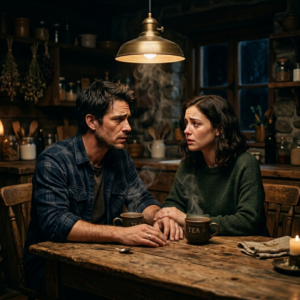
The tension peaked in a dark kitchen late at night. Over tea, Julian admitted he couldn’t pretend anymore. “I wish things were different,” he said, his eyes dark and serious. “I wish you weren’t just my sister.”
When his hand finally covered hers on the table, the spark was absolute. It wasn’t just a touch; it was an admission. They stood in the quiet of the house, the boundary between “family” and “lovers” blurring into nothingness. They were adults. They were not blood relatives. They were two lonely souls who had finally found the one person who truly knew their history.
Chapter 5: The Caught Secret
The climax arrived not with a shout, but with a gasp. As Julian pulled Stella closer, their faces inches apart, the floorboards creaked. They jumped apart, but it was too late. Stella’s mother stood at the top of the stairs, her face a mask of confusion and mounting dread.
The secret was out. The “dangerous” truth they had only just begun to acknowledge was now laid bare under the harsh kitchen lights.
The conversation that followed was the hardest of their lives. Sitting around the kitchen table, the three of them navigated the minefield of morality and family. Her mother’s fears were practical: “People will talk. People will judge.” But Julian’s resolve was unshakable. He looked Stella in the eyes and, for the first time, said the words out loud: “I love her.”
Robert, hearing the commotion, joined them. Instead of the anger they expected, he offered a grace that brought them all to tears. He saw his children—not as step-siblings, but as two people who had cared for him, cared for each other, and deserved a chance at happiness. “Let them talk,” he said, his weak hand resting on the table. “My children are happy. That is what matters.”
The Universal Lesson of the Heart
Stella and Julian’s story is a profound meditation on the boundaries we build around ourselves. We often let the labels of the world—sister, brother, stranger, enemy—dictate who we are allowed to love and how we are allowed to heal. Their journey teaches us that the past does not have to be a prison. Forgiveness is a quiet, daily action, and sometimes, the person who caused our deepest wounds is the only one who can truly help them heal. In the end, family isn’t just about the names on a birth certificate; it’s about who stands by you when the heart starts to fail.
Call to Action: Love often finds us in the most unexpected and “impossible” places. Have you ever had to fight for a relationship that others didn’t understand? Or have you found peace by forgiving someone from your past? Share your story in the comments below. Let’s talk about the courage it takes to listen to your heart when the world is whispering otherwise.
Disclaimer : This content may be created by AI for entertainment purposes. Any resemblance to real persons, events, or places is coincidental.






