The Sound of Silence: A Journey from Trauma to Triumph
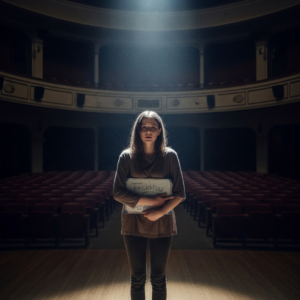
In a world that demands we speak up to be heard, what happens to the voice that is stolen by unspeakable trauma? The story of Kennedy Blythe is a poignant exploration of this profound question. It is a narrative that weaves through the darkest corners of human experience, yet emerges into the radiant light of resilience and self-discovery.
Kennedy, a young woman whose life was irrevocably altered by a tragedy she could not articulate, found herself trapped in a prison of silence. For years, she carried the heavy burden of a secret, her voice extinguished by fear and the agonizing memory of a loss too painful to bear. This is the chronicle of her journey—a journey that challenges our understanding of communication, the devastating impact of trauma, and the extraordinary power of a single, courageous step toward healing.
Chapter 1: The Echoes of a Shattered Past
The air in the rehearsal space hung heavy with an unspoken tension, thick as the dust motes dancing in the dim, golden light spilling from the stage. Here stood Kennedy, a young woman whose very presence seemed an apology for taking up space. Her eyes, wide and fearful, held the haunted look of a trapped animal, a stark contrast to the lively energy of her peers.
The stage, usually a place of vibrant expression, was to her a daunting precipice. The words of Shakespeare, usually resonant and powerful, caught in her throat like jagged glass. “If we shadows have offended…” Her voice, a fragile whisper, barely carried past the first row of empty seats.
The instructor, Megan, a woman with a gentle persistence, tried to coax the words out. “Can you say it louder? More precisely?” she asked, her voice a soft command. But Kennedy was paralyzed, a prisoner in a fortress of her own making, built not of bricks, but of a trauma so deep it had silenced her soul.
Her world was a mosaic of fragmented memories—the chilling command to “stay here no matter what,” the agonizing realization that she was powerless to stop the unfolding tragedy. Her silence was not a choice, but a desperate shield, a desperate attempt to protect herself from the unbearable truth she had witnessed.
Chapter 2: The Theater of the Unspoken
The Winston Education Foundation scholarship interview loomed like a storm on the horizon—a beacon of hope, yet a terrifying trial. To win the scholarship, she had to do the one thing she feared most: speak. The requirement was a cruel irony, demanding the very currency she had forfeited years ago.
It was in this crucible of fear that Megan, the drama teacher, recognized the profound struggle within Kennedy. During a group therapy session, where words were expected to flow freely, Kennedy’s silence was a deafening roar. Megan saw beyond the quiet exterior; she saw a spirit desperate to be heard, yet terrified of the sound of its own voice.
Megan proposed a radical approach—a journey into the theater of the unspoken. She provided Kennedy with a white board and a journal, offering alternative avenues for expression. “You need to find your voice,” Megan said, her eyes filled with a compassionate understanding that resonated deep within Kennedy.
The process began with the simplest, yet most challenging task: eye contact. In a world where connection is often forged through the spoken word, maintaining eye contact was a monumental hurdle for Kennedy. Megan, with her unwavering patience, guided her. “Start with my chin. Now my mouth. Watch my lips move as I talk. Good. Now my eyes.”
Chapter 3: A Symphony of Silence
As the weeks turned into a dance of silent progress, Megan introduced an exercise that would prove pivotal. She asked Kennedy to act out the concept of “family” without speaking.
Kennedy, her heart heavy with the weight of her past, stepped onto the stage. Her movements were initially hesitant, but as she delved into the emotion, a raw and powerful narrative unfolded. She pantomimed the tender embrace of a mother, the protective stance of a guardian, the devastating void left by a sudden loss.
Her performance was a symphony of silence, a visceral expression of the love she had known and the agonizing pain she endured. The other students watched, captivated by the depth of emotion conveyed without a single word. In that moment, Kennedy realized that her silence, though a heavy burden, could also be a powerful tool for storytelling.
Chapter 4: The Interview: A Crucible of Fear
The day of the Winston Scholarship interview arrived, bringing with it a tidal wave of anxiety. Kennedy, clutching the iPad Megan had given her—a modern iteration of her whiteboard—stepped into the interview room. The air was sterile, the panel of judges imposing.
“Please state your name,” the lead interviewer demanded, her voice crisp and formal.
Kennedy, her heart pounding a frantic rhythm against her ribs, stared at the iPad. The silence stretched, agonizing and heavy. The memories of that fateful day—the screams, the instructions to stay hidden—flooded her mind, drowning out the present.
“What did you see? Can you tell us anything about…” The questions felt like an interrogation, reopening wounds she had desperately tried to seal. The pressure mounted, the silence grew unbearable, and Kennedy, overwhelmed by the sheer magnitude of the moment, fled the room, leaving her hopes and dreams shattered on the floor.
Chapter 5: The Crescendo of Courage
The culmination of Kennedy’s journey arrived not in the sterile interview room, but on the stage she had once feared. Her final performance was a testament to her resilience, a defiant reclamation of her voice.
She stood center stage, the spotlight illuminating her determined face. She didn’t use the iPad. She didn’t use the whiteboard. She spoke.
“I dedicate this performance to the last person to hear me,” she began, her voice gaining strength with every syllable. “Silence has been the most comforting but cruelest companion. It has kept me safe, but kept me from success.”
Her words, raw and emotionally charged, filled the auditorium. She spoke of the agonizing void left by her mother’s death, the missed milestones, the unshared joys. “More than anything else, I just miss you,” she concluded, her voice trembling with a profound sorrow, “because even in my silence, I always knew you could hear me.”
The auditorium erupted in a standing ovation, a testament to the transformative power of her performance. Kennedy had not merely found her voice; she had unleashed a symphony of emotion that resonated with everyone who heard it.
Chapter 6: A New Dawn
The following semester, the atmosphere in the drama class was electric. The instructor, known for her rigorous roll calls, began calling out names.
“Asher… Blythe… Kennedy Blythe?”
A moment of silence hung in the air, a familiar echo of the past. But this time, it was broken.
“Here,” Kennedy said, her voice clear and resonant, a simple word that carried the weight of a thousand victories. She sat among her peers, no longer a shadow, but a vibrant presence, ready to embrace the world she had once feared.
Deep Reflection: The Resonance of Resilience
The story of Kennedy Blythe is a profound meditation on the devastating impact of trauma and the incredible resilience of the human spirit. It reminds us that silence is not merely an absence of sound; it can be a heavy burden, a protective shield, or a deafening roar of unspoken pain.
Kennedy’s journey teaches us that healing is not a linear path, but a courageous exploration of our deepest fears. It emphasizes the importance of compassionate guidance, the power of alternative forms of expression, and the transformative potential of finding our voice, even when it feels impossible.
Her story is a beacon of hope for anyone who has ever felt silenced by circumstance or trauma. It is a reminder that our voices, no matter how fragile they may seem, possess the power to heal, to connect, and to change the world.
Call to Action:
Have you ever felt silenced by a difficult experience? How did you find your voice again? Share your stories of resilience and the power of expression in the comments below. Let’s create a community where every voice is heard and valued.
Disclaimer : This content may be created by AI for entertainment purposes. Any resemblance to real persons, events, or places is coincidental.






