One Woman’s Journey from Fear to Freedom
The air in a small village in the Philippines has a specific weight—it is heavy with the scent of jasmine, fried garlic, and the salt of the sea. For Emily, that air was the only thing she had ever known. At nineteen, the world is supposed to be a wide-open book of possibilities, but for Emily, it was a chapter that closed abruptly with a wedding ring. She didn’t know then that the man her parents called “good” would become the architect of a silent prison, or that a silver bracelet from her mother would eventually become her only anchor in a storm of isolation. This is not just a story of a difficult marriage; it is a sprawling epic of the human spirit’s refusal to be crushed, a cinematic journey from the tropical warmth of home to the biting frost of New Jersey, and the ultimate triumph of a mother’s love.
The Weight of a Tropical Goodbye
The wedding was a blur of white lace and the hopeful smiles of her parents. To them, David was a golden ticket—a man who lived in the United States, promising a life of stability and abundance. Emily, however, felt a cold dread pooling in her stomach. She was a girl who had never seen the inside of an airplane, whose English was limited to polite greetings, and whose heart was physically tethered to her mother.
The three weeks David spent at their house before the move were a quiet warning. He was a shadow in the room, rarely speaking, his eyes often fixed on his phone or the floor. Emily, in her youthful optimism, labeled it shyness. She didn’t yet realize that his silence was a lack of interest, not a lack of confidence.
The day of departure felt like a funeral. Emily’s mother, the woman who had been her everything—her cook, her comedian, her protector—held her hands as if she could keep her daughter on Philippine soil through sheer grip. She slid a thin silver bracelet onto Emily’s wrist. It was cool against her skin, a stark contrast to the humid heat. “This is to remind you of me,” her mother whispered, her voice cracking for the first time in Emily’s life. “Stay strong, my daughter.” As the plane ascended, Emily watched the islands of her home shrink into the blue of the Pacific, feeling as though her heart was being physically extracted from her chest.
A Winter of Iron and Silence
Landing in New York was a sensory shock. The air didn’t just feel cold; it felt aggressive, biting at her skin through her thin clothes. Snow fell—a beautiful, white veil that Emily had only seen on postcards—but she couldn’t appreciate it. To her, it looked like a frozen shroud. David didn’t comfort her on the long flight; he had stared out the window, leaving her to drown in her own nausea and tears.
They arrived at a small, dark house in New Jersey, the home of David’s parents, Mr. and Mrs. Collins. The atmosphere inside was sterile and heavy. Mr. Collins was a man of loud, booming authority who didn’t believe in smiles, and Mrs. Collins was a woman who saw Emily not as a new daughter, but as a domestic acquisition.
By the second morning, the honeymoon—if there ever was one—was over. Mrs. Collins handed Emily a list of chores that would have exhausted a seasoned worker. “Don’t be lazy,” she warned in a voice as sharp as the New Jersey wind. Emily spent her days with her hands submerged in ice-cold water, her back aching as she scrubbed floors and cooked rice to perfection. When she burned the rice once, Mr. Collins’ shouting was so violent that Emily hid in the bathroom for an hour, the silver bracelet clinking against the tile as she shook. David sat in the next room, watching TV, his silence now a weapon of neglect.
The Golden Call and the Secret Life
Isolation is a slow erosion of the self. Emily felt her laughter dying. She became a ghost in the Collins’ house, a presence meant to serve and be silent. David controlled her access to the world, claiming the phone bill was too expensive to allow more than one call a month to the Philippines.
Emily lived for that call. She would mark the days on a hidden calendar, treating each minute of her mother’s voice like a precious gemstone. When the connection finally clicked through, Emily would squeeze the silver bracelet until it left a mark on her skin. She lied. “I’m fine, Mama. Everything is okay.” She couldn’t tell the truth; the shame of her “success” in America being a lie was too much to bear. She protected her mother from the reality of the cold house and the shouting men, but the weight of the secret made her heart heavier than the chores.
The Hope of Ethan and the Shadow of the Kitchen
After three months, the news of her pregnancy brought a flicker of light to the dark house. Emily dared to hope that a baby would soften David’s heart and earn her respect from Mrs. Collins. She was wrong. Mrs. Collins merely viewed the pregnancy as a hurdle to Emily’s efficiency. “A strong woman works even when she is pregnant,” she declared.
Emily worked until she was dizzy, her head spinning as she stood over a hot stove while her body grew heavy. One afternoon, she collapsed on the kitchen floor, the room spinning in a kaleidoscope of grey and brown. She sat there, alone on the linoleum, and whispered to her stomach. “You are not alone. I will protect you.”
When Ethan was born, he was a masterpiece of soft hair and big brown eyes. Holding him, Emily felt a tectonic shift in her soul. She was no longer just a frightened girl from a small town; she was a mother. When Mrs. Collins refused to help, saying “He is your baby, not mine,” and David returned to his indifference, Emily’s fear began to transform into a quiet, simmering resolve. She would hold Ethan in the dark, praying through his fevers while David watched movies, and she realized a terrifying truth: no one was coming to save her. She would have to save herself.
The Power of the First Word
The path to freedom began with the alphabet. Emily discovered a community center offering free English classes. She had to beg David for weeks, enduring his scoffs that she was “too busy” or “not smart enough.” Eventually, he relented—two days a week, mostly to get her out of his hair.
In that classroom, Emily found a tribe. Women from Mexico, India, and Egypt—all immigrants, all carrying the weight of new worlds—sat together. When Miss Lisa, the teacher, told Emily she was smart, it was the first time in years she felt like a person rather than a tool. She learned to say, “I need help.” She learned to say, “My baby is sick.” Each word was a brick in the wall she was building between her old life and her new one.
She took a job at a local bakery owned by a woman named Grace. The warmth of the ovens and the kindness of the customers began to thaw Emily’s frozen spirit. She saved every dollar, hiding the money like a squirrel preparing for winter. She bought her first winter coat—not a hand-me-down from the Collins, but something she chose. Something that was hers.
The Breaking Point: “The Boy Stays”
The climax of Emily’s ordeal arrived on a night that smelled of stale beer and broken promises. David came home late, his silence replaced by a volatile, drunken rage. He pushed a chair, the sound echoing like a gunshot in the quiet house. Emily grabbed Ethan and locked herself in the bedroom, her heart hammering against her ribs.
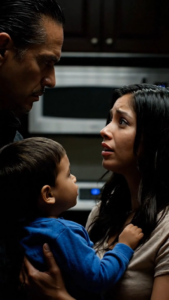
The next day, the betrayal went deeper. Mr. Collins approached her in the kitchen. He didn’t offer comfort; he offered an ultimatum. “You can leave if you don’t like it here, but the boy stays. This is David’s family.”
The room went cold. The threat to take Ethan was the final catalyst. Emily realized she wasn’t just fighting for her own comfort; she was fighting for her son’s future. She called her mother, sobbing the truth into the receiver for the first time. “Come home,” her mother cried. But Emily knew she couldn’t. She had no legal residency, no way to take Ethan across an ocean without permission. She had to fight on American soil.
The Church Room and the Legal Light
Through her friend Maria at the bakery, Emily found a support group that met behind a local church. Led by a woman named Helen, the group provided Emily with the missing piece of her puzzle: knowledge.
“No one can take your child,” Helen told her, her voice steady and sure. “You have rights here.”
Emily spent months in a state of dual existence. By day, she was the submissive daughter-in-law at the Collins’ house. By night, she was a strategist, working with legal aid to secure residency and applying for low-income housing. She was no longer the girl who arrived in New York with red eyes; she was a woman with a plan.
The Sunrise in a Small Apartment
The day Emily left was quiet. David was at work. Mrs. Collins stood in the kitchen, her face a mask of arrogance. “You’ll come back,” she sneered. “You need us.”
Emily didn’t argue. She simply picked up Ethan, her bag of clothes, and the silver bracelet. She walked out the door and didn’t look back. Her new apartment was tiny—two rooms with peeling paint—but the window faced the sun. When she sat on the floor with Ethan that first night, she cried until her chest hurt. But for the first time, she wasn’t crying because she was broken. She was crying because the cage was open.
A Final Promise to the Philippines
The journey ended with a heartbreak that nearly leveled her. A letter arrived from the Philippines: her mother had passed away. The guilt was a physical pain; Emily hadn’t been able to say goodbye in person, hadn’t been able to show her mother the life she had built.
But as she clutched the silver bracelet, she heard her mother’s voice in her head: Be brave, my daughter. Emily realized that her mother’s strength lived in her. She had lived fully for Ethan, for her mother, and for herself.
Today, Emily manages that small bakery. She speaks with a voice that is small but clear. She isn’t rich, but she has a son who laughs freely and a home where no one shouts. She has peace. She has freedom. And as she looks out her window at the New Jersey snow, it no longer looks like a shroud—it looks like a clean, white page, ready for the next chapter.
Have you ever had to find strength you didn’t know you possessed? Emily’s journey reminds us that even in the coldest winters, the warmth of our roots and the love for our children can keep us alive. Please share your thoughts and your own stories of resilience in the comments below.
Disclaimer : This content may be created by AI for entertainment purposes. Any resemblance to real persons, events, or places is coincidental.






