Why My Father’s “One Word” Was Everything
For the longest time, I was a prisoner of a specific kind of silence—the kind that echoes in a house where love exists but lacks a voice. My name is a detail, but my experience is a global anthem. I grew up believing I was unloved, not because I was mistreated, but because I was comparing my home to the vibrant, noisy, affectionate world of other families. I watched other fathers scoop their children into bear hugs; I heard them roar with laughter in the park. My father, however, was a monolith of quiet. He was a man of steel and shadow, a person who lived in the margins of the day, waking before the light and returning after the stars had claimed the sky.
I used to stand near him, vibrating with the desperate, unspoken need for him to just see me. I would linger in the doorway of the living room, watching the back of his head as he read, hoping he would turn around and ask me about my day. He never did. Or so I thought. This is a story for everyone who has ever felt a distance so vast it felt like an ocean between two people sitting at the same breakfast table. It is a story about the painful realization that love doesn’t always speak—sometimes, it just works.
THE ANATOMY OF DISTANCE
Every morning began with the same heavy, rhythmic percussion of his life. I would lie in bed, my eyes squeezed shut, pretending to be asleep, listening to the small, metallic clinks from the kitchen. The sound of the refrigerator door, the slow, dragging weight of his footsteps—each sound felt like a barrier. I felt uncomfortable when he was near, a strange, buzzing tension that wasn’t fear, but a profound sense of being a stranger in his presence.
When I finally joined him at the table, the atmosphere was thick. The only sound was the scraping of a fork against a plate. He would look at me, his eyes unreadable, and utter a single, sharp command: “Eat.”
That was our ritual. One word. No “how did you sleep?” No “are you ready for your test?” Just a functional directive to consume fuel. At school, the silence of my home felt like a defect. My friends would boast about toys, trips to the park, and fathers who helped with homework. I would smile and nod, but inside, a cold, heavy knot was tightening in my chest. I began to look at my father not as a parent, but as a roommate who happened to share my DNA.
THE FRACTURED LOGIC OF THE HEART
One night, the knot became too tight to ignore. I had received high marks on a difficult exam, and for a fleeting moment, I thought I had found the “key” to his affection. I walked up to him, my heart racing, clutching my paper.
“Dad,” I said. He didn’t look up immediately. The silence stretched until it felt like a physical weight. Finally, he looked at me. “Yes.”
“I… I got good marks today.” I waited. I expected a smile, a pat on the back, or perhaps a rare “I’m proud of you.” Instead, he looked at the paper, then back at me, and said: “Good. Study more.”
That was the moment the door slammed shut. I retreated to my room and lay staring at the ceiling, the shadows of the trees dancing like ghosts above me. My throat felt tight, a lump of unexpressed grief lodged firmly in my windpipe. He doesn’t love me, I whispered into the dark. It was the first time I had given those words a voice, and once they were out, they became my reality. I stopped trying. I stopped waiting. I stopped hoping. I decided that if he chose to be a ghost, I would be a shadow.
THE TEXTURE OF AN UNSEEN WAR
The explosion happened on a night that started with a simple mistake. I had stayed out late playing with friends, losing track of the hours until the sun had long since vanished. When I stepped through the front door, the house was a cavern of darkness, save for a single light in the living room. My father was sitting there, waiting.
“Where were you?” his voice was low, vibrating with a frequency I had never heard before. “I was outside,” I stammered. “Do you know what time it is?” he shouted. The sharpness of his voice made me shake.
In that moment, all the years of perceived neglect, the cold breakfasts, and the one-word answers boiled over. “You don’t care anyway!” I screamed. The words felt like a physical strike. The room went deathly silent. My father froze. I saw a look in his eyes I will never forget—a flash of raw, exposed pain, as if I had pulled back a curtain and found a wound. He didn’t shout back. He simply turned away and walked to his chair, retreating back into his fortress of silence.
I told myself I was right. I told myself his anger was just control, not care. But I didn’t see the slow closing of the door. I didn’t see that after that night, even the word “Eat” began to disappear.
THE GEOMETRY OF HIDDEN CARE
The revelation didn’t come in a grand speech; it came in the small, mundane details I had been trained to ignore. I began to notice that even when we didn’t speak, the world around me was being curated. My school bag was always cleaned and placed in the same spot. My clothes were washed and folded with military precision. The lights were always on to welcome me home. The food was always warm on the table.
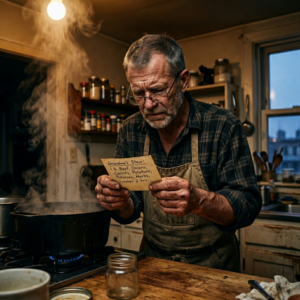
One afternoon, I came home earlier than usual and heard a clatter in the kitchen. I crept toward the door and saw my father. He wasn’t the strong, stoic figure I knew. He looked lost. He was looking at a crumpled piece of paper in his hand, then back at a pot on the stove, his brow furrowed in intense concentration.
I looked closer. It was a recipe I had written for myself weeks ago and forgotten. He was trying to cook my favorite meal, following my handwriting like it was a sacred text. My chest felt like it was being squeezed by a giant hand. He wasn’t just “living” in the house; he was maintaining my entire existence with his bare, tired hands. He was using his limited energy to decipher my world because he didn’t know how to speak to it.
THE SCAFFOLDING OF THE TRUTH
The final collapse of my misunderstanding happened in the sterile, white hallway of a hospital. My teacher had pulled me out of class with a voice like velvet—too soft, too careful. “There was an accident,” she said. “Your father collapsed at work.”
When I finally reached his room, the sight of him shattered the last of my defenses. This man, who I thought was an immovable mountain, looked fragile and small under the hospital sheets. He was surrounded by the rhythmic, mechanical heartbeat of monitors: beep, beep, beep.
“He’s been overworked for a long time,” the doctor told me quietly. “He works extra hours almost every day.” “Why?” I whispered, though I already knew the answer. “For you,” the doctor said.
In that moment, the “ocean” between us evaporated. I saw the lines on his face for what they truly were: a map of every hour he had spent laboring for my tuition, my clothes, my warm meals. The silence wasn’t coldness; it was exhaustion. He didn’t have words left at the end of the day because he had given all his strength to the work that sustained me. I took his hand—it was warm, calloused, and shaking—and I wept. I wept for every “Eat” I had dismissed and every “Study more” I had resented.
DEEP REFLECTION: THE ECHO OF SILENT LOVE
We are a generation obsessed with the “loud” expression of love—the social media posts, the grand declarations, the constant verbal affirmation. But Noah’s journey reminds us that there is a profound, tectonic love that moves beneath the surface. For some, love is not a poem; it is a paycheck. It is not a hug; it is a repaired school bag. It is not “I love you”; it is “Eat.”
If you are living in a house of silence, I invite you to look at the small things. Who turned on the light? Who fixed the door? Who worked the extra shift so you could dream? Sometimes, we judge the heart by the tongue, and in doing so, we miss the most devoted hearts of all. Love doesn’t always speak. Sometimes, it just waits for you to finally see it.
CALL TO ACTION: Is there someone in your life whose love is quiet? What is one small thing they do for you that you’ve been ignoring? Don’t wait for a hospital room to tell them you see them. Share your stories of silent love below—let’s give a voice to those who don’t have one.
Disclaimer : This content may be created by AI for entertainment purposes. Any resemblance to real persons, events, or places is coincidental.






