WHY MODERN LOVE IS COLLAPSING IN THE PALM OF OUR HANDS
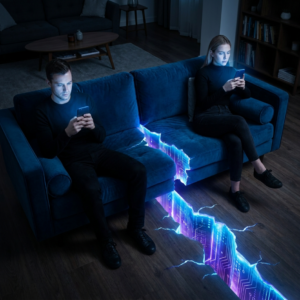
Look closely at a typical living room on a Tuesday night. The air is still, filtered through the soft, artificial glow of a lamp that casts long, flickering shadows against the walls. Two people occupy the exact same physical space, sitting on a plush couch, their bodies mere inches apart. To an outside observer, they are a picture of domestic harmony. But look deeper. Look at the invisible chasm yawning between them. They are separated by miles of cognitive distance, a vast and silent territory where intimacy goes to die. We have been conditioned to believe that relationships fracture through the thunderous noise of loud arguments or the jagged glass of massive betrayals. We wait for the big explosion. But the actual decay—the true, terminal rot of modern partnership—is much quieter. It is a slow, rhythmic erosion that starts with a single, habitual movement: the downward tilt of the head toward a glowing screen.
This is the era of “phubbing,” or phone snubbing. It is the pervasive, modern phenomenon where one partner habitually defaults to their digital device over the living, breathing human being sitting right next to them. We are witnessing the systematic, engineered extraction of human presence from our most sacred spaces. It is not that we have stopped loving each other; it is that we have allowed a highly engineered third party to move securely into our bedrooms and our hearts, siphoning away the very currency that makes love possible: our undivided attention.
The Biological Betrayal: When Minds Refuse to Align
Human intimacy is not a vague, poetic concept; it relies on a very specific, ancient biological mechanism. To truly connect, our species requires the synchronization of two minds, a feat built through the bedrock of unbroken, shared attention. When two people sit together, look into each other’s eyes, and truly listen, something miraculous happens beneath the surface. Our nervous systems actually begin to align. Our heart rates find a shared rhythm; our brain waves begin to mirror one another. This synchronization is the biological signature of safety, trust, and deep love.
But what happens to that delicate, synchronized state when a highly engineered device sits in our pockets, constantly pinging and pulling at the margins of our awareness? The device is not a passive tool; it is a predator of presence. Every time the screen flashes, the biological bridge we are trying to build with our partner is sabotaged. We are fighting an uphill battle against a system designed specifically to exploit our evolutionary triggers, and in this fight, our relationships are becoming the unintended casualties of a digital war for our dopamine.
The Split Second of Disconnect: A Anatomy of a Vanishing Act
Let us freeze the exact split second this disconnect happens. Imagine a woman is speaking to her partner, sharing the nuances of her day or perhaps a vulnerable thought she has been holding since morning. Her voice carries a specific emotional weight; her eyes are searching for his. Suddenly, his phone lights up on the coffee table. It is a sharp, blue-white intrusion into the warm dimness of the room.
In that fraction of a second, his eyes dart away. It is a micro-movement, almost imperceptible, but the impact is seismic. In that moment, he is gone. He has entered a state psychologists call “continuous partial attention.” He is no longer fully immersed in the digital world, but he is certainly no longer fully present in the physical room. He is suspended in a gray zone, a cognitive limbo, passively scanning for the next piece of optimal stimuli.
While his body remains on the couch, his mind has abandoned the “slow burn” processing required for empathy. Empathy is a heavy cognitive lift; it requires focus, patience, and emotional labor. The digital alert, by contrast, offers frictionless novelty. It is the sugary hit of an unpredictable dopamine reward that human conversation—no matter how deep—simply cannot compete with. He isn’t acting out of malice; his cognitive load has simply been hijacked by an algorithmic ghost.
The Hierarchy of Rejection: The Implicit Message of the Ping
Now, we must look at the other side of the couch. We must consider the partner whose vulnerability was just cut off mid-sentence. Throughout the long arc of human evolution, sustained eye contact has served as a primary indicator of safety and social cohesion. For our ancestors, when someone looked away during an interaction, it signaled a break in the social contract.
When that attention is suddenly withdrawn to check a notification, our nervous system interprets it with primal urgency. It feels like a tiny yet acute threat of abandonment. An implicit message is sent through the silence: “Whatever is on this screen is more important than whatever is in your heart.”
Look at the hierarchy of priority in that moment. The ignored partner is abruptly bumped down a tier, displaced by a glowing notification from a stranger, a news alert, or a trivial social media “like.” We tend to forgive one single distraction, calling it “unimportant.” But the danger does not lie in a single event. The danger lies in the sheer, overwhelming volume of these interactions. Hundreds of these micro-rejections compile over weeks and months, fracturing the heart and carving a vast, invisible digital divide straight down the middle of the relationship.
The Terminal Lack of Resonance: How Love Starves to Death
The symptoms of this digital decay follow a predictable and tragic pattern. First, the conversations become drastically shorter. Why dive deep when you know you will be interrupted by a buzz in a pocket? The risks of vulnerability become too high when the “audience”—your partner—is constantly vanishing. Next, the incidental physical touch disappears. The hand that used to reach out to brush a shoulder is now busy scrolling through a feed.
Both people slowly retreat into emotional withdrawal. They inhabit the same house, but they live in separate digital silos. They begin to assume the other is simply no longer interested, mistaken in the belief that the passion has faded naturally. But the relationship didn’t burn down in a fire of conflict. It quietly starved to death from a terminal lack of deep, sustained emotional resonance.
The most insidious part of this decay is that it happens completely unnoticed. Couples sit in the same room for hours, illuminated by their respective screens, and mistakenly believe they are spending “quality time” together. They are physically co-present, but emotionally absent. They have allowed their private sanctuaries to be breached by active portals that stream the unpredictable chaos of the outside world directly into the space meant for their union.
The Deliberate Act: Reclaiming the Currency of Attention
To save our partnerships from this state of digital decay, we must first embrace a harsh and uncomfortable realization. Love and intimacy are not passive states of being that simply maintain themselves like a stone sitting in a field. They are deliberate, exhausting acts of sustained, focused attention. Intimacy is a choice we make every time we choose the eyes of our partner over the glow of our phone.
Reclaiming that space requires more than just “trying harder.” It requires the construction of rigid physical and temporal boundaries. We must treat our homes like a laboratory for human connection. This means creating screen-free zones—especially in the bedroom and at the dining table—and designating “disconnected hours” where the devices are quarantined. We must protect our shared human spaces from algorithmic interference with the same ferocity we would use to protect our homes from a physical intruder.
If we want to save our romantic partnerships, we have to start treating our undivided attention as exactly what it is: the most precious, rare, and non-renewable currency we have left to give to another human being. In a world that wants to sell every second of our awareness to the highest bidder, giving someone your full, unfragmented presence is the ultimate act of revolution and the only path back to true love.
How often do you find yourself “gone” while sitting right next to the person you love? Have you felt the sting of the digital divide in your own home? Let’s start a conversation about how we can take our presence back. Share your thoughts in the comments below.
Disclaimer : This content may be created by AI for entertainment purposes. Any resemblance to real persons, events, or places is coincidental.






