The Shadow Over Kulai: The Tragic Eclipse of a Rising Star
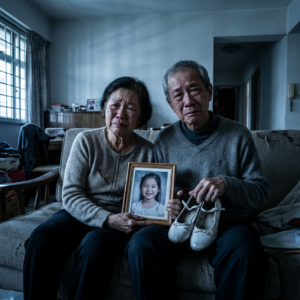
The air in the small district of Kulai, Johor, usually carries the quiet hum of a community nestled just an hour’s drive from the bustling heart of Singapore. But in 2008, that peace was shattered by a darkness so profound it would dominate headlines for nearly two decades. This is not merely a chronicle of a crime; it is the exhaustive narrative of Lai Jinh Xin—known to her loved ones as Lai Ung Tinh—a girl whose radiance was extinguished by the very hands she once considered friendly.
Chapter I: The Girl Who Carried the Sun
To understand the gravity of what was lost, one must first look at the life of Lai Ung Tinh. Born on April 16, 1992, she was the third child in a family that, while not wealthy in material riches, was abundant in affection. In the hallways of Senai Ibrahim National High School, she was a figure of admiration. She possessed a natural, breathtaking beauty that earned her the title of “School Beauty,” yet she remained remarkably grounded.
Every morning, she would meticulously style her hair and choose her outfits, a testament to her vibrant spirit and self-respect. But Ung Tinh was more than a face; she was a brilliant mind. She achieved seven straight As in her lower secondary evaluations, a feat that signaled a promising future. She was also an artist of motion, a skilled performer of the Diabolo—the Chinese yo-yo—where she moved with a grace that seemed to defy gravity.
Despite her accolades, she chose to work. To ease the financial burden on her parents, she took a part-time job at a clothing boutique in a nearby shopping mall. Her colleagues remember her as the girl who never let her talents breed arrogance, the one who invited friends for meals and movies, the one of whom it was said, “With a personality like hers, it was impossible to hate her.“
Chapter II: The Final Farewell at the Mall
The evening of Thursday, September 11, 2008, began like any other. The shopping mall was filled with the usual evening crowd, the scent of floor wax and perfume lingering in the conditioned air. Ung Tinh worked her shift with her characteristic smile, folding clothes and assisting customers until the clock neared 10:00 PM.
As the mall began to quiet down, she waved a cheerful goodbye to her colleagues. She was exhausted, her shoulders heavy from a long day of balancing school and labor, but the thought of her bed at home kept her moving. She stepped out into the humid Malaysian night, the neon lights of the mall reflecting in her eyes one last time. She walked toward the exit, unaware that a predatory gaze had been fixed on her for weeks. In that single step from the light of the mall into the shadows of the parking area, her world—and the world of those who loved her—was irrevocably altered.
Chapter III: A Night of Silent Telephones and Cold Demands
By 11:00 PM, the silence in the Lai household became deafening. Ung Tinh was never late. Her parents paced the floor, checking the windows, their initial thoughts of a minor delay curdling into a sharp, icy fear. Seconds turned into agonizing hours. They contacted the police, their voices trembling as they reported their daughter missing.
At 6:20 AM, a flicker of hope appeared: Ung Tinh’s phone number flashed on the screen. Her parents lunged for the device, expecting to hear their daughter’s voice, perhaps tearful but alive. Instead, they were met with a voice like cold stone. A stranger informed them that Ung Tinh had been kidnapped. The demand was 60,000 Malaysian Ringgit—a fortune for a working-class family—to be paid within twenty-four hours.
Panic turned into a frantic scramble for survival. While the police formed a task force, a “friend” of the family appeared. He stayed by the parents’ side, his face a mask of concern, urging them to pay the money quickly “before the kidnappers lose patience.” This shadow-play was happening while the real kidnappers played a deadly game of cat and mouse, switching the drop-off location to Marina Bay in Johor Bahru, 45 minutes away, and keeping every phone call under thirty seconds to evade tracking.
Chapter IV: The Betrayal of the “Protector”
By 3:00 AM the following day, the family had managed to scrape together 33,000 Ringgit. A friend of Ung Tinh followed the kidnappers’ instructions, placing the bag of cash in a pre-arranged bush. Then, the line went dead. No confirmation. No release. Only a void of silence.
The police, working with clinical precision, intercepted a pickup truck at 6:15 PM that same day. Within an hour, seven youths were in custody. As the investigation deepened, a horrifying truth emerged: the suspects were not strangers. They were acquaintances.
Among them was Zheng Jing Hong, 22, and three minors. The most chilling revelation was that the “concerned friend” who had been comforting Ung Tinh’s parents while they wept was one of the conspirators. He had used his proximity to the family to monitor the police presence and manipulate the parents into paying faster. The bag of ransom money was found inside their vehicle, a Proton Wira, along with Ung Tinh’s phone.
Under the weight of interrogation, the facade crumbled. They led the police to a desolate, weed-choked clearing near the Princess Jaya residential area. There, in a shallow 30cm pit, lay the remains of the girl who once carried the sun.
Chapter V: A Final Dance in White
The autopsy was a grim reading of a life cut short. Ung Tinh had been strangled to death almost immediately after her abduction. To hide their crime, the captors had attempted to burn her body, leaving her beautiful face scarred and her dreams reduced to ash. There was no evidence of sexual assault—this was a crime of possessiveness and cowardice.
On November 24, 2008, her funeral was held. Two hundred people gathered, the air thick with the scent of incense and the sound of stifled sobs. Her friends had spent nights folding 400 paper roses, placing them around her casket alongside handmade cards. In her coffin, her parents placed a white voile dress and a pair of dance shoes. They wanted her to be able to dance in the next world, free from the cruelty of this one.
The motive was as pathetic as the crime was heinous. Zheng Jing Hong had been obsessed with Ung Tinh. He had pursued her for months, ignoring her polite rejections. Enraged by her loyalty to her steady boyfriend and her refusal to acknowledge his advances, he orchestrated the kidnapping to “claim” her and extort her family. When they realized she could identify them, they chose to silence her forever.
Chapter VI: The Scales of Justice and the 16-Year Wait
Justice in Malaysia is a long road. It wasn’t until 2011 that the verdicts were finalized. Zheng Jing Hong, the only adult, was sentenced to death—twice. The two minors involved were sentenced to life imprisonment at the pleasure of the Sultan of Johor. For a decade and a half, the family lived with the small comfort that the murderer would eventually face the gallows.
However, in 2023, the legal landscape shifted. Malaysia abolished the mandatory death penalty, allowing inmates to appeal for resentencing. In April 2024, Zheng Jing Hong stood before the Federal Court again. His lawyer argued that he was “young and impulsive” at 22 and that the act of burning the body was merely an attempt to hide evidence, not an act of “cold-bloodedness.”
The court’s decision sent shockwaves through the nation. Zheng’s death sentence was commuted to 45 years in prison and 17 strokes of the cane. Having served time since 2008, he could potentially walk free by 2048 at the age of 62—or even earlier with good behavior.
Chapter VII: Reflections on an Unfinished Story
The family of Lai Ung Tinh remains in a state of perpetual mourning. They have never received an apology. They live in fear that the man who stole their daughter’s life might one day return to their streets. To them, the “humanitarian” shift in the law feels like a secondary betrayal—a wound reopened sixteen years later.
The story of the Kulai high school girl is a haunting reminder of how fragile a bright life can be when it encounters a dark heart. It forces us to ask: Does true justice have an expiration date? Can a crime so calculated and cruel ever be “balanced” by a prison term?
To our global community: How do you feel about the balance between legal mercy and the rights of the victim’s family? Does the abolition of the death penalty bring progress, or does it leave families like Ung Tinh’s in the shadows? Please share your thoughts below. Let us keep her memory alive.
Disclaimer : This content may be created by AI for entertainment purposes. Any resemblance to real persons, events, or places is coincidental.






