The Day My Husband Discovered My “Simple” Mother Was Actually His Boss
My name is Vanessa. Before I recount the echoes of the family gathering—the moment my husband, Leonard, stood in front of forty people and let a glass of wine peel back the layers of his own arrogance—I need to describe a specific kind of blindness. It is not the blindness of one who cannot see, but the blindness of one who refuses to look.
For five years, I watched my husband live in a world built on the rigid geometry of status. Leonard was thirty-eight, a senior project manager at a top-tier consulting firm. He was a man defined by the sharp crease in his trousers, the promptness of his calendar, and a deep-seated belief in hierarchies of credibility. To Leonard, expertise announced itself with a megaphone. He believed that the “professional class”—people like him—ran the world, while quiet people in modest circumstances were simply modest people with modest histories.
He had spent our entire marriage looking at my mother, Rosalie, and seeing a shadow where a sun should be. He had decided, with the terrifying confidence of the uninformed, that she was a “sweet, simple woman.” He saw her 62-year-old face, her 5’2 frame, and her silver-streaked hair, and he assigned her a value of zero in the marketplace of ideas. He was never overtly mean—that would be too easy to fight. Instead, he was cordially dismissive. He treated her with the kind of polite distance one reserves for a piece of furniture that is comfortable but unremarkable.
What Leonard did not know—what he had never possessed the curiosity to ask—was that the very ground he stood on in his professional life was owned by the woman whose dishes he let her wash. For eleven years, my mother had owned the parent company of his firm. For four years, he had been her employee. And for three years, she had been watching him, waiting to see if he would ever look up from his spreadsheets long enough to see the giant standing right in front of him.
The Woman Beneath the Surface
To truly understand my mother, you have to look past the practical car she drove and the sensible blouses she wore. Rosalie was a woman forged in the fires of a specific, quiet determination. Her grandparents were sharecroppers who had migrated North not just for a job, but for a different kind of air to breathe. They understood that while geography wasn’t destiny, staying in a place that didn’t want you to grow certainly was.
Growing up, my mother watched her parents work with a “dignified exhaustion.” They gave everything to a system that gave them back fractions. At twelve years old, Rosalie looked at that math and decided she would not replicate the equation. It wasn’t born from resentment; it was born from a crystalline clarity. She worked through community college, earned a four-year degree in business, and spent a decade in corporate finance. But she didn’t view corporate life as a destination. She viewed it as an apprenticeship.
She saved money with a discipline that would have made a monk look indulgent. She invested with the patience of a mountain. By the time I was in college, she had built a holding company, Larkswood Holdings, that controlled interests in four different industries. She told almost no one. She knew that visible wealth in a Black woman often attracted a category of attention that was more extractive than celebratory. She chose to keep her life small on the surface so it could be enormous underneath.
When I married Leonard, she already knew his name. She had seen it in the senior staff documentation of one of the seventeen companies under her umbrella. She said nothing. She wanted to see what kind of man he was when he thought no one of importance was watching. For three years of Sunday dinners and holiday visits, she played the role of the “simple mother-in-law,” waiting for a spark of curiosity from him that never came.
The Fragile Silence of the Birthday Celebration
The setting for Leonard’s undoing was my cousin Tasha’s fortieth birthday. Tasha’s home was a sprawling, warm space, perfect for the kind of African-American family gathering that feels like a living, breathing entity. The air was a heavy, delicious fog of slow-cooked brisket, seasoned greens, and the sweet, humid scent of cornbread. Three generations of our family filled the rooms, creating a cacophony of seven different conversations happening at the same volume.
I have always loved these events. They are the heartbeat of my history. Leonard, however, “tolerated” them. He found them tiring in the way people find things tiring when they haven’t learned to value them. He was there because I needed him to be, performing the role of the dutiful husband, but his presence was always slightly diminished. I could see it in the set of his jaw and the way he gripped his wine glass—he was “performing” enjoyment rather than experiencing it.
My mother arrived an hour into the party. She entered as she always did: quiet, unassuming, carrying two large foil-covered dishes. She was wearing a simple dark blouse and trousers, her hair pulled back in a neat low bun. She greeted everyone with the genuine warmth of a woman who had spent sixty-two years mastering the art of making people feel seen.
Leonard saw her arrive from across the room. He raised his glass in a slight, perfunctory acknowledgment—a gesture of “I see you, but we have nothing to discuss”—and turned back to his own circle. He had already filed her away under “unimportant.” He had no idea that the “trouble” was already in the room, moving quietly toward him.
The Lecture in the Living Room
The shift happened ninety minutes later. It started slowly, the way a crack in a dam begins with a single drop of water. Leonard, loosened by two glasses of wine and the intoxicating feeling of being the most “professionally accomplished” person in the room, began talking to Tasha’s neighbor, Derek.
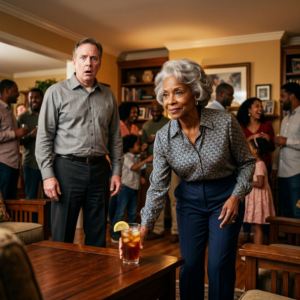
I was in the kitchen, helping plate the food, when I heard Leonard’s “project manager voice”—the one he used when he was holding court. I walked to the doorway and saw a small cluster of people had gathered. Leonard was in the center, looking polished and authoritative. Derek was listening with polite interest. And there, at the edge of the circle, was my mother.
She was holding a glass of sweet tea, her expression perfectly still. It was a look I knew well—it meant she was retreating behind her eyes, choosing not to react, becoming a witness rather than a participant.
Leonard was explaining the consulting industry as if he had invented it. He spoke about the necessity of “educated leadership.” Then, he pivoted to a topic he clearly felt passionate about: the “problem” with family-owned businesses. He argued that they were inefficient because they prioritized “legacy over competence.” He spoke about how the “professional class of managers” were the ones who truly understood operations, while the owners were usually just “background.”
Then Derek asked the fatal question: “What about the ownership level? Don’t they set the direction?”
Leonard smiled—the charming, condescending smile of a man who thinks he’s teaching a child. “Ownership without expertise,” he said, “is just inherited money looking for somewhere to sit. The owners are usually just… you know, background.” He gestured vaguely with his glass. The gesture swept across the room, encompassing the house, the family, and my mother, who stood three feet away.
In that moment, I felt a physical chill. I saw my mother’s face. She had a small smile—a complicated, heavy smile. It was the look of a woman who had just received the final, missing piece of a very disappointing puzzle.
The Unmasking of Rosalie Larkswood
My mother set her sweet tea glass down on a side table. The click of the glass against the wood felt as loud as a gunshot in the sudden lull of the room. She turned to Leonard with a look of pure, unadulterated warmth.
“That’s a really interesting perspective, Leonard,” she said, her voice soft but carrying a new, gravitational weight. “What firm do you work for again?”
Leonard, completely oblivious to the trap, cited the name of his firm with the ease of someone citing a high-ranking credential.
“And what do you do there?” she asked, nodding thoughtfully.
“Senior project manager,” Leonard replied, his chest puffing out just a fraction. “Five years now. I run the operational delivery side for three of our major accounts.”
“That’s impressive,” my mother said. And she meant it. She was always capable of recognizing competence, even when it was wrapped in arrogance. “Do you know who owns the firm?”
Leonard chuckled, the sound of a man who finds a question adorably simple. “It’s part of a holding company. Larkswood Holdings. Private equity situation, I think. I’ve never met anyone from ownership. They’re very… background.” He used his own word again, a verbal noose he didn’t realize he was tightening.
The room had gone completely silent. People had stopped eating. The quality of my mother’s attention had pulled the air out of the room.
“I’m Rosalie,” she said, her voice steady and clear. “Rosalie Larkswood.”
The silence that followed lasted exactly four seconds. I watched Leonard’s face undergo a violent transformation. He moved through confusion, then a rapid mental recalibration, then a dawning, horrific understanding. He looked like a man who had just walked into a glass door he thought was an open hallway.
“Larkswood Holdings,” my mother continued, her tone unhurried and kind, “is mine. I founded it twenty-five years ago. Your firm joined our portfolio eleven years ago. You’ve been working for me for four years, Leonard. It’s very nice to finally properly meet you.”
The Quiet After the Storm
There was no explosion. This wasn’t a movie; it was real life, which is often much more devastating. There was just the specific, heavy quiet of forty people recalibrating their reality. Derek made an involuntary sound—not a laugh, but a gasp of pure shock.
My mother took a slow sip of her tea. She looked at Leonard not with malice, but with the expression of a teacher who had been waiting all semester for a student to finally get the answer wrong so she could teach the real lesson.
Leonard stood paralyzed. He was a smart man, and in that moment, he realized every dismissive comment he’d ever made, every time he’d talked over her, and every time he’d treated her like a “pleasant background figure” was now laid bare. He realized he had spent three years auditioning for a woman he thought didn’t matter, and he had failed the audition of character.
“Rosalie, I—” he started, his voice cracking.
She raised one hand. Not a stop sign, just a gentle dismissal. “It’s a party,” she said. “Let’s enjoy it.”
She turned and walked toward Tasha, wishing her niece a happy birthday with the same easy grace she had arrived with. She spent the rest of the night helping in the kitchen and laughing with her sisters. She didn’t mention it again. She didn’t need to. She had already said the one true thing that changed everything.
The Long Drive into the Truth
The drive home was an eleven-minute exercise in absolute silence. I watched the clock on the dashboard. I wasn’t angry; I was waiting. I knew that whatever I said first would define the future of our marriage, and I needed to be precise.
“I didn’t know,” Leonard finally said. It wasn’t an excuse; it was a confession of his own failure.
“I know you didn’t,” I replied, watching the streetlights flicker across the windshield.
“Why didn’t you tell me?”
“Because you never asked,” I said, my voice even. “In five years, Leonard, you never once asked about my mother’s work. You decided who she was in the first year, and you never revisited the data. I even asked you once about Larkswood Holdings, and you told me private equity wasn’t worth understanding unless you were ‘in the deal.’ You weren’t incurious about the world—you were incurious about her.”
He was quiet for a long time. The weight of his “cultivated ignorance” was finally starting to feel heavy.
“She’s been watching you for three years,” I continued. “She watched how you treated her when you thought she was ‘simple.’ She watched to see if you would ever become curious about people who didn’t immediately signal that they could do something for you. She wanted to see your default setting.”
“What did she decide?” he asked, his voice small.
“She decided you were talented at your job,” I told him, “and that the talent had made you lazy about everything else. And I don’t think she’s wrong.”
The Slow Work of Becoming Real
Leonard didn’t change overnight. Real life doesn’t work that way. Instead, he began a slow, painful process of dismantling the man he used to be. On Monday, he called my mother. He didn’t do it because I asked; he did it because he realized he had a debt to pay.
He told her he was sorry—not just for what he said at the party, but for the general way he had related to her for three years. He admitted his assumptions were unexamined. My mother told him she wasn’t offended; she was disappointed. She had hoped, for my sake, that he would have been the kind of man who asked questions.
Leonard also went to his supervisor, Warren. He found out that Warren had known about Rosalie for years. Warren told him, “Your mother-in-law is one of the sharpest business minds I’ve encountered in thirty years. I’d suggest learning everything she’s willing to teach.”
Six months later, the “cordial dismissal” was gone. Leonard and my mother now meet once a month for dinner. He asks her questions about business structures, about long-term strategy, and about the things she learned in those twenty-five years that aren’t in any textbook. He listens now—not “performing” listening to look good, but actually absorbing the wisdom of a woman he once thought was “background.”
The moral of this story is something my mother told me recently: The most dangerous thing you can do is decide you already know the shape of a person. Because the shape is never what you think it is. And when the truth is revealed, you have to decide if you are the kind of person who can grow into that new reality, or the kind of person who shrinks away from it.
Leonard chose to grow. And for that, I am finally proud to call him my husband.
Do you have someone in your life who everyone underestimates? Have you ever had a “blind spot” about someone close to you that turned out to be a life-changing lesson? Share your stories in the comments below—let’s talk about the power of looking twice.
Disclaimer : This content may be created by AI for entertainment purposes. Any resemblance to real persons, events, or places is coincidental.






