The Sacred Bond and the Wicked Betrayal of Adi Berga
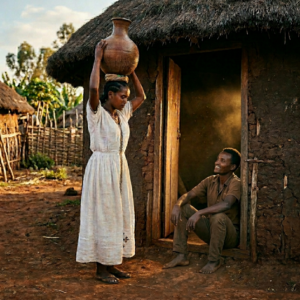
In the quiet dust of a village compound, where the rhythm of life is dictated by the fetching of water and the sweeping of earth, a story unfolded that would challenge the very foundations of blood and morality. It is a narrative that begins with the radiant beauty of a girl named Adi Berga—a beauty so profound it became a curse, igniting a darkness in the hearts of those sworn to protect her. This is not merely a tale of a girl escaping a forced marriage; it is a cinematic exploration of the thin line between love and obsession, the sanctuary of the natural world, and the ultimate justice that awaits those who dare to twist the laws of nature for their own selfish desires.
CHAPTER 1: THE RADIANCE OF ADI BERGA AND THE POISON OF OBSESSION
Adi Berga was the light of her home. Her father had long since passed into the realm of the ancestors, leaving her in a house dominated by her mother and four older brothers. To look at Adi Berga was to see the grace of the morning sun. But she was more than a pretty face; she was the heartbeat of the household. From the first light of dawn, she was a blur of motion—fetching heavy pots of water from the distant river, the clay cool against her skin; stirring the pots of food until the steam carried the scent of spices through the air; and meticulously cleaning the family compound until the dirt floor shone like polished stone.
Everyone loved her, or so it seemed. But love, in its purest form, seeks the happiness of the beloved. In the heart of her eldest brother, love had curdled into something unrecognizable.
It began with a mother’s simple plea. “You are a man now,” she told her eldest son one afternoon, the heavy heat of the day pressing down on them. “You must find a wife and marry her.” His response was immediate and chilling. “I don’t want a wife,” he declared, his eyes following Adi Berga as she moved across the yard. “My sister looks after me.”
Days turned into a week. The mother pressed again, her voice laced with the anxiety of tradition. “Go out and look for a girl,” she urged. But the son’s heart was a locked room. “My sister is the most beautiful girl in the world,” he argued. “Where can I find another like her?”
The final blow to morality came shortly after. “I want to marry Adi Berga,” he stated plainly, a declaration that should have shattered the walls of the hut. “Then she will stay at home with us forever.” At first, the mother’s anger was a righteous fire. “She is your sister!” she shouted, the cultural weight of the taboo crashing down between them. But the son’s obsession was a slow-acting poison. Day after day, he whispered his intent. He wore down her resistance with the persistence of water hitting rock. Eventually, the unthinkable happened. The mother stopped shouting. She began to listen. At last, she whispered a “yes” that would change their lives forever.
CHAPTER 2: THE CRUEL GAME AT THE HUT DOOR
The betrayal was not a single event, but a series of micro-aggressions that turned Adi Berga’s home into a prison. One evening, after the long trek to the river, Adi Berga returned with her water pot balanced perfectly on her head. She reached the door of the hut, her muscles aching, seeking the cool shade of the interior.
But the threshold was barred. Her eldest brother sat there, his leg extended across the entrance like a fallen timber. “Brother,” she said, her voice soft and weary. “Please put your leg down. I want to come in.”
He didn’t move. He looked up at her, a smile spreading across his face that made her blood run cold. “I am not your brother,” he said, the words heavy with a new, dark claim. “I am your husband.” Only then did he retract his leg.
Confused and trembling, she tried to step forward, only to find the path blocked again. The second brother raised his leg. “Please, brother,” she pleaded. “I am not your brother,” he mimicked. “I am your brother-in-law.” The third brother followed suit, repeating the cruel riddle. Then, the most heartbreaking moment of all: her own mother sat by the door, her leg raised against her daughter. “Mother, let me in,” Adi Berga cried. “I am not your mother,” the woman replied, her eyes devoid of the warmth that had once been there. “I am your mother-in-law.”
Only the fourth brother, the youngest of the men, broke the pattern. He was disabled, his legs weak and unmoving. He had to use his hands to lift his own leg, but he looked at his sister with eyes that still held the truth of their bond. “Yes, dear sister,” he whispered, “you can come in.”
This ritual became a daily torment. Every time Adi Berga returned from the river, she had to navigate this psychological labyrinth, forced to acknowledge her brothers as husbands and her mother as a stranger. The air in the hut grew thick with the unspoken horror of the upcoming wedding.
CHAPTER 3: THE SECRET IN THE TREES AND THE FLIGHT TO FREEDOM
The breaking point arrived through an act of supposed vulnerability. The fourth brother asked Adi Berga to carry him out to the fields so he could relieve himself. She picked him up, his weight familiar and light, and walked past the teff fields and the sorghum. “Not here,” he kept saying, leading her further and further away from the prying ears of the compound until they reached a dense grove of trees.
“Put me down,” he said, his voice suddenly sharp and clear. “I brought you here to talk. Tomorrow, they are going to give you to our oldest brother. They are going to force you to marry him.”
The world seemed to tilt beneath Adi Berga’s feet. The “wicked thing” she had sensed was now a concrete reality. “But I can’t marry my own brother!” she cried, tears blurring the green of the leaves. “It is wicked.” Her brother nodded, his face a mask of grief. “I agree. You must run. Go now.”
“But where?” she asked, the vastness of the world suddenly terrifying. “God will help you,” he said firmly. “Be strong. Go.”
Adi Berga ran. She didn’t look back at the brother who had saved her or the home that had betrayed her. She ran over the rolling fields, her feet pounding against the earth. She climbed steep mountain paths until her lungs burned and descended into deep, shadowed valleys where the air was cool and damp. Finally, she reached a river so wide and deep it seemed like the end of the world.
Desperate for safety from the wild beasts of the night, she climbed a massive tree overlooking the water. There, high above the ground, she made a home among the branches, surviving on the bitter taste of leaves and the sweetness of wild fruit, her only company the reflection of the moon in the rushing water below.
CHAPTER 4: THE MIRROR IN THE WATER AND THE TEST OF THE SPEAR
Life in the tree was a solitary existence until the day the servant girl of a wealthy man came to the river. As the girl bent to fill her pot, she saw a face in the water. It was not her own rugged, tired reflection, but the ethereal beauty of Adi Berga sitting in the branches above.
The servant girl, convinced she had suddenly been transformed into a princess, smashed her pots in a fit of newfound arrogance. “I’m going to find a rich man to marry me!” she shouted. But the illusion shattered when Adi Berga spat from the branches, forcing the girl to look up. Realizing the beauty was not hers, the girl ran to her master, not with news of her own vanity, but with a report of a “girl as beautiful as St. Mary” hiding in the trees.
The rich man arrived, his curiosity piqued. He stood beneath the tree, looking up at the silent, trembling girl. He was a man of logic and tradition, and he proposed a test to determine if this girl was a criminal or a victim. He struck a spear into the ground, its sharp point glinting in the sun. On one side, he laid a soft carpet; on the other, another carpet.
“Jump,” he commanded. “If you are a wicked girl who has run from justice, you will fall on the spear. But if you are a good girl who ran to save her life, you will fall on the carpet.”
Adi Berga did not hesitate. She surrendered herself to the air. She did not fall on the cold steel of the spear; she landed softly on the carpet, a divine confirmation of her innocence. The rich man, moved by this sign and her undeniable grace, asked her to be his wife. A new life began—a life of silk, servants, and a big house where the shadows of her brothers could not reach her.
CHAPTER 5: THE RETURN OF THE BROTHERS AND THE WEIGHT OF JUSTICE
Years passed. Adi Berga became the mistress of a grand estate, her past a fading nightmare. But she was not forgotten. Her fourth brother, the one who had urged her to flee, had spent those years dragging himself across the land using only his arms. He sought his sister with a devotion that matched the eldest brother’s obsession, but his was born of pure love.
When he finally arrived at the rich man’s gates, the servants noticed the resemblance immediately. “His face is like yours,” they told Adi Berga. She went out to meet him, and the reunion was a torrent of joy. She brought him inside, washed his travel-worn feet, and fed him the finest foods.
However, she knew her husband’s nature. “He likes to trick people,” she warned her brother. “When he returns, do the opposite of what he tells you.” When the rich man told the brother to push the cattle over a cliff, the brother instead led them to a lush valley. Impressed by this “subversive” wisdom, the rich man gave him a sack of animal hairs and a stick. “Go home and beat this sack,” he instructed.
Upon his return, the fourth brother beat the sack, and hundreds of healthy livestock—sheep, goats, and horses—poured out, making him a rich man in his own right.
But when the eldest brother heard of this wealth, his greed was ignited. He traveled to Adi Berga’s house, not out of love, but seeking his own reward. Adi Berga did not greet him with kisses. She did not smile. She was cold as stone. Her husband, sensing the rot in this man’s soul, gave him a different command: “Take the cattle to the desert and kill them.” The eldest brother, eager to please and secure his fortune, did exactly that. He slaughtered the innocent animals in the heat of the sands.
For his “reward,” he was given a sack. “Beat it when you reach home,” the rich man said. The eldest brother hurried back, his mind filled with visions of gold. He stood outside his hut and struck the sack with his stick.
But out of this sack came no sheep or goats. Instead, the air was filled with the terrifying roars of lions, the snarls of leopards, and the shadows of hyenas. The animals he had “earned” through his wicked life turned upon him. The eldest brother, who had tried to consume his sister’s life, was himself consumed by the wild.
DEEP REFLECTION: THE INEVITABLE HARVEST OF THE SOUL
The story of Adi Berga is a profound meditation on the nature of sanctuary and the inevitability of justice. Adi Berga found safety in the natural world—the trees and the river—because she was in harmony with the moral law. Her eldest brother, however, viewed the world and the people in it as objects to be owned. His death was not a random tragedy, but the physical manifestation of the darkness he had cultivated.
The fourth brother, despite his physical limitations, became the wealthiest and happiest of men because his strength resided in his character. In the end, the story teaches us that blood may define a family, but it is our actions that define our destiny. The “sack” we carry through life will eventually be opened; whether it contains a bounty of life or a pride of predators depends entirely on how we treat the “Adi Bergas” in our own lives.
Disclaimer : This content may be created by AI for entertainment purposes. Any resemblance to real persons, events, or places is coincidental.






