Why Your Most Valuable Asset Has No Price Tag
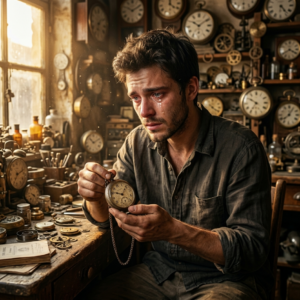
In a world where we measure success by the digits in our bank accounts and the labels on our clothes, we often forget the only currency that truly matters—a currency that is given to every human being in equal measure, yet once spent, can never be earned back. This is the story of a father, a son, and a dusty watch kept inside a wooden cupboard. It is a narrative that began in a small, quiet village, but its echoes carry a universal truth that could change the way you look at your life today.
We often see “laziness” as a simple lack of effort, but for Agma’s father—a wise man who watched his son wander aimlessly through the village squares—it was a tragedy of wasted potential. His son was careless, floating through the days like a leaf on a stream, unaware that the stream was leading toward a waterfall. The following is the account of a masterfully crafted lesson that transformed a wanderer into a man of purpose.
The Cupboard in the Corner
The sun was casting long, amber shadows across the earthen floor of their humble home when the father finally decided that enough was enough. He sat on a low wooden stool, his eyes reflecting a deep, quiet concern for the future of his only son. The boy was not unkind, but he was hollow; he spent his mornings chasing shadows and his evenings counting the stars, never realizing that the sun was setting on his youth.
The father called the boy to him. The boy approached, his gait slow and his expression bored, perhaps expecting another lecture he would surely ignore. But the father’s voice was gentle, lacking the sharp edge of frustration. “Son,” he said, gesturing toward the heavy, dark wood of the cupboard in the corner, “there is a watch kept inside. Bring it to me.”
The boy obeyed, his fingers brushing against the rough grain of the wood as he opened the heavy doors. The cupboard smelled of cedar and time. He reached in and pulled out a simple watch. It was metal and glass, a mechanical heart that ticked with a rhythmic, indifferent pulse. He brought it to his father, who took it and turned it over in his hands. The lighting in the room caught the scratches on the glass—each one a memory of a second that had already passed.
The Market of Opinions
“Take this watch to the market,” the father instructed, his gaze steady. “Ask everyone you meet how much they think it is worth.”
The boy nodded, seeing this as just another errand. He walked into the bustling chaos of the village market, a place where the air was thick with the scent of spices, the braying of livestock, and the loud haggling of merchants. He stood amidst the crowd, holding out the watch to anyone who would stop.
One man, a merchant with flour-dusted hands, squinted at it and shrugged. “Five hundred rupees,” he muttered, barely breaking his stride. Further down the path, a woman selling silk touched the metal and sighed, “Maybe a thousand.” Another man offered eight hundred. The boy moved through the sea of people, and with every person he met, the “value” of the watch shifted. Some people gave the same price, but no one agreed completely.
When the boy returned home, he was exhausted. “Father,” he said, placing the watch back on the table, “everyone told me a different price. Five hundred, eight hundred, a thousand. It seems no one can agree on what it is worth.” The man smiled, a knowing glint in his eyes. “All right,” he replied. “Put the watch back in the cupboard.”
The Question That Changed Everything
The next day, the father called the boy again. The ritual repeated—the opening of the cupboard, the retrieval of the watch. But this time, the mission was different. The father leaned in close, his voice dropping to a whisper that commanded attention. “Go to the market again. But this time, do not ask for the price of the metal or the glass. Ask the people the price of the time inside this watch.”
The boy’s brow furrowed in confusion. He looked at the ticking hands. How do you price the movement of a shadow? He didn’t understand, but he obeyed. He returned to the market, but the atmosphere had changed. When he approached the same merchants and asked, “How much is the time inside this watch worth?” the reactions were no longer about currency.
People looked at him strangely. A group of young men laughed, mocking his “foolish” question. Merchants waved him away as if he were a nuisance. He felt a deep, biting embarrassment. The “value” had disappeared because they could not see it. He felt sad, wandering the stalls until he reached the very edge of the market, where a small, cramped shop sat tucked away from the noise.
The Wisdom of the Watchmaker
Inside the shop, an old man sat hunched over a workbench, a magnifying loupe pressed to his eye. He was surrounded by the skeletal remains of old clocks, the air filled with a thousand different ticks and tocks. When the boy asked his question, the old man did something no one else had done: he stopped.
He set down his tools and looked at the boy with a kind, weary smile. He saw the confusion in the boy’s eyes and the heavy weight of the watch in his hand. “Son,” the old man said softly, his voice like the rustle of old parchment, “you cannot put a price on time. You can give millions of rupees, you can offer all the gold in the mountains, but you cannot buy back even one single second of your life once it has slipped away.”
The boy stood frozen. The noise of the market outside seemed to fade into a dull hum. The old man continued, “Time has one bad thing and one good thing. The bad thing is that it passes—it is a river that only flows one way. The good thing is that you can choose how to spend it. Whether you are the richest king or the poorest beggar, the gods give you exactly twenty-four hours in a day. The only difference between a life of greatness and a life of regret is how you use those hours.”
The Birth of a New Man
In that micro-moment of silence in the watchmaker’s shop, the boy’s eyes filled with a sudden, sharp understanding. The “lazy wanderer” died in that shop, and a man of purpose was born. He didn’t see a metal object anymore; he saw a ticking countdown. He thanked the old man and ran home, his feet pounding against the earth with a new urgency.
He told his father everything. He described the laughter of the fools and the wisdom of the watchmaker. The father didn’t say a word; he simply placed a heavy, proud hand on his son’s shoulder. That touch carried the weight of a thousand unspoken hopes.
From that day forward, the boy’s life was unrecognizable. The wandering stopped. The carelessness vanished. He began to work with a fervor that startled the village. He understood that every moment spent in idleness was a piece of his life he was throwing into the fire. He realized that while time is free, it is also priceless.
A Final Reflection for the Global Community
Friends, this story is not just about a boy in a village. It is about you. You are holding that watch right now. You cannot keep time in a cupboard; you cannot save it for a rainy day. You can only spend it.
Once a minute is gone, it is gone forever. You can use your twenty-four hours to build a legacy, to love your family, and to grow your soul—or you can let them slip through your fingers like sand. The choice is the only power you truly have. Use your time wisely, for it is the only thing you possess that you can never replace.
How are you spending your twenty-four hours today? Have you ever had a moment that made you realize the true value of your time? Share your thoughts below and let’s inspire each other to make every second count.
Disclaimer : This content may be created by AI for entertainment purposes. Any resemblance to real persons, events, or places is coincidental.






