A Chilling Tale of Envy, Betrayal, and the Illusion of the Perfect Crime
The winter air in Seoul carries a specific, biting chill in late December, a freezing breath that seems to seep through the heavy coats and settle directly into the bones. It was around seven in the evening on December 29, 2003, when the sprawling metropolis was winding down, bathed in the amber glow of streetlights and the festive remnants of the year’s end. But in a quiet, unassuming apartment complex in Songpa-gu, a darkness was waiting to be uncovered—a darkness so profound and meticulously engineered that it would shatter the illusion of safety for an entire nation.
A thirty-four-year-old man, known to the public as Mr. Na, stood before the heavy iron door of his seventh-floor apartment. He pressed the doorbell. The chime echoed faintly through the thick metal, followed by absolute, suffocating silence. He pressed it again. He knocked, his knuckles rapping hard against the cold surface. There was no familiar pitter-patter of tiny feet running to greet him, no warm voice of his wife answering from the kitchen.
Frustration morphed into a creeping, nameless dread. His wife, Mrs. Park, was not answering her cell phone. The apartment was sealed from the inside. Desperate and out of options, Mr. Na reached for his phone and dialed the number of someone he knew was intimately familiar with his family’s daily routines: Ms. Lee, his wife’s best friend from high school.
This singular phone call would set in motion the unspooling of one of the most diabolical, psychologically terrifying, and heartbreaking criminal investigations in the history of South Korea. It is a story not of random violence, but of a quiet, festering jealousy that mutated into an unspeakable evil.
The Silence Behind the Iron Door
“Hello? Where are you? What is going on?” Ms. Lee’s voice came through the receiver, laced with immediate, breathless concern.
“I am standing right in front of the house,” Mr. Na replied, his breath pluming in the freezing hallway. “I have been ringing the bell for a long time, but there is no sound from inside. Nothing at all.”
“I will be right there,” she promised, her tone urgent.
When Ms. Lee arrived at the seventh-floor corridor, she presented a demeanor of a deeply worried confidante. She approached the panicked husband and pointed toward a small, frosted window that belonged to a secondary bedroom, facing the communal hallway. She reminded him of a small, seemingly insignificant detail about his own wife: Mrs. Park habitually left her purse near that specific window sill.
“Look,” Ms. Lee said, her voice steady and helpful. “The window is slightly unlatched. Try reaching your hand inside and see what you can find.”
Mr. Na pressed his arm through the narrow gap, his fingers blindly grasping in the darkness of the small room until they brushed against the familiar leather of his wife’s handbag. He pulled it through the opening. Trembling, he unzipped the bag and found the spare set of house keys resting exactly where Ms. Lee had predicted.
With a metallic clack, the heavy front door finally gave way. Mr. Na stepped across the threshold, enveloped immediately by a chilling, unnatural stillness. The ambient warmth of a family home was entirely absent. He reached out and flicked the switch for the living room light.
The harsh fluorescent illumination flooded the space, revealing a tableau of horror so absolute it defied human comprehension.
Lying lifeless on the living room floor was his beloved wife. Her head was completely shrouded in a thick towel, blinding her to the world. Wrapped tightly around her neck was a bright orange clothesline. The line extended upward, suspended terrifyingly from the top of the doorframe that separated the living room from the small adjacent bedroom.
A few feet away, the tragedy deepened into an abyss of sorrow. Their ten-month-old infant daughter lay dead upon the floor, a suffocating plastic bag pulled mercilessly over her fragile face.
Staggering backward, his mind shattering into a million pieces, Mr. Na stumbled toward the small room. There, the final piece of this macabre nightmare awaited. His vibrant, energetic three-year-old son was found hidden away in a closet, a piece of cloth tied viciously around his small neck.
In a matter of seconds, a father and a husband had lost his entire universe. The wails of a broken man echoed through the seventh floor of the Songpa-gu apartment building, summoning a tragedy that would soon demand answers from the silent, bloodless walls.
The Illusion of a Mother’s Despair
When the Songpa-gu district police arrived, the apartment was transformed into a chaotic sea of flashing lights, forensic kits, and the devastated sobs of arriving family members. The initial assessment of the crime scene pointed toward a horrifying, albeit familiar, narrative: a tragic double murder-suicide committed by a despairing mother.
The physical evidence seemed to support this grim theory. The apartment was a perfect locked-room mystery. The heavy front door had been securely locked from the inside. The balcony sliding doors were bolted shut. The heavy iron security bars on the seventh-floor windows remained completely intact and undisturbed. There were absolutely no signs of forced entry, no shattered glass, no muddy footprints belonging to a stranger, and no foreign fingerprints dusting the pristine surfaces of the home.
Furthermore, the condition of Mrs. Park’s body led investigators to believe she had taken her own life. There were zero defensive wounds on her arms or hands. If an intruder had attempted to slip a noose around her neck and hoist her up, human instinct dictates a frantic, violent struggle. A victim would claw at their own throat, dig their nails into the rope, and fight with every ounce of their primal strength to breathe. Mrs. Park’s neck and hands were entirely clean of such desperate self-inflicted scratches.
To the untrained eye, it appeared she had smothered her children, set up the orange clothesline, placed a towel over her own head to hide the finality of her actions, and ended her life.
But seasoned detectives know that crime scenes, like people, can lie.
The narrative of a depressed, suicidal mother began to fray under the magnifying glass of forensic scrutiny. First and foremost, Mrs. Park had absolutely no history of mental illness, depression, or marital strife. She was known to be a vibrant, loving mother who adored her children and cherished her stable, happy life.
Second, the sheer brutality inflicted upon the children did not align with the psychological profile of maternal murder-suicide. While such tragedies do occur, mothers rarely employ such excessively violent and terrifying methods as suffocating an infant with a plastic bag or brutally trampling on the bodies of their toddlers. The forensic team had discovered distinct, violent trampling marks on the bodies of both the three-year-old boy and the ten-month-old girl. It was an act of pure, unadulterated hatred, not a misguided act of tragic mercy.
Third, the silence of the apartment was too loud. There was no suicide note. A mother taking her own life and the lives of her children almost invariably leaves behind a testament of her despair—an apology, a final plea, a written manifestation of her sorrow. The home was completely devoid of any such message.
Finally, a microscopic piece of evidence shouted the loudest truth. Clenched tightly within the palm of Mrs. Park’s right hand was a tiny, torn piece of wallpaper, measuring no more than 1.5 centimeters. It had been ripped from the wall near the doorframe. Why would a woman committing suicide clutch a piece of wallpaper?
It was not a suicide. It was a highly orchestrated, theatrical execution. But if the doors were locked from the inside, how did the phantom killer escape?
The Ghost in the White Coat
The detectives pivoted their investigation, knowing that the perpetrator had to be someone intimately familiar with the family—someone Mrs. Park would willingly allow into her home on a quiet afternoon. Because there were no obvious suspects, the police began routinely interviewing those closest to the victims to establish alibis.
The husband, Mr. Na, was the first logical suspect, but his alibi was ironclad, placing him far away at his workplace during the time of the murders.
The next person on the list was Ms. Lee, the grieving high school best friend who had been the very person to discover the keys through the window. She had been a frequent guest, visiting the apartment two to three times a week, treated almost as a member of the family. The children even called her “Auntie.”
When called in for standard questioning, Ms. Lee appeared the picture of a traumatized friend. She answered the detectives’ questions calmly, her voice appropriately somber, offering nothing that would naturally arouse suspicion.
Meanwhile, the investigative team had secured the security footage from the apartment building’s elevator. By establishing the estimated time of death from the autopsy reports, they focused their attention on the mid-afternoon hours. The grainy footage yielded a monumental breakthrough. At approximately 3:00 PM on the day of the murders, a woman wearing a white winter coat was captured stepping out of the elevator on the seventh floor.
The detectives recognized her instantly. It was Ms. Lee.
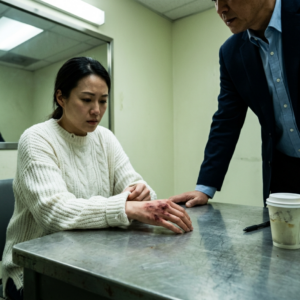
She was immediately summoned back to the precinct for a secondary, far more intense round of questioning. She sat in the sterile, fluorescent-lit interrogation room, surrounded by seasoned detectives pounding away on their keyboards, recording every nuance of her testimony.
It was during this high-stakes environment that a veteran detective’s sharp intuition cracked the case wide open.
Despite the stifling, heavily heated air of the precinct’s interrogation room, Ms. Lee kept shivering. But it wasn’t a biological shiver; it was a highly controlled, repetitive physical tic. The detective watched her hands. Every time she rested them on the table, she would immediately, almost compulsively, pull her hands back inside the long, oversized sleeves of her sweater, hiding them from view.
It was a micro-expression of guilt—a subconscious attempt to conceal something.
“Ms. Lee,” the detective said, his voice dropping into a low, commanding register. “The room is quite warm. Please, take your hands out of your sleeves and place them flat on the table.”
Startled, caught off guard by the sudden pivot in the conversation, her composure faltered. Flustered, she slowly extended her arms, revealing her bare hands under the harsh light.
The detectives leaned in. There, branded across the back of her right hand, was a deep, fierce red ligature mark—a friction burn consistent with someone gripping a rough rope and pulling with immense, explosive force. A similar, painful red indentation marked her left index finger.
The atmosphere in the room shifted from an interview to a trap snapping shut.
“Why do you have rope burns on your hands?” the lead detective asked, his eyes locked onto hers.
“I… I was helping them fix something in the bathroom at their house,” she stammered, her alibi hastily constructed and crumbling instantly.
The detectives pressed harder, relentless and uncompromising. They asked for specific details of this alleged bathroom repair. They boxed her into a corner of logic until there was no room left to breathe. Finally, leaning across the table, the detective delivered the killing blow to her facade.
“You didn’t fix a bathroom, did you? You killed her. You murdered your best friend.”
The pitch of her voice broke. The perfectly crafted mask of the grieving friend shattered into a million jagged pieces. Trembling, her voice rising to a high, unnatural squeak, Ms. Lee finally surrendered to the weight of her own evil.
“Yes,” she confessed into the quiet room. “I killed her.”
The Diary of a Green-Eyed Monster
The police immediately secured a search warrant for Ms. Lee’s small, isolated apartment. What they found inside was a descent into the mind of a meticulous, calculating psychopath.
Hidden away was a diary that served as a masterclass in premeditated murder. For three to six months, Ms. Lee had been drafting, revising, and perfecting a blueprint for the annihilation of the Na family. The diary contained detailed architectural sketches of the victim’s apartment, step-by-step methodologies for the murders, lists of required tools, and contingency plans if she were interrupted. It was an encyclopedia of envy.
But why? What could drive a woman to slaughter the woman she had called her best friend since high school, along with two innocent infants?
The answer was a toxic, combustible mixture of profound inferiority, blinding jealousy, and a devastating secret betrayal.
Ms. Lee and Mrs. Park had reconnected in 2001 through an online alumni network. Over the two years that followed, Ms. Lee became a fixture in the Park household. But every time she crossed the threshold of that warm, loving seventh-floor apartment, she was violently confronted with her own perceived failures.
Mrs. Park had everything Ms. Lee felt she was owed by the universe. Mrs. Park was happily married to a caring, successful husband. She had two beautiful children. She had a comfortable home. Ms. Lee, on the other hand, was in her thirties, unmarried, living alone in a cramped room, feeling the societal pressure of her age weighing heavily upon her. The contrast gnawed at her soul like a parasite. She felt ignored, patronized, and profoundly inadequate in the presence of her friend’s domestic bliss. She even wrote in her diary about her intense fury when she perceived Mrs. Park’s in-laws looking down on her.
But the jealousy was only the kindling. The spark was a dark, hidden affair.
During the investigation, a shocking truth emerged from the shadows. Mr. Na, the grieving husband, initially denied any inappropriate relationship with Ms. Lee. However, under the weight of the evidence, he finally confessed that he and his wife’s best friend had been engaging in a secret, illicit affair since January of 2003.
Ms. Lee had tasted the life she desperately coveted. She had convinced herself that if she could simply erase Mrs. Park and the children from existence, she could seamlessly slide into the empty space left behind. She believed she could claim Mr. Na, the apartment, and the status of a beloved wife, entirely for herself. In her diary, she had even chillingly noted: “After I die, I will leave all my assets to Mr. Na.” She decided to trample upon the happiness of the woman who had welcomed her into her home. She became the monster at the dinner table.
A Symphony of Absolute Terror
The reconstruction of the murder, based on the meticulous blueprints found in her diary and her own cold confession, revealed a theatrical execution of unimaginable cruelty. It was a plan that veteran homicide detectives admitted they had never seen the likes of in their entire careers.
At noon on December 29, Ms. Lee visited the apartment under the guise of borrowing 1.5 million won. This was merely a scouting mission, a reconnaissance to ensure the husband was at work and the victims were alone.
Satisfied with the environment, she returned at 3:00 PM. She found Mrs. Park and the children relaxing in the master bedroom, watching television. Ms. Lee, armed with her hidden tools and a heart made of ice, initiated her performance.
She turned up the volume on the television to mask any upcoming sounds. Smiling warmly, she approached the innocent three-year-old boy. “Let’s prepare a big surprise for your mom,” she whispered, taking his small hand and leading him into the small, adjacent bedroom. She closed the door behind them.
The betrayal that occurred in that small room defies human language. She told the toddler to lie down and wrapped him in a towel as part of the “game.” Once he was immobilized, the game ended. She stuffed a cloth into his mouth to muffle his screams, forced a plastic grocery bag over his head, and tied a ligature around his neck. As the child thrashed in the darkness, she placed her foot upon his small neck, crushing the life out of him until he was perfectly still. She then callously shoved his lifeless body into the closet, shutting the door on his stolen future.
She stepped back out into the living room, her hands steady, her breathing controlled. “We are almost ready,” she called out to Mrs. Park over the loud television.
Returning to the small room, she constructed the engine of her locked-room mystery. She tied a bright orange clothesline to a heavy shelf inside the room. She draped the other end of the rope over the top of the open doorframe. But Ms. Lee knew that a heavy rope pulling across a wooden doorframe would leave deep friction grooves—evidence of murder.
To circumvent this, she pulled out a piece of a plastic bottle she had pre-cut at her own home. She wedged the smooth plastic over the top of the doorframe, underneath the rope. This ingenious, psychopathic detail created a frictionless pulley system, ensuring the rope would glide smoothly without leaving a single scratch on the wood.
She walked back to her best friend. “It’s time for the surprise,” Ms. Lee smiled. “You have to wear this towel over your head like a blindfold so you can’t see.”
Mrs. Park, trusting her friend implicitly, allowed the towel to be draped over her head. Holding her ten-month-old infant daughter securely in one arm, the blinded mother was gently guided by Ms. Lee toward the threshold of the small room.
As they reached the doorframe, Ms. Lee seamlessly slipped the noose of the orange clothesline over the towel-covered head of her best friend.
Before Mrs. Park could register the sensation of the rope, Ms. Lee stepped backward into the small room. She climbed onto a waiting chair. Gripping the tail end of the rope with both hands, Ms. Lee threw her entire body weight backward, pulling downward with explosive, homicidal force.
The chair clattered to the ground.
Mrs. Park was violently hoisted into the air. Blinded, suffocating, and plunged into absolute terror, she realized she was being murdered. But the tragedy of her final moments lies in her maternal instinct. She was still holding her ten-month-old baby.
She did not reach up to claw at the rope burning into her throat. She did not fight for her own life. Instead, with her free hand, she desperately clawed at the wall in a blind panic, her fingernails scraping the wallpaper, tearing away a 1.5-centimeter piece as she tried to balance herself to keep her baby from falling.
It was a futile, heartbreaking struggle. As the lack of oxygen overwhelmed her brain, her muscles gave out. The infant tumbled to the floor. Mrs. Park succumbed to the darkness, dying while trying to protect her child.
Ms. Lee, standing in the small room, her hands burning from the friction of the rope, completed her symphony of terror. She walked over to the crying ten-month-old infant on the floor and murdered her with the same cold, mechanical efficiency she had used on the brother.
The stage was set. Ms. Lee meticulously cleaned the apartment. She gathered her plastic bottle pieces. She walked to the front door, locked it from the inside, and then walked to the small bedroom window facing the hallway. She tossed Mrs. Park’s purse containing the house keys through the window gap, creating the perfect locked-room illusion.
She walked away, returning hours later to play the role of the horrified, grieving friend alongside the husband she intended to claim as her prize.
Deep Reflection: The Poison of the Inferiority Complex
The “Perfect Locked-Room Murder” of Songpa-gu ultimately collapsed not because of a flaw in the mechanical design, but because the human body cannot hide the physical toll of extreme violence. The burn marks on Ms. Lee’s hands and her obsessive need to retrieve her plastic pulley pieces were the breadcrumbs that led investigators to the truth.
Initially sentenced to death in July 2004, Ms. Lee’s sentence was inexplicably reduced to life imprisonment in March 2005, with the court citing severe depression as a mitigating factor. The ruling sparked massive, nationwide outrage. To the family of the victims, and to a horrified public, no amount of depression could justify the calculated, theatrical slaughter of two infants and a loving mother.
Throughout her interrogations, Ms. Lee repeatedly muttered that “the world is unfair.” She refused to take genuine accountability, attempting to shift the blame onto the victim, claiming Mrs. Park’s happiness was the source of her own misery.
This chilling case forces us to stare into the abyss of human envy. It demonstrates how an unchecked inferiority complex can fester, mutating from quiet bitterness into an apocalyptic entitlement. Ms. Lee did not just want what Mrs. Park had; she wanted to punish Mrs. Park for having it. She weaponized trust, transforming the sanctity of a family home and the innocence of a children’s game into an execution chamber.
Life is inherently unequal, and the success of others can sometimes cast a long, uncomfortable shadow over our own perceived inadequacies. But using the joy of others as an excuse to cultivate hatred is a poison that destroys the vessel carrying it. Ms. Lee believed that by eliminating her friend, she could steal a life of happiness. Instead, she traded a lonely apartment for a concrete cell, forever branded as a monster who choked the life out of a child who called her “Auntie.”
How does this harrowing story change your perspective on the dangers of hidden envy and toxic relationships? Do you believe the justice system failed the victims by reducing the killer’s sentence to life in prison? Share your profound thoughts, your empathy for the Na family, and your reflections on this chilling case in the comments below. Let us remember the mother who spent her final, agonizing seconds trying to save her child.
Disclaimer : This content may be created by AI for entertainment purposes. Any resemblance to real persons, events, or places is coincidental.






