A Love Built on the Ashes of a Lie
In the quiet, cobblestone streets of a town where time seems to stand still, a shadow has loomed for generations. It is a shadow cast not by the mountains, but by the weight of a grudge so old that the people carrying it have forgotten how it began. They only know one thing: the name on the other side is the enemy. But what happens when the heart refuses to read the map drawn by our ancestors? What happens when a single, dusty piece of paper holds the power to dismantle a wall built over decades?
This is the story of Emma Carter and Alex—two souls born into a war they didn’t start, fighting for a love that wasn’t allowed, and discovering a truth that would change their world forever. It is a cinematic journey through fear, betrayal, and the ultimate power of forgiveness.
Chapter 1: The Primary School Teacher and the Invisible Wall
Emma Carter was a woman of simple rhythms. She found her peace in the early morning light filtering through her kitchen window, the steam rising from a porcelain cup of warm tea, and the pure, bell-like laughter of the children in her primary school classroom. To the outside world, Emma’s life was an open book of kindness and structure. But inside her home, there was a chapter that remained perpetually locked.
Since she was a small child, her parents had instilled in her a singular, chilling rule: “Never trust his family.” They spoke the words with a gravity that made the air in the room feel thin. There were no explanations, no history lessons, just a visceral warning that acted like a wall built inside her heart. Emma remembered the tired, guarded look in her mother’s eyes—a look that said some stories were too painful to be told, and some hatreds were too sacred to be questioned. She lived her life in the shadow of this invisible wall, never realizing that on the other side, someone else was staring at the same bricks.
Chapter 2: A Chance Encounter Under a Coffee Shop Roof
The world changed on a Tuesday afternoon when the sky turned the color of bruised slate. Emma had forgotten her umbrella at school, and the rain began to fall in heavy, rhythmic sheets that turned the streets into rivers. Seeking shelter, she ducked under the narrow roof of a local café. The air was thick with the scent of damp pavement and ozone.
That was when she saw him. He was standing by the glass door, a warm cup of coffee in his hand, watching the rain with a quiet intensity. When he saw her shivering, he didn’t just look; he saw her. “You can come inside,” he said. His voice was a calm harbor in the storm. Emma hesitated, a lifetime of warnings whispering in the back of her mind, but the cold was too sharp. She stepped inside.
The café smelled of toasted sourdough and roasted beans. The man introduced himself as Alex. He had just moved back after years away. As they talked, Emma felt a strange, magnetic pull. It was easy. It was natural. He listened as if her words were precious stones he was collecting. For the first time in her life, the world felt quieter, as if the invisible wall had suddenly turned to glass.
Chapter 3: The Name That Stopped the World
For days, Emma and Alex moved in a bubble of discovery. They walked through the old park, sharing small secrets and large dreams. But the bubble burst on a sunny afternoon near the edge of town. Alex pointed toward a patch of land and mentioned his family used to live there. Curiosity, innocent and deadly, prompted Emma to ask the one question she should have avoided: “What’s your last name?”
The moment the name left his lips, the sun seemed to lose its warmth. The air turned heavy, as if a physical weight had dropped onto Emma’s shoulders. She stopped dead in her tracks. The man standing before her was no longer just “Alex”—he was the face of the enemy. He was the personification of every “No” her parents had ever uttered.
“That’s not possible,” she whispered, her voice cracking. She took a step back, her eyes wide with a realization that felt like a physical blow. She saw the confusion in his eyes turn to a slow, agonizing understanding. “You know about it, too,” he said quietly. In that moment, they weren’t just Emma and Alex; they were the heirs to a tragedy they didn’t understand.
Chapter 4: The Domestic Storm
The fallout was immediate and brutal. When Emma confessed the truth to her mother the next morning, the domestic peace of their home shattered. Her mother’s face, usually soft, turned into a mask of stone. “No,” she said, the word cutting through the room like a blade. “This must stop now.”
Emma demanded the truth. She was tired of fighting shadows. But her mother insisted that some things were better left in the past. “It’s not the past if it still controls us!” Emma shouted, the sound of her own voice surprising her. The tension escalated when her father arrived home. The anger in his eyes was ancient. He gave her an ultimatum that felt like a death sentence: “If you continue this, you are going against your own family.”
Emma was caught in a vice between the love she felt for a man she had just met and the loyalty she owed to the people who had raised her. She was no longer just a teacher; she was a soldier being asked to choose a side in a war that had no end in sight.
Chapter 5: The Secret of the Hill House
The situation turned dangerous when Emma received a frantic call from her mother. “They know where he is.” Both families had mobilized, their shared hatred acting like a tracking device. Emma and Alex found themselves running—not from a crime, but from a legacy of spite.
They ended up at the old bridge outside of town, breathless and terrified. It was there that Alex shared the only fragment of the truth he knew. His grandfather, on his deathbed, had whispered that the families were once as close as brothers. They had shared land, business, and life itself. Then came the betrayal—a sum of money gone missing, a shattered trust, and two families who chose to believe the worst of each other.
“My grandfather said there was a letter,” Alex said, his eyes searching Emma’s. “A letter that explains everything. It’s in your family’s abandoned house on the hill.”
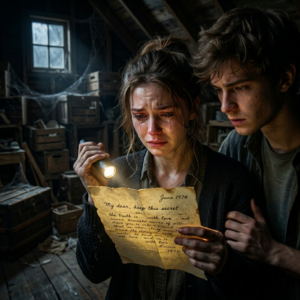
The house was a place of ghosts, locked for years. But Emma knew that the key to their future lay in the ruins of their past. Under the cover of a moonlit night, they broke into the dusty, silent structure. Every floorboard creaked like a warning. In a small wooden cabinet, Emma’s fingers brushed against an old, yellowed box. Inside lay the paper that would either save them or destroy them.
Chapter 6: The Truth That Sat in the Dark
With trembling hands, Emma read the words written decades ago. The letter told a story of a third party—an employee who worked for both families—who had stolen the money and fled, leaving the two families to tear each other apart. The “betrayal” was a phantom. The “enemy” was a misunderstanding.
“All this hate for nothing,” Emma whispered, tears blurring the ink. Generations of children had been taught to hate, weddings had been canceled, and friendships had been buried—all because no one had stopped to ask “Why?”
The next morning, Emma and Alex did the unthinkable. They forced both families into the same room. The tension was so thick it felt like it could be cut with a knife. Emma stood in the center, held the letter high, and read it out loud. She read until the anger in the room began to evaporate like morning mist. She watched her father’s eyes close in grief and Alex’s mother begin to sob. The wall didn’t just crack; it dissolved.
Deep Reflection: The Choice to Heal
Emma and Alex’s story is a profound reminder that we are often the prisoners of stories we never wrote. In every culture and every corner of the world, there are “old stories” that dictate who we should love and who we should fear. We carry the baggage of our ancestors’ mistakes as if they were our own.
The ultimate lesson of the hill house is that the truth is the only thing capable of breaking a cycle of pain. However, healing is not an overnight event. Emma and Alex chose a “slower path.” They didn’t run away together into the sunset; they stayed to help their families rebuild. Because sometimes, the greatest act of love isn’t leaving—it’s staying to fix what was broken before you were even born.
Call to Action: Emma chose the truth over a century of tradition. What would you do in her place? Have you ever had to stand up to your family for what you knew was right? Share your thoughts and your own stories of forgiveness in the comments below. Let’s start a conversation about breaking the walls that divide us.
Disclaimer : This content may be created by AI for entertainment purposes. Any resemblance to real persons, events, or places is coincidental.






