Rebuilding a Life from the Ashes of Silence
The mountains of the United States stood like jagged, indifferent sentinels against a sky that had turned a bruising shade of purple. In the small, quiet town nestled in their shadow, the air tasted of pine needles and the approaching, bone-deep chill of a mountain winter. For Grace, a thirty-two-year-old mother of two, that air had felt like lead in her lungs for far too long. She lived in a house that was a museum of a life interrupted—a house where the white door and green trees once symbolized a sanctuary, but now felt like the borders of a beautiful prison.
We often believe that the narratives of our lives follow a predictable arc, a steady climb toward a horizon of “forever.” But as the wind rattled the windowpanes of her small kitchen, Grace knew the truth: life is a fragile thread that can be severed in the time it takes to draw a single, labored breath. This is not just a story of a widow; it is a sprawling odyssey of a woman who had to learn that the heart is not a fixed object, but a vessel that can be shattered and, with the help of a stranger’s hands, painstakingly rebuilt into something new.
CHAPTER 1: THE SHATTERING OF A MOUNTAIN SANCTUARY
Grace met Caleb when she was only twenty—a lifetime ago in a world that felt infinitely more colorful. He was thirty, a decade her senior, and while the town gossips whispered about the age gap, Grace only saw the strength in his calloused hands and the kindness that lived in the corners of his eyes. Their wedding was a testament to simplicity: a small wooden church perched near a tranquil lake. Grace walked down the aisle in a blue dress, the fabric whispering against the floor, while Caleb stood waiting in a crisp white shirt and black pants. It wasn’t a grand affair, but in that moment, under the timber rafters, the air was thick with the scent of old wood and the promise of a thousand Sundays.
For years, the promise held. They inherited an old house from Caleb’s father, a structure that breathed with history. Caleb built a workshop behind the house, a place that smelled of sawdust and cedar, where he birthed tables and chairs that the townspeople cherished. Life was a rhythm of market Sundays and quiet kitchen mornings. They welcomed Luke, a quiet baby who seemed to mirror Caleb’s steady nature, and then Emily, whose smile was Grace’s but whose hands were already showing the sturdy strength of her father.
The tragedy arrived on a winter evening that should have been a celebration. The house was warm, filled with the aroma of a celebratory dinner and the boisterous laughter of friends. Caleb had just secured a contract to build tables for the town school—a milestone for his small business. But as the guests departed and the echoes of laughter faded, the silence that rushed in was predatory. Caleb sat on the couch, his face slick with an unnatural sweat, his chest heaving. “I feel strange,” he whispered, a sound so small it seemed to vanish into the shadows of the room. Before Grace could even process the glass of water she held, Caleb’s heart—the engine of their entire world—simply stopped. He died on that couch, leaving Grace holding hands that were rapidly turning cold, her screams echoing against the mountains that didn’t care.
CHAPTER 2: THE LONG WINTER OF THE SOUL
The days that followed were a grey blur of “be strong” and “he’s in a better place.” Grace retreated into a cavern of grief. The house, once full of noise, became a tomb. Emily, only seven, cried into her pillow every night, a sound that pierced Grace’s heart but couldn’t pull her from her bed. Luke, at nine, became a ghost, sitting by the window for hours, watching the snow fall as if he were waiting for his father to walk back from the shop.
Grace stopped eating; she stopped smiling. The world outside the bedroom door ceased to exist until one night, a small, trembling hand touched hers in the dark. It was Emily. “Mom,” the child whispered, “please don’t leave us, too. We need you.”
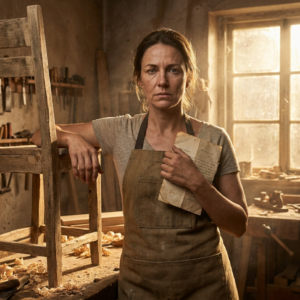
Those six words were the first crack in the ice. The next morning, Grace forced herself into the kitchen. The simple act of cracking eggs and toasting bread felt like climbing a summit. But when she saw Luke’s small, hesitant smile and felt Emily’s desperate hug, she realized that while the man who built their house was gone, the woman who kept its heart beating was still there. She walked into Caleb’s workshop for the first time since his death. It was a cathedral of dust and unfinished dreams. She touched the wooden chair he had been carving, a single tear falling onto the grain. She remembered his voice: “Grace, you must learn the business… you must know how to do things.”
Finding a hidden letter in his desk—a letter that told her she was stronger than she knew—Grace began to pick up the tools. She didn’t know how to be a carpenter, but she knew how to honor a promise. She called a client and told them she would finish their table. She made mistakes, her hands bled, and she cried over every misplaced nail, but she finished it.
CHAPTER 3: THE SCENT OF FLOWERS AND NEW THREADS
As winter finally bled into a hesitant spring, Grace found herself standing before a sign for a sewing class. It was a Thursday, 6:00 p.m. She went not because she wanted to sew, but because the silence of the workshop was starting to feel like a weight again. The class was held in a small building that smelled of fresh bread from the nearby bakery, mixed with the floral scent of soap and the vibrant energy of colorful thread.
It was there she met Mia, the teacher—a woman with silver hair and a voice like warm honey. Mia taught Grace that a needle, much like a heart, must move gently to avoid breaking the thread. As Grace sat among the six other women, listening to their stories and the rhythmic shush-shush of fabric, she felt a different kind of peace.
One evening, a man appeared in the doorway. He was tall, his shoulders broad, and his jacket bore the fine dust of a man who worked the earth. This was Corey, Mia’s nephew. He was twenty-nine, a landscaper who spent his days planting trees and coaxing life from the town’s parks. When Mia introduced them, Corey reached out a hand. His blue eyes were soft, reflecting a kindness that Grace hadn’t expected to encounter again. He was there to fix a broken shelf, a task so simple yet so symbolic. As Grace watched him work, her heart gave a small, traitorous flutter—a spark of electricity in a room she thought had been permanently disconnected.
CHAPTER 4: THE LANDSCAPER’S PATIENCE
Corey didn’t rush into Grace’s life; he grew into it like one of the saplings he tended. He fixed lights, he carried boxes, and eventually, he asked her for coffee. They sat by the window of a small shop, the air smelling of cinnamon and roasted beans, and Grace found herself talking about Caleb, about her children, and about the hollow space in her chest. Corey listened. He didn’t offer platitudes. He simply told her, “Love does not end. It changes shape. You don’t lose the past; you just find room for the future.”
He began to visit the house, not as a replacement, but as a companion. He brought Emily a small flower pot with her name painted on it, teaching her that even a tiny seed can find the strength to push through the dirt. He played ball with Luke, never forcing the boy to talk, but being there when he was ready to speak.
One Saturday in the park, as the children ran through the grass, Grace asked Corey if he ever felt guilty for smiling again. He looked at her with a profound understanding. They both knew loss; they both knew the weight of the “before.” That night, Grace looked at Caleb’s photo in the workshop. She realized that loving Corey didn’t mean she loved Caleb less. It meant that Caleb’s love had prepared her to be loved again.
CHAPTER 5: TWO DOORS, ONE HEART
The transition was a series of small, deliberate steps. Corey moved into the house a month after a quiet conversation with the children. He brought books, a guitar, and a forest of window plants. He didn’t try to sit in Caleb’s chair; he brought his own. The house felt fuller, the music of his guitar filling the gaps where the silence used to live.
Luke was the hardest to win over, but the boy’s wisdom surpassed his years. “Dad would want you to be happy,” Luke told his mother one evening. It was a benediction.
Two years passed. The children grew taller, the trees Corey planted matured, and the “new” life began to feel like the “only” life. One morning, over eggs and coffee in a kitchen bathed in golden light, Corey took Grace’s hand. He didn’t ask for a replacement for what she had; he asked to make their current family “real” in the eyes of the world. “I want to marry you,” he said. “Not today, not tomorrow, but whenever you are ready.”
Grace went to the lake where she and Caleb had spent so many hours. She read his old letter one more time, the paper soft as silk from her touch. She felt the wind in the trees and heard a soft, internal “yes.” Caleb had told her to look for the light again. She realized she had found it, but it didn’t look like the old light; it was a new, steady glow.
CHAPTER 6: THE GARDEN REBORN
The wedding was held in the same wooden church. It wasn’t an act of erasure, but an act of continuity. Emily wore blue, Luke wore a suit that made him look like a young man, and Grace wore a simple white dress. As she walked toward Corey, she felt Caleb’s memory not as a ghost, but as a gentle push forward.
Today, Grace’s heart is like a house with two doors. One door opens to the past, to the man who gave her her children and her strength. The other door opens to the future, to the man who helped her rebuild the shelves of her soul. She keeps both doors open. She still misses Caleb every day, but she loves Corey with a fierce, seasoned devotion.
As she stands in her kitchen now, watching Corey teach the children how to tend the vegetables in the garden, Grace knows the ultimate truth: Healing doesn’t mean the pain goes away. It means the love grows large enough to surround the pain until it becomes a part of the beauty.
SHARE YOUR LIGHT
Life is a collection of second chances and unexpected turns. Grace found her light in a sewing class and a landscaper’s kindness. Where have you found your light during your darkest seasons? Have you ever had to learn that the heart can hold two loves at once?
Tell us your story in the comments. We are a global community, and your words might be the thread someone else needs to start their own rebuilding.
Disclaimer : This content may be created by AI for entertainment purposes. Any resemblance to real persons, events, or places is coincidental.






