WHY THE WORLD’S KINDEST SOULS OFTEN STAND ALONE WHEN THE LIGHTS GO OUT
We have all felt it—the intoxicating warmth of being someone’s everything. It is a siren song that whispers to our hearts, telling us that our value is measured by the weight of the burdens we carry for others. We answer the phone at 3:00 AM because someone is lost; we open our doors to the broken and the weary, offering the very fabric of our souls to patch their wounds. In those moments, the exhaustion feels like a badge of honor. We tell ourselves it is love. We convince ourselves that staying is the ultimate form of strength.
But what if we have been living a beautiful lie? What if the “love” we feel is actually just someone else’s convenience? This is the story of Mara—a woman who spent her life becoming the glue that held a village together, only to realize that when she finally broke, there was no one left to pick up the pieces. It is a journey from the hollow pride of being “useful” to the profound, aching clarity of being truly seen.
The Woman Between Two Hills: A Life Built on Other People’s Needs
Mara lived in a small village nestled between two rolling hills. The road leading to her home curved sharply, a geographic metaphor for her own life: you could never see what was coming until it was already standing in front of you, demanding your attention. Mara was neither wealthy nor famous, yet her name was a whispered prayer on the lips of every villager.
If a neighbor’s roof groaned under the weight of a storm, Mara was there before the rain could touch the floor, carrying her husband’s heavy, rusted tools. She didn’t wait to be asked; she simply arrived. When a mother was overwhelmed by a sick child, Mara’s home became a sanctuary for the other siblings, the air filled with the scent of her cooking and the quiet hum of her reassurance.
The most poignant testament to her spirit was Old Thomas. After his wife passed, Thomas had retreated into a tomb of grief, sitting in his house on the hill for three weeks without eating. While the rest of the village looked away, uncomfortable with such raw sorrow, Mara came every morning. She didn’t offer platitudes or forced cheer. She simply brought bread and sat beside him in the heavy, dust-moted silence. She waited until the silence was no longer a cage, but a bridge, until he finally found the words to live again.
People said Mara had a “gift.” They said she was “born to help.” And Mara believed them. When she was neck-deep in someone else’s crisis, she felt a fleeting sense of peace—a flicker of purpose that masked the growing emptiness in her own chest. She was exactly where the world told her she was supposed to be.
The Quiet Chill of a Half-Empty Marriage
At home, Mara lived with Edric, a man of wood and stone. He was a craftsman by trade, possessing strong, calloused hands that could fix the most intricate carvings. But Edric’s spirit was tied to his work; when the commissions dried up and the pantry grew thin, he became a ghost in his own house.
During these dark seasons, Edric would sit by the fireplace for hours, his eyes fixed on the dancing flames, his thoughts miles away in a land of perceived failure. Mara, ever the caretaker, would move like a shadow around him. She would bring him tea, the steam rising in the cold room, and set it down softly. He would take it without a word, without a glance.
Mara told herself this was the sacred contract of marriage: you hold the lantern while the other person wanders through the dark, trusting that the light will eventually return. And it always did. When Edric found work, he would transform back into the man she loved—warm, full of small jokes, and grateful for her presence. But in her heart, a small, quiet voice began to wonder: why was she only “loved” when he was whole? Why was his affection a reward for her endurance?
The Heavy Weight of a One-Way Friendship
Then there was Cella, Mara’s closest friend since childhood. Cella was the storm to Mara’s calm, possessed of a sharp mind and a laugh that could be heard across the village square. But Cella’s visits followed a predictable, exhausting pattern.
Whenever Cella’s life became a tangled web of husband-troubles or financial shame, she would burst through Mara’s door. She didn’t come to ask about Mara’s garden or the health of her soul. She came to “pour.” She would spend hours unloading her anxieties, her regrets, and her demands for validation.
Mara was a master at receiving. She would nod, offer comfort, and hold Cella’s hands until the storm subsided. After every visit, Cella would walk out the door, her shoulders light and her eyes bright, while Mara would sit in the sudden, ringing silence, feeling heavier than the hills surrounding the village. She was proud to be the “strong one,” the “reliable one,” but she didn’t notice that her own strength was being traded away for someone else’s comfort.
The Motherless Boy and the Illusion of Legacy
Perhaps the most complex thread in Mara’s life was Doran, a 17-year-old boy with a restless spirit and an absent family. He was a whirlwind of energy with nowhere to go, often finding himself on the wrong side of village disputes. Mara saw a reflection of a need she could fill, and she took him under her wing.
She gave him work in her garden, lent him money that she knew would likely never be repaid, and listened to his grandiose dreams of leaving the hills behind. Doran called her “the closest thing to a mother I’ve ever known.”
Those words were like a drug to Mara. They filled her heart so completely that she failed to notice the physical toll of her devotion. She stopped sleeping well, her mind racing with other people’s problems. Most tragically, her own small garden—the one she had planted for herself, filled with the flowers and herbs that brought her joy—had gone dry. The soil was cracked, the leaves were yellowed, and the gate was hanging off its hinges. She was so busy watering everyone else’s fields that she had let her own sanctuary die.
The Autumn Shift: When the Giver Finally Breaks
Nature has a way of demanding balance. That autumn, the weight of years finally caught up to Mara. She fell ill. It wasn’t a life-threatening plague, but it was a deep, bone-weary exhaustion that forced her into bed for two weeks. For the first time in her life, the “useful woman” was useless.
She sent word to her neighbors, to Thomas, to Cella, and to Doran. She waited, imagining the same level of care she had so freely given would now return to her like a rising tide.
The reality was a cold, sharp blade. Edric took care of the house, but he did so with a visible, awkward resentment. By the fifth day, he began to complain about the “piling work” and the “burden” of the daily chores. He wasn’t overtly cruel, but his sighs spoke volumes: being the one who gives was her job. He was a customer who had suddenly been asked to run the store, and he didn’t like the view from behind the counter.
Cella came once, on the third day. She brought a small, dry cake and spent the entire visit talking about a new argument she’d had with her husband. She didn’t ask Mara if she needed water or if her fever had broken. Before leaving, she squeezed Mara’s hand and said, “You’ll be better soon. You always are.” It was a dismissal, not an encouragement. It was Cella’s way of saying, Hurry up and get back to being my emotional dumping ground.
And Doran? Doran did not come at all. The boy who called her “mother” found her illness too inconvenient to witness.
The Quiet Lake: A Realization Beyond Bitterness
Lying in her bed, staring at the cracks in the ceiling, Mara entered a state of profound stillness. It wasn’t the heat of anger or the cold of sadness; it was the clarity of a lake right before the surface freezes.
She thought about the neighbors, Old Thomas, and the countless hours she had spent in their service. She realized that Thomas had built a fence between their houses the moment he felt better. She realized that Cella only valued her as a mirror to reflect her own drama. She realized that she had been a “service,” not a person.
The truth ached: She had not been loved; she had been useful.
Being loved means being seen when you have nothing to offer. Being useful means being valued only for what you can do. Mara understood that if you fill every empty space in people’s lives, you rob them of the necessity to grow, and you rob yourself of the right to exist. She had grown smaller, a tiny, fading spark, while everyone around her warmed themselves by her fire until it nearly went out.
The Rebirth of the Garden: Setting the Terms of the Soul
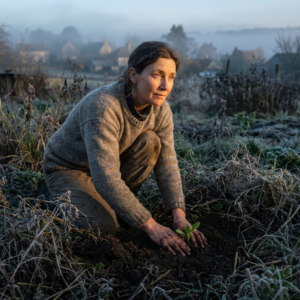
On the fourteenth day, Mara didn’t just get out of bed; she stepped into a new life. She walked to her neglected garden. With her own hands, she pulled out the dry weeds and turned the soil. She planted new seeds—not for the neighbors, not for Thomas, but for herself.
She decided that morning that she would still help, but she would help from a position of “choice,” not “obligation.” She would give from a full cup, not from the dregs of her own exhaustion.
When Cella arrived later that week, ready to unleash another storm of complaints, Mara did something revolutionary. She poured two cups of tea, sat down, and spoke first. She didn’t wait to be the receiver; she became the participant. She told Cella about her illness, about her loneliness, and about her new boundaries. Cella was shocked, then uncomfortable, but for the first time in decades, something real passed between them. It was the birth of a friendship, rather than an extraction.
She stopped filling Edric’s silences. She let him sit with his own thoughts until he was forced to reach out. Slowly, awkwardly, he began to ask her real questions: How are you? What do you want for supper? He had to learn to see her as a woman, not an appliance.
When Doran returned months later, full of excuses, Mara didn’t offer a mother’s easy forgiveness. She told him, “I noticed you weren’t there. People who care about someone show up. You are old enough to know that now.” In doing so, she gave him a standard to live up to—a gift far greater than any loan she had ever provided.
Deep Reflection: The Lesson of the Open Door
Mara’s story is a mirror for every “giver” in the world. It teaches us that kindness without boundaries is eventually suicide. You are not a service. You are a person.
When you have nothing left to give, the people who stay are your tribe. The ones who leave were never loving you—they were just consuming you. Real love is not a hunger that asks what you have; it is a presence that asks who you are.
Mara’s garden grew back stronger because the soil was finally hers again. She opened her door with love, not fear. She helped because she chose to, not because she was afraid of the silence that would follow a “no.”
A Warm Invitation to Our Global Community:
Have you ever felt like Mara? Have you ever realized that you were being “used” under the guise of being “needed”? How did you find the courage to tend to your own garden again?
Please, share your stories in the comments below. Let us support one another in the journey toward real love—the kind that sees you even when your hands are empty.
Disclaimer : This content may be created by AI for entertainment purposes. Any resemblance to real persons, events, or places is coincidental.






