40 Miles of Terror in the Back of a Racing Cargo Van
The morning of February 9, 2024, began with the cold, sterile light of a Studio 6 motel room in Fort Worth, Texas. For 29-year-old Eric Santiago, it was supposed to be the start of a standard workday. Instead, it became the moment his world fractured. What started as a domestic argument over the simple act of Eric leaving for his job spiraled into a violent, claustrophobic nightmare that would stretch across four Texas cities and forty miles of high-speed interstate.
Imagine the transition: one moment you are standing on solid ground, and the next, you are trapped in a vibrating, metal box—an enclosed 2017 cargo van—speeding down the highway at lethal velocities. There are no seats in the back, no seatbelts to hold you, and most terrifyingly, no way to see where you are going. This was the reality for Eric Santiago as his boyfriend, Tekim Allah Pendan, allegedly took the wheel in a blind rage, turning a vehicle meant for labor into a rolling prison.
The Motel Room Fracture: When Words Turn to Blows
The air inside room 310 at the Studio 6 was thick with tension long before the first punch was thrown. According to Eric’s frantic initial call to 911, the disagreement was sharp and sudden. The “silent moments” of the morning were shattered by the sound of a splintering door. Eric’s voice, recorded by dispatch, carries the jagged edge of someone who has just realized the person they love has become a stranger.
“He’s acting crazy and he’s about to beat me up,” Eric told the operator, his breathing heavy and uneven. The fight spilled out of the room and into the parking lot—a public space that offered no safety. In a desperate bid to protect his property and perhaps find a place to hide, Eric jumped into the rear compartment of his van. But Tekim was faster. He leaped into the driver’s seat, slammed the door, and floored the accelerator. The tires screeched against the asphalt, and Eric was thrown against the metal walls of the cargo hold as the van lurched toward the interstate.
40 Miles of Blind Panic: Navigation by Sound
Inside the back of a cargo van, the world is reduced to sounds and vibrations. Eric was plunged into a terrifying sensory vacuum. He couldn’t see the road, the traffic, or the police cars he hoped were following. He had to navigate his own kidnapping by leaning his ear against the vibrating metal walls and peering through tiny gaps to catch glimpses of green highway signs.
“I’m in a moving van that my friend stole and I’m in the back and he’s driving crazy!” Eric shouted into his phone. The dispatcher, acting as a steady anchor in the storm, began a grueling game of “Where are you?”
-
“We’re going down Lancaster right now.”
-
“We’re passing the YMCA.”
-
“We’re passing Jon Street.”
Every time Tekim slammed on the brakes or swerved into the express lanes of I-35, Eric was tossed like a ragdoll. At one point, his elbow slammed into the van wall so hard he began to bleed. The physical pain was secondary to the mental toll—the realization that he was at the mercy of someone who was “driving crazy,” weaving in and out of 18-wheelers, with no intention of stopping.
The Shirt in the Window: A Desperate Signal for Help
As the van kined down I-30 and onto I-35, the situation grew even more dire: Eric’s phone battery was dying. With his lifeline to the police fading, he turned to the only other group of people who could save him—the drivers sharing the road with his captor.
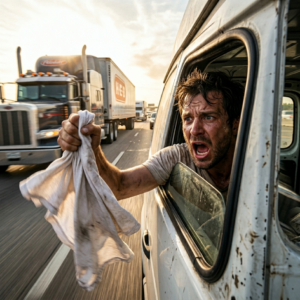
In a micro-moment of sheer survival instinct, Eric took off his shirt. He began waving it frantically out of the small back window, banging on the glass with his free hand. To some passing drivers, it looked like a friendly greeting—a man in a van just saying hello. They waved back, smiling, unaware that the man behind the glass was screaming for his life. But eventually, the “Global English” of distress became clear. The swerving, the banging, and the half-naked man in the window began to look less like a game and more like a tragedy in motion.
The Community Responds: The Highway Watch
The 911 switchboards began to light up with calls from concerned citizens. These weren’t just reports of “reckless driving”; they were witnesses to a kidnapping. “There’s a white van swerving in and out of traffic and there’s a guy in the back window banging… like there’s something wrong,” one caller reported.
Another witness watched in horror as the back door of the van—the only thing keeping Eric inside—flew open while they were racing down the bridge connecting to 287. Eric was seen perched on the very edge of the open door, looking out at the rushing pavement below, weighing a leap into traffic against the danger inside the van. These witnesses provided the “Real-Time Crime Center” with the eyes they needed. They corrected the description of the van, tracked its movements through Arlington and Grand Prairie, and followed it all the way into the heart of Dallas.
The Climax in Southern Dallas: Fighting for the Wheel
The ride finally reached its breaking point in Southern Dallas. As Tekim veered off an exit ramp, the sudden change in momentum gave Eric his window of opportunity. He didn’t wait for the van to stop. He rushed through the internal cargo door—the thin barrier separating the victim from the driver—and launched himself at Tekim.
It was a struggle for the soul of the vehicle. Eric fought back with the strength of a man who refused to be a victim. He struck Tekim hard enough to disrupt his grip on the steering wheel. The van, now truly out of control, veered off the road and crashed to a violent stop. Within minutes, a Texas Department of Public Safety helicopter was hovering overhead, and Dallas police officers were swarming the wreck. Tekim was pulled from the driver’s seat and taken into custody, facing charges of aggravated kidnapping with bodily injury.
The Aftermath: The Invisible Scars of a Survivor
Paramedics evaluated Eric at the scene. He was alive, but the “Master Narrative” of his life had been permanently altered. “I’m still shaking up,” he admitted days later. “It started off in an argument… to then not knowing if I’m going to get out of the hotel room alive.”
Even as the physical bruises healed, the emotional shock remained. Eric shared his story not for fame, but as a “Global English” warning to others. He speaks of the “eye-opener”—the importance of trusting your instincts when a relationship shifts from love to control. His experience serves as a testament to the power of a community that doesn’t just “wave back” but stops to ask what is wrong, and the incredible resilience of a man who fought his way out of the darkness of his own cargo van.
How would you react if you saw a frantic signal from a passing vehicle? Have you ever had to trust your instincts to escape a dangerous situation? Share your stories of resilience and community vigilance below. Let’s look out for one another.
Disclaimer : This content may be created by AI for entertainment purposes. Any resemblance to real persons, events, or places is coincidental.






