A Journey from Abandonment to a Life Reclaimed
My name is Immani, and I need you to understand what it feels like to be six years old and watch the only two people who are supposed to be your whole world walk out of a door and not look back.
There is a myth about abandonment—that it is always loud, violent, or cinematic. But the truly devastating kind is silent. It is a quiet Tuesday morning. It is the sound of a suitcase zipper. It is the mundane clink of a spoon against a cereal bowl. My mother, Diane, packed a bag while I sat in my yellow pajamas. My father, Curtis, stood by the door with a specific, haunting stillness. They told me they were going “somewhere” and that a “someone” was coming to stay with me. They said it with the practiced calm adults use when they are terrified a child might ask a question they cannot answer.
I believed them. I sat at that kitchen table, watching the milk turn the cereal into a soft, grey mush, and I waited. I waited for hours as the sunlight shifted across the linoleum floor. The “someone” never arrived. My parents never returned. The apartment wasn’t even ours; it was a transient shell, a two-bedroom unit in a building that smelled of old carpet and other people’s dinners—a place they had rented specifically to leave me in, like an object they could no longer afford to keep.
The Day the World Went Quiet: The Day and a Half of Waiting
For thirty-six hours, I existed in a vacuum of silence. A six-year-old’s mind is not equipped to process a permanent exit; I simply thought the “somewhere” they went was further away than promised. It was Mrs. Nora, a Nigerian-American woman from next door, who finally broke the silence. She had heard my muffled crying through the thin apartment walls.
When she found me, she didn’t call the police immediately. She brought me to her own kitchen. I remember the smell of her home—rich, spicy, and welcoming. She fed me rice and stew, and while she made the phone calls that would change my life forever, she held my hand. In the thirty-one years that have passed, that hand remains a foundational pillar of my psyche. It wasn’t the act of my parents leaving that defined me; it was the hand that stayed.
The foster care system eventually arrived in the form of a social worker and a clipboard. I want to be fair to the system, because “fair” is the only emotional register I can maintain without it costing me my peace. Some of it was helpful; much of it was negligent in the way overpopulated institutions often are. Between the ages of six and eleven, I was processed through three different homes.
I lived with the Reeds, an older couple who were kind but exhausted, running on the fumes of fifteen years of fostering. I lived in a high-volume home where I learned to be invisible—a survival strategy to avoid the friction of five other children. And then, there was the third home, run by a man who used guardianship as a weapon of intimidation. I reported him. My caseworker, Miss Pharaoh, moved me within two weeks. I am still grateful for those fourteen days of courage.
Auntie Gloria: The Architect of a Soft Landing
At eleven years old, I arrived at the doorstep of Gloria. She was fifty-one, a retired school librarian with silver-shot natural locks and reading glasses that hung from a beaded chain. She had fostered eleven children and adopted two. When I walked in, guarded and invisible by habit, she looked at me with a directness that bypassed my defenses.
“You don’t have to be small here,” she said.
It took me three months to believe her. Auntie Gloria was the pattern-interrupter. She didn’t use grand gestures; she used the unglamorous, daily consistency of showing up. She attended every parent-teacher conference. She noticed I read voraciously and made the library our Saturday ritual. She saw my mathematical mind and found programs to feed it. She turned the dinner table from a place of interrogation into a place of genuine conversation.
When she formally adopted me at thirteen, I wore a deep blue dress. Sitting in that courtroom, hearing the judge say my new last name, I felt the specific relief of permanence. I belonged to someone who wanted me. That sense of belonging propelled me through college and into a career as a Licensed Clinical Social worker. I became the hand that stays. Auntie Gloria passed away three years before the ghosts of my past reappeared, but her influence was the armor I wore when the phone finally rang.
The Ghost on the Other End of the Line
I was thirty-seven years old, a woman of substance and carefully curated peace. I had a private practice, published papers on childhood trauma, and a home filled with books and warm light. I was dating Jerome, a man whose patience was a balm to my provisional trust. Then, on a Wednesday evening, an unfamiliar number flashed on my screen.
“Immani, this is your mother.”
I sat down on my kitchen floor—not out of weakness, but because my body recognized the magnitude of the moment and chose to be at ground level. Her voice was older, weathered by thirty-one years I hadn’t witnessed. She told me she and my father were sick. She said they “hoped” to see me.
The professional in me noted her genuine distress, but the six-year-old in me noted the audacity. They wanted absolution because they were facing the end. I ended the call and summoned my best friend, Tamson, who arrived with wine and the willingness to sit on the kitchen floor with me. With the help of my mentor, Dr. Raymond, I set the terms: one meeting, in my office, on my turf.
The Reckoning: A Saturday Morning in the Office
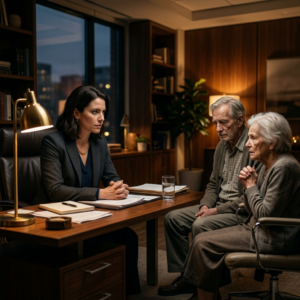
They arrived at 10:00 AM on a Saturday. I watched them from my window—two elderly people negotiating with their aging bodies. Diane was sixty-three; Curtis was sixty-five. In my office, they sat in the “client” chairs. Diane had a script; she talked about youth, addiction, and the delusion that I would be better off without them.
I asked one question: “In thirty-one years, did you ever try to find me?”
Diane admitted they found out I was adopted when I was fourteen, but they told themselves a story that I was “settled” to avoid the discomfort of their own guilt. It was Curtis, however, who struck the chord of honesty. He didn’t perform. He looked at his hat and admitted they were selfish.
I told them about Gloria. I told them I became someone not because of them, but in spite of them. I told them that Gloria was the reason I could sit in that chair and help other children process the wreckage left by parents like them. I did not offer forgiveness that day. Forgiveness is not a debt; it is a process.
The Garden of the Present: Finding Finality
Diane passed away eight months after that meeting. I went to her funeral—not for her, but for me. I refused to let her death be another event in my life that I wasn’t present for. Standing at that graveside, I felt a messy, beautiful collision of grief, relief, and loss. I let it all be true.
Before Mrs. Nora passed, I visited her. At eighty-three, she still remembered the little girl in yellow pajamas. I told her what her hand had meant to me at that kitchen table. We both cried, and in that moment, a circle that had been broken for three decades finally closed.
Healing doesn’t look like a scar-free life. It looks like the life I have now: a garden I tend on Sunday mornings, a home filled with my own choices, and the knowledge that the story didn’t end at the kitchen table in 1995. The story continued, and I am the one who got to write the ending.
If you have ever had to rebuild yourself from the silence of someone else’s exit, how did you find your “hand that stays”? Share your journey in the comments below.
Disclaimer : This content may be created by AI for entertainment purposes. Any resemblance to real persons, events, or places is coincidental.






