When the Mind Becomes Its Own Haunting
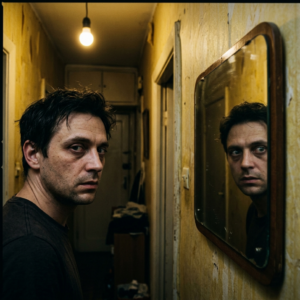
The world usually grows quiet at 11:11 p.m., but for Ryan, that was the moment the silence began to scream. We often think of ghosts as external entities—shrouded figures in the mist or cold breezes in a locked room—but the most terrifying hauntings are those that originate from the attic of our own consciousness. This is the chronicle of a man whose life was a repetitive loop of safety and solitude, until his own mind decided it could no longer carry the weight of a forgotten truth.
It is a journey through the fractured corridors of memory, a descent into the psychological abyss where the line between self and shadow dissolves. It is a story for anyone who has ever looked in a mirror and felt, if only for a fleeting second, like a stranger was looking back.
The Monotony of a Shadow Life
Ryan was a man who lived on the periphery of existence. At thirty-one, he had cultivated a life designed to minimize friction. As a night security guard, his world was composed of fluorescent-lit hallways, the hum of vending machines, and the comforting predictability of empty desks. He preferred the night because it asked nothing of him. There were no social cues to misinterpret, no complex emotions to navigate. His mantra was a simple one: less noise, less people, less problems.
His home was an extension of this philosophy. A third-floor apartment in an aging building that smelled of old wood and forgotten afternoons. It was a space of functional minimalism—one bedroom, one bathroom, and a small kitchen. In the hallway stood a mirror, a mundane object of glass and silver backing that served only to tell him if his uniform was straight. Ryan believed his life was simple because he had scrubbed it clean of any depth. He went to work, he came home, he slept, and he repeated the cycle. He was a man in stasis, unaware that the stillness was not peace, but a dam holding back a flood of repressed history.
The First Crack in the Facade
The first tremor occurred on a night like any other. Ryan had returned from his shift, his muscles aching with the specific fatigue of the graveyard watch. The air in the apartment was still. He glanced at his phone—the glowing digits read 11:11 p.m. It was a symmetrical moment, a quirk of the clock. Then, the air seemed to vibrate.
“You’re not safe,” a voice whispered.
It was soft, calm, and terrifyingly intimate. It didn’t have the muffled quality of a neighbor through a wall or the distant tone of a television left on. It sounded as if the words were being formed an inch from his ear, yet the room was vacant. Ryan froze, his breath hitching in his chest. He checked the locks; they were secure. He peered into the shadows of the closet; they were empty. He attributed it to the exhaustion of his profession—hallucinations are the tax the mind pays for lack of sleep. He laughed it off, a hollow sound in the quiet room, and went to bed.
But the universe, or perhaps Ryan’s own subconscious, had a schedule. The next night, at the exact same moment, the digits on his phone aligned once more. 11:11 p.m. This time, he was fully awake, the blue light of his phone screen illuminating his face. The voice returned with a sharper edge of mystery: “She knows the truth.” The fear that had been a spark the night before now caught fire. Ryan scoured his apartment, opening the front door to stare into the dimly lit, empty hallway of the building. There was no one. The isolation he had once craved was now a vacuum that amplified his growing dread.
The Surveillance of the Soul
As the nights progressed, the messages grew more accusatory. “You did this. Don’t pretend. Remember.” Each word felt like a physical weight being added to Ryan’s chest. He stopped sleeping. He became a man possessed by his own environment, checking the bathroom, the space under his bed, and the corners of his kitchen three or four times an hour. The hunter was within, but Ryan was looking for a ghost outside.
In an act of desperate rationality, Ryan installed a camera in his hallway. He needed the cold, hard logic of technology to prove he was losing his mind or being pranked. The next day, he sat with a racing heart to watch the footage. The clock on the screen ticked to 11:11 p.m. He saw himself—a tired, pale man standing in the hallway, looking around with wild eyes. There was no intruder. There was no shadow moving in the background. But through the speakers of his computer, the audio was unmistakable. The voice, his own tone but stripped of all hesitation, said: “You can’t hide forever.”
The realization was a chilling wave of cold. If there was no person and the camera caught the sound, the voice was a broadcast from a part of himself he didn’t know existed. The mirror in the hallway began to feel like an eye, watching him with his own gaze.
I Am You: The Mirror’s Revelation
Ryan decided to confront the source. At 11:10 p.m., he stood before the mirror in the hallway. He watched his reflection—the dark circles under his eyes, the pallor of his skin, the slight tremble in his hands. He waited for the threshold. When 11:11 p.m. arrived, the voice didn’t whisper; it spoke his name with the clarity of a bell.
“Ryan.”
“Who are you?” Ryan whispered back, his voice cracking like dry parchment.
The answer was the most terrifying thing he had ever heard: “I am you.”
The world seemed to tilt. Ryan stared at his reflection, searching for a twitch, a change in expression, anything to suggest that the man in the glass was a monster. But the image was perfect. The voice told him he already knew the truth, but the more he searched his mind, the more he found only blank walls. He fled into the lights of his apartment, turning on every lamp until the shadows were burned away, yet the darkness remained inside his head.
The next day at work, his coworker Mark noticed the decline. Ryan looked like a man who was being eaten from the inside out. He was advised to take time off, but Ryan knew that time off meant more time in the apartment. More time with the mirror. More time with the voice that sounded more like him than he did.
The Breaking of the Mental Dam
The “haunting” soon escalated beyond the 11:11 p.m. window. The voice began to bleed into his music, into his quiet moments, into his walks. It demanded he stop running. It asked the one question he couldn’t answer: “Why can’t you remember?”
Standing before the mirror again, Ryan witnessed the laws of physics begin to bend under the pressure of his trauma. His reflection moved, but with a microscopic delay. It was a second late, a subtle lag that made his stomach turn with nausea. Then, the first image flashed—a jagged, sensory explosion. A dark street. The smell of asphalt and rain. Someone shouting.
He clutched his head, begging it to stop, but the voice was relentless. “Look closer.” Images of a hand pushing, the sickening sound of glass shattering, and a sudden, violent impact began to fill the gaps in his memory. Ryan fell to his knees, his mind feeling like a mirror being struck by a hammer. These weren’t just thoughts; they were fragments of a reality he had painstakingly dismantled and buried in the basement of his psyche to survive.
The Corner of Forgotten Sins
Driven by a compulsion he couldn’t name, Ryan wandered into the city. He walked until the air felt heavy, until the streetlights began to flicker with a rhythmic familiarity. He stopped at a corner. He saw a broken street light and a specific crack in a brick wall. The geography of his guilt was laid bare.
“I’ve been here,” he whispered.
“Yes,” the voice confirmed, sounding almost mournful now.
The memory finally surged forward, no longer a fragment but a full, cinematic horror. Months ago, on a rainy night, Ryan had been here. He wasn’t the quiet, solitary security guard. He was a man consumed by a broken, angry passion. He saw a woman—someone he knew, someone he had once been close to. She was trying to leave. She was pleading for space. Ryan saw himself blocking her way, his voice a roar in the rain. He saw the moment of loss of control. The push. The fall. The silence that followed the storm.
He saw the emergency lights, the sirens that he had somehow convinced himself were part of a dream, and his own hands shaking in the rain. He had broken his own mind to escape the weight of what he had done. He had created a “simple life” as a penance he didn’t even remember paying.
The Final Integration
Ryan returned to his apartment, the heaviness in his limbs now a permanent part of his biology. He stood before the hallway mirror one last time. He didn’t see a ghost or a monster. He saw a man who had committed an act of violence and then committed an act of mental cowardice.
“I protected you from breaking completely,” the voice explained. It wasn’t a malicious entity; it was his own conscience, the “guardian” of his sanity that had finally decided the only way to heal was to face the wound.
“So what now?” Ryan asked the silence.
“Now you live with it.”
The mirror went still. The voice vanished. The 11:11 p.m. “hauntings” ceased because the truth was no longer a secret kept from himself. Ryan didn’t find a magical solution; he found reality. He went to therapy, began the grueling process of legal and moral accountability, and started the slow walk toward becoming a whole person again. He realized that the mind can protect us, but it cannot fix us. Only the truth can do that.
THE HUMAN LESSON: Our minds are capable of incredible feats of architecture, building walls to shield us from trauma we aren’t ready to face. But those walls eventually become a prison. Ryan’s journey teaches us that peace cannot be found in denial. We must eventually face our mirrors, acknowledge our shadows, and accept that our pasts—no matter how dark—are part of who we are. Only then can we stop running.
CALL TO ACTION: Do you believe that we can ever truly outrun our past? Have you ever had a “wake-up call” from your own conscience? We invite you to share your experiences and thoughts in the comments below. Let’s discuss the power of the mind and the path to redemption.
Disclaimer : This content may be created by AI for entertainment purposes. Any resemblance to real persons, events, or places is coincidental.






