How a Near-Death Impact Shattered a Lifetime of “Not Yet”
The world is filled with people who are expertly preparing to live, yet never actually beginning. We spend our youth trading our hours for coins, our energy for security, and our dreams for a balanced ledger. We tell ourselves that once the number in the bank account reaches a certain threshold, the “real” life will start. We build fortresses of savings, only to realize too late that we have accidentally built a prison. For decades, I was the warden of my own gilded cage. I lived a life of rigorous, disciplined absence—denying myself the taste of the world in exchange for the safety of a future that felt like it was always just one more paycheck away.
My name is not important, but my awakening is. I spent sixty years as a shadow, a man who saved every cent, bypassed every restaurant, and wore clothes until they were thin as parchment. I was the person everyone pointed to as “careful,” while I looked at those traveling or eating fine meals as “foolish.” But when the universe decided to intervene with the screech of tires and the shatter of glass, I realized that the future I was saving for was a ghost. This is the story of how a terrifying accident on a rain-slicked road taught me that life does not wait for you to be ready—it only waits for you to join it.
THE PRISON OF THE CAREFUL MAN
For as long as I can recall, my existence was a mathematical equation. I worked every hour available, and every coin I earned was immediately sequestered into a savings account that I guarded like a holy relic. To me, money wasn’t a tool for joy; it was a shield against a “what if” that never seemed to arrive. I lived in a house that was too small, drove a car that groaned with age, and refused to buy a new shirt even when the collar frayed. My peers would invite me to dinner, to the theater, or on trips to the coast. My answer was always a variation of the same lie: “Not yet. Maybe next year.”
I watched the world through a window. I saw people laughing over wine, children running through parks in cities they had traveled hundreds of miles to see, and couples dancing in the rain. I told myself I was the smart one. They were wasting their future; I was securing mine. But the “one day” I was waiting for—the day I would finally rest, finally eat well, finally see the ocean—was a horizon that moved further away every time I took a step toward it. My bank account grew, but my soul remained in a state of deep, malnourished hibernation. I was rich on paper and a pauper in experience.
THE RAIN, THE LIGHTS, AND THE SHATTERED GLASS
Everything changed on a Tuesday evening that smelled of wet asphalt and old ozone. The rain was coming down in heavy, silver sheets, blurring the world outside my windshield. I was driving home from work, my hands gripping the wheel at ten and two, being “careful,” as I always was. I was thinking about the interest rates on my savings, not the road. Suddenly, the darkness was pierced by two blinding orbs of white light. There was no time to scream, only a split second to feel the surge of adrenaline before the world folded in on itself.
The sound was the worst part—a violent, metallic crunch that echoed in my teeth. My car spun like a toy. My head struck the side window, and for a moment, the pain was white-hot and all-consuming before it faded into a heavy, suffocating blackness. In those final seconds of consciousness, I didn’t think about my savings account. I didn’t think about my “careful” choices. I felt a sudden, crushing regret: I haven’t done anything yet.
AWAKENING IN THE CLINICAL WHITE
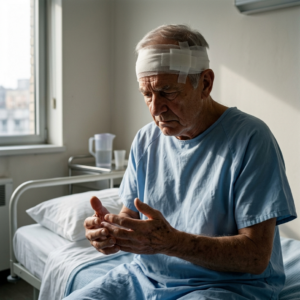
I woke up to a world that was too bright and smelled of bleach and antiseptic. The hospital room was a stark, clinical white that hurt my eyes. Every inch of my body felt like it had been crushed by a giant hand. My chest was tight, my legs were heavy weights, and my arms were mapped with bruises. A doctor stood at the foot of my bed, his face a blur of professional concern. “You are lucky,” he said. “The accident was horrific, but you will survive.”
I looked down at my hands. They were pale and trembling. I was alive, but for the first time in sixty years, I was truly afraid. Not afraid of the pain, but of the void. What if I had died on that road? What would have happened to the money I had hoarded? It would have sat in a computer at a bank, a collection of digital zeros that meant nothing to a dead man. I realized that while I was busy preparing for “anything,” I had missed “everything.” I had worked, saved, and slept in a repetitive cycle that lacked color, adventure, or meaning. I was a man who had been given a second chance, and the realization hit me harder than the car: I had been wasting my life by trying to protect it.
THE SILENT EPIPHANY AT THE CEILING
The nights in a hospital are long and loud with the sounds of heavy machinery and distant footsteps. As I lay there, staring at the perforated tiles of the ceiling, I conducted an audit of my existence. I had spent decades accumulating wealth, but my memories were bankrupt. I had never seen the ocean. I had never stood at the foot of a great mountain. I had never tasted a meal that I didn’t first scrutinize for its price.
When a nurse came in to check my vitals, she smiled a sad, knowing smile. “Many people don’t walk away from hits like that,” she whispered. Her words were a final verdict. I was lucky to be in pain, because pain meant I was still here. The doctor told me I needed to “rest,” a word that felt foreign to me. I had never rested; I had only paused to prepare for more work. But in that forced stillness, I made a silent vow. I would not return to the man who lived in the “Not Yet.” If I left this white room, I would leave the prison of my own making.
THE FIRST BITE OF A NEW WORLD
My recovery began with small, micro-moments. A few days later, the nurse brought a simple tray: a bowl of steaming soup, a piece of crusty bread, and a cup of tea. In my old life, I would have eaten it quickly and thought about the cost of my hospital stay. But now, I took the spoon and tasted the broth. It was warm, savory, and rich. I noticed the texture of the bread, the steam rising from the tea. I had never truly “tasted” food before because my mind was always in the future.
When the doctor finally gave me the news that I could go home, I felt a strange sense of hesitation. Home was the small house and the old car that represented my old identity. I didn’t want to go back to being the man who counted pennies while his life slipped through his fingers. I sat by the hospital window that evening and watched the sunset. The sky was a bruised palette of red and gold, a masterpiece I had ignored for sixty years because I was too busy working through the sunset hours. I watched the colors fade into twilight and, for the first time in my life, I smiled without checking the time.
THE FINAL DEPARTURE FROM THE SAFE ZONE
Leaving the hospital felt like being born again. The air outside was cool and fresh, filling my lungs with a vitality I hadn’t felt since childhood. I hailed a taxi, and when the driver asked, “Home?” I paused. The word felt like an anchor I wasn’t ready to drop. “Actually,” I said, “just take me to the city center.”
I went back to my small, quiet house, but it no longer felt like a sanctuary—it felt like a storage unit for a life I was finished with. I opened my laptop, not to check my bank balance, but to look at maps. I saw images of blue water, white sand, and ancient streets. My hands shook as I clicked “Book Ticket.” I had never bought a plane ticket in my life. I had never crossed a border. I was terrified, my heart drumming a frantic rhythm against my ribs, but beneath the fear was a soaring sense of joy. I was finally spending my life instead of just hoarding it.
THE SMELL OF THE SALT AIR
The airport was a chaotic symphony of rolling luggage and frantic announcements. I felt out of place with my one simple bag and my old clothes, but as the plane took off, my stomach dropped in a way that had nothing to do with the accident. I looked out the window as the clouds became a floor of white wool beneath me. I was high above the ground I had spent sixty years clinging to.
When I landed in a small town by the sea, the transition was complete. The air was warm and heavy with the scent of salt and blooming jasmine. The streets were a vibrant tangle of music and voices. I checked into a hotel with a view of the ocean—a “waste of money” in my old life, but a necessity in my new one. I walked down to the beach, feeling the sand, soft and cool, between my toes. I took off my shoes and let the waves wash over my feet. The water was cold, a shocking, beautiful reminder of the physical world. I laughed aloud, the sound lost in the roar of the surf.
COLLECTING MOMENTS, NOT DIGITAL ZEROS
I spent hours that night just watching the stars. I had never looked at them before—really looked at them. I sat on the sand, listening to the rhythmic breathing of the ocean, and realized that the “perfect time” I had been waiting for was a lie. There is no perfect time; there is only “now.” I had spent sixty years protecting a future that could have ended in a second on a rainy road.
Now, my journey is just beginning. I am no longer working to save; I am working to live. I want to meet strangers, eat food I can’t pronounce, and see every sunset until my eyes fail me. I have realized that the most dangerous thing you can do is play it safe. Money is just paper, and time is the only currency that actually matters. Don’t wait for a car accident to wake you up. Start living today, because the “Not Yet” is a ghost that will haunt you until you have nothing left.
Have you been waiting for “the right time” to start your dream? What is one thing you’ve been putting off that you will do today? Let’s talk about living in the comments.
Disclaimer : This content may be created by AI for entertainment purposes. Any resemblance to real persons, events, or places is coincidental.






