Chapter One: The Garage
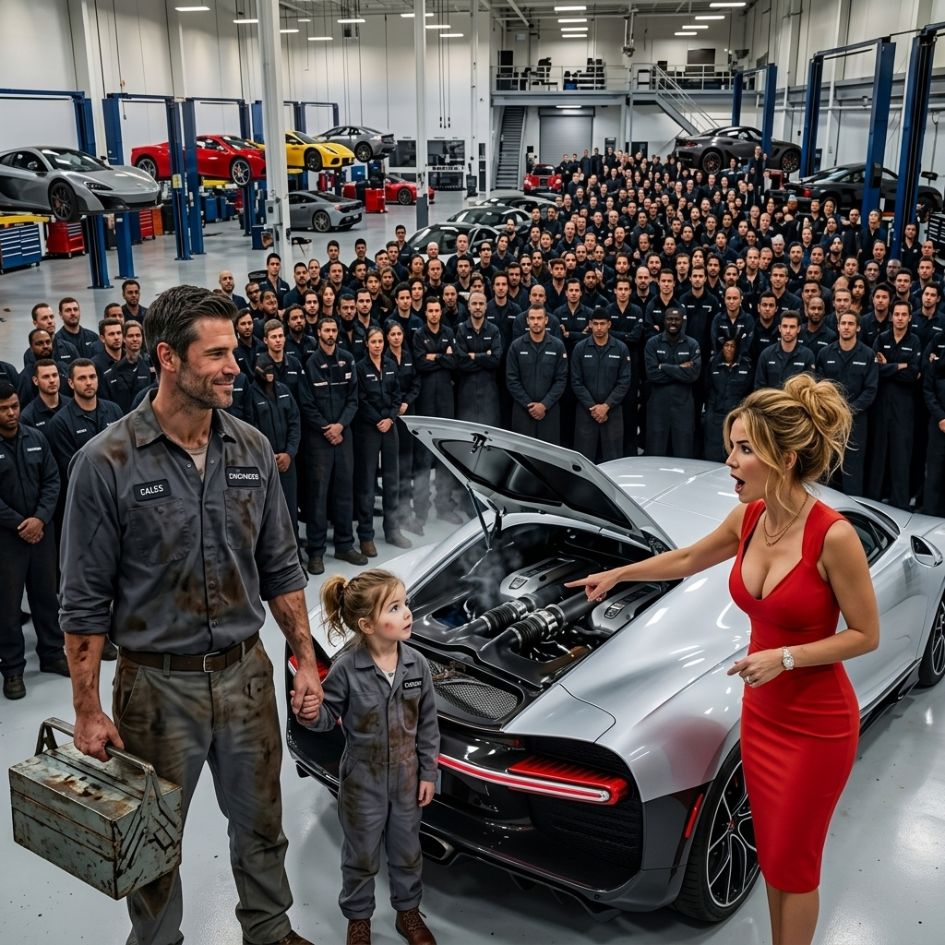
The sign above the door had been faded for four years.
Carter & Son Auto Repair. Established 2003.
Liam Carter arrived at 6:43 AM. Seventeen minutes early. Sleep had stopped cooperating at 4 AM, so he’d stopped fighting it.
The fluorescent tubes flickered twice before catching.
He stood in the doorway like he always did. Let the smell settle into him. Motor oil. Cold concrete. The faint ghost of WD-40 from yesterday’s lift mechanism.
He was thirty-two. Five-foot-eleven. Hands that told their own story.
Knuckles split and healed so many times they’d developed a permanent roughness. Fingernails that never quite came clean. A three-inch scar on his left forearm from a jagged exhaust pipe that slipped when he was twenty-six.
He didn’t think about it much anymore. It was just part of the map.
The coffee machine had one cracked button. Required a specific sequence to operate.
Liam knew that sequence like muscle memory. No thought required.
He poured a cup. Stood at the doorway between the office and the garage floor. Drank it looking at the Henderson truck.
1997 Ford F-250. Coolant leak. The owner had described it as “she runs hot sometimes.”
He’d driven it around the block yesterday evening.
“Sometimes” meant “constantly and aggressively.”
The thermostat housing had a hairline crack. Almost invisible until the engine warmed up. Then the coolant found its way out.
Easy enough fix.
But Henderson had also mentioned—almost as an afterthought—that it sometimes hesitated on cold starts.
Liam had filed that away. Even though Henderson hadn’t asked about it.
His father had taught him: the things people mention as afterthoughts are sometimes the things that matter most.
The phone buzzed on the workbench.
Unfamiliar number. Area code he didn’t recognize.
He let it buzz twice. Then picked up.
“Carter’s Auto.”
A pause. Then a woman’s voice. Crisp. Precise. Carrying the particular tone of someone accustomed to being listened to the moment she spoke.
“Is this Liam Carter?”
“Depends on who’s asking.”
Another pause. Slightly longer. Like she was deciding whether to be annoyed or amused.
“My name is Diana Reeves. I’m calling on behalf of Victoria Sterling.”
Liam set his coffee down.
“I know who Victoria Sterling is.”
Everybody in the automotive world knew who Victoria Sterling was. You’d have to be living under a particularly large rock not to.
“What does she want?”
“Ms. Sterling is experiencing a mechanical situation with one of her vehicles. A significant one. She’s been referred to you.”
“Referred by who?”
“A mutual contact. Marcus Webb.”
Liam exhaled slowly.
Marcus Webb. That made sense. Marcus ran a specialty restoration outfit two counties over. Had worked alongside Liam’s father for almost a decade before Frank got sick.
Marcus was one of maybe six people on Earth who understood what Frank Carter had actually known. What he’d actually been capable of.
Apparently, Marcus had decided to put Liam’s name into a conversation he knew nothing about.
He’d have words with Marcus later.
“What’s the vehicle?”
“A Bugatti Chiron Super Sport.”
Liam picked up his coffee again. Took a sip.
“How many people has she had look at it?”
Diana’s hesitation was barely perceptible.
“Two hundred and seventeen specialists. Including three engineers from Bugatti’s factory team in Molsheim.”
“None of them fixed it.”
“That is correct.”
He leaned against the workbench.
A Bugatti Chiron Super Sport. One of approximately sixty in existence. 8.0L quad-turbocharged W16. Nearly 1,600 horsepower. Worth somewhere between four and six million dollars.
The kind of car that existed in a category so far beyond his usual work, it might as well have been a spacecraft.
He should have said no.
His day was already mapped out. Henderson’s truck. A brake job on a Civic at ten. An alignment on a Subaru at two. A nine-year-old daughter to pick up from school at 3:15. A parent-teacher conference at 4:30 he’d already rescheduled once.
Exactly forty-seven dollars in the business checking account. Needed to become at least two hundred by Friday.
“What’s the timeline?”
“Ms. Sterling has an investor event this evening. The vehicle is meant to be displayed. The event begins at 8:00 PM.”
Liam checked the clock.
6:51 AM.
“That’s thirteen hours.”
“Yes.”
“And the Bugatti factory engineers already looked at it.”
“Yes.”
“And they couldn’t fix it.”
“Ms. Sterling is aware the situation is complicated. She’s prepared to compensate you generously regardless of the outcome.”
“I’m not asking about money.”
He wasn’t either.
What was running through his head was a very specific memory. Sitting in his father’s garage at age fourteen. Watching Frank Carter spend six hours on a car three other mechanics had given up on.
Finding the problem in the one place nobody had thought to look.
Not because Frank was smarter than everyone else. Because Frank had asked a different question.
“Never try to fix the system that looks broken. Find the system that’s making it look broken.”
That was what Frank always said.
It had sounded like fortune cookie wisdom when Liam was young. It had taken him twenty years to understand what it actually meant.
“Send me the address,” Liam said. “I’ll need all the diagnostic reports. Every test result. Every system check. Every log.”
“I’ll have Diana send everything to your phone within the hour.”
“You are Diana.”
A beat of silence.
“Yes. I am.”
She sounded—for just a moment—like a person instead of a title.
“I’ll send it myself. Right away.”
Liam hung up.
Finished his coffee standing at the workbench.
Called Marcus Webb.
Marcus picked up on the second ring. Already in his shop. Expecting this call.
“Before you say anything,” Marcus said.
“You put my name in without asking me.”
“I did.”
“You want to explain that, Liam?”
Marcus’s voice had that particular weight. The one it got when he was being serious. Unmistakable when it happened.
“Two hundred and seventeen people couldn’t fix that car. You know what your father would have done if someone called him with that problem?”
“Enlighten me.”
“He would have gone. That same morning. First thing.”
A pause.
“You’re his son, aren’t you?”
Liam didn’t answer that.
Which was in itself an answer.
“I got a brake job at ten,” he said.
“I’ll send Tommy over. He can handle a brake job.”
“Dale Henderson’s truck needs—”
“Write me a note. Leave it on the hood. Tommy will read it.”
Marcus’s voice softened.
“Go look at the car, Liam. Worst thing that happens, you don’t fix it and you come home. But I got a feeling.”
“You always got a feeling.”
“And I’m right more than I’m wrong. You know that.”
Liam looked around his garage. The faded sign. The flickering fluorescent. The Henderson truck sitting there in the early morning light.
Patient. Broken. Waiting.
“Call Tommy,” he said. “Tell him the thermostat housing on the F-250 has a hairline crack. It’s visible when the engine’s at temperature. There’s something in the cold start behavior that might be related to the injector timing. I haven’t confirmed it yet. He should check before assuming.”
“I’ll tell him.”
“And Marcus.”
“Yeah?”
“Next time you volunteer my name for something? Ask me first.”
Marcus laughed. A warm laugh. The kind that came from somewhere genuine.
“Sure thing, kid.”
Liam hung up.
Went to the back office. Found a legal pad. Wrote a four-paragraph note to Dale Henderson. Explained what he’d found. What needed to happen. Instructions to call his cell if Dale had questions.
He weighed the note down on the truck’s hood with a wrench.
Grabbed his jacket from the hook by the door.
Spent forty-five minutes reading through the diagnostic reports that arrived on his phone while he drank a second cup of coffee.
By the time he locked up the shop and got into his truck, he’d already started forming an idea.
Not a solution yet.
Just a question.
The right question, he thought. Or at least a different one than anybody else had asked.
Chapter Two: The Estate
He’d expected security.
What he hadn’t expected was three separate checkpoints. A gate that required biometric scan. A man in a charcoal suit who met him at the end of a quarter-mile driveway and walked alongside his truck like an escort.
Awkward at three miles per hour.
The estate was in Westfield County. Ninety minutes from Liam’s shop. Set back from the road behind an avenue of old oak trees. Clearly a century old before the house was built.
The house itself was what magazines would probably call “modern farmhouse.” Clean lines. Reclaimed wood. Enormous windows reflecting the November sky.
Helicopter pad to the left. Currently had a helicopter on it.
Detached structure to the right. Obviously a garage. Built to match the house’s aesthetic.
About four times the size of Liam’s entire shop.
He parked where the man in the charcoal suit indicated. Got out. Stood for a moment taking in the scale of the place.
His truck—a 2009 Ford F-150 with 214,000 miles and a small dent in the rear quarter panel he kept meaning to fix—looked almost comically out of place on the pristine gravel.
“Mr. Carter?”
Different voice. But he recognized it.
Diana Reeves in person turned out to be a woman in her mid-forties. Sharp eyes behind understated glasses. Tablet tucked under one arm. Permanent feature of her appearance.
“Thank you for coming on short notice.”
“Thanks for the reports. They were helpful.”
She studied him for a moment. He could see her recalibrating something. People sometimes did that when they’d expected one thing and gotten another.
“Ms. Sterling would like to meet you before you see the vehicle. If that’s acceptable.”
“That’s fine.”
She led him not into the main house. Around the side. Along a flagstone path toward a smaller structure.
Combination office and meeting space. Glass walls on two sides. View of the property’s back field.
Liam noticed a low-slung sports car under a cover. Sitting on a patch of grass.
Victoria Sterling was standing at the far end of the room with her back to him. Phone to her ear. One hand pressed flat against the glass wall.
She held up one finger without turning around.
Liam stood and waited.
Looked around the room. Framed photographs on the wall. Cars mostly. Ranging from a 1960s racing prototype to several modern hypercars.
Whiteboard in one corner. Covered in numbers and diagrams someone had started erasing and then apparently given up on.
Half-empty coffee cup on the table. Ring underneath it suggesting it had been sitting there a while.
“No,” Victoria said into the phone. Voice low and tight. “I understand what he’s saying. Tell him we can revisit the terms after tonight. But I need his commitment on the event before I’m willing to have that conversation.”
A pause.
“Michael, I’m not negotiating the timeline. The event happens at eight. Everything else is secondary.”
She ended the call.
Turned around.
She was thirty years old. Liam knew that from the brief background search he’d done on his phone during the drive.
She looked it. Sharp and composed and energetic. The way people who hadn’t yet run into the wall they were going to run into tended to look.
Dark hair pulled back in a way that was probably supposed to be casual. Clearly took some effort.
Clothes simple and expensive. Designed to look like they weren’t.
She assessed him. Quickly. Efficiently. Pulling information and filing it in real time.
He could also see underneath all of it. The tension. In the set of her jaw. In the way her hands moved—quick, deliberate. Constantly redirecting nervous energy into purposeful motion.
“Mr. Carter.”
She crossed the room with her hand extended.
“I’m Victoria.”
“Liam.”
He shook her hand. Her grip was firm. Direct.
“You look like you haven’t slept in a couple of days.”
She blinked. Suspected most people were more careful than that around her.
“Twenty-three days will do that to a person.” There was something unexpectedly wry in her tone. He hadn’t anticipated that.
“Did you read through the reports on the way here?”
“And?”
He chose his words carefully.
“I have some questions.”
“What kind of questions?”
“The kind nobody else seems to have asked.”
He paused. Watching her.
“You had factory engineers from Molsheim. Three of them.”
“Yes.”
“When were they here?”
“Days seven through eleven.”
“And they tested everything.”
“Everything. Full ECU analysis. Fuel system diagnostic. Ignition sequence verification. All of it. They were as thorough as anyone I’ve ever seen work.”
She said it without ego. Just a fact she was stating. The fact clearly frustrated her.
“They found nothing wrong.”
“That’s interesting.”
She tilted her head.
“Most people when they hear factory engineers found nothing wrong say something like ‘that’s impossible’ or ‘they must have missed something.’ You said ‘that’s interesting.'”
“Because it is.”
He looked at her steadily.
“If they found nothing wrong with any individual system—and they were thorough, and they were from the factory—then the problem isn’t in any individual system.”
She was quiet for a moment. He could see her turning that over.
“Come on,” she said finally. “I’ll take you to the car.”
Chapter Three: The Bugatti
The garage was exactly what he’d expected from the outside. Temperature controlled. Immaculate. Lit with the careful, slightly warmer light that made cars look like art installations.
Six bays. Four empty.
One held a vintage Ferrari under a fitted cover.
One held a silver AMG GT that looked recently driven.
And in the center bay, under its own spotlight—like a museum exhibit—sat the Bugatti.
Liam had looked at photographs of the Chiron Super Sport before coming. Thought he’d prepared himself for it.
He hadn’t.
In person, the car had a physical presence photographs couldn’t capture. Something about the proportions. The way the bodywork curved and folded over itself. The darkness of the blue paint that seemed to absorb light rather than reflect it.
The kind of machine that made you understand, just by looking at it, that some human beings had poured an almost irrational amount of intelligence and craft into making it exist.
And it hadn’t started in twenty-three days.
“May I?”
He gestured at the driver’s side door.
“Please.”
He opened it. Sat in the driver’s seat.
Didn’t reach for anything. Didn’t touch any controls.
Just sat for a moment with his hands resting on his thighs. Taking in the cockpit.
The smell. Leather and something faintly chemical. The smell of a machine that had been worked on extensively and recently.
He looked at the instrument cluster. The center console. The shift paddles.
Sat there for perhaps two minutes without moving.
From outside the car, he could feel the attention of the room focused on him. Four other people besides Victoria and Diana. Two technicians in clean uniforms. An older man in a blazer introduced as a consultant named Gareth. He didn’t seem pleased by Liam’s presence.
A young woman with a laptop. Apparently logging everything.
“What are you doing?” Victoria asked.
“Reading it.”
“Reading it?”
“Your mechanics. The previous ones. What did they do first when they came in?”
She hesitated.
“Started the diagnostic protocols. Plugged in the OBD interface. Pulled the error codes.”
“And you had error codes. Multiple.”
“Yes. But when they addressed each one, the codes would clear. And the car still wouldn’t start.”
“So the codes were accurate descriptions of the symptoms. Not the cause.”
He nodded slowly.
Got out of the car.
Crouched at the front. Looked at the underside. Not with any particular technical purpose yet. Just looking.
Then he stood. Walked around the car slowly.
The way his father had always done first. Before touching anything.
Frank called it “listening with your eyes.” You looked at the whole thing before you touched any part of it. Because sometimes the whole thing told you something no single part could.
He noticed on the driver’s side rear quarter—a very faint mark in the bodywork. Not a scratch exactly. More like a pressure mark.
The kind of thing that happened when something hard had rested against the panel. Recent, from the look of it. Probably from one of the many specialists who’d been crawling around the car.
“What’s the event tonight?” he asked without looking up.
“Investor presentation. I’m launching a new division. Performance electrification consulting. High-end automakers who want to integrate electric powertrains without losing the character of their vehicles.”
She paused.
“It’s complicated to explain.”
“The car that won’t start is supposed to prove you understand electrification.”
She was quiet for a moment.
“That’s actually a fairly accurate simplification.”
“How much is riding on tonight?”
Another pause. Longer this time.
“Eighty million in potential commitments. And a partnership with a European automotive group. Would take the company from a consulting firm to an actual operation.”
“If tonight goes well, everything changes.”
“If it doesn’t—”
She didn’t finish the sentence.
“How much of tonight depends specifically on the car running?”
“The demonstration is the centerpiece of the presentation. It’s not just showing them the car. It’s a live performance data demonstration. Showing real-time system integration data while the engine is running.”
“I can’t run the demonstration with the car sitting dead.”
She let out a breath. Quiet and controlled. But it carried weight.
“Without the demonstration, the presentation works on paper. But it doesn’t land the same way. These are car people. People who understand machines. They need to see it. Not just read about it.”
Liam nodded.
Walked to the rear of the car. Crouched again. Looking at the engine cover.
The Bugatti’s equivalent of one. A glass-topped rear structure giving you a partial view of the W16 under the right lighting.
“I need the full technical specifications. Not the diagnostic logs. The actual build spec. What modifications were made after factory delivery? Anything adjusted, added, or changed.”
Victoria looked at Diana.
Diana was already working the tablet.
“There were some aftermarket calibrations done to the boost management system,” Diana said, scrolling. “And there was a software update to the stability management system. Done at the owner’s request about six weeks before the problem started.”
Liam went very still.
“Six weeks before,” he said. “Not at the same time.”
“Six weeks before. Correct.”
He stood up.
Looked at the car for a long moment. Saying nothing.
“What?” Victoria was watching him closely.
“Can you tell me exactly what the stability management software update was meant to do?”
Diana read from the tablet.
“It was a performance calibration update. Intended to refine the vehicle’s handling profile at high speed. Reduce certain stability interventions to allow for more driver-direct response above 140 miles per hour.”
“And when was the last time the car was driven above 140 miles per hour before it stopped starting?”
Silence.
Victoria turned slowly to look at Diana.
Diana looked at the screen. Scrolled. Looked at Victoria.
“The car was tracked at Hartwell Speedway,” Diana said carefully. “Seventeen days before the starting issue began.”
“So six weeks after the stability update.”
“Yes.”
“And the car started fine after Hartwell.”
“Yes. For about ten days.”
Liam put his hands in his jacket pockets. Looked at the floor for a moment. Thinking.
“What?” Victoria said again. Her voice had changed slightly. Something in it now that hadn’t been there before.
“What are you seeing?”
“I’m not seeing it yet.” He was honest about that. “I have a direction. That’s different.”
He looked up.
“Has anyone looked at the interaction between the stability management calibration and the fuel delivery system? Under conditions below normal operating temperature?”
Gareth made a sound that might have been a laugh.
“That’s not a realistic failure pathway. The systems are designed—”
“I know what they’re designed with.” Liam said it not unkindly. Just with the flatness of someone who didn’t have time for the conversation. “I’m asking if anyone tested it specifically. That interaction. Specifically under cold conditions.”
Gareth opened his mouth. Closed it.
“No,” Victoria said quietly. “That’s not in any of the reports.”
“No,” Liam agreed. “It’s not.”
He looked around the garage. Then back at the car.
“I’ll need some time. And I’ll need to work without people watching me.”
“You want us to leave?”
“Not all of you. I could use one of your technicians. Whoever’s most familiar with the car’s electronics. Just one.”
He looked at Gareth.
“No offense. But not the consultant.”
Gareth looked at Victoria.
Victoria looked at Gareth with an expression politely neutral. Communicated something very clearly.
Gareth exhaled. Picked up his briefcase from the workbench.
“I’ll be in the main house if needed.”
“I’ll stay,” Victoria said.
“I’d rather you didn’t.”
She raised an eyebrow.
“When someone’s watching, I second-guess myself. I can’t afford to second-guess myself today.”
She looked at him for a long moment.
He held her gaze.
This was not the kind of conversation she usually had. Most people deferred to her.
She seemed to be deciding how to handle the fact that he wasn’t.
“Fine,” she said finally. “I’ll be in the office. Diana will stay with communications.”
She paused at the door.
“Mr. Carter.”
“Liam.”
She said it like she was testing the word.
“For what it’s worth, Marcus Webb has a great deal of confidence in you.”
“I know.”
“Do you share that confidence?”
He thought about his father. Six hours spent on a car three mechanics had quit on. Frank finding the answer in the one place nobody had looked.
He thought about what Frank had always said.
“Never fix the system that looks broken. Find the one that’s making it look broken.”
“I share the question,” Liam said. “That’ll have to be enough for now.”
She nodded once. Left.
The technician who stayed was named Priya. Late twenties. Quiet. The kind of economy of movement that indicated someone who’d worked around expensive machinery long enough to understand that unnecessary motion was wasteful. Potentially catastrophic.
She didn’t talk much. Liam appreciated that.
She handed him things when he needed them. Held tools when he asked. Didn’t offer opinions he hadn’t solicited.
She was ahead of most people.
They started at 7:45 AM.
The first hour was mostly reading. Not the diagnostic reports he’d already studied. Those were in his head.
The reading he was doing now was the car’s own data.
He had Priya pull the full live data feed from the ECU. Put it on a laptop where he could scroll through it.
Not looking for error codes. Looking at relationships between values. Fuel trim. Ignition timing. Throttle position. Boost pressure. Coolant temperature. Oil temperature.
He scrolled through them slowly. The way his father had told him to read a machine’s data.
Not hunting. Wandering.
Looking for something that felt slightly off-key. The way a flat note feels off-key before you consciously identify it as flat.
“You run diagnostics differently than the others did,” Priya said at one point. Watching him.
“How’d they do it?”
“Point and click. Mostly. They’d see an error code. Go investigate that system. Clear the code. Come back, see what new codes appeared. Working through the list. Like treating symptoms.”
“Yes.”
She paused.
“Isn’t that what you’re supposed to do?”
“Only if the symptoms are pointing at the cause. If the symptoms are pointing at each other, you can go in circles forever and never find anything.”
He kept scrolling.
“When a car won’t start and nobody can find why, it usually means one of two things. Either the problem is somewhere so obscure that standard diagnostics don’t reach it. A sensor marginally out of spec. Something like that.”
“Or?”
“Or the problem isn’t a broken thing at all. It’s a conflict between things that work perfectly fine by themselves.”
Priya was quiet for a moment.
“That’s an interesting way to think about it.”
“It’s my father’s way.”
He stopped scrolling. Leaned forward.
She came to look over his shoulder.
“What am I seeing?”
“This value here. The adaptive fuel trim correction. See how it’s set? It’s within range.”
“It’s within range now. With the engine not running and the temperature at ambient. What’s it going to do when the engine is at operating temperature and the turbo is spooling?”
He was working something out as he talked. Not explaining to her so much as processing out loud.
“The stability management update. The one they did six weeks before the problem started. It modified the throttle response curve. Changed how the ECU interprets driver input above certain speeds. That part everybody looked at.”
“But what nobody asked is whether that change also affected how the fuel delivery algorithm interprets conditions during cold start.”
“Those should be separate systems.”
“They are mostly. But they share the same sensor array. The stability management system uses the same throttle position and boost readings that the fuel delivery system uses for its cold start enrichment calculations.”
“And if the recalibration changed the range within which the stability system considers certain values normal—”
He stopped. Reached forward. Scrolled back to a specific set of values.
“Look at the ambient temperature compensation curve for the fuel delivery system. See this threshold value here? 41 degrees Fahrenheit. Below that threshold, the system runs a different cold start enrichment protocol.”
“Yes. Standard cold start protection. Makes the mixture richer when it’s cold.”
“Right. Now look at the stability management calibration data. Specifically the boost management override threshold.”
She leaned in. Studied the screen.
Then she went very still.
“That’s—”
She trailed off.
“The stability management recalibration moved a threshold value. Overlaps with the range the fuel delivery system uses to initiate cold start enrichment.”
“The stability system now sees that condition—the same condition that triggers cold start enrichment—as a performance event. Requires boost management intervention.”
“They’re fighting each other. When it’s cold enough to trigger cold start mode, the stability system thinks the engine is about to go into high-performance operation. Starts modifying boost delivery. That modification drops the manifold pressure just enough that the fuel delivery system doesn’t see the confirmation signal it needs to complete the start sequence.”
Priya stared at the screen.
Then at him.
Then at the screen again.
“That’s—” She stopped. Started again. “That’s extraordinarily unlikely.”
“I know.”
“The probability that those two threshold values would be set close enough to cause that interaction is very small.”
“Yes.”
“Which is why two hundred and sixteen people didn’t find it.”
He paused.
“Also why it only shows up as a starting problem. Once the engine is running and temperatures normalize, both systems operate normally. The conflict only exists in that very specific window. Cold ambient temperature. Cold start initiation.”
“Hit the right temperature range on the wrong day and the car simply won’t start.”
“November in Westfield County. Average overnight low this month is 43 degrees. Right at the threshold. Some nights colder.”
He looked at the car.
“The night it first didn’t start. Do you remember what the temperature was?”
Priya was already on her phone.
“38 degrees overnight. The car was in the garage. But the garage temperature—”
She looked at a different screen.
“The garage environmental log shows 41.3 degrees at 6:00 AM when Ms. Sterling attempted to start it.”
“41 degrees exactly at the threshold.”
They were both quiet for a moment.
“If you’re right,” Priya said carefully, “the fix is recalibrating one of the threshold values.”
“If I’m right. Which I won’t know until we try.”
“And if the recalibration is wrong, we could make it worse.”
“Yeah.”
He looked at her.
“How good are you with the ECU programming interface?”
She straightened slightly.
“Better than anyone else who’s been in this garage in the last three weeks.”
“All right. Pull up the calibration interface on the laptop. Let’s find out if I’m right.”
Chapter Four: The Start
It was 11:14 AM when Liam walked out of the garage and found Victoria in the office. Phone to her ear. At least four windows open on her laptop. The look of someone who had been managing a controlled crisis so long it had become her resting state.
She looked up when he appeared in the doorway. Put the phone down.
“Well?”
“I need you to do something for me.”
“What?”
“I need you to lower the temperature in the garage to 41 degrees Fahrenheit.”
She stared at him.
“I need to replicate the exact conditions under which the car first failed to start. If I’m right about what’s causing this, the problem will reproduce itself. And then we’ll know for certain the fix I’m about to make is actually targeting the right thing.”
“And if the temperature drop reproduces the problem—and then we apply the fix and try again?”
“With six hours left before the event.”
“Yes.”
She looked at him for a long moment. He could see the calculation happening. Not doubting him exactly. Measuring the risk.
The risk of being wrong. Spending two hours cooling the garage only to have the fix fail. Running out of time.
“How confident are you?” she asked.
He thought about that honestly.
“Seventy percent.”
She blinked.
“Seventy.”
“You asked me how confident. I’m not going to tell you 100 because it’s not 100. 70 percent is where I am. I think I’m right. I think the theory holds and the recalibration will fix it. I’m not certain and I’m not going to pretend to be.”
She was quiet for a moment.
“Every other specialist I brought in told me they were 90 percent confident. Or 95.”
“And none of them fixed it.”
A pause.
“No. None of them did.”
She reached over and pressed a button on what appeared to be a building control panel on her desk.
“Diana. Tell the garage team to drop the temperature to 41 degrees Fahrenheit. Yes, I know. Tell them I said so.”
She looked back at Liam.
“What do you need in the meantime?”
“Nothing. I’m going to sit with the car and think.”
“You’re going to sit and think?”
“It’s what I do between steps.”
He paused.
“Is there more coffee?”
She almost smiled. The kind of almost-smile that told him she hadn’t done it much lately.
“I’ll have some sent over.”
He went back to the garage. Sat on a rolling stool next to the Bugatti while the climate system began bringing the temperature down.
Priya was at the laptop working through the recalibration parameters they’d identified.
The garage was quiet. Soft hum of the HVAC. Distant sound of someone on a riding mower somewhere on the property.
Struck Liam as a very November activity in a very expensive place.
He thought about his daughter Maisie. She would be in school right now. Third grade. Mrs. Papadopoulos’s class. Maisie had a complicated relationship with it. Liked the subject material. Found Mrs. Papadopoulos’s voice too loud.
He thought about the parent-teacher conference at 4:30.
He thought about the $47 in the checking account.
He thought about his father.
Frank Carter had spent 31 years in that garage on Kellen Street. Never driven anything more expensive than a used Dodge Ram. Never been called in to consult on anything remotely like this.
But the knowledge in his head. The specific, particular way he understood how machines talked to each other and fought each other and compensated for each other.
That knowledge was worth more than all the degrees and certifications and expensive consulting fees that had come through this garage in 23 days.
That felt important in a way Liam couldn’t quite articulate.
He just sat with it.
The temperature dropped slowly. 45. 43. 42.
At 41.2 degrees Fahrenheit, Priya looked up from the laptop and said quietly:
“Ready.”
Liam stood. Walked to the driver’s side door. Opened it. Sat in the seat.
He looked at the start button for a moment.
“Before I do this. Yes?”
“If it doesn’t start, I want to run through the recalibration sequence once before we panic.”
“Okay. Understood.”
He pressed the start button.
The Bugatti systems came to life. Dash illuminated. Systems cycling through their startup checks. Everything nominal.
The starter motor engaged.
The engine turned over.
For one long suspended second—
Nothing.
And then silence.
It hadn’t started.
Priya exhaled.
“Temperature confirmed the failure mode. You’re right about the conditions.”
“Good.”
His voice was steady.
He got out of the car.
“All right. Let’s fix it.”
The recalibration took 47 minutes.
It wasn’t dramatic. It wasn’t fast. It was careful, methodical work. Adjusting threshold values in the ECU. Verifying the new parameters against the fuel delivery system’s logic. Checking and re-checking the overlap between stability management calibration and cold start enrichment protocol.
Priya was precise and fast. Liam directed, verified, double-checked everything twice.
The garage temperature held at 41 degrees. Their breath fogged slightly in the cold air.
At 12:22 PM, Liam sat back from the laptop. Looked at the screen. Looked at Priya.
“Let’s try it.”
He walked to the car. Opened the door. Sat down.
The garage had gone very quiet. Diana had appeared in the doorway at some point. Standing there now holding her tablet. Watching.
Priya was still at the laptop but had turned around.
The two technicians in clean uniforms were at the edge of the bay.
Liam pressed the start button.
The system cycled. The starter engaged.
And then the W16—all eight liters of it, all four turbochargers, all sixteen cylinders—woke up.
The sound it made was unlike anything else Liam had ever heard up close. It wasn’t a roar exactly. It was bigger than that. Deeper. More complex. A sound that seemed to fill the cold air of the garage and vibrate in your chest before your ears fully processed it.
The kind of sound that made the air feel different.
It ran smoothly. Immediately. Without hesitation.
The instruments were nominal.
The engine was running perfectly.
Twenty-three days. Two hundred and seventeen specialists.
One question nobody had asked.
Liam sat in the driver’s seat of the running Bugatti for a moment. Said nothing.
Just let it run. Felt the vibration through the seat. Through his hands on the wheel.
Then he turned it off.
Got out.
Looked at Priya.
She was staring at the car with an expression that he suspected was a lot like what his own face looked like. Not triumph exactly. More like the quiet acknowledgement that something that was supposed to be impossible had just happened.
“Go get Ms. Sterling,” he said.
Victoria Sterling came into the garage at 12:31 PM.
Stood at the entrance for a moment. Looking at the car.
“It started.”
Her voice was careful.
“Yes. And it’ll start again now. Reliably. Start it yourself.”
She walked to the driver’s side door slowly. Like she half-expected the car to disappear if she moved too fast.
She opened it. Sat down.
She knew the car’s start sequence from eight months of ownership. Went through it naturally. Without hurrying.
The engine started immediately. Clean. Perfect. Instant.
She sat there for several seconds with the engine running.
From where Liam was standing, he couldn’t see her face. Just the back of her head and her hands on the wheel.
She turned it off.
Got out.
Looked at him.
There were a lot of things that could be said in a moment like this. Liam had seen people say many of them. The speeches. The expressions of gratitude. The professional effusiveness.
He’d never seen it quite like this.
What Victoria Sterling actually did was let out a breath she’d apparently been holding for twenty-three days and said quietly:
“How?”
Not a question. Almost like a word she needed to say out loud just to mark that the moment was real.
“My father.” Liam said. “My father figured out how to ask the right question.”
She looked at him for a long time. The engine was off. The garage was quiet. The temperature was still 41 degrees.
“I want to know everything,” she said. “But not now. Tonight needs to happen first.”
“Then go make tonight happen.”
She nodded once. Looked at the car one more time.
Then she looked back at him.
“Stay. For the event. Stay and see what happens when it works.”
He thought about the parent-teacher conference. He thought about Maisie. He thought about $47.
“I need to make a call first,” he said.
“Of course.”
He walked to the side of the garage and called his sister Julie. She lived 20 minutes from the school. Had bailed him out in various forms for the past three years without complaint.
He explained the situation in about 45 seconds.
“Go,” Julie said. “I’ll get Maisie. Tell her dad’s fixing a fancy car.”
“Tell her I’ll explain it tonight.”
“She’ll want details.”
“She’ll get them.”
He paused.
“Thanks, Julie.”
“Stop thanking me every time and just buy me dinner sometime.”
He hung up. Stood in the cold garage for a moment next to the most expensive car he’d ever touched. In a building that cost more to construct than he’d earned in his entire life.
Thought about the sign above the door of his shop on Kellen Street.
Carter & Son Auto Repair.
The “Son” part had always been about Liam. Frank had been the Carter.
But the question. The specific, particular, irreplaceable question that had cracked this open.
That had been Frank’s too.
He didn’t know exactly how he felt about that. Proud, probably. Also something quieter and harder to name. The way you feel when you realize you’ve been carrying something valuable without fully knowing it.
He walked back into the main garage where Priya was already beginning to document the recalibration parameters in detail.
“Make sure you log everything. Every step. The full theoretical basis. Not just the technical adjustments.”
“I will.”
She looked at him.
“You know this is going to spread, right? What you found. The methodology. The way you approached the diagnostic. People are going to want to understand how you got here.”
He thought about that.
“Good. That’s probably as it should be.”
The event was seven hours away.
The car was running.
And Liam Carter—who had woken up that morning to a faded sign and a flickering fluorescent light and $47 in a checking account—stood in the most expensive garage he’d ever entered.
Understood, not for the first time, but more clearly than ever before, that the thing his father had left him was worth more than any of the things surrounding him right now.
He just hadn’t known until today how to prove it.
Chapter Five: The Event
The event was scheduled for 8:00 PM in the main hall of the Sterling Estate’s East Wing.
A space Liam had not seen before that afternoon. Turned out to be the architectural equivalent of a statement. High ceilings. Exposed steel beams. Walls of glass looking out onto floodlit grounds.
Someone had clearly spent a great deal of money making it look like nobody had spent any money at all.
The Bugatti sat at the center of the room on a low platform. Freshly detailed. Deep blue paint catching the carefully positioned lighting from three directions.
It looked like it had never had a problem in its life.
Liam stood near the far wall with a glass of water he wasn’t drinking. Watched the room fill up.
He was still in the same clothes he’d arrived in that morning. Worn boots. Dark jeans. The jacket with the fraying left cuff. Hadn’t brought anything else. Hadn’t occurred to him until he was standing among people in tailored suits and dresses that it would be a consideration.
He’d managed to wash his hands twice. Get most of the grease out from under his fingernails.
“Most” was doing a lot of work in that sentence.
Diana had offered to send someone to a nearby boutique to get him something to wear. He told her he was fine.
She’d looked at his jacket with an expression she kept carefully neutral.
“Of course.”
There were maybe sixty people in the room by 7:50. They had the particular quality of people accustomed to being the most important person in whatever room they entered.
Created an interesting energy when sixty of them were in the same place at the same time.
Liam watched them navigate it. The subtle recalibrations. How introductions were made and received. The invisible math of who acknowledged whom first.
He’d been in rooms like this exactly once before. Regional auto show four years ago. Went with his father. Spent most of the time in the back near the complimentary food.
Gareth was speaking to a group of three men near the bar. He’d changed into a different blazer. Glanced at Liam once from across the room. Looked away with the deliberateness of someone deciding not to acknowledge something.
Priya appeared at his elbow with her own glass of water.
“How are you doing?”
“I’m standing in a room full of people wearing shoes that cost more than my truck.”
“Your truck is a 2009 F-150 with 200,000 miles on it. That’s not a high bar.”
“214,000. And it runs perfectly.”
She smiled at that. A small real smile. Not a professional one.
He decided he liked Priya. She said exactly what she meant and nothing else. A quality he valued more than most people seemed to realize.
“For what it’s worth,” she said, “half the people in this room wouldn’t know the difference between a throttle position sensor and a decorative piece of trim.”
“The other half might.”
“Which half has the money?”
“Roughly equal distribution.”
He almost laughed.
Victoria appeared at the front of the room at 8:03. Three minutes late. Liam suspected it was intentional. A small calibration of the room’s attention.
She wore something dark and simple. Managed to communicate authority without trying to communicate authority. Harder than it looked.
She had the composed, forward-facing energy of someone who’d spent the last seven hours preparing for exactly this moment. Finally in the moment itself.
She spoke for about twelve minutes.
Liam listened to the shape of it rather than every word. She was good at this. Some people are just constitutionally suited to standing in front of a room.
She laid out the premise of the new division clearly. Without jargon. The automotive world was changing. The question was not whether high-performance vehicles would electrify, but how.
The gap between what engineers thought was possible and what was actually achievable was where her company intended to live.
She talked about the Bugatti. Not as a relic or a statement against electrification. As a case study in understanding what made a machine feel alive. The thing you couldn’t afford to lose in translation when you changed its fundamental architecture.
“But I want to show you something rather than tell you about it.”
She nodded toward the platform.
One of the technicians opened the driver’s side door.
Victoria got in.
The room had been talking softly throughout her presentation. The low sustained hum of sidebar conversations.
That stopped now.
Sixty people in tailored clothes and expensive shoes all went quiet and looked at the Bugatti.
Victoria ran through the start sequence.
The W16 fired immediately. Clean. Instant. Deep.
The sound of it in that enclosed space was something else entirely. Not aggressive exactly. Impossible to ignore.
The way a sound can fill a room—not by being loud, but by being fundamentally present.
Several people near the front stepped back slightly without appearing to notice they’d done it.
The data visualization system Priya had connected to the car’s live telemetry came up on four screens around the room. Real-time engine data. Boost pressures. System interactions.
All running. Stable. Nominal.
Nobody spoke for a moment.
Then the room started talking all at once. The quality of the conversation had changed completely.
Liam set down his water glass on a nearby table. Breathed out slowly.
He hadn’t realized until that moment how much tension he’d been carrying since noon. The background awareness that the car needed to perform tonight. The recalibration needed to hold. The one test in the garage didn’t constitute certainty.
He felt it leave now. The slow release of held breath.
“Nice work,” Priya said quietly beside him.
“We’ll see.”
Old habit. His father had always said that. We’ll see. Even when the evidence was overwhelming. Never claimed to win until the moment was fully passed.
“Give it another hour.”
She looked at him sideways.
“It’s running fine.”
“I know. Give it another hour.”
She didn’t argue.
Across the room, Victoria had gotten out of the car. Now at the center of a very animated group of five people. All talking at once.
She caught Liam’s eye from across the room.
Something passed between them. Not a smile exactly. More an acknowledgement.
He nodded once.
She turned back to her guests.
Chapter Six: The Conversation
The next two hours were interesting in the way situations outside your normal context are interesting. Mildly disorienting. Occasionally fascinating. Mostly involving navigating conversations with people who didn’t quite know what to make of him.
A man named Holt—senior figure at a German automotive group Liam vaguely recognized—found him near the Bugatti at around 9:00 PM. Introduced himself with the slightly overenthusiastic warmth of someone who’d had two drinks and was genuinely curious.
“Victoria tells me you’re the one who solved the car problem,” Holt said. His accent was slight. German with American overlay. The kind you got from spending half your professional life on different continents.
“I found what was causing the starting issue.”
“In one day. After 200 and some specialists couldn’t.”
“217.”
Liam looked at the car.
“The specialists were all looking in the right places. They just weren’t asking the right question.”
“What was the right question?”
“Whether two systems that were both working correctly could be conflicting with each other in a way neither one’s diagnostics would flag.”
Holt nodded slowly. Processing that.
“An interaction failure rather than a component failure.”
“Yes.”
“We have similar issues in our development pipeline. Complex system integrations where the components test perfectly in isolation and then behave unexpectedly in combination.”
He paused.
“How did you know to ask that question? What made you think to look there when 200 engineers didn’t?”
Liam thought about how to answer that honestly.
“My father taught me that every system in a machine has a relationship with every other system. Not just technical connections. Influences. Dependencies. Feedback loops that aren’t always obvious from the schematic.”
“When you can’t find anything broken, you stop looking for broken things. And start looking for the relationships.”
Holt was quiet for a moment. Liam could see him genuinely thinking about that. Not nodding politely. Actually thinking.
“Where did your father learn that?”
“30 years in a small garage on a state route in Pennsylvania. And probably 20 years of thinking about it before that.”
Holt looked at him differently then. Not condescension going away—there hadn’t been condescension, which Liam noted. More like something clarifying.
“He sounds like a remarkable man.”
“He was.”
The word landed without fuss. Just the fact of it. The past tense. Still had a slight weight even four years in.
“He died in 2021. Pancreatic cancer. 14 months from diagnosis to—”
He stopped.
“14 months.”
“I’m sorry.”
“Thank you.”
He meant it.
He looked at the Bugatti for a moment.
“He would have liked seeing this. He never worked on anything remotely like it. But he would have loved the problem. The complexity of it. He was the kind of person who liked problems that fought back.”
Holt extended his hand.
“It was a genuine pleasure to meet you, Mr. Carter.”
“Liam.”
“Liam.”
He shook his hand firmly.
“I suspect we’ll speak again.”
Liam didn’t know what to make of that exactly. Just nodded.
The event wound down around 10:30. People departing in clusters. The room gradually thinning.
The Bugatti sat on its platform the whole time. Occasionally started for new groups of visitors who wanted to hear it. Performing every time without hesitation.
By 11:00, the platform crew was beginning to disassemble the display setup.
Liam was sitting in a chair near the back wall. Tired in the specific way you get tired when adrenaline finally clocks out.
Victoria sat down in the chair beside him. She had a glass of something amber colored. Set it on the floor beside her chair.
She looked like someone who had just finished a very long sprint and wasn’t quite ready to stop moving but was running out of options.
“Well?”
“The German group committed.” She said it flat. Without performance. “Full partnership. Not just investment. They want a joint development program for three specific platforms.”
A pause.
“The number is significantly above what I was projecting.”
“That’s good.”
“That’s transformative.”
She leaned back in the chair.
“There’s a difference.”
He nodded.
She turned to look at him. In the quiet of the emptying room, without the event’s energy sustaining her composure, she looked her age for the first time since he’d met her.
Not young exactly. Not the polished forward-facing 30-year-old from earlier. Just a person who was tired and relieved and sitting with the weight of what had just happened.
“I owe you an explanation.”
“You don’t owe me anything. We had an arrangement.”
“I don’t mean the compensation. I mean—”
She stopped. Seemed to be choosing her words.
“I brought in 217 people before you. And I treated each of them with a level of deference that I realized, looking back, was disproportionate to their results. I deferred to their credentials. To their reputations. To the size of their invoices.”
She paused.
“I almost didn’t call you. Diana pushed back on it. Said we’d tried everything else and Marcus Webb had vouched for you.”
“Diana seems sharp.”
“She is. She’s consistently right about things I want to be wrong about.”
Victoria picked up her glass. Turned it in her hands without drinking.
“I stood in this garage watching you sit in the driver’s seat of my car and not touch anything for two minutes. And I thought—I genuinely thought—that I had made a mistake. That I’d wasted half a day out of desperation.”
“That’s a reasonable thing to have thought. I was a stranger with a small shop and worn out boots.”
“You still have the worn out boots.”
“I didn’t pack extras.”
She almost smiled. This time the almost made it all the way. A real one. Tired. Slightly reluctant. But real.
“The methodology you described to me. What you said about relationships between systems. About finding the system that’s making the problem look like something it isn’t. Where did that come from?”
“You said your father.”
“He called it relational diagnostics. He never wrote it down anywhere as far as I know. He just talked about it constantly for as long as I can remember.”
“When I was a kid, he’d explain things using that framework. Not just cars. Anything. Why two people argued. Why a team didn’t function. He saw everything in terms of relationships and conflicts between systems.”
Liam paused.
“It drove my mother absolutely crazy. He’d look at her dishwasher breaking down and start explaining the interaction between the water pressure calibration and the heating element cycle timing.”
“Was he right about the dishwasher?”
“He was always right about the dishwasher. He was sometimes wrong about the people.”
She actually laughed at that. A surprised laugh. Not a prepared one. Changed her face for a moment. Made her look like someone different from the Victoria Sterling who’d been on stage ninety minutes ago.
“How old were you when he started teaching you?”
“He didn’t exactly teach me. He just talked to me. From the time I was small enough to fit under a car with him, he’d explain what he was thinking while he worked. Not the technical stuff necessarily. The thinking. Why he was looking where he was looking. What question he was asking.”
Liam leaned back. Looking at the ceiling.
“I didn’t realize until years later that not every mechanic thought like that. I just assumed it was standard. Like learning to read. You learn it from your parents, and you think everyone learned it the same way.”
Victoria was quiet for a moment.
“And now you run the shop on your own.”
“Yeah.”
“Is it enough financially? I mean—I’m asking directly. You can tell me it’s none of my business.”
He considered that.
“It covers the mortgage and Maisie’s school expenses and the basic costs of keeping the shop operational. Some months there’s a little left. Some months there isn’t.”
He said it without self-pity. Just the truth of it.
“I’m not going under. I’m not getting ahead either.”
“Maisie is your daughter.”
“Nine years old. Fourth grade. She has her mother’s stubbornness and my inability to leave a problem alone. Which is either a great combination or a terrible one. I haven’t decided yet.”
Something shifted in Victoria’s expression. Small. Attentive.
“Her mother isn’t in the picture.”
Not a question.
“She left when Maisie was three. It wasn’t—it wasn’t a dramatic thing. She wasn’t a bad person. She just wasn’t ready for the life that materialized. And she knew that about herself before I did.”
He paused.
“She lives in Oregon now. Sends birthday cards. Maisie accepts them with a kind of dignity that makes me feel like a lesser person by comparison.”
“Nine-year-olds can be more adult than adults.”
“This one definitely is.”
He was quiet for a moment.
“She knows about her grandfather. About the work he did. She asks about him sometimes. Not with grief exactly—she was five when he died. The grief part has mostly softened into something she carries without pain. She asks because she’s curious. She wants to understand where things come from.”
Victoria nodded slowly. She seemed to be doing what she’d been doing all day. Processing and filing. Pulling information and putting it where it fit.
But the quality of her attention now was different from earlier. Earlier it had been the attention of someone assessing a professional situation. This was something more like the attention of a person genuinely interested in another person.
“Can I ask you something?”
“You’ve been asking me things all day.”
“This one is different.”
She turned to look at him directly.
“What do you actually want? Not for the shop. Not for Maisie’s college fund. What do you want?”
He looked at her for a moment. It wasn’t a question people asked him often. Most people in his life operated on the reasonable assumption that what Liam Carter wanted was what Liam Carter had. The shop. The work. The routine. The daughter. The forward motion of managing everything alone without asking for much.
They weren’t wrong to assume that. He’d spent three years presenting exactly that picture.
“I want the knowledge to keep existing,” he said finally.
“That’s the thing that actually bothers me. Not the money. Not the shop. My father spent 31 years developing a way of thinking about machines that I genuinely believe is more valuable than most of what gets taught in engineering programs right now. And there’s no record of it anywhere. It’s in my head because he put it there. And that’s it. If something happened to me—”
He stopped.
“It disappears.”
“Like it was never there.”
He was quiet for a moment.
“That bothers me more than anything else I can name.”
She was looking at him with the expression of someone who had just heard the answer to a question they didn’t know they’d been waiting to ask.
Before she could respond, Diana appeared in the doorway of the room. Tablet in hand. The expression of someone who had two items on an agenda and was about to deliver both of them.
“The crew chief wants to know whether the car is staying on the platform until morning,” Diana said. “And Mr. Holt is in the driveway asking if he can have five minutes with Ms. Sterling before his car leaves.”
Victoria stood. Looked at Diana.
“Tell the crew to leave the platform set up as-is until tomorrow. I’ll deal with it in the morning.”
Then she looked at Liam.
“And tell Mr. Holt I’ll be there in two minutes.”
Diana disappeared again.
Victoria picked up her glass from the floor.
“Don’t leave yet,” she said to Liam. “I’ll be back in ten minutes.”
“I should actually get on the road. It’s late and—”
“Ten minutes.”
She said it firmly but not unkindly.
“What I want to say won’t take longer than that. And I think you’ll want to hear it.”
He looked at her for a moment.
Then he settled back in his chair.
“Ten minutes.”
She was gone for seventeen. He suspected it was because Holt had more than five minutes of things to say. Victoria had chosen to let him say them.
Liam spent the time on his phone texting his sister a brief update. Then texting Maisie good night. Even though it was past her bedtime and she was almost certainly already asleep.
The text came back almost immediately. She was not in fact asleep.
Dad, did you fix the fancy car?
He smiled at his phone.
“Yeah. It’s running.”
How much is it worth?
“A lot.”
More than our house?
“Yes. More than our whole street probably.”
A pause.
Was it hard?
He thought about that for a moment. The honest answer was complicated. It hadn’t been hard the way carrying something heavy was hard. It had been hard the way remembering something important is hard. The particular strain of reaching for something you know is there but can’t quite see yet.
“It was the kind of hard Grandpa was good at.”
The reply took a little longer this time.
I bet he would have been proud.
He set the phone face down on his knee. Looked at the Bugatti on its platform for a moment. Sitting alone now in the partially dismantled room. Crowd gone. Lighting dimmed to half.
In this light, without the performance of the evening around it, it was just a machine. An extraordinarily complex and beautiful machine. But a machine built from systems and relationships between systems.
Problems that could be found and understood and fixed if you asked the right questions.
His father had always said: “The car is never mysterious. You might be. But the car isn’t. The car is just waiting for you to speak its language.”
Victoria came back at 11:17. Sat down again without preamble.
“Here’s what I want to say.”
She had the tone of someone who had been organizing their thoughts during the walk from the driveway.
“What you did today has a value that goes well beyond fixing one car or saving one event. You demonstrated a diagnostic methodology that every specialist I’ve employed for two years in this company—and in the consulting work we do for clients—does not have and cannot currently replicate.”
She paused.
“I want you to be part of this company.”
He looked at her.
“Not as a mechanic. I want to be clear about that. Not as someone we bring in to fix problems when our people are stuck. Although that would be part of it. I mean structurally. A leadership role. Building out a diagnostic program based on your father’s methodology. Formalizing it. Teaching it. Applying it across the consulting work we do with automakers.”
“That’s a significant offer to make to someone you met eight hours ago.”
“I know. Based on one problem.”
“Based on the way you solved one problem that 217 other people couldn’t. That’s not a small data point.”
She looked at him steadily.
“I’ve been in business for seven years. I’ve built two companies. I’m reasonably good at identifying capability.”
She paused.
“I’m occasionally terrible at it to be transparent. But usually not this obviously.”
He didn’t say anything for a moment.
“What would it actually look like?”
“That’s partly up to you. You’d need to relocate. We’re based in Harfield. About 40 miles from here. The role would be full-time. With a salary that is—I’ll send you the specific number tomorrow—but it’s significantly above what a small repair shop generates in a good year. You’d have equity. Which given the German partnership closing is worth something real.”
She leaned forward slightly.
“And you’d have actual resources to document and develop the methodology. Staff. Technology. Time to think instead of just time to work.”
He turned that over slowly.
“I have a shop.”
“I know.”
“I have a lease. I have customers who depend on me. I have—”
“I know all of that.”
She wasn’t dismissive. She said it like she’d already accounted for it.
“I’m not asking you to walk away from anything tonight. I’m asking you to think about it.”
“And Maisie. If I relocate—”
“Harfield has good schools. I looked it up while Holt was talking. Which was probably rude of me, but—”
She stopped.
“There’s a K through 8 in the North District that has strong third grade scores. Which I realize you didn’t ask me to find out. But I found it out.”
Something about that—the specificity of it, the fact that she’d been on her phone looking up elementary school ratings while managing a major investor conversation—cut through some of his resistance in a way he hadn’t expected.
“That’s a strange thing to have done.”
“I’m aware. Most people making an employment pitch don’t research the local school district.”
“Most people making an employment pitch aren’t talking to a single father who just fixed an unfixable car.”
She was quiet for a moment.
“I grew up without a lot of options. A lot of doors that weren’t open until I forced them open myself. That shapes how you see a situation like this.”
She paused.
“I’m not asking you to be grateful. I’m making a business decision. But it’s not—I’m aware it’s not nothing. What you’re being asked to give up.”
He looked at her. She was tired. Slightly too honest. Trying to hold the professional composure together past the point when the evening had earned it.
He found unexpectedly that he trusted her. Not fully—that was too fast. But enough.
There was a quality of directness about her. Even when she was being calculated. More reliable than the smoothness of people who never let their edges show.
“I’ll think about it.”
“That’s all I’m asking.”
He stood up.
She stood up too. Out of habit or courtesy or both.
“One thing.”
“Yes.”
“If I come on board—if I do this—I’m not just building a diagnostic program for your clients. I’m building something that outlasts the company. A methodology that can be taught broadly. Not proprietary. Not something you lock behind an NDA.”
She looked at him.
“You want the knowledge to be public.”
“I want the knowledge to exist somewhere other than my head. I want someone to be able to read it in 20 years and understand what my father was thinking.”
He paused.
“That’s non-negotiable.”
She didn’t hesitate.
“Agreed.”
He nodded. Picked up his jacket from the back of the chair.
“I’ll expect the number tomorrow. And send me the Harfield information. The school district thing.”
“Diana will send it in the morning.”
He walked toward the door. Stopped once and looked back at the Bugatti sitting alone on the platform in the half-light.
In the quiet of the emptied room, it had a different quality again. Not the performing machine from the evening. Not the broken puzzle from the garage. Just itself.
A machine at rest.
He thought about Maisie’s text.
I bet he would have been proud.
“Yeah,” he thought. “He probably would have.”
He pushed through the door and out into the cold November night. His 2009 Ford F-150 with 214,000 miles on it was waiting in the gravel driveway. Slightly incongruous among the cars of sixty people who measured success in entirely different units than he did.
He got in. Started the engine. First try. Immediate. Reliable. The way he’d maintained it to be.
Sat for a moment in the dark.
Ninety minutes home. Parent-teacher conference he’d missed. Need to reschedule tomorrow. $47 in the business checking account that hadn’t changed because he hadn’t actually discussed compensation with anyone except in vague terms.
He put the truck in gear.
Thought about a man standing on a step stool on a Saturday morning in October. Painting letters too large for the brush he was using. A seven-year-old handing up paint cans and asking questions.
Thought about what those letters meant. What they might mean if the sign came down.
Thought about the question nobody had asked. The answer that had been sitting there in 41 degrees of cold air. Waiting for someone to look in the right place.
He drove home through the dark November roads. The heater worked because he’d fixed the blend door actuator himself six months ago. Done it correctly.
The radio played something low and indistinct.
Somewhere ahead of him was a house where his daughter had fallen asleep after texting him about a fancy car.
He let himself sit with all of it. The weight and the possibility. The grief that was never fully not grief.
As the miles moved underneath him and the night stayed quiet around him.
He didn’t have the answer yet.
But he had—for the first time in a long time—the right question.
Chapter Seven: The Decision
He rescheduled the parent-teacher conference for the following Thursday. Mrs. Papadopoulos agreed with the particular tight-lipped graciousness of someone who had done this before and was keeping a mental ledger.
He sent an apology that was genuine rather than performative. Explained there had been a work emergency. Left it at that.
Maisie, when he told her, shrugged with the nine-year-old’s comprehensive indifference to institutional scheduling. Asked if he wanted to see the drawing she’d made of the Bugatti based on his text description.
It was surprisingly accurate. Someone working from the words “dark blue, kind of like a spaceship, but lower.”
He taped it to the wall of his office above the coffee machine. Next to a photograph of Frank.
The number Diana sent him the next morning was enough to make him set his phone down on the workbench. Stand there for a full minute looking at the Henderson truck—which Dale had finally picked up—and the empty bay it left behind.
He picked the phone back up. Read the number again. Set it down again.
Called Marcus.
“She offered you a job,” Marcus said before Liam had finished explaining.
“How did you know?”
“Because that’s what was always going to happen. If you went over there and did what I knew you could do.”
A pause.
“What’s the number?”
Liam told him.
The silence on Marcus’s end lasted long enough that Liam checked the phone to make sure the call was still connected.
“Marcus?”
“I’m here. I’m doing the math on what your father earned in his best year versus that number.”
“Don’t do that math.”
“But I already did it.”
Marcus exhaled slowly.
“Frank would have had something to say about that.”
“What would he have said?”
“Something wise and slightly infuriating. You know how he was.”
A pause.
“Are you going to take it?”
“I don’t know yet.”
“Liam. Be honest with yourself. You know.”
He looked around the garage. The flickering fluorescent had finally given up the previous evening. Just off now. Made one corner of the space darker than it should have been. He’d been meaning to replace it for six weeks.
A crack in the concrete floor near the second bay. Patched twice. Kept opening up again. Patient and persistent. Like the building was trying to tell him something.
“I know,” he said.
“Then don’t wait too long to act on what you know. That’s the other thing your father would have said.”
He spent that week working through the shop’s obligations. Finishing two jobs he’d committed to. Making arrangements for two others. Calling the three regular customers he felt he owed a personal heads-up.
Dale Henderson, when Liam explained he was likely closing the shop, was quiet for a long moment.
“Well, you do what you got to do.”
In a tone that communicated both acceptance and a mild sense of personal inconvenience. Exactly the Dale Henderson response Liam had anticipated.
Mrs. Kowalski—who’d been bringing her Oldsmobile to Carter Auto for nineteen years, first to Frank, then to Liam—got quiet in a different way. The kind of quiet that meant she was managing something.
“Your father would be proud,” she said finally.
He’d been hearing that a lot lately. He didn’t know how to respond to it except to say thank you and mean it.
The lease on the shop had eight months remaining. He spoke to his landlord, Gene Purcell. A retired electrician in his 70s. Had rented the space to Frank at below-market rate for reasons that had something to do with a carburetor Frank had fixed for him in 1989.
Gene considered it a debt he’d never fully settled.
Gene listened to the situation without interrupting. Unusual for him.
“What are you going to do with the equipment?” Gene asked.
“The major stuff I’ll sell. The smaller tools I’ll keep.”
“The sign?”
He stopped.
“What about the sign?”
Liam looked up at it through the office window.
Carter & Son Auto Repair. Established 2003.
The paint was faded. But the lettering was still legible. Frank’s handwriting scaled up, translated through a too-wide brush into something that had lasted twenty years in the weather.
“I’m keeping the sign.”
Gene was quiet.
“Then good. That’s the right call.”
A pause.
“Your father was a good man, Liam. Whatever you’re doing next, just be the same kind of man he was. Don’t worry about the rest.”
That conversation stayed with him longer than it should have. Not because it was remarkable. Because it wasn’t. The most important things people said were often the ones that didn’t try very hard. Just landed.
He called Victoria that evening. Told her he was taking the position.
She said “good” in a tone that managed to be both business-like and something warmer underneath it. Then immediately shifted into logistics. Start date. Relocation support. The structural questions about what the diagnostic program would actually look like. Who would be involved in building it.
He appreciated that about her. She didn’t linger in the emotional register of a moment any longer than it warranted. A quality he recognized in himself. Found unexpectedly reassuring in someone else.
“I have a condition.”
“You mentioned that at the event. I’m being more specific now.”
“The methodology documentation. I want to start there before I do anything client-facing. Before I sit in on consulting work or meet with the German partnership or whatever the first six months involves. I want to spend time writing down what my father taught me. All of it. The way he thought. The way he explained it. The specific frameworks.”
“I need to do that before it gets diluted by everything else.”
A pause.
“How long do you need?”
“I don’t know. As long as it takes to do it right.”
“Can you do it concurrently with the other work?”
“Some of it. Not all of it.”
He could hear her thinking.
“We can build the onboarding around it. I’ll have Diana structure the first three months so the documentation work is protected time. Minimum four hours a day that are yours without interruption.”
Another pause.
“But I need you available for the German partnership kickoff meeting. That’s in six weeks.”
“Fine.”
“And if something urgent comes through a client—something that genuinely needs your specific eye—I’ll need some flexibility.”
“Define urgent.”
“Another car that defeats 200 specialists.”
“Those come along once in a while.”
“I’m aware.”
A beat of silence. Something lighter in it.
“Is that acceptable?”
“Yes.”
“Good. Diana will send the contract tomorrow. Read all of it. There’s a section on IP I want to make sure you’re comfortable with before you sign.”
“I’ll read it.”
“And Liam—”
Her voice shifted slightly.
“I know what you’re leaving. I want you to know I understand that it’s not nothing.”
He didn’t say anything for a moment.
“Thank you,” he said.
He hung up and went to sit with Maisie. She was at the kitchen table working on a math worksheet with the focused scowl of someone engaged in a personal war with fractions.
He sat across from her and watched her work for a minute without saying anything. The way he sometimes did. Just being present in the same space.
Without looking up, she said:
“Did you take the job?”
“Yeah.”
She nodded once. Still focused on the fractions.
“Are we moving?”
“Probably.”
“Okay.”
“Is the new place nice?”
“I haven’t seen it yet.”
She looked up then. Her expression had the particular mixture of things Maisie’s face often held. The stubbornness he’d mentioned to Victoria. But also something older than nine. Some quality of equanimity he’d noticed in her since she was very small.
Suspected she’d been born with it rather than learned.
“Will there be good trees?”
He blinked.
“What trees?”
“For climbing. Our street has good climbing trees. I want to know if the new place has trees.”
He looked at her for a moment.
“I’ll ask.”
“Also, I want to keep my room color.”
“We’ll paint it the same color.”
“The same color?”
“Same color.”
She went back to her fractions. Apparently satisfied.
He sat there a while longer in the kitchen. Had accumulated nine years of Maisie’s drawings on the refrigerator. Three years of living alone. Thirty-two years of being Frank Carter’s son.
Thought about what it meant to leave a place. Whether leaving was the same as losing. Whether what you carried with you was enough to make it not be.
He decided it was.
He wasn’t sure he fully believed that yet.
But he decided it.
Chapter Eight: The Move
The move took three weeks to execute. Faster than he’d expected. More exhausting than he’d planned for.
The shop equipment sold in pieces over two weekends. A floor jack to a guy in Trenton. The tire mounting machine to a shop in Allentown. The alignment rack to someone who drove down from upstate and showed up with a trailer slightly too small.
Had to be creative about the loading.
The personal tools—the ones Frank had owned before him, the ones he knew by feel in the dark—he packed into two red rolling cabinets. Loaded them into the truck himself.
Not because they were too heavy for help. Because they weren’t something he wanted other people’s hands on during the process.
The sign he took down on the last day. A Wednesday morning in December. Standing on a step stool with a screwdriver. The same weather Frank had faced in October when he’d put it up.
He worked the screws loose carefully. Didn’t want to damage the wood backing.
Took longer than it should have. Two of the screws had rusted into their brackets. He had to work them out slowly. Applying pressure in the right sequence to avoid stripping the heads.
When the last screw came free and he lifted the sign down—felt its weight in his hands—it was heavier than he’d expected.
Or maybe he’d just never picked it up before.
He stood there on the step stool for a moment holding it.
Put it in the cab of the truck. Not in the bed. Not wrapped in a blanket in the back. In the cab. Passenger seat. Leaning against the door where he could see it.
He locked the shop for the last time. Handed the key to Gene Purcell.
Gene took it without ceremony.
“Drive safe.”
And got in the truck.
He didn’t look back at the building.
He’d said what he had to say to it in other ways.
Harfield was 43 miles from the shop on Kellen Street. Close enough that the drive took less than an hour on the route Diana had suggested. Far enough that the landscape changed in a way that made it feel like a different country.
The Sterling Company’s operations were centered around a converted industrial building on the edge of Harfield’s older commercial district. The kind of building that had been a manufacturing facility for something in the 1940s. Repurposed so thoughtfully you could still see what it had been while understanding completely what it was now.
High ceilings. Original brick. The kind of light that came through large north-facing windows and didn’t have an opinion about itself.
Liam’s workspace was on the second floor. A room that was neither an office nor a workshop. Something between.
A workbench along one wall. A desk along another. A drafting table in the corner. He hadn’t requested it. Found himself pleased by it almost immediately.
The floor was concrete. Sealed and clean.
A window looked out over the parking area. A section of the old rail yard Harfield had never quite decided what to do with.
He put one of the red rolling cabinets under the workbench. Hung Frank’s photograph on the wall above the drafting table. Set a coffee machine on the corner of the desk.
Not the one from the old shop—he’d sold it with the equipment. A new one. Slightly less cantankerous. Buttons that worked on the first press.
He stood in the middle of the room for a while. Getting used to it. The way he’d stood in the garage on that first November morning.
The smell here was different. Not motor oil and cold concrete. Something cleaner. The faint chemical smell of new paint. The ambient warmth of a building that was properly heated.
It wasn’t unpleasant. It was just different.
He gave himself permission to not be entirely comfortable yet.
The first week was mostly orientation. Meeting the company’s existing team. Understanding the structure. Learning the current client work and where it was heading.
Victoria had built a staff of fourteen people. Larger than Liam had expected. Engineers. Consultants. Two data analysts. An operations manager named Carver who ran the daily logistics with the organized intensity of someone who had decided early in life that chaos was a personal affront.
There was also a partnership manager handling the German relationship. A young woman named Sasha. Had the particular competence of someone who’d been doing a senior job in a junior role for two years and knew it.
They were collectively a capable group. Liam could see that clearly.
They were also collectively operating with a diagnostic framework that was built almost entirely around individual system analysis. The same approach that had sent 217 specialists home empty-handed from the Bugatti.
He didn’t say this immediately.
He spent the first week mostly listening.
On the eighth day, Victoria called him into her office. A corner room on the top floor. Same industrial aesthetic as the rest of the building.
Desk too large and always covered in papers. Whiteboard never fully erased. View of the rail yard he’d come to realize she actually looked at while thinking.
He found he respected that.
“How are you finding it?” she asked.
“Competent team. Missing a framework.”
She nodded.
“That’s what I hired you for.”
“I know.”
He sat down in the chair across from her desk.
“I’ve been reading through the current client diagnostic files. The work on the Hartman platform. The hybrid system integration issues they’re having. Three months of back and forth on that. No resolution because everyone is looking at the hybrid control unit in isolation. The problem almost certainly isn’t in the control unit.”
“Where is it?”
“I don’t know yet. I’ve been reading the files for two days. Give me another three and I’ll tell you.”
He paused.
“The point is that everyone on your team is trained to look at components. None of them are trained to look at relationships. That’s the gap.”
“Can you train them?”
“That’s what the documentation is for. But training someone to think differently than they were trained to think is—”
He stopped. Considered.
“It’s not fast. It’s not a seminar. It’s a way of seeing that takes time to develop.”
“How long did it take you?”
“I grew up with it. So technically 20 years. But the first 15 I wasn’t trying.”
A pause.
“For someone starting from scratch, working deliberately—I’d guess 18 months before it becomes instinctive. Maybe two years. You can start seeing results earlier than that. But the instinct part takes time.”
Victoria leaned back in her chair.
“The German partnership is expecting results in six months.”
“I know. They’re not paying for a two-year training program. They’re paying for diagnostic capability they don’t currently have.”
“I know that too.”
He looked at her steadily.
“Two things can be true. I can do client-facing work starting now. Applying the methodology directly to their problems. And simultaneously, I can begin developing the people who will be able to do it without me in two years. Those aren’t in competition.”
She was quiet for a moment.
“You’ve thought about this more than I expected in eight days.”
“I’ve been thinking about it longer than eight days. Since before I came here.”
He shifted in his chair.
“My father spent 30 years being the only person who could do what he did. He never thought about what happened when he was gone. I’m not going to make that same mistake.”
Something crossed her face. Attentive. Careful.
She picked up a pen and turned it in her hand. The way she often did when she was processing.
“Who do you want to start with on the team?”
“Priya. She’s already been talking about the methodology since the day at the estate. She’s asked me twice whether you were going to formalize it.”
“Good. She’s got the instinct. She just needs the framework to hang it on.”
He paused.
“And there’s a kid on the data analysis team. Ezra. He’s running analysis on the Hartman files. He’s the only one asking the right questions. He just doesn’t have the vocabulary for what he’s sensing yet.”
“You’ve been watching the team.”
“You hired me to fix a diagnostic problem. I started with the most obvious one.”
Victoria looked at him for a long moment. Something in her expression he’d noticed occasionally in the two weeks since the estate. A quality of recognition. Like she was seeing something she’d been waiting to see without knowing she was waiting for it.
“All right,” she said. “Priya and Ezra. Start there.”
She paused.
“And Liam—the documentation. Don’t let the client work crowd it out. I mean that. If you need me to enforce the protected hours, tell me and I’ll enforce them.”
“I’ll tell you.”
He meant it. He’d learned in the first week that the client work had a gravitational pull. Problems that needed solving. People waiting on answers. The specific satisfaction of applying the methodology to something concrete and watching it yield.
It would be very easy to let it consume everything. Spend two years doing excellent client work and producing nothing that would survive him.
Frank had made that mistake.
Liam was clear-eyed about it in a way he could only afford to be because he’d had four years to grieve it and arrive at something other than grief.
He started the documentation that same evening after the building had mostly emptied.
Sat at the drafting table with a legal pad.
He tried to start on his laptop and found he couldn’t. That the thinking came differently when his hand was moving.
Wrote at the top of the page in plain block letters:
Relational Diagnostics: A Working Framework
After Frank Carter (1961-2021)
He looked at that for a while before writing anything else.
Then he started writing.
Chapter Nine: The Framework
The Hartman problem resolved in eleven days.
The hybrid control unit was, as Liam had suspected, fine. The issue was in the interaction between the regenerative braking system’s energy recovery protocol and the thermal management algorithm for the battery pack.
Under specific load conditions, they were issuing contradictory commands to the same set of actuators.
Each system working correctly according to its own logic. Each one making the other look like it was malfunctioning.
Three months of individual system analysis had confirmed that everything worked.
Eleven days of looking at the relationship between systems found what everyone had missed.
The Hartman engineers, when Liam walked them through the finding on a video call, were quiet for longer than was comfortable. Then their senior engineer—a methodical German man named Klaus who had been sending increasingly frustrated emails for three months—said:
“We tested both of those systems independently. They passed every diagnostic.”
“I know. They should have. They both work correctly. The problem is that they work correctly in ways that conflict.”
A longer pause.
“That’s not a failure mode we have a protocol for.”
“I know that too. That’s part of what I’m here to help with.”
Klaus was quiet again.
“How do you develop a protocol for something that doesn’t present as a failure?”
Liam thought about a seven-year-old handing up paint cans on a Saturday morning. A man with a too-wide brush explaining why you had to look at the whole thing before you touched any part of it.
“You change the question you’re asking. Instead of ‘what’s broken,’ you ask ‘what’s fighting.’ It sounds like a small difference. It isn’t.”
Klaus said nothing for a moment.
Then he said something in German to one of his colleagues on the call. Too fast for Liam to catch. His colleague responded.
Klaus turned back to the camera.
“We’d like to discuss bringing your team on site. Not just for this platform. For a broader review of our current development pipeline.”
Victoria—who was on the call but had been quiet—said:
“We’d welcome that conversation.”
After the call ended and the screen went dark, she looked across the table at Liam. The office was quiet. Outside, the November light was doing what November light does. Failing early. Turning the rail yard into a study in gray and amber.
“That’s the German partnership’s entire development team asking to expand the relationship,” she said.
“I know what it is.”
“It’s been three weeks.”
“I know how long it’s been.”
He gathered his notes from the table.
“The Hartman problem was solvable. It needed someone to look at it correctly.”
“Liam.”
She said his name the way she sometimes did. Not as an introduction. As a full stop. A way of making him hold still for a moment.
“I’m not saying it to give you credit. I’m saying it because the pace of this matters. The German team expanding the relationship means the company’s capacity requirements change. Which means the program you’re building—the training work, the documentation—the timeline on that changes too.”
He looked at her.
“You’re asking me to speed it up.”
“I’m telling you the external pressure is accelerating. What you do with that information is your call.”
He didn’t say anything for a moment. He understood what she was navigating. The gap between the pace of business development and the pace at which something real could be built. The temptation to use his presence as the solution rather than investing in building the capability that wouldn’t require his presence.
“I’ll talk to Priya and Ezra. We’ll move faster on the framework documentation. But I’m not cutting corners on it because a client wants to expand scope.”
“I’m not asking you to cut corners.”
“I know. I’m telling you in advance what my answer will be if the conversation drifts that direction.”
She looked at him with an expression he’d come to recognize. The slight narrowing of assessment. The recalibration.
“You push back more than most people who work for me.”
“Is that a problem?”
A pause.
“No. It’s occasionally inconvenient.”
Another pause.
“It’s also why I hired you.”
He left her office and went back to the second floor. To the room with Frank’s photograph above the drafting table and the red rolling cabinets under the workbench and the legal pad already seven pages into a document trying to translate 30 years of one man’s thinking into something other people could learn from.
He sat down and added three pages more. Before the building went completely quiet around him.
He was halfway through the eighth page when his phone showed a text from Maisie.
Dad, there are good trees here.
He’d taken her to see the rental house in Harfield that weekend. A two-story colonial on a street lined with old maples. Bare for winter. Their structure told you everything about what they’d be in spring.
Maisie had assessed the maple in the front yard with the critical eye of a professional. Declared it “workable, maybe good.” From her, high praise.
“Yeah,” he texted back. “The big one in front. I checked the branches. It’s good.”
Glad to hear it. Also, my room is bigger than my old one.
“I know.”
Still want the same color.
“Still happening.”
He set the phone down. Looked at Frank’s photograph for a moment.
Went back to the legal pad.
The document was called Relational Diagnostics: A Working Framework. Dedicated to a man who had spent 31 years in a garage on a state route in Pennsylvania, explaining things to a kid too young to understand how unusual the explanation was.
It was slow work. It was the right work.
Outside the window, the Harfield rail yard was dark. The old building quiet around him.
He wrote until his hand cramped. Switched the pen to his other hand. Kept going.
He had a lot to get down before he forgot the sound of his father’s voice explaining it.
Chapter Ten: The Growth
He’d learned fixing the Bugatti that the most important things were the ones that existed between systems. In the relationship. In the interaction. In the space standard diagnostics didn’t reach.
He was learning now that the same was true of people.
What mattered wasn’t always what you built or what you fixed. But what you carried from one place to the next without setting down. What you passed forward without losing the original shape of it.
Frank had passed it to him imperfectly. The way all real things were passed. Mixed in with ordinary days and interrupted conversations and the accumulated noise of living alongside someone.
Liam was going to pass it forward as cleanly as he could. Not perfectly—he knew better than to aim for perfect. But cleanly. Honestly. With enough of the original shape intact that someone 20 years from now could read it and understand not just what Frank knew, but how he thought.
That was the work.
He kept writing.
The document grew slowly. The way things grown carefully tend to.
By the end of his fifth week at Sterling Automotive Consulting, the legal pad had become a binder. 41 pages of handwritten notes. Liam had been transferring them to his laptop in the early mornings before the building filled up.
A habit he developed partly because the quiet helped him think. Partly because Maisie’s school bus came at 7:40. The window between dropping her off and arriving at the building was the cleanest thinking time he had.
The document wasn’t finished. Wasn’t close to finished. But it had a shape now. An architecture of ideas he could see from a distance. The way you could see the structure of a building before all the walls were up.
He divided it into three parts. Felt right in a way he couldn’t entirely articulate but trusted.
The first was about observation. How to look at a machine before you touched it. What you were actually trying to see. Why the whole picture mattered more than any component within it.
The second was about questioning. The specific discipline of asking not what was broken but what was in conflict. How to train yourself to feel the difference between those two problems.
The third part—which he’d barely started—was about the space between systems. The relationships themselves. The feedback loops and dependencies standard engineering documentation almost never mapped.
The invisible architecture experienced diagnosticians developed a feel for over years. Frank had spent his career trying to articulate it in plain language.
Priya was reading drafts. She read them the way he’d hoped someone would. Not deferentially. Not just confirming what he’d written. Pushing back on the parts that were unclear. Asking questions that forced him to be more precise.
She’d done this twice in person. Sitting across from him at the drafting table with the printout marked up in red pen. The conversations had been the kind that made the document better. Left him slightly exhausted in the productive way.
“This section,” she said one Thursday morning, tapping a page. “Where you talk about threshold overlap. You describe it perfectly as a concept. But you don’t give anyone a method for finding it. A reader who understands the theory still won’t know where to start looking.”
“Because there isn’t a universal starting point.”
“I know that. But you need to give them something to hold on to. Or the theory floats.”
She turned the page.
“What did you do on the Bugatti? Walk me through the actual sequence of thinking.”
He did.
She listened without interrupting. He watched her absorb it the way she absorbed things. Not storing it exactly. Integrating it. Fitting it into a structure that already existed in her mind. Seeing where it expanded that structure.
Priya had, he’d come to understand, a natural inclination toward the relational framework. Suppressed by years of training that pointed her in a different direction.
Reorienting that wasn’t a matter of teaching her new information. It was more like adjusting a lens already ground correctly but pointed at the wrong subject.
“The temperature condition,” she said when he’d finished. “That was the key to making it concrete. You weren’t just looking for the overlap in the abstract. You were looking for the specific environmental condition that would expose it.”
“Right. A systems conflict that never gets triggered stays invisible forever. You need to understand the conditions under which it becomes active.”
“So the method is—identify what conditions could trigger the interaction. Then replicate those conditions deliberately.”
“That’s the method. Yes.”
She looked at the page. Wrote something in the margin.
“That’s what’s missing from this section. One clear sentence that names the method.”
She handed him the page.
“Write that sentence.”
He looked at what she’d written. She was right.
He took the page. Wrote a sentence in the margin next to hers. Scratched it out. Wrote another one.
“That one,” Priya said, reading over his shoulder.
He looked at it. It was exact.
“Fine.”
She went back to her desk across the room. They worked in silence for a while. The particular companionable quiet that develops between people doing serious work in the same space. Reached the point of not needing to fill the air.
Liam had worked alone for three years in the shop on Kellen Street. He hadn’t thought much about what he was missing until this.
The specific quality of another person’s focused presence. The way it anchored you without requiring anything.
Ezra came in at 10:30 with a printout and a look Liam had learned to read as I found something and I’m not sure I’m right, but I think I’m right.
Ezra was 24. Two years out of an engineering program. The particular combination of genuine ability and genuine uncertainty. Liam found it far more promising than the people who had only the ability.
He had a habit of starting sentences and then stopping them when he wasn’t fully confident. It annoyed some people on the team. Liam had told him plainly it was one of his better qualities.
Better to stop when you’re not sure than to finish when you’re wrong.
“The Veltry file,” Ezra said, setting the printout on Liam’s workbench. “I’ve been running the system interaction analysis the way you showed me. I think I’m seeing something in the active suspension data.”
Veltry was a client who had come through the German partnership. A boutique Italian manufacturer building a limited-run sports car. Their active suspension system was producing inconsistent handling behavior. Their own engineers had been chasing it for eight weeks.
The car handled perfectly in most conditions. Then intermittently and unpredictably produced a steering response the test drivers described as “hesitation.” A fraction of a second delay in the system’s response. Barely measurable. Completely perceptible at speed.
The kind of thing that in normal driving was merely puzzling. At a racing circuit could be genuinely dangerous.
Liam looked at the printout. Ezra had run a cross-system correlation analysis. Not just the suspension system in isolation. Its data set alongside the data from the steering assist. The traction control. The vehicle dynamics control unit.
Looking at the timing relationships between them.
He’d drawn a circle in red pen around a section of the correlation data.
“Tell me what you see.”
“The suspension system and the vehicle dynamics control are sharing a sampling rate. They’re both reading from the lateral acceleration sensor at 40-millisecond intervals. But they’re not synchronized. They’re sampling at the same rate, but offset from each other.”
“So there are moments when the dynamics control has a reading that’s 40 milliseconds old from the suspension system’s perspective. If a lateral input happens during that window—”
“The dynamic system is responding to data that’s already outdated. And its response is contradicting the suspension’s current action.”
Ezra looked at the printout with the expression of someone who’d been staring at something long enough to start doubting it.
“Am I wrong?”
Liam studied the data for a moment.
“You’re not wrong.”
Ezra let out a breath.
“Okay.”
“The fix is synchronizing the sampling rates. That’s a software calibration. Shouldn’t take more than a day once Veltry’s team has the diagnosis.”
He handed the printout back.
“Write it up. Full documentation. How you found it. The method you used. The theoretical basis. Not just the conclusion. The whole process.”
Ezra looked at him.
“The whole process. That’s the most important part. Anyone can write a conclusion. What’s valuable is the path you took to get there. If you document the path, someone else can walk it on a different problem.”
Ezra nodded. Liam could see him absorbing that. Not just as a work instruction. As something larger. A principle that reconfigured what documentation meant.
“Is that what your dad taught you?” Ezra asked.
He’d heard about Frank in the way you heard about things in a workplace where people talked. Pieces of context assembled themselves over time.
“He never wrote any of it down. Which is the reason I’m doing this.”
He paused.
“Don’t make his mistake.”
Ezra took the printout and left.
Liam went back to the document. The morning moved forward in its ordinary way.
Chapter Eleven: The Leak
The problem arrived at 2:00 in the afternoon.
In the form of a call from Victoria. Her voice had the flat quality it got when something had gone sideways. She was managing the urge to be reactive about it.
“I need you downstairs. Now, if possible.”
He went downstairs.
The conference room had four people in it besides Victoria. Carver, the operations manager. Sasha from the partnership team. A man Liam hadn’t met before—turned out to be the company’s legal counsel. A composed man named Adler. Wore his composure the way some people wore expensive clothes.
And on the video screen at the end of the room—Klaus from the German team.
“There’s been a leak,” Victoria said when Liam sat down.
He looked at her.
“What kind of leak?”
“The Hartman diagnostic findings. The specific methodology. The relational framework. The systems interaction approach. It’s been shared externally. We don’t know yet whether it was deliberate or not.”
She paused.
“It’s appeared in a technical forum used by automotive engineers. Posted anonymously. Detailed enough that it’s clearly from someone who was in the room or had access to the documentation.”
Liam was quiet for a moment. Then he looked at Adler.
“What’s the legal exposure?”
“That depends on the IP ownership question. Which is partly why we’re here.”
Adler opened a folder.
“The methodology as a concept predates your employment with this company. It originated with your father. The specific application to the Hartman case is the company’s work product. The line between the two is—”
“There shouldn’t be a line.”
The room went quiet.
Liam said: “I told Victoria before I signed the contract that the methodology needed to be publicly available. That was an explicit condition of my joining the company.”
He looked at Victoria directly.
“You agreed to it.”
“I agreed to eventual publication,” Victoria said carefully. “Not uncontrolled dissemination before we’ve documented it properly.”
“I know the difference. I’m not saying the leak is fine. I’m saying the legal response to it can’t be to claim proprietary ownership of a framework that my father developed over 30 years and that I explicitly declined to hand over exclusively.”
He held her gaze.
“That was the deal.”
A beat of silence.
Klaus from the video screen said: “May I say something?”
They looked at the screen.
“From the German partnership’s perspective, the question of whether the framework is proprietary is less important than the question of whether it is real.”
He paused.
“What has been posted on this forum—I have read it. It is generating significant discussion. Engineers are recognizing what it describes. They are saying they have seen this kind of problem in their own work and had no language for it.”
Another pause.
“That kind of recognition is not a threat to the company. It is validation.”
Victoria looked at the screen for a moment. Then she looked at Liam. Then she looked at Adler.
Adler closed his folder.
“There may be less legal exposure than I initially assessed.”
“There’s no legal exposure,” Liam said, “if we respond by doing what we said we’d do. Make the methodology public. Formally. On our own terms. Whoever leaked it did it early and without permission. We respond by completing the documentation and releasing it properly.”
He paused.
“The company’s value isn’t in owning the methodology. It’s in being the people who best know how to apply it.”
The room was quiet in a different way now. Not the quiet of conflict. People reassessing what they’d walked in prepared for.
Victoria turned her pen in her hands. She did this when she was deciding something. Usually decided it faster than the gesture implied.
“Who has access to the current documentation?”
“Priya. Ezra. Me. You through the shared drive.”
“One of them leaked it.”
“Probably Ezra. Not maliciously. He’s 24 and he found something and he was excited and he shared it in a forum where he talks to other engineers.”
He paused.
“I’ll talk to him.”
“You don’t seem very upset about it.”
“I’m frustrated that it happened without control. I’m not upset about engineers reading it and recognizing what it describes.”
He looked at her steadily.
“Are you?”
She held his gaze for a moment.
“No,” she said finally. “I’m upset about the loss of control. The content itself—”
She exhaled.
“Klaus is right. The recognition it’s generating is not nothing.”
Sasha spoke for the first time.
“Three companies have contacted us today asking about the methodology. Two are current clients. One is new.”
The room absorbed that.
“Then we have a decision to make,” Victoria said. “We either treat this as a crisis or we treat it as an accelerant. We can’t do both.”
She looked around the table. Adler had relaxed in his chair. Carver had a slight expression Liam read as approval. Sasha was already on her laptop.
“Accelerant,” Liam said.
Victoria looked at him.
“Complete the documentation. Release it formally. The full framework—open access. Attributed to Frank Carter. Published under the company’s name as the stewards of the work. Build the training program around it publicly. Let the methodology be known and let the company be known as the people who know it best.”
He paused.
“That’s what I came here for. The leak just moved the timeline up.”
“By how much?”
“Four weeks. Maybe six. The core document is further along than it looks from the outside.”
She turned her pen once more.
“Can you do it in four?”
“I can try.”
“Can Priya help accelerate it?”
“She’s already the reason it’s as far along as it is.”
Victoria nodded once. The decisive nod.
“Adler—no legal action. We’re not claiming exclusive ownership of the framework. Draft a statement that establishes the company’s role in developing and formalizing it.”
“Sasha—respond to the three companies that reached out. Tell them we’re formalizing the training program and they’ll have information within the month.”
She looked at the screen.
“Klaus—does this change anything for the partnership?”
Klaus was quiet for a moment.
“It changes the scale of what we discussed. Upward.”
A pause.
“The interest this is generating in our own network suggests the partnership may be more valuable than we initially projected.”
After the call ended and the room cleared, Victoria and Liam stood at the window looking out at the rail yard. A gray December afternoon. Someone had left a coffee mug on the conference table. Sending up a thin thread of steam.
“Ezra,” she said.
“I’ll talk to him today. He needs to understand the consequences of sharing work product without authorization.”
“He does. And he’ll understand it as soon as I explain it.”
He paused.
“He’s 24 and he was excited about something he found. I’m not going to treat that like a crime.”
“I’m not asking you to.”
“I know. I’m telling you how I’m going to handle it.”
He looked at her.
“Same way you’d want it handled.”
She was quiet then.
“Yes. Probably.”
She turned from the window.
“Four weeks, Liam. I need the document finished in four weeks.”
“I heard you.”
“Good.”
The conversation with Ezra happened that afternoon. In the second-floor workspace with the door closed and Frank’s photograph on the wall and the winter light doing its failing thing outside the window.
Ezra came in already knowing what it was about. 24-year-old engineers who’ve done something they know they shouldn’t have tend to walk through a closed door with a specific expression.
It tells you everything before they sit down.
“I posted it on the forum,” Ezra said before Liam could begin.
“I know I should have asked first.”
“Yes.”
“I wasn’t thinking about the business side. I just—the engineers on that forum, they’ve been talking about this kind of problem for months and nobody had a framework for it. And I found it and it worked and—”
He stopped.
“I wanted them to see it.”
Liam looked at him for a long moment.
“I understand that feeling.”
“I know I should have asked.”
“You should have. You didn’t. We’re not going to spend a lot of time on that part because the outcome was actually fine and we’re going to let the company move forward on the back of it rather than treating it as damage.”
He paused.
“But I need you to understand something. Not about company policy. About the work itself.”
Ezra waited.
“What you shared—it isn’t just a diagnostic method. It’s the documented thinking of a man who spent 30 years developing something that nobody else had put into words. When you share that without care, without context, without the full framework it belongs to—people read pieces of it and they think they understand it when they’ve only seen the surface.”
He paused.
“The most dangerous thing that can happen to an idea is that it gets misunderstood at scale.”
Ezra was quiet for a moment.
“I didn’t think about it that way.”
“I know you didn’t.”
“The people who responded—they seemed to understand it. They recognized what it was describing.”
“Some of them did. And that’s genuinely good. But understanding what a problem looks like and understanding how to find it are two different things. The framework isn’t just a description. It’s a method. You release the description without the method—”
He leaned forward slightly.
“That’s like handing someone a map with the destination circled, but no roads marked.”
Ezra sat with that.
“I’m sorry.”
“I know. Now here’s what you’re going to do. Instead of apologizing—”
Liam picked up the binder from the drafting table and set it in front of Ezra.
“You’re going to help me finish this in four weeks. Full documentation. Method included. We’re going to release it properly with everything it needs to actually be useful. And when it goes out under the company’s name, the first line of the acknowledgement section is going to say that a significant portion of the core documentation was accelerated by an unauthorized forum post by a junior analyst who was too excited to wait.”
He paused.
“That’s not a punishment. That’s just true.”
Ezra looked at the binder. Then at Liam. Something shifted in his expression. The defensiveness gone. Something steadier underneath.
“Okay.”
“Okay?”
“Okay.”
Liam picked up his legal pad.
“Are you free this afternoon?”
“Yes.”
“Then let’s start.”
They worked through the afternoon and into the evening. The three of them—Liam, Priya, and Ezra. Documents spread across the drafting table and two laptops. The conversation moving between the technical and the philosophical.
The way good work conversations do.
Each of them pulling the thing toward greater clarity from different angles. Priya precise and challenging. Ezra fast and intuitive.
Occasionally reaching the right formulation before he understood exactly why it was right. Liam found it useful rather than problematic. You could always go back and explain the why to someone who’d already found the what.
Liam moved between them. Directing and questioning. Occasionally just listening to see where their thinking went without his intervention.
Around 8:00, Priya set down her pen and looked at the ceiling.
“Can I ask you something unrelated to the document?”
“Sure.”
“When you were growing up watching your father work—did you ever resent it? The way he was always in the garage. Always thinking about machines. Always—”
She paused.
“I’m not saying he wasn’t present. I’m asking if it ever felt like the work took something from the time.”
The question landed in a specific place.
Liam was quiet for a moment.
“Sometimes. Honestly. There were things that didn’t happen because the shop needed attention. Trips that got postponed. Events he was late to.”
He paused.
“He was a better mechanic than he was a planner. My mother managed most of what managing looked like in our house. And she did it without making him feel bad about where his attention went.”
“That took something from her. I think she was generous about it in a way I understood better after she was gone than when she was there.”
“Do you think he knew?”
“He knew. He wasn’t oblivious. He just—”
Liam thought about how to say this accurately.
“He believed the work was the thing. The most important thing. Not more important than family. But not separate from it either. Like the work was his way of—not just earning a living. Proving something about what a person could know and do and figure out.”
He paused.
“I think he thought the knowledge was a form of love. Something he was building that would outlast him. He just never got around to the part where he wrote it down.”
Priya was quiet for a moment.
“Is that why this matters so much to you?”
“The documentation. Partly.”
He looked at the binder on the table.
“The other part is I have a daughter. And she’s going to inherit whatever I build. Even if she never works on a car in her life. What I put into the world is what she’s going to have to navigate. I want it to be something real. Something that actually helps people.”
“Not just a salary.”
“Not just a salary.”
He paused.
“The salary is good. Don’t get me wrong.”
Priya smiled at that.
Ezra, who’d been listening from across the table, looked like he was filing something away.
“My father was an accountant,” he said after a moment. “He wanted me to be an accountant. He thought engineering was impractical.”
A pause.
“He still thinks that. Mostly.”
“Does he know what you’re working on?”
“I told him about the Hartman problem. He didn’t really follow the technical part.”
A pause.
“He said it sounded like something my grandfather would have appreciated. My grandfather was a watchmaker. He spent his whole life looking at the relationships between small mechanisms.”
Ezra stopped. Seemed to realize something.
“Huh.”
“Yeah.”
Liam said: “I never connected those two things before.”
“Most of us don’t. Until something makes us look.”
He turned back to the document. Page 38.
“We need a better example for the feedback loop section. What’s the clearest case you’ve seen in the client work?”
The conversation turned back to the work. The evening passed. The document grew.
Chapter Twelve: The Sign
Two weeks into the four-week push, Liam drove back to Kellen Street on a Saturday.
He hadn’t planned to. He’d been heading to a hardware store in the area for something domestic. Found himself taking the longer route. The one that went past the old strip of commercial properties where Carter Auto sat between a dry cleaner and a vacant unit that had been vacant for at least six years.
He pulled over on the opposite side of the street. Sat with the engine running. Looked at the building.
Gene had already rented the space. A new sign in the window. Hand-lettered. Slightly crooked. Advertising a screen-printing business.
The garage door was painted over in a flat gray that didn’t match the rest of the facade.
The step stool marks where Frank had stood were invisible now. Under the new paint on the front wall.
All of it covered. No trace remaining of the letters Frank had put there.
Liam sat there for a minute. Felt whatever needed to be felt about it. Which wasn’t dramatic. Not grief exactly. More the low specific ache of something gone that you knew was gone and had made your peace with.
Still sometimes needed to acknowledge.
Then he put the truck in gear and drove on.
In the cab passenger seat—still leaning against the door where he’d placed it during the move—was the sign.
Carter & Son Auto Repair. Established 2003.
He’d meant to find a wall for it in the new house. Hadn’t yet.
He looked at it for a moment as he drove.
That evening, when Maisie was doing homework at the kitchen table and he was making dinner badly—he cooked the same four things well, everything else through determination rather than skill, and tonight was not one of the four—she looked up from her worksheet and said out of nowhere:
“Dad, what does your work do now?”
He stirred something on the stove.
“What do you mean?”
“I mean like—before you fixed cars. What do you do now?”
He thought about that.
“I try to teach people how to find the problem nobody else found.”
She considered this with the serious concentration she gave to things that interested her.
“Like a detective?”
“Kind of. More like—you know how sometimes two people are both right about different things but they’re fighting each other anyway?”
“Like when me and Jonah both wanted the window seat, but we were both on aisle seats?”
He blinked.
“Yeah. Exactly like that. The car systems do that sometimes. Both of them working fine. Both of them right. But fighting each other because nobody set them up to work together properly. I find where the fight is.”
She nodded slowly.
“Grandpa taught you that.”
“He did.”
“And now you’re teaching other people.”
“Trying to.”
She went back to her homework.
After a moment, without looking up:
“That’s good, Dad.”
He turned back to the stove. The thing he was cooking had passed from done to past-done while he wasn’t paying attention. A fairly standard outcome when he cooked while thinking about something else.
He turned the heat down. Decided it was still edible.
Let it go.
Through the kitchen window, the maple tree in the front yard was bare and gray against the December sky. Its branches showing the full structure of itself in a way summer concealed.
He could see exactly what it was and what it was capable of. Every fork and extension visible. The whole architecture exposed.
In spring, you’d see the leaves. But you understood the tree better in winter.
Frank had said that once about machines.
“Take the cover off. Look at the bare structure before you look at anything running. Understand the architecture before you worry about the function.”
Liam had written that down three weeks ago. On page six of the binder.
He’d written it down because he was afraid of forgetting the exact words. The particular way Frank had said it—casually, definitively. The way he said most true things. As if they were simply facts about the world that anyone paying attention could see.
He set two plates on the table. Called Maisie for dinner.
She arrived. Looked at what was on her plate. Said nothing with the diplomacy of someone who had learned that some battles weren’t worth having.
“I know,” he said.
“It’s fine.”
“I was distracted.”
“You’re always distracted.”
She said it not unkindly. Just a fact.
The kind of thing Frank would have said about himself.
He sat down across from her. They ate dinner in the kitchen of the Harfield house. Outside, the maple tree held its architecture against the cold sky.
The binder sat on the counter where he’d left it. Open to page 43.
In four weeks, it would be done.
In four months, it would be in the hands of engineers across three countries.
In two years, the people he was teaching would be solving problems he hadn’t anticipated yet.
None of that was fully real to him right now.
Right now there was just this. A kitchen. A daughter. A bad dinner. And the quiet accumulated weight of everything that had been passed to him imperfectly. Inadequately. With all the gaps and interruptions of an ordinary life lived alongside someone.
He was spending his days trying to pass it forward with as much of the original shape intact as he could manage.
It wasn’t everything.
It was the work.
Chapter Thirteen: The Release
The document was finished on a Tuesday morning in late January.
Three days ahead of the four-week deadline. Surprised everyone, including Liam.
He printed it at 6:40 AM before anyone else arrived. Standing at the printer in the second-floor hallway. Listening to it work through 87 pages.
When the last page came through, he picked up the whole stack and stood there holding it for a moment with both hands. Feeling the weight of it—not heavy in the physical sense. Heavy in the way finished things sometimes are.
The specific gravity of something that had existed only as intention for a long time. Had now become actual.
He took it back to the drafting table. Set it down. Sat and looked at the cover page.
Relational Diagnostics: A Framework for Systems Interaction Analysis in Complex Mechanical Engineering
Developed and formalized by Liam Carter
Sterling Automotive Consulting, Harfield
An acknowledgement:
For Frank Carter (1961-2021), whose 31 years of practice in the field produced the foundational thinking this document attempts to preserve.
He’d written and rewritten that acknowledgement eleven times. Every version had felt either too small or too large. Either not capturing what Frank had actually done. Or overclaiming in a way that would have made Frank uncomfortable.
Frank had been constitutionally allergic to his own importance.
The version on the page was the one he’d settled on at 11 PM two nights ago. Writing at the drafting table with the building empty around him.
It was the version that said what was true without dressing it up.
Frank would have objected to the word foundational. He would have said something like “All I did was pay attention for a long time.”
Which was both true and a significant understatement.
Liam had decided he was allowed to overrule a dead man on this particular point.
Priya arrived at 7:15. She stood in the doorway. Looked at the stack on the drafting table.
“Is that it?”
“That’s it.”
She came in. Sat down. Picked up the first 20 pages. Read them without speaking.
He made coffee and worked on emails and didn’t watch her. Which was itself a kind of watching.
After about 40 minutes, she set the pages down.
“It’s good, Liam.”
“It’s not perfect.”
“No. But it’s good and it’s real and it’s complete. Which is more than most things are.”
She paused.
“Your father would recognize himself in it.”
He didn’t answer that immediately. Looked out the window at the rail yard. In the early morning, it had a particular gray stillness.
“I hope so,” he said finally. “I spent more time on the parts I wasn’t sure about than the parts I was confident in. The places where his thinking was subtle. Where I understood what he meant, but couldn’t always reconstruct the exact logic he used to get there.”
“Is there anything in it you think is wrong?”
“A few places where I simplified something to make it transmissible. Lost some precision in the process. I’ve marked those sections. They’re not wrong exactly. They’re approximations.”
“That’s honest.”
“It’s the most honest thing I could do with them.”
He paused.
“Approximate truth that people can actually use beats perfect truth that nobody can access.”
Priya nodded slowly.
“I want to say something. I want you to hear it as coming from a colleague and not as flattery.”
“Go ahead.”
“What you’ve built here is going to matter. I don’t mean to this company—though it will. I mean to the field. The way you’ve articulated the distinction between component failure and systems conflict—there are engineers who have been sensing that distinction their whole careers and never had language for it. This gives them the language.”
She paused.
“That’s rare. Most technical documentation describes solutions. This one changes how people think about problems.”
He sat with that. Not dismissing it. Not deflecting it. Just sitting with it the way his father had always sat with things before deciding how to respond to them.
“My father would have disagreed with about a third of how I phrased it.”
“Probably. But he also would have agreed with the project.”
She picked up her coffee.
“Go show Victoria.”
He took the document upstairs at 8:30. Victoria was in.
She was on the phone when he appeared in the doorway. Held up one finger. The same gesture she’d made the first morning at the estate.
A lifetime ago in November.
He stood and waited. Looking at the whiteboard with its partially erased diagrams. The desk still covered in papers. The view of the rail yard she still looked at while thinking.
She ended the call. Looked at the stack in his hands.
“Done.”
“Done.”
She extended her hand. He gave her the first 30 pages. The section she’d be most concerned with. The parts dealing with the framework’s application to client work and its relationship to the company’s methodology.
She read quickly. The particular quality of attention she brought to documents that mattered.
He sat in the chair across from her desk. Drank his coffee. Waited.
When she finished, she looked up.
“Ezra’s contribution in the appendix—”
“He developed the cross-system correlation method we used on the Veltry case. He deserves the credit.”
“I wasn’t questioning it. I was going to say it’s the right call.”
She set the pages down.
“When do you want to release it?”
“End of the week. I want one more pass with Priya on the sections I’ve marked as approximations. And I want to send a copy to Klaus before it goes public. Professional courtesy. Given the partnership.”
“I’ll have Sasha coordinate the release. She’s already been fielding inquiries from the forum fallout. Timing couldn’t be better.”
She paused.
“The three companies that reached out—two of them have confirmed interest in the training program. One of them wants to send four engineers to work through the framework with you directly.”
“Where are they based?”
“One is in Ohio. One is in Northern California. The third is in—and this is the interesting one—Stuttgart.”
He looked at her.
“Bugatti’s backyard.”
“More or less.”
She held his gaze.
“The industry is paying attention, Liam. The forum post that Ezra put up has been read by more engineers in six weeks than most technical papers reach in two years. And now we’re releasing the complete document.”
She paused.
“Are you ready for what that means?”
He thought about that honestly.
“Not entirely.”
“Good answer.”
“I’m not being modest. I mean—there are parts of what comes next that I don’t have figured out. The training program at scale. I know what it needs to look like. But building it is going to take things I don’t fully have yet.”
“Good people mostly.”
“You have Priya and Ezra. I need more people like them. People with the instinct who just need the framework.”
He paused.
“And I need them from specific backgrounds.”
“Define specific.”
This was the part he’d been building toward for weeks. He said it plainly because plain was the only way he knew to say important things.
“Working class people from small shops. Community college programs. Trade certifications. People who grew up around machines without the credentialing that gets you into rooms like this.”
He watched her face.
“The engineers applying the relational framework best aren’t the ones from the most prestigious programs. They’re the ones who spent years developing an intuition for how machines actually behave versus how they’re supposed to behave.”
“The credential world and the intuition world overlap less than anyone in the credential world wants to admit.”
She was quiet for a moment.
“You’re describing a hiring philosophy that runs counter to almost every partnership we have.”
“I know. The German group—Klaus spent 20 minutes on the phone with me last week asking how I developed the methodology. When I told him I grew up in a small shop run by a man without a degree, he was quiet for a long time. Then he said it explained something he’d been wondering about.”
He paused.
“Klaus isn’t going to object to this.”
She turned her pen in her hands. The familiar gesture. The decision forming underneath it.
“You want a formal program. Not just a hiring preference. An actual structured pipeline. Apprenticeships. Paid. Working alongside the consulting teams from day one. Not in a training silo. People selected based on demonstrated intuition rather than academic credentials.”
“There are ways to test for the instinct. I’ve been thinking about how to do it.”
He paused.
“And I want the program named for my father.”
She looked at him. Something passed across her face. Not just professional assessment. Something more personal. Attentive.
“The Frank Carter Diagnostic Fellowship.”
She said it slowly. Trying it out.
“If that’s too sentimental for the business context—”
“It’s not. It’s exactly right.”
She set down her pen.
“Draft the program structure. I’ll put the resources behind it.”
A pause.
“All of it, Liam. I’m not negotiating the scope down.”
He looked at her for a moment. She said things like that. Decisive. Direct. No performance around them.
Every time, he found himself recalibrating his expectations of what the next year might actually look like.
“Thank you,” he said.
“Don’t thank me. It’s a good business decision.”
But she said it with the slight quality that meant it was also more than that. They both knew it.
Neither felt the need to say so further.
Chapter Fourteen: The Fellowship
The document released on a Friday morning at 9:00 AM. Posted to the company’s platform. Simultaneously submitted to two engineering publications Sasha had arranged in advance.
By noon, it had been downloaded 400 times.
By the following Monday, the number was over 3,000.
By the end of that week, emails were arriving from engineers in 11 countries. The forum where Ezra had posted his unauthorized preview had turned into something between a discussion group and a study session.
Engineers working through the framework with their own case studies in the comments. Testing the methodology against problems they’d been sitting with. Finding that it applied.
Liam read as many of the responses as he could. Most of them he couldn’t respond to individually. There were too many. Sasha was managing the professional inquiries.
But he read them. What they told him was not just that the methodology worked. It had been needed.
People were describing problems they’d been carrying for months or years that the framework had opened up. They were describing the specific experience of asking the new question—not what’s broken, but what’s fighting—and feeling the problem suddenly become navigable.
One email came from a mechanic in rural Tennessee. Ran a one-man shop servicing farm equipment. He’d read the document twice, he wrote. Wanted to say that it described exactly how his father had taught him to think about problems. He’d never seen it written down anywhere before.
He wanted to know if Liam’s father had ever worked in Tennessee. The thinking was so similar it was uncanny.
Liam wrote back.
I don’t think they ever met. But some things get discovered independently by people paying close attention to the same thing. Your father and mine were both paying close attention.
He almost sent it. Added one more line.
If you’re ever interested in how we’re trying to formalize this—reach out. The program we’re building is looking for people like you.
He pressed send. Didn’t know if anything would come of it.
He’d learned from Frank that you planted things without knowing what would grow. The planting was the part you controlled.
The apprenticeship program was announced in March. Six weeks after the document’s release.
Four slots for the first cohort. Expanding to 12 in the second year.
Applications required a work sample. A documented diagnostic case. Any vehicle. Any problem. With the applicant’s complete reasoning process written out.
No resume. No credentials.
Sasha built the application system. Carver handled the logistics. Priya and Liam reviewed the submissions.
They received 241 applications in the first three weeks.
Going through them became its own kind of education. Most were from working mechanics. Technicians. Service department staff. People with years of practical experience and no formal pathway into the kind of work Liam was now doing.
The quality of reasoning varied enormously. What he was looking for wasn’t technical knowledge—which could be taught. He was looking for the instinct to ask the relational question. To arrive—through whatever path—at the recognition that component analysis wasn’t the whole picture.
He found it in unexpected places.
A diesel mechanic from Michigan. Had spent eight years servicing long-haul trucks. Wrote six pages about a fuel system problem that had stumped three shops. The whole thing told in plain language. The reasoning visible at every step.
A woman in her 40s from rural Georgia. Managed maintenance for a fleet of agricultural vehicles. Her application was the most concise of any he read. Two pages. Exact. No wasted words. The diagnosis arriving at the end like a proof.
A 22-year-old who’d gone to trade school. Worked two years at a dealership. Quit because—as he wrote without self-pity—”the diagnostic approach there was to replace parts until the problem stopped. And I kept wanting to understand why the problem existed in the first place. And nobody wanted to talk about that.”
Liam read that one twice. Put it in the yes pile without deliberating.
The first cohort started in April.
Four people.
The diesel mechanic from Michigan. His name was Roy. Arrived at the Harfield building on the first day with the careful, slightly formal manner of someone operating outside their usual context. Navigating it with discipline.
The woman from Georgia. Naeem. She was 51. Looked at everything with an evaluative attention that reminded Liam—in the best way—of Priya.
A young man named Theo from Philadelphia. Had the specific nervous energy of someone who’d been told his whole life that his kind of intelligence wasn’t the kind that opened doors. Now inside a door. Not quite sure yet that it was real.
The 22-year-old from the dealership. Marcus Jr. Not the Marcus he knew—different person entirely. Had the disarming habit of asking exactly the right question at the wrong time. Not seeming to notice it was the wrong time.
Liam ran the first session himself. He’d written a curriculum. The written version and the actual version diverged almost immediately. Teaching real people in a room was not the same as writing for an abstract reader.
The divergence was the useful part.
He found himself going places the curriculum hadn’t anticipated. Following the questions where they led. Finding that the framework opened differently depending on who was looking through it and what they were bringing to it.
Roy had 30 years of intuition he’d never had language for. The framework didn’t teach him anything he didn’t already feel. It named things he’d been experiencing for decades without a vocabulary.
The first time Liam walked through the threshold overlap concept, Roy nodded with the slow recognition of someone who’d seen this exact thing. Filed it under wrong categories for years.
“I had a truck,” Roy said. “About six years ago. Every diagnostic came back clean. But the engine kept dropping out at highway speed. Replaced the fuel pump. The filters. The injectors. Still dropped out. Eventually the owner gave up on it.”
“What do you think it was?”
“Now that I have the words for it—I think it was the fuel delivery system and the turbo boost management getting into a fight at high load. The sensors they shared were giving each system a different picture of the same moment.”
He paused.
“I never had the framework to chase that down. I just knew the conventional diagnosis wasn’t finding it.”
“If you’d had the framework—”
“I would have started by looking at what the two systems had in common. What they were both reading from.”
Roy looked at his hands for a moment.
“Six years ago.”
Liam let that sit without trying to fill it. Something in Roy’s expression he recognized. The particular feeling of understanding something too late to use it on the problem you’d been thinking about.
A painful kind of knowledge. Also motivating in a way only that kind of pain could be. The determination to make sure the same gap didn’t swallow the next problem.
Naeem was different. She didn’t have the sense of missed opportunities. She had the calm, collected quality of someone who’d been right about things for a long time. Now simply acquiring new tools to be right about more things.
She asked the most precise questions of any of the four. The few times she challenged something Liam said, she turned out to be identifying a genuine imprecision in his explanation. Not misunderstanding him.
He adjusted his language based on her challenges three times in the first week. Each time the adjusted version was clearer.
Theo and Marcus Jr. were generationally different from Roy and Naeem. Showed up in how they learned. They came without 30 years of practice. Without language. Also without 30 years of wrong language.
They could build the framework without needing to dismantle something first.
Theo’s instinct was visual. He built diagrams of the relationships he was trying to understand. Mapping the conflicts spatially in a way Liam found genuinely illuminating. Ended up incorporating it into the second section of the document as a supplementary method.
Marcus Jr. processed by talking. Not aimlessly. Productively. Working the ideas out loud in a way that was occasionally disruptive and regularly useful.
By the end of April—four weeks in—something was happening in that room.
Liam had hoped for it. Hadn’t let himself count on it.
The four of them were starting to teach each other. Filling in gaps in each other’s experience. Asking questions that were really observations. Building something collectively that was more than the sum of what any individual had brought.
He reported this to Victoria on a Friday afternoon.
“That’s the design working,” she said.
“It’s more than the design. They’re doing something with it that I didn’t plan.”
He paused.
“Theo built a visual mapping system for systems relationships. It’s better than anything I’ve described verbally. It should be in the curriculum.”
“Then put it in the curriculum.”
“The curriculum is supposed to be my father’s framework.”
“Your father’s framework—extended by the people learning it.”
She looked at him steadily.
“That’s how things stay alive, Liam. Not by being preserved exactly. By being carried forward by people who add to them.”
A pause.
“Frank’s framework plus what you added to understand it plus what Theo adds plus what the next cohort adds—that’s not dilution. That’s how knowledge grows.”
He sat with that for a moment.
“He would have liked that.”
“What did you tell me? He always said—never focus on individual systems. Understand the relationships between them.”
“Yeah.”
“Then he’d understand that knowledge works the same way. It’s not in any one person. It’s in the relationships between the people carrying it.”
He looked at her.
She’d taken the principle from the document he’d written about his father’s thinking. Turned it back on itself. Applied it to the thing it described.
It was the kind of thing that would have made Frank nod slowly and say “Huh.” Then be quiet for a long time.
“That’s going in the document.”
“I’d be honored.”
She meant it without irony. The best way to mean something.
He drove home that evening on the route that took him past the elementary school. Even though Maisie had already been picked up by Julie—he was late.
The school was closed and quiet. The playground empty in the April afternoon light.
He drove past it slowly.
Thought about the parent-teacher conference he’d missed in November. The one he’d rescheduled and then attended.
Mrs. Papadopoulos—whose voice was indeed too loud, Maisie was objectively correct about this—had said that Maisie had an unusual capacity for systems thinking for her age. She approached problems by looking at the whole before the parts.
Had Liam noticed this at home?
He’d said yes.
He hadn’t said where it came from.
Maisie was at the kitchen table when he got home. Not doing homework—she’d apparently finished it at Julie’s. Drawing.
She drew constantly. The particular seriousness of someone who understood drawing as a means of understanding. Not just a means of representation.
He came and stood behind her. Looked at what she was working on.
A diagram of some kind. She’d drawn a series of overlapping circles with arrows between them. Inside each circle were small labels he had to lean in to read.
Engine, said one. Fuel, said another. Temperature, said a third.
The arrows were labeled too. Shares. Tells. Conflicts with.
He stared at it.
“What is this?”
“It’s how the Bugatti broke. I’ve been thinking about what you told me. I wanted to draw it so I understood.”
He pulled out a chair and sat down next to her.
She handed him the drawing without being asked. The way she handed him things she wanted him to look at properly.
He looked at it properly.
It wasn’t technically accurate in every detail. She was nine and some of the labels were slightly wrong. But the structure was right. The relationships were right.
She’d drawn exactly the kind of diagram that would have been useful to any of the 217 specialists who’d stood in Victoria’s garage for 23 days. A map of the conflicts. The shared resources. The places where two systems’ logic collided.
“Maisie—”
“What?”
“Did you figure this out yourself? From what I told you?”
“And from the document. The one on your laptop. I read some of it.”
He looked at her. She was looking at the drawing. Unconcerned with the expression she wore when she’d done something that seemed obvious to her. Faintly puzzled by the reaction it produced.
Nine years old. Reading a technical framework document. Translating it into a visual map of systems conflicts.
He thought about Frank. Standing at the side of an engine. Explaining things to a seven-year-old too young to know he was being taught something unusual.
The particular patient attention Frank gave to every question. Stupid or smart. Because Frank believed paying attention was the most basic form of respect you could give a mind.
“Can I keep this?” he asked, holding up the drawing.
She shrugged.
“Sure. It’s not that good.”
“It’s better than you think.”
“That’s what you always say.”
“I say it because it’s usually true.”
He paused.
“Your grandpa would have thought you were very smart.”
She considered this seriously. The way she considered most things.
“Do you think he would have liked me?”
The question arrived with the directness children used on things they actually wanted to know. Unprotected by the social padding adults wrap around difficult feelings.
“Yeah. Very much. He would have spent hours explaining things to you that you probably didn’t need explaining. And he would have asked you questions that seemed simple and actually weren’t. And he would have let you hand him tools and asked your opinion on problems and taken your opinion seriously.”
He paused.
“He was good with kids who paid attention. You pay attention.”
She looked at the drawing for a moment.
“I wish I could have met him.”
“Me too.”
He held the drawing.
“But here’s the thing. The way he taught me to see—you’re already starting to see the same way. That’s not an accident.”
He paused.
“That’s him still in the room.”
She thought about that with the solemn consideration it deserved. Then she picked up her pencil and added one more label to the diagram. A small arrow connecting two circles he hadn’t labeled yet.
The word relationship written carefully in her best printing.
He watched her do it. Said nothing.
Just watched.
Chapter Fifteen: The In Between
On a Saturday in May—six months after the Bugatti started in a cold garage at 41 degrees—Liam brought Maisie to the Sterling building for the first time.
She’d asked to see it. He told her it was just an office building. Not very exciting.
She said she wanted to see it anyway. Her manner when she said it suggested his assessment of what was or wasn’t exciting was not the operative factor in her decision-making.
He took her through the whole building. The first-floor conference rooms. The second-floor workspaces. His room with the drafting table and Frank’s photograph and the red rolling cabinets under the workbench.
She stood in front of Frank’s photograph for a long time.
“He looks like you,” she said.
“Everyone says that.”
“You have the same—”
She gestured vaguely at her own face. Not having the vocabulary for what she was seeing.
“The same thing around the eyes.”
“Yeah.”
“The serious thing.”
“Is that bad?”
“No.”
She looked at the photograph a little longer.
“It’s a good serious. Not a mean serious.”
He didn’t say anything to that. Nothing needed saying.
Victoria appeared in the doorway. She’d been in the building working—not unusual for a Saturday. Introduced herself to Maisie with the directness she brought to everything.
Not talking down. Not performing warmth. Addressing her as a person.
“Your father tells me you figured out the Bugatti diagram on your own,” Victoria said.
Maisie looked at Liam briefly. Verifying he’d actually said this.
“I drew it. It’s probably wrong in some places.”
“He showed it to me. It wasn’t wrong in the places that mattered.”
Maisie received this without false modesty or excessive pride. The correct response.
“I read part of the document. The section about shared sensors was interesting.”
“Which part of it?”
“The part about how both systems can be right and still cause a problem. I thought that was interesting because usually when there’s a problem, someone is wrong. But this is different.”
Victoria looked at her with the expression Liam recognized as genuine attention. Not performance. Not condescension dressed as encouragement. Actual interest.
“What made it interesting to you?”
“Because it’s like arguing. Sometimes two people are both right about different things and they still can’t agree. And everyone thinks someone has to be wrong. But really the problem is that nobody figured out how to make the right things work together.”
Victoria looked at Liam.
He looked back at her with an expression that said: I know. I see it too. Let’s not make a thing of it.
Victoria looked back at Maisie.
“Would you like to see the car? It’s in the lower garage. We use it for demonstration work.”
“The Bugatti?”
“Yes.”
Maisie looked at Liam.
He nodded once.
They went downstairs. Victoria and Maisie walking side by side in a way that managed to be entirely natural.
The billionaire and the nine-year-old. Both of them asking each other questions with the same directness. Both of them getting real answers back.
He walked behind them and listened. Thought about things he didn’t have words for yet.
The Bugatti sat in the lower garage bay. Careful lighting of a car being used as a teaching tool rather than a showpiece.
It looked exactly as it had in November. Which was to say—extraordinary.
Maisie stood in front of it for a long time without speaking.
“Can I see the engine?” she asked.
Victoria looked at Liam. He nodded.
Victoria opened the engine cover.
The W16 sat there in the warm light. All sixteen cylinders. All four turbochargers. Eight liters of engineering representing about as far as the combustion engine concept had ever been pushed by human ingenuity.
Maisie leaned in close. Not touching. Just looking with the focused attention she brought to things that genuinely interested her.
“Where was the problem?” she asked.
Liam came to stand beside her. Pointed not at a component. At the relationship between two areas.
The sensor array both systems shared. The space between the stability management calibration and the fuel delivery threshold.
“In between. Right there in the middle where they overlap.”
She looked at where he was pointing. Nodded slowly.
“That’s where all the important things are,” she said.
“In between.”
He looked at his daughter. Nine years old. Standing in front of a $5 million machine in a building that represented everything his life had changed into over six months.
Understood that she had just said the truest thing anyone had said in this entire story.
That’s where all the important things are. In between.
Not in the individual component. Not in the individual person. In the relationship. In the shared space. In the overlap between two systems trying to do their jobs without knowing what the other one needed.
Frank had known this about machines. Spent 30 years trying to say it.
Passed it imperfectly to a son who had spent four years grieving the loss of it before understanding he hadn’t lost it at all.
Who had then carried it into a cold garage on a November morning and used it to start an engine that 217 people had declared unstartable.
Who had written it down for the first time in 87 pages. Now being read by engineers in 11 countries.
Who was building a program to carry it forward through people who’d never had access to the rooms it opened.
Standing here now watching his daughter see it. Not because he’d taught her. Because some things, if you’re lucky, get passed in the space between words. In the doing. In the presence. In the accumulation of ordinary moments where someone pays attention to a young mind and takes it seriously.
He put his hand on Maisie’s shoulder.
She didn’t look up from the engine.
“Yeah,” he said. “That’s exactly right.”
He didn’t say anything else. Didn’t need anything else.
Outside, the May afternoon was doing what May afternoons in Harfield did. The light coming through at the angle that made everything look worth looking at. The kind of light that didn’t argue with what it fell on.
Just illuminated it.
The rail yard beyond the building’s windows was growing something green between its old tracks. Patient and indifferent to the history underfoot.
The maple tree on Maisie’s street had its leaves now. Full and particular. The bare winter architecture hidden away but not gone.
Still there underneath. Still holding everything up.
Roy, Naeem, Theo, and Marcus Jr. were upstairs in the second-floor space. Working through a case file from a new client. Doing it without Liam for the first time. He’d told them to do it.
They’d been nervous about it. He suspected they were handling it better than they knew.
He’d check in on their work Monday.
For now, he let them work.
The document with Frank’s name in it was being read somewhere right now by someone he’d never meet. Solving a problem he’d never hear about.
The mechanic in Tennessee might apply to the next cohort.
Klaus might bring his development team to Harfield in the fall.
Holt from the German group had sent three emails in the past month. Progressively warmer in tone. Suggesting a comfort with Liam’s presence in the ecosystem that hadn’t been there in November.
None of it was finished.
It wasn’t supposed to be finished.
The work didn’t finish. It grew. You handed it forward. The handing forward was the point.
Frank had taught him that without ever quite saying it. In 31 years of being present in a garage while a boy learned to see.
The boy had carried it through 32 years without fully knowing what he had.
Now—standing in a building he’d never imagined, in a life he’d never planned—he understood that the work had never been about fixing the Bugatti.
It had always been about this.
Finding where things overlapped.
Finding the relationship nobody had looked at.
Finding in the space between systems the thing that made everything else finally make sense.
He was his father’s son. He’d always been his father’s son.
He was just now finally doing something with it that his father would have recognized.
That was enough.
In fact, it was more than enough.
It was everything.
THE END
Disclaimer : This content may be created by AI for entertainment purposes. Any resemblance to real persons, events, or places is coincidental.






