A Journey Back to the Heart’s True North
There is a specific kind of silence that only exists in a mountain town in the deep of winter—a heavy, velvety quiet that feels less like the absence of sound and more like the presence of peace. It is a world where time doesn’t just pass; it lingers, suspended in the frost-covered needles of ancient pines and the flickering amber of candlelight behind old shop windows. For those of us who have ever felt adrift in the relentless, neon-lit hum of a modern city, there is a primal pull toward the places that “made” us. This is a story about that pull. It is a narrative of two souls, Charlotte and Edgar, who found that the most profound journeys don’t always take us to new horizons, but lead us back to the creaky floorboards and childhood promises we thought we had outgrown. This is a testament to the enduring power of a first love, the restorative magic of a snowy valley, and the courage it takes to admit that the “missing piece” of your life might be exactly where you left it twenty years ago.
The Rhythmic Lullaby of the Iron Path
Charlotte’s forehead rested against the cool, vibrating pane of the train window, her breath forming a rhythmic bloom of fog that obscured the world outside. Beyond that frosty veil, the landscape was a shifting gallery of giants—towering granite peaks that seemed to lean in, whispering of home. The sky was an architectural marvel of heavy, bruised clouds, hanging so low she felt she could reach out and trace the curve of their dark bellies. She knew the scent of that sky; it smelled of impending snow, a crisp, metallic sharpness that signaled the arrival of a New England winter.
As the train chugged—a steady, hypnotic thump-thump, thump-thump—Charlotte allowed her eyes to flutter shut. The mechanical drone became a bridge to the past. In the theater of her mind, she wasn’t a city professional; she was a little girl again. She could almost feel the weight of a wool blanket draped over her shoulders as she stood by her childhood window, watching the snowplows drift massive white dunes to the curb. She remembered the transformative power of the first snowfall, how it subdued the harsh lines of the world, turning the jagged edges of the valley into a soft, monochromatic masterpiece.
The trance was gently broken by the sliding of a heavy door. A waiter, clad in a deep velvet coat that seemed to absorb the dim light of the carriage, placed a cup of steaming hot chocolate before her. The aroma—rich, earthy, and unapologetically sweet—bloomed in the small cabin. As she took her first sip, the heat radiated through her chest, but it was the arrival of the passenger across from her that truly set her heart thrumming.
Amber Eyes and the Architecture of Memory
He sat down with a quiet grace, a man with skin the color of deep mahogany and eyes that held the warmth of a hearth fire. When Charlotte’s gaze met his, the years of city living, the crowded subways, and the anonymous glass towers of her adult life seemed to dissolve. She knew those eyes. In a town like White Cedar Valley, memories are etched into the people as much as the land. This was Edgar—the boy who had been the sun around which her childhood revolved.
To look at Edgar was to flip through a scrapbook of a life well-lived. She saw the summer nights they spent in meadows, the grass cool against their legs as they trapped fireflies in mason jars, their faces illuminated by the pulsing, organic neon of the insects. She saw the autumns where they lost themselves in cornfields, the air thick with the scent of dried husks and ripening apples. She remembered the bite of the winter wind on her cheeks as they spun in dizzying circles on the frozen pond, their laughter the only thing keeping the air from freezing solid.
They had shared everything: the tentative, electric grace of a first kiss, the nervous excitement of prom night, the transition from children to young adults. But then, life happened. College called her away, the gravity of the “big world” pulling her out of the valley. Seeing him now, it was as if the intervening years were merely a long commercial break. Behind his amber gaze was the same fierce compassion and the same playful spirit that had always made her feel, above all else, safe.
The Geography of Belonging: White Cedar Valley
As the train crested the final ridge and began its long, winding descent into the valley, the conversation between the two old friends deepened. Charlotte spoke of the city—its frantic energy, its endless possibilities, and the heavy, hollow ache she had begun to feel in the middle of all that noise. Edgar spoke of staying behind, of taking up his father’s carpentry tools, and the satisfaction of building things that lasted, even as he harbored a quiet longing to see the sun on different horizons.
Then, the valley revealed itself. White Cedar Valley sat cradled by three walls of granite, the peaks seemingly kissing the heavy clouds. Evergreens and white pines stood like silent sentinels, dusted in a fresh coat of white. To the west, the river—a stubborn, living thing—snaked through the landscape. Even in the dead of winter, it refused to freeze entirely; instead, it wore pockets of ice like armor, with bubbling holes where the water gasped for air, providing a drinking well for the local deer.
The town center was a postcard brought to life. Cobblestone streets, worn smooth by centuries of footsteps, ran past cozy brick storefronts and towering Victorian mansions whose turrets glowed in festive shades of sapphire and emerald. Church steeples kept watch over the inhabitants, their silhouettes sharp against the darkening sky. It was a fairytale landscape, but for Charlotte, it was the only place where the air felt thick enough to actually breathe.
The Language of Light and the Willow’s Shadow
That night, back in her childhood bedroom, Charlotte found herself unable to sleep. She walked across the old wooden floor, her toes finding the familiar knots in the grain, her ears catching the specific creaks she had memorized as a girl. Outside, the orange glow of the streetlamps turned the falling snow into a shower of sparks.
Then, she saw it. A single light flickered in the house across the street.
Years ago, they had invented a language of light. She reached into the nightstand drawer—her fingers brushing against the cold metal of a flashlight she hadn’t touched in a decade—and clicked it on. Across the way, Edgar’s silhouette was a dark shape against the glow. He began to pulse the light in Morse code. I-M-I-S-S-E-D-Y-O-U.
The simplicity of the words hit her with the force of a physical blow. She signaled back, her hand trembling slightly. Then came the final code, a sequence of letters they used when words were too cumbersome: M.M.A.T.W.T. Meet me at the willow tree.
Stepping out into the midnight air, Charlotte felt a surge of vitality. The world was silent, save for the rhythmic crunch-crunch of her boots on the fresh powder. She headed toward the edge of the neighborhood, where a massive, ancient willow stood. It was the only one of its kind for miles, now transformed into a crystalline sculpture by a layer of ice. Its long, sweeping tendrils reached for the ground, heavy with snow, creating a private, shimmering cathedral.
Inside the curtain of branches, she found the bench they had built together. Wiping away the frost, she saw their names still etched into the wood. When Edgar stepped through the icy veil, carrying two cups of their “special” childhood hot chocolate recipe—a concoction so sweet it was practically liquid candy—the circle was complete. They sat in a silence that was far from empty. It was full of the “what-ifs” and “if-onlys” of the last twenty years, all of them dissolving in the rising steam of their drinks.
The Catharsis of a Mid-Street Kiss
The night grew colder, their breaths forming white clouds that drifted and mingled in the air. Edgar, noticing Charlotte’s slight shiver, draped his suede jacket over her shoulders. The scent of woodsmoke and cedar clung to the fabric, and as he leaned in to adjust the collar, the magnetic pull that had existed since they were toddlers became undeniable.
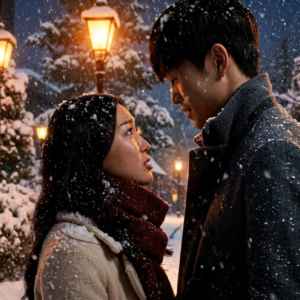
They began the slow walk back to their respective doors, their pace decelerating with every step. Neither wanted the night to end. Above them, the sky opened up, and a flurry of large, fluffy snowflakes began a slow, theatrical dance toward the earth. It was a scene of such cinematic perfection that it felt like the universe was demanding a resolution.
Charlotte stopped. She looked at Edgar—at the way he still looked at the world with awe, at the kindness etched into the lines around his eyes. She reached up, her hand cupping the back of his neck, and drew him down. The kiss was not just a romantic gesture; it was a homecoming. It was the release of years of suppressed longing, a quiet explosion of “I’m here” and “I’m not leaving.” In that moment, in the middle of a snow-silent street, the emptiness Charlotte had carried in the city was finally filled.
A New Horizon: The Gratitude of the Journey
The weeks that followed were a blur of moonlit dances on cobblestones and shared meals at old local haunts where they still blew bubbles in their sodas like children. But they realized that they couldn’t just stay still; they both had dreams that required movement. Their solution was a testament to their combined spirits: they renovated an RV, creating a mobile sanctuary where Charlotte could work remotely and Edgar could bring his carpentry skills to different corners of the map.
As they drove out of White Cedar Valley, rising over the mountain pass, Charlotte looked back one last time. She saw the glowing town, the frozen river, and—far in the distance—the glisten of the willow tree. She wasn’t leaving her home; she was taking the best part of it with her.
We often think of “home” as a set of coordinates on a map, but as Charlotte held Edgar’s hand while the valley disappeared behind them, she realized that home is actually the person who knows the song of your soul and sings it back to you when you’ve forgotten the words. There would be many more willow trees in their future, but as long as they walked beneath them together, they would never be lost again.
How does your “hometown” live within you? Is it a specific smell, a person, or a quiet memory that keeps you grounded? We would love to hear your stories of returning to what matters most.
Disclaimer : This content may be created by AI for entertainment purposes. Any resemblance to real persons, events, or places is coincidental.






