Why the Truth Is Never as Loud as the Lie We Choose to Believe
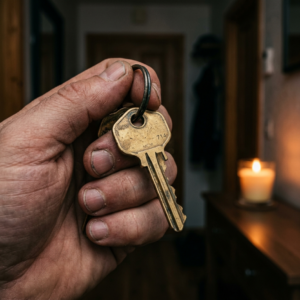
The world didn’t end with a scream. It ended with a vibration. I was standing in the middle of our entryway, the air thick with the heavy, artificial scent of vanilla—a candle she only lights when she is preparing to cross a threshold, never when she is settling in. In my palm, I was already holding her keys. They were still warm, carrying the residual heat of her skin, as if she had only just set them down moments ago. Then, the phone in my pocket buzzed.
It was 12:47 a.m. The digits on the screen glowed with a cold, digital indifference. I called her immediately. Two rings—steady, rhythmic, hopeful—and then a sudden, jagged silence. Not a decline. Not a transition to voicemail. Just a sharp, intentional cut. The apartment felt wrong the second that silence settled, like an engine had been turned off that was supposed to keep us moving.
I looked around. A window was cracked open, letting in a sliver of the winter night. She hates that; she always complains it messes with her sinuses. Yet, there it was—the cold air slipping in like a ghost. In the kitchen, her wine glass sat on the counter, half-full, a crescent of lipstick smudged on the rim as if she’d wiped it with the back of her hand in a hurry. She doesn’t leave drinks unfinished. Not her. The glass was still slightly warm to the touch. I set it back exactly where it was, mirroring a life that was already out of alignment.
The Message That Wasn’t a Message
My phone buzzed again. She’s not coming home tonight. No emoji. No “I love you.” No explanation. It didn’t even sound like her voice translated into text. It sounded like a statement of fact issued by a stranger. I stared at the message until the screen dimmed and went black. I typed, “Where are you?” but my thumb hovered, trembling, and I deleted it. I typed, “Are you okay?” and deleted that, too. Three gray dots appeared on the screen—pulsing, breathing, waiting—and then they vanished into nothingness.
I noticed her laptop on the dining table. Open. Screen asleep. The charger was plugged in, the cord snaking across the wood like a tether. She never leaves it like that. I touched the trackpad, and the light flooded my eyes. Her inbox was a graveyard of unread emails. Her calendar was still open to a single entry: Company dinner, 7:00 p.m. There was no afterparty listed. No late-night strategy session. Just a void.
Something crunched under my shoe. I looked down at a piece of bread, charred black on one side. I remembered flipping it too late earlier that evening. She had laughed then, telling me I always forget. I hadn’t laughed back. Now, I picked it up and held that burnt scrap for a second longer than made sense before dropping it into the trash. The weight of my phone felt heavier now, like lead. That was when I saw it: the spare car key was gone from the hook.
The Digital Breadcrumbs of Betrayal
I stood up so fast the chair scraped a raw, screaming sound against the floor. I walked to the door and looked down the hallway, half-expecting to see her standing there with an apology that would stitch the world back together. Nothing. Just the hum of the fluorescent building lights.
I checked our shared parking app. Her car hadn’t moved from the garage since 6:18 p.m. I stared at that timestamp, then back at the text. She’s not coming home. I realized then it didn’t say “I’m not coming home.” It was third-person. It felt like permission.
Then, a notification arrived, buried under spam: Arrived. Let me know if you need anything. Sent from an unknown number at 12:51 a.m. Four minutes after the first message. I typed, “Who is this?” The three dots danced and died. I checked the laptop again. I shouldn’t have, but I did. I found the thread pinned at the top. No name, just that same number.
The messages were clean, clinical, and devastating. Her: I’ll stay for a bit. Don’t make it weird. Him: I won’t. Her: He thinks it’s just dinner. Him: It is. Unless you decide otherwise.
Then, the final blow: Him: Garage is full. Come up instead. Same as last time.
The Mercer and the Mirror
The words “Same as last time” didn’t just hurt; they recontextualized my entire history. I remembered a night I waited outside a residential building across from The Mercer for forty minutes while she “dropped something off for work.” I had listened to the same song twice, oblivious to the clock.
I didn’t rush. I reset the scene in the kitchen, putting the keys and the glass back in their precise locations, a silent witness to a crime not yet fully confessed. In the bedroom, I found a dark blue dress missing from the closet—the one she’d asked if was “overkill” for a work dinner. I had said yes without looking. She had smiled because she knew it was.
I tracked her phone. The little blue dot pulsed across the street from the Mercer. Unit numbers didn’t show, just the outline of a structure where lives are unmade in silence. I went back to the kitchen and rinsed her wine glass. I didn’t do it aggressively; I just wanted to clear the stain. The click of the cabinet door echoed like a gunshot.
At 2:06 a.m., I sent one final text: Do you need me to come get you? No read receipt. No answer. Just the cold air from the window I had opened wider, counting my breaths instead of the minutes. Then, the unknown number sent a photo.
The Silhouette in the Hallway
The image loaded slowly, pixel by agonizing pixel. A hallway. Soft, amber lighting. A mirror at the end. I knew that hallway. I had stood in it once, holding files she’d forgotten. The mirror caught two silhouettes. One was hers—standing with her weight on one leg, shoulder forward, already halfway inside a door. Behind her, a man. His hand was resting on her lower back. It wasn’t a guiding hand; it was a familiar one.
The unknown number texted again: Third floor. End of the hall. You should come.
The elevator smelled of sharp cleaning spray. I watched the numbers climb: Two. Three. The doors slid open to the exact scene from the photo. Empty. Quiet. I walked toward the third door from the end. It was slightly ajar. I saw her heels, placed neatly to the side. She never lines them up like that.
Inside, I heard a man’s voice. Calm. “He knows enough.” The man laughed. “He won’t. He doesn’t do scenes.” I pushed the door another inch. The hinge groaned—a small, pathetic sound. Everything inside stopped. I saw her back, the blue dress shimmering. I saw him in the mirror. He didn’t look surprised. He nodded at me like we were old acquaintances.
The Final Revelation: A House of Cards
I stepped inside. The door drifted open behind me. She didn’t turn around immediately. She was looking at her phone—at my message asking if she needed a ride. She finally turned, her eyes meeting mine without panic, only recognition.
“She wasn’t supposed to choose like this,” the man said, his voice almost polite. He looked at me with a tired kind of pity. “You think this started tonight? Same building, same floor, different door.”
I looked at the wine glasses on his table—two of them, filled to the same level. I walked past them into the bedroom. The bed was made too neat. I came back, picked up her heels, and carried them further into the apartment, setting them down as if placing them in a museum of a finished life.
“You don’t need to come home,” I said.
Panic finally surfaced in her eyes, flickering like a dying bulb. “Wait,” she whispered. “You don’t understand.” “You don’t,” I replied. “I filed this morning.”
The man, sensing the shift, picked up her phone and held it toward the mirror so I could see the reflection of another chat thread. A third name. A third man. You said you’d leave him after the party. I promise.
She wasn’t choosing him. She wasn’t choosing me. She was never going to leave any of us because she was already gone before the night began.
Reflection: When the Truth Stops Changing Anything
I walked out. The door closed—soft, final. I sat in my car and watched my phone light up with her name, over and over. Then, a final message from the unknown number: She was never going to leave any of us.
The next morning, I made coffee. I put bread in the pan and watched it burn. I didn’t flip it. I didn’t fix it. I just let it happen. I ate the charred remains standing up. I took her spare key, placed it next to mine on the counter—both cold, both exactly the same—and I left.
Some endings don’t happen when you learn the truth. They happen when the truth stops changing anything. The betrayal wasn’t the dinner or the hallway or the man in the mirror. It was the fact that the person I loved had moved out of our life months ago, leaving only the vanilla candles and the half-empty glasses behind.
How do you know when a story is truly over? Is it the moment you find the evidence, or the moment you realize you no longer care to hear the explanation? We all have a “click” in our lives—the moment the lock turns and we realize we are standing on the outside. Share your thoughts below. I read every one.
Disclaimer : This content may be created by AI for entertainment purposes. Any resemblance to real persons, events, or places is coincidental.






