How One Word Rewrote a Father’s Legacy
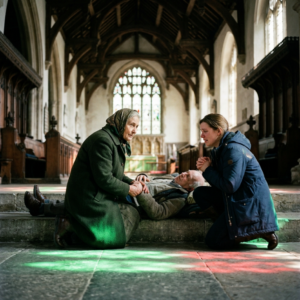
The morning mist clung to the stone walls of the village church, a cold, grey shroud that seemed to mirror the heavy silence within the sanctuary. For Miss Jane Marple, a woman whose frailty often masked a mind as sharp as a Victorian straight razor, the day was meant to be one of quiet service. Alongside her goddaughter, Bunch—the vibrant, protective wife of the local vicar—Jane had braved the biting chill to arrange flowers. The air inside was stagnant, smelling of ancient dust and damp earth, “as cold as the grave,” as Bunch had noted with a shiver.
But as the weak morning sun struggled to pierce the East window, casting long, jewel-toned shadows across the chancel steps, the two women discovered that the sanctuary was no longer empty. A man lay huddled at the altar, his life force ebbing away in the sacred quiet. This was not a mere trespasser; this was a man seeking a final refuge. His last words, whispered through the haze of a mortal wound, would launch Miss Marple and Bunch on a perilous journey from the quiet lanes of St. Mary Mead to the frantic platforms of Paddington Station. This is not just a mystery of hidden gems; it is a profound exploration of a father’s ultimate sacrifice and the radical lengths to which the human heart will go to protect its own.
The Dying Request in the Chancel Light
The discovery was a chilling intrusion into the mundane. As Bunch moved to the altar, her eyes caught a figure that didn’t belong. He looked like a heap of discarded rags until the light hit him. “Hello?” she called out, her voice echoing in the rafters. No response. Upon closer inspection, the horror revealed itself: the man had been shot.
Miss Marple, her instincts for human behavior immediately overriding her own physical aches, knelt beside him. She saw a man who had used his own handkerchief to plug a bullet wound—a desperate, disciplined attempt to stay alive just long enough to reach this specific spot. He was gasping, his eyes searching the ceiling as if looking for something beyond the stained glass. “Sanctuary,” he rasped. Then, a name or a thing: “Jewel.” And finally, a word repeated with agonizing weight: “Please. Please.”
As his hand clutched at his side, grasping at something only he could feel, the light faded from his eyes. He was William Sandborn, a man the world would soon label a common criminal, but whom Jane Marple would see as something far more complex. The internal bleeding, according to Dr. Haydock, had been catastrophic. He had walked miles while dying, a feat of sheer willpower. But what had he walked for? Was it for Julian, the vicar? Or was it for “Jewel”? The mystery was born in the blood on the chancel steps, and Miss Marple knew that “please” was a directive she could not ignore.
The Vulture and the Beaver Coat
The aftermath of a death always brings out the scavengers. Enter Mrs. Eckles, a woman who claimed to be the sister of the deceased. She arrived at the vicarage not with the soft edges of grief, but with the sharp, predatory focus of someone looking for lost cargo. Her story was convenient: William had been depressed, he’d stolen her husband’s revolver, he’d come to the country to end it all.
But Jane Marple, sipping her tea with a deceptive air of elderly distraction, noticed the cracks in the facade. Mrs. Eckles had no interest in the wallet or the watch the police had recovered. Her eyes were constantly darting to the hallway, specifically to the shabby, blood-stained coat William had been wearing. “I’d really like to have it,” she insisted, her voice tight with a forced sentimentality. “For memories, you know.”
Miss Marple realized that the coat held more than blood. While Mrs. Eckles was distracted by Bunch, Jane had already performed a quiet, meticulous surgery on the garment. She had found a small, peculiar thread that didn’t match the rest of the lining. Unpicking it, she discovered the “Jewel” the man had clutched at: a cloakroom ticket for Paddington Station. Jane had replaced the ticket with a blank piece of paper and resewn the lining before Mrs. Eckles could blink. The “sister” left with the coat, unaware she was carrying a hollow prize. The real hunt was just beginning.
The Paddington Gambit: A Masterclass in Deception
Miss Marple decided that the only way to honor the dead man’s plea was to collect the item himself. Despite Bunch’s worries that her aunt was still recovering from a fever, the two women boarded a train to London. The atmosphere at Paddington Station was the polar opposite of St. Mary Mead—a chaotic, soot-stained arena of rushing crowds and shrill whistles.
The plan was a “theatrical” masterpiece. Jane knew they were being followed by Mrs. Eckles’ accomplice, a man named Edwin Moss. To outwit him, Jane utilized Edna, her loyal maid. On the platform, under the guise of shifting bags during the “sales,” a silent swap occurred. Edna took the real suitcase retrieved from the cloakroom, while Miss Marple and Bunch walked away with a decoy filled with Jane’s old Beaver-collared coat and some wool jumpers.
The climax occurred as they prepared to return. Edwin Moss, thinking he had cornered a pair of defenseless old ladies, pounced. He demanded the case, claiming it was “rightful property.” In a moment of high drama, Inspector Slack—whom Jane had tipped off via a cryptic message—stepped out from behind a pillar. The trap was sprung. As Moss looked inside the case, expecting the legendary jewels of a Raja, he found only the moth-eaten furs of an elderly woman. The look of pure, unadulterated defeat on his face was, as Jane put it, “most diverting.”
The Legend of Zubeda’s Emeralds
The investigation then moved to the quiet comfort of the vicarage kitchen, where Inspector Slack and the captured Moss laid out the dark history of the “Jewel.” It turned out William Sandborn was a man of education who had fallen from grace and into the world of professional jewelry fences.
Moss revealed the legend of a music hall dancer named Zubeda, who had performed a specialty act called “Aladdin in the Cave of Jewels.” An Asiatic prince had gifted her a magnificent emerald necklace—the historic jewels of a Raja. When the affair ended, the necklace vanished. The world believed it was stolen, but Jane Marple had a different theory.
As the real suitcase—retrieved by Edna—was forced open with a chisel, the room was bathed in the glint of what looked like cheap stage props. A theatrical costume lay inside, heavy with oversized, colored stones. Moss scoffed, thinking it was just glass and tin. But Jane Marple reached out and touched a “dragon stone” on the hem.
“Aladdin’s cave,” she whispered. The jewels were never “stolen.” William Sandborn, a skilled jeweler, had fastened the genuine emeralds onto the costume itself, disguised as mere baubles. Zubeda had sent him the cloakroom ticket from her deathbed, a final gift to the man she truly loved.
The Father’s Final Sanctuary: A Legacy for Jill
However, the jewels were only half of the story. As Inspector Slack lifted the heavy costume, an envelope fluttered to the floor. Inside were two documents that transformed a crime story into a tragedy of parental love: a marriage certificate between William Sandborn and Mary St. John (Zubeda’s real name) and a birth certificate for their daughter, named Jewel.
The realization hit Bunch like a physical weight. “Jewel… that’s what he said in the church.”
But there was no one in St. Mary Mead named Jewel. Miss Marple, ever the expert on village lineages, connected the dots. There was a young girl named Jill, a quiet ward living with the elderly Mundy family. The Mundies were ill—Mrs. Mundy had suffered a stroke, and Mr. Mundy had pneumonia. Jill was facing a future in an institution, a child of nobody with nothing to her name.
William Sandborn hadn’t escaped prison to become rich. He had broken out because he knew the Mundies were failing and his daughter was in danger. He had carried a mortal wound across miles of countryside, grasping at his side, not to save his life, but to ensure that the cloakroom ticket reached someone who could find Jill’s inheritance. The “Sanctuary” he sought wasn’t for his body, but for his daughter’s future. He had died to ensure that the girl who was about to be sent to an institution would instead be set up for life.
Deep Reflection: The Moral Architecture of a Sacrifice
The story of “Sanctuary” challenges our perceptions of “good” and “bad” people. William Sandborn was a thief, a convict, and a fugitive. Yet, in the final forty-eight hours of his life, he performed an act of such profound, selfless love that it eclipsed his criminal past. He chose the church not just for the right of sanctuary, but because he knew that in a holy place, his dying plea might find a heart capable of understanding it.
Miss Marple’s involvement is equally significant. She recognized that a “paragon” like Mrs. Eckles is often a mask for a vulture, and that the truth usually hides in the “trifles”—the thread in a coat lining, the return half of a ticket, the weight of a theatrical costume. She understood that Sandborn’s “please” was a prayer for Jill.
This narrative serves as a powerful reminder that every person carries a “hidden lining”—a secret motivation or a buried love. It teaches us that sanctuary is not just a building, but the safety we provide for one another through our vigilance and our empathy. William Sandborn found his sanctuary in the arms of Miss Marple’s integrity, and through her, he finally found peace for his daughter.
Does the story of William Sandborn change how you look at the “outsiders” in your own community? Have you ever had to fight for a “sanctuary” for someone you love? We invite you to share your reflections on sacrifice, legacy, and the hidden “jewels” in your own life in the comments below.
Disclaimer : This content may be created by AI for entertainment purposes. Any resemblance to real persons, events, or places is coincidental.






