The Terrifying Stalking and Triple Murder That Shook South Korea
Springtime in Seoul, South Korea, is usually a season of breathtaking renewal. Cherry blossoms bloom along the Han River, and the streets hum with the vibrant energy of millions of people. But in the spring of 2021, an invisible darkness crept into an apartment in the bustling, densely populated Nowon district—a darkness born not of nature, but of a toxic digital obsession.
This is the harrowing, real-life story of Jong Da-rang, a bright, twenty-five-year-old veterinary clinic worker whose life was shattered by a man she met in the virtual world of an online video game. It is a terrifying chronicle of how an innocent match in League of Legends spiraled into relentless stalking, psychological terror, and a massacre that forced an entire nation to rewrite its laws.
If you have ever brushed off an online interaction or ignored the subtle red flags of a stranger’s behavior, this story is a chilling reminder of the monsters that hide behind a screen.
Chapter I: The Bright Light of Nowon and the Shadow from Gangnam
Jong Da-rang was the heart of her family. Having grown up without a father, she was the devoted eldest daughter, working tirelessly at a local veterinary hospital to help support her mother and her twenty-two-year-old sister, who was a university student. Da-rang was vivacious, pretty, and deeply loved by her friends and colleagues. She loved shopping, singing karaoke, and sharing the simple joys of her life on social media. Like many young adults, she also loved unwinding by playing League of Legends, a popular team-based multiplayer game.
In the digital arena of November 2020, the matchmaking algorithm paired Da-rang with a player whose username was “Heo Pak.” His real name was Kim Tae-hyun.
Kim Tae-hyun was a stark contrast to Da-rang’s bright existence. Born in Busan, he had grown up in a fractured, volatile home. After his parents’ bitter divorce, he moved to the famous Gangnam district in Seoul—a place renowned globally for its extreme wealth and luxury. But Tae-hyun did not live in luxury. He lived in a cheap, suffocating basement apartment. He was a high school graduate who drifted aimlessly through life. After completing his mandatory military service, he failed to hold down a job, once quitting a restaurant gig after a single day because it was “too hard.” His life revolved entirely around the dim, neon-lit glow of internet cafes (PC bangs).
When they played together, they coordinated perfectly in the game. What began as friendly voice chats about strategy quickly morphed into casual conversations. For Tae-hyun, however, it was not casual. In the isolated, lonely vacuum of his basement life, Da-rang became a sudden, magnificent obsession. He began waiting online for hours just to see her username light up.
By January 2021, they decided to meet in person at an internet cafe. The first meeting went smoothly enough. But the fragile illusion shattered during their second encounter.
Da-rang, feeling cautious, did not go alone; she brought a male and a female friend. Tae-hyun’s reaction was immediate and deeply disturbing. The moment he saw the other man, his demeanor darkened into a sullen, hostile silence. He refused to speak, creating an atmosphere so thick with tension it was suffocating. Da-rang, ever the peacekeeper, tried desperately to lighten the mood, but Tae-hyun eventually erupted, getting into a fierce, aggressive argument with Da-rang’s male friend.
Disgusted and frightened by his erratic, explosive behavior, Da-rang returned home and made a definitive decision. She texted Tae-hyun, explicitly stating she never wanted to see or speak to him again. Then, she blocked his number.
She thought the nightmare was over. She had no idea it had just begun.
Chapter II: The Anatomy of a Stalker
Rejection, to a mind like Kim Tae-hyun’s, is not an ending; it is a declaration of war.
Diagnosed later as having antisocial personality disorder with extreme psychopathic traits, Tae-hyun could not accept being discarded. The friendly gamer transformed into a terrifying, relentless predator. He bombarded her with messages from alternate numbers. When that failed, he utilized the very tool she used to share her life: her social media.
Tae-hyun meticulously scoured the photos Da-rang posted. In a display of horrifying calculation, he zoomed in on a picture she had taken at home. He managed to read the shipping label on a cardboard box in the background, extracting her exact home address in Nowon.
The stalking escalated into physical terror. Tae-hyun began haunting the streets around her veterinary clinic, forcing Da-rang to constantly change her route home. One evening, while Da-rang was out with friends, her mother called in a panic. A strange man was repeatedly ringing their apartment doorbell, claiming to be Da-rang’s “boyfriend.” Terrified, Da-rang instructed her mother to lock the doors and never open them.
The psychological toll was immense. Da-rang was terrified to walk alone, relying on friends to escort her. She changed her phone number, desperately trying to erase her digital footprint. But Tae-hyun was a phantom she could not shake. He was researching his darkest fantasies, typing search queries into his phone like “the fastest way to kill a person.”
Chapter III: The Delivery of Death
March 23, 2021. It was a Tuesday.
At 5:00 PM, Kim Tae-hyun appeared in Da-rang’s Nowon apartment complex. He was dressed entirely in black, carrying a white backpack. Inside the bag, he carried the tools of a premeditated massacre: a change of clothes, blue duct tape, and leather gloves.
His movements were calculated and chillingly calm. He stopped at an internet cafe—the same one Da-rang frequented—paying in cash so he couldn’t be tracked, simply to check if she was there. Realizing she wasn’t, he walked to a nearby convenience store. He bought a bottle of water, a pack of cigarettes, and a lighter. While the cashier was distracted, he stole a knife.
At 5:30 PM, he entered Da-rang’s building. He bypassed security by claiming to be a delivery worker. He rode the elevator to her floor and stood before her door.
Inside, Da-rang’s 22-year-old sister was home alone. When the doorbell rang and a voice announced a package delivery, she was cautious. She texted her mother and Da-rang: “Did either of you order anything?” Both replied no.
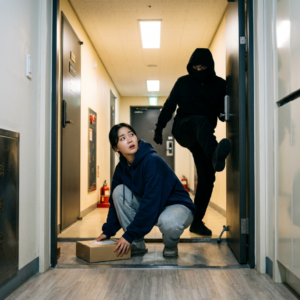
Tragically, without waiting for their replies to fully process, the young sister unlocked the door and bent down to check for a package.
In a flash of blinding violence, Tae-hyun kicked the door open. The two locked eyes. Tae-hyun realized it wasn’t Da-rang, but the hesitation lasted only a fraction of a second. He shoved the terrified young woman inside, slammed the door, and ruthlessly stabbed her to death.
He didn’t flee. He didn’t panic. He moved her body to her bed, covered her with a blanket, and then sat in the silence of the apartment. He waited.
Five agonizing hours later, at 10:30 PM, the front door unlocked. Da-rang’s 59-year-old mother walked in, exhausted from a long day. Tae-hyun ambushed her from the shadows, murdering her without a sound.
He waited another hour.
Just past midnight, Da-rang finally returned from her shift. As she stepped into the sanctuary of her home, she was met with a scene from a horror film. Her mother lay dead in a pool of blood. Through an open door, she saw her sister’s lifeless body. As she fell to her knees, screaming in absolute agony, the monster stepped out of the darkness. Tae-hyun pulled her up, looked into the eyes of the woman he claimed to love, and drove the knife into her.
Chapter IV: Three Days of Madness
What happened next defies all logic and human empathy. After wiping out an entire family, Kim Tae-hyun did not run. He attempted suicide, slashing at himself, but intentionally avoided his vital organs.
When he woke up, thirsty and bleeding, he walked to the family’s refrigerator. He drank their beer and their milk. He changed out of his blood-soaked clothes into the clean ones he had packed.
For three unimaginable days, Kim Tae-hyun lived inside that apartment alongside the three decomposing bodies. He ate their remaining food. Most disturbingly, he took Da-rang’s phone. He accessed her social media accounts, deleting himself from her friend list and blocking specific contacts to buy himself more time, creating the illusion that she was simply ignoring people. He then performed a factory reset on the device to destroy evidence.
It wasn’t until March 25th, when Da-rang’s increasingly panicked friends forced the police to break down the door, that the unimaginable horror was discovered. Tae-hyun was found bleeding but alive, resting near the bodies of his victims.
Chapter V: The Cold Stare of a Psychopath
The arrest of Kim Tae-hyun ignited a firestorm of absolute fury across South Korea. Over 250,000 citizens signed a petition to the Blue House (the executive office of the President), demanding his identity be revealed to the public and that he face the harshest punishment possible.
When Tae-hyun was paraded before the media, the public expected a broken, remorseful man. Instead, they saw a monster in his purest form. When a reporter asked him to lower his mask, he didn’t hesitate. He pulled it down and stared directly into the camera lenses with a cold, unblinking, terrifying confidence.
Criminal psychologists immediately noted that this was the classic behavior of a psychopath. He felt no remorse; he felt validation. He believed he was special. He believed he had won.
The investigation into his past revealed a history of terrifying, escalating violence. He had previously stalked a young male gamer, beating him with a roll of toilet paper in a restroom and threatening his life. He had been fired from an internet cafe for stealing cash, violently destroying equipment when he was angry. He was a registered sex offender, having been fined for sneaking into women’s restrooms to take illicit photos, and for sending explicit images to a high school girl.
He was a ticking time bomb, and society had failed to hear the countdown.
Chapter VI: The Legacy of Da-rang and the Change in the Law
During the trial at the Seoul Central District Court, Tae-hyun attempted to claim that the murders of the mother and sister were “accidents.” The prosecution swiftly dismantled this lie, presenting evidence that he had used the sister’s phone to text the mother after the first murder, luring her into the trap.
Kim Tae-hyun was sentenced to life in prison without the possibility of parole. While South Korea technically retains the death penalty, it has not carried out an execution in decades. For the grieving relatives of the Jong family, the sentence felt like a bitter compromise.
However, the blood of the Jong family was not spilled entirely in vain. The sheer brutality of the case forced the South Korean government to act. Just one day after Tae-hyun’s arrest, the National Assembly rapidly passed the Anti-Stalking Law. Enacted in September 2021, the law finally classified stalking as a serious crime punishable by up to three years in prison, empowering police to issue immediate restraining orders and communication bans.
Deep Reflection: The Monsters in Our Midst
The tragedy of Jong Da-rang is a devastating mirror held up to our modern, digital society. We live in an era where we share the intimate details of our lives online, often forgetting that the internet is a crowded room, and we do not know who is watching from the dark corners.
Da-rang did everything right. She recognized the red flags, she set boundaries, she cut off contact, and she sought the safety of her friends. But she was fighting a predator who operated outside the boundaries of human empathy.
This story is a stark, urgent warning: stalking is not romantic obsession. It is violence in its incubatory stage. It is a demand for control that, when denied, often ends in bloodshed.
The three women of the Jong family will never return. Their laughter will never echo in their apartment again. But their story must be told, shared, and remembered. It stands as a powerful call to action for empathy, for heightened digital security, and for a justice system that protects the vulnerable before the shadow crosses their threshold.
How does this chilling true story change the way you view online interactions and social media privacy? Do you believe the laws in your country are strict enough to protect victims from stalkers? Share your thoughts, your anger, and your prayers for the Jong family in the comments below. Let us build a world where “no” is enough.
Disclaimer : This content may be created by AI for entertainment purposes. Any resemblance to real persons, events, or places is coincidental.






