The Forty-One Days That Shook Japan’s Soul
How does a society weigh the life of a bright, hopeful seventeen-year-old girl against the legal leniency granted to “misguided youth”? In the quiet suburbs of Saitama Prefecture, Japan, in late 1988, a nightmare began that would not only end a life in the most barbaric manner imaginable but would forever change the Japanese legal landscape. This is the story of Junko Furuta—a daughter, a student, and a dream of a better future—whose life was extinguished by a group of monsters hiding behind the status of minors.
It was a time when the neon lights of Tokyo felt invincible, yet just twenty kilometers away in Misato City, a darkness was festering. To understand the gravity of what happened, one must first look at the person Junko was before she became a tragic headline. Born on January 18, 1971, she was a girl defined by her sweetness and her sense of duty. With her family facing financial hardships, Junko didn’t just study; she worked at a local hardware store and a plastics factory, saving every yen to ease her father’s burden as the sole breadwinner. She was a girl with a plan, having already passed interviews for a steady job after graduation. She was on the cusp of womanhood, ready to fly, until the evening of November 25, 1988.
A Trap Set in the Shadows: The Night the World Went Dark
The evening was crisp, a typical Friday in late November. At 8:20 PM, Junko finished her shift at the plastics factory. She adjusted her backpack, hopped onto her bicycle, and began the familiar pedal home. The streetlights were sparse, casting long, rhythmic shadows across the pavement. She had no reason to fear the silence—until the roar of a motorcycle shattered it.
In an act of senseless violence, a stranger sped up from behind and kicked her with such force that she and her bicycle tumbled into the dirt. As she scrambled to her feet, bruised and disoriented, a “savior” appeared. Hiroshi Miyano, an eighteen-year-old high school dropout, approached her with a look of feigned concern. He spun a terrifying lie: the man on the motorcycle was a dangerous member of the underworld who was stalking her. He offered to escort her home.
In her state of shock, Junko saw a kind face in a dark alley. She walked beside him, limping, trusting a stranger because the alternative seemed worse. But as the surroundings grew more desolate, the mask slipped. Miyano revealed the truth: the motorcyclist was his accomplice. He was not her protector; he was her captor. With a cold threat to her life, he forced her into a hotel, beginning an ordeal from which she would never return.
The House of Silence: A Prison in Plain Sight
Miyano did not act alone. He summoned three others—Jo Ogura, Shinji Minato, and Yasushi Watanabe—to a local park. There, they stripped Junko of her dignity and her privacy, searching her bag to find her diary. In those pages, they found her home address. They used it as a psychological shackle, promising to slaughter her parents and siblings if she dared to scream or run.
They chose their fortress: Shinji Minato’s family home in Adachi, Tokyo. It was a two-story house with a small yard, a place where families lived, ate, and slept. For the next forty-one days, the second floor of this ordinary home became a chamber of horrors.
What makes this story uniquely chilling is the “silence” of the environment. Shinji’s parents were often home. They saw Junko. When they questioned their son, he simply claimed she was his “new girlfriend” and told them to stay out of it. Fearing the volatile temper of their son and his gang-affiliated friends, they retreated into a state of lethal apathy. They heard the sounds through the floorboards; they saw the bruised girl in the hallways. They did nothing. Even Shinji’s brother, who lived on the same floor and occasionally brought Junko scraps of bread or milk out of pity, lacked the courage to call the police.
The Forty-One Days of Endurance
As the weeks dragged into December, the cruelty escalated from physical assault to systematic torture. The gang grew bored with their victim, treating her not as a human being, but as an object for their amusement. They forced her to dance without clothes on the balcony in the freezing winter air until she collapsed from hypothermia. They recorded her suffering on video, forcing her to watch her own degradation.
To keep Junko’s parents from calling the authorities, Miyano forced her to call home periodically, her voice trembling as she lied to her mother, saying she was staying at a friend’s house. These phone calls were the last threads of her life, thin and fraying under the weight of her secret agony.
On December 7, the thirteenth day of her captivity, a flicker of hope appeared. Her captors had fallen into a deep sleep after a night of excess. Despite her shattered spirit and broken body, Junko managed to crawl downstairs to the telephone. She dialed the emergency number. But as she began to speak, Miyano’s hand slammed onto the receiver. The “prank” he told the operator was a death sentence for Junko. For her attempt at freedom, he poured gasoline on her legs and set them on fire.
The Final Act: A Concrete Sarcophagus
By early January, Junko was no longer recognizable. Her face was swollen beyond features, her body was a map of infections, and she could no longer stand. She lay on the floor, drifting in and out of consciousness. On January 4, 1989, Miyano arrived at the house in a rage after losing a significant sum of money gambling. He took his frustration out on the dying girl, using a heavy iron pipe to strike her repeatedly for hours.
On the morning of January 5, Junko Furuta finally found peace in death.
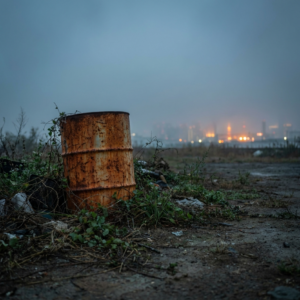
The gang’s reaction was not one of remorse, but of logistics. They stole a 55-gallon steel drum from a construction site and filled it with cement. In a bizarre nod to Miyano’s superstition—fearing she would return as a vengeful spirit—he placed a videotape of her favorite TV show, Dragonfly, inside the drum with her. They drove the heavy sarcophagus to a wasteland near Tokyo Bay and left it there, covered in grass, hoping the concrete would hold their secret forever.
Justice Denied and the Lesson for the World
The secret lasted only until March. Miyano and Ogura were arrested for a different crime, and under the pressure of interrogation, the truth of the “Girl in the Concrete” spilled out. When the police finally cracked open the drum, the sight inside was so horrific it left seasoned investigators in tears.
The legal battle that followed became a national scandal. Because the killers were between sixteen and eighteen years old, they were tried as minors. Despite the sheer depravity of the crime, Miyano received only twenty years. The others received even lighter sentences, ranging from three to ten years.
The aftermath of their release proved the skeptics right. Almost all the perpetrators returned to a life of crime within years of their release. The “rehabilitation” the courts had hoped for was a fantasy.
Deep Reflection: The tragedy of Junko Furuta is a haunting testament to the failure of a society that prioritizes the “potential” of the criminal over the “justice” for the victim. It reminds us that evil often thrives not in the absence of light, but in the presence of bystanders who choose to look away. Junko’s story is a call to vigilance—for parents, for neighbors, and for the law.
We invite our global community to share their feelings on this heart-wrenching case. How do we protect the innocent from the monsters among us, and can there ever truly be “rehabilitation” for such acts? Let us honor Junko’s memory by never being the ones who stay silent.
Disclaimer : This content may be created by AI for entertainment purposes. Any resemblance to real persons, events, or places is coincidental.






