Why I Read My Best Friend’s Journal and Lost the Only Life I Knew
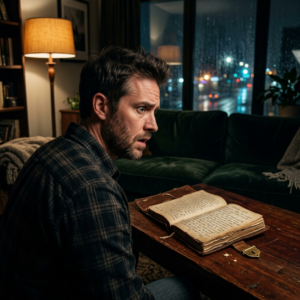
The rain didn’t fall in Chicago that Tuesday; it attacked. It lashed against the windowpanes of Claire’s third-story apartment in long, slanted lines that blurred the city’s neon amber into a watercolor of isolation. Inside, the air was heavy with the scent of damp wool and the faint, lingering trail of chamomile tea. It was a quiet evening, the kind we had shared a thousand times in our six years of inseparable friendship. But as I sat on her velvet couch, waiting for her to return with takeout, the silence began to hum with a frequency I didn’t recognize.
On the mahogany coffee table, nestled between a stack of half-read self-help books and her reading glasses, lay the journal. It was brown leather, worn to a soft tan at the edges where her thumbs usually rested. The gold clasp—the one she always complained about—was unhooked. It wasn’t just cracked; it was open. It lay flat against the wood, the pages white and inviting, like a confession waiting for a witness.
I am not a voyeur. I am the man who respects boundaries, the friend who listens, the person Claire trusts more than anyone in the world. But as the elevator dinged down the hall, signaling she was at least ten minutes away, my eyes betrayed my principles. The handwriting was hers—loopy, slanted to the left, written in the frantic blue ink of someone who was bleeding their soul onto the page. I looked away. I scrolled through my phone. I looked back. And then, I read the words that would end our friendship as I knew it.
CHAPTER 1: THE ACCIDENTAL ARCHAEOLOGY OF A SOUL
“I told myself I wouldn’t do this again. But every time he walks into a room, something in me just—”
The sentence ended there, dangling like a person at the edge of a cliff. My heart didn’t just beat; it hammered against my ribs. He. Who was he? In six years, I had been the one to vet her boyfriends, the one who held her hand through her parents’ messy divorce, the one who drove four hours through a Vermont snowstorm because she texted “I’m not okay” at 2:00 a.m. I thought I knew every inhabitant of her heart.
I should have closed it. A good person would have walked to the window and counted the raindrops until the door clicked open. But standing in the amber glow of her floor lamp, I felt a desperate, selfish hunger. I sat down, set my own book aside, and dove into the six pages that would rewrite our entire history.
She wrote about the Italian dinner on 5th last August. I remembered it clearly—it was my birthday. I remembered the way the candlelight caught the gold in her eyes and how she had suddenly gone quiet when my ex-girlfriend texted me. I had assumed she was bored. In the journal, she wrote that she had almost told me the truth that night, but watched the light in my eyes shift back toward my past and lost her nerve.
She wrote about our hiking trip in Vermont. I had tripped over a root and tumbled down a small embankment, making a fool of myself just to hear her laugh. She wrote that as she watched me brush the dirt off my jeans, she felt like the sun had come out from behind a cloud and aimed itself specifically at her.
Then came the entry from three days ago. The ink was darker here, the handwriting more jagged:
“I think I’ve been in love with him for years and I’ve been calling it friendship because that felt safer. Because losing him as a friend would be worse than never having him as anything more. He doesn’t see it. He’s never seen it. And maybe that’s better. Maybe some feelings are meant to stay in leather journals with broken clasps. But God, I am so tired of pretending.”
CHAPTER 2: THE TEN-SECOND TRANSFORMATION
The elevator dinged.
I had exactly ten seconds to decide who I was going to be. I could close the book, slide it under a magazine, and pretend to be the oblivious best friend for another six years. I could live in the safety of the lie. But as the key turned in the lock, I realized that the “safety” she wrote about was actually a slow-motion suffocation for both of us.
The door swung open, bringing with it a gust of cold Chicago air and the smell of spicy peanut sauce. Claire stood there, her dark hair damp and clinging to her forehead, her cheeks flushed pink. She looked beautiful in her olive-green coat—a detail I had noticed a thousand times and never permitted myself to dwell on.
“They gave us a free spring roll!” she chirped, holding up the brown paper bags. “I feel like this is a sign that tonight is going to be—”
She stopped. Her gaze traveled from my face to the coffee table. She saw the journal. She saw the open pages. The bags of food lowered slowly until they rested on the counter. The vibrant life drained from her face, replaced by something fragile and utterly terrified. She looked at the door as if calculating her escape from her own home.
“Ryan,” she whispered. “I didn’t mean… it was open…”
“How much did you read?” Her voice was so thin it barely carried across the room.
I didn’t answer. I didn’t have to. The silence between us, once so comfortable, was now a bridge that had collapsed into the water.
CHAPTER 3: THE END OF THE “KIND” LIE
“Claire, don’t,” I said as she started to back away.
“Please don’t do the thing where you’re kind about it,” she snapped, her voice cracking. “I really cannot handle you being kind right now. I know the script, Ryan. You’re going to say I’m like a sister to you. You’re going to say we’re too important to make it weird. Just say it fast so I can call Dana and go sleep on her couch.”
She was shaking. The woman who had been my rock for nearly a decade was crumbling because she thought I was her executioner.
“The Vermont trip,” I said, stepping toward her.
She blinked, confused. “What about it?”
“When I tripped over that root and fell down the hill. I told you I was clumsy. I lied. I didn’t trip, Claire. I fell on purpose because you’d been quiet for three days and I couldn’t figure out what was wrong. The only thing I could think to do was something stupid enough to make you laugh.”
The room went still. The only sound was the rain drumming a rhythmic heartbeat against the glass.
“And New Year’s Eve at Dana’s party?” I continued, taking another step. “On the walk home, when you said the stars looked different? I almost said it then. I talked myself out of it because I was so sure—so terrifyingly sure—that it wasn’t what you wanted. I’ve been writing it off as friendship, too. Because being ‘just friends’ felt easier than being rejected by the only person who actually knows me.”
CHAPTER 4: SIX YEARS IN SIX PAGES
Claire stared at me, her hands at her sides, the paper bag of takeout rustling as her grip tightened. “You read all of it?”
“Six pages,” I admitted.
“Ryan, those are six years of feelings,” she exhaled, pressing a hand to her forehead. “This isn’t how this was supposed to happen. I had a plan. Well, not a plan, but there were supposed to be better lighting conditions. I was supposed to be less damp.”
A small, hysterical laugh escaped my throat. And then, she laughed too—that helpless, breathless laugh that always cracked the tension between us. Her eyes were wet, sparkling under the amber lamp.
“What are we doing?” she asked softly.
“I think,” I said, meeting her halfway in the center of the living room, “we’re being honest. Maybe about six years too late.”
We stood two feet apart. In the history of our friendship, we had hugged a thousand times, but this was different. This was the moment where you look at someone and finally stop pretending they are a “sibling” or a “best friend.” You look at them and see your future, terrifying and bright.
CHAPTER 5: COLD SPRING ROLLS AND CLEAR WINDOWS
We didn’t go to the dining table. We sat on the linoleum floor of her kitchen at midnight, backs against the white cabinets, the cold spring rolls forgotten between us. She had lit a vanilla candle on the windowsill, its tiny flame flickering against the dark window.
For hours, we traded secrets like currency. She told me about the August dinner—how she’d picked that specific restaurant because it was my favorite, and how she’d counted every time I looked at her.
“Seventeen times,” she whispered. “You looked at me seventeen times while we were waiting for the check. I counted.”
“I notice more than you think I do,” I replied.
We opened every carefully filed-away moment. The late-night calls, the “accidental” touches, the jealousies we had masked as concern. It was a massive, beautiful exhalation.
“I’m terrified,” she said, leaning her head back against the cabinet. “The friendship thing… losing it if this goes wrong. It’s a lot to risk.”
“Something could also go very right,” I said.
She tilted her head and looked at me sideways—a look I had misread as “platonic affection” for half a decade. Now, I saw it for what it was: a quiet, enduring hope.
“When did you get so optimistic?” she teased.
“About ten minutes after I read your journal without permission,” I said.
She laughed and reached over, taking my hand. It wasn’t a dramatic, cinematic gesture. It was quiet and steady. It was the feeling of a broken clasp finally clicking into place.
DEEP REFLECTION: THE TRUTH ABOUT BROKEN CLASPS
We often treat our most profound feelings like those leather journals—we keep them tucked away on coffee tables, hidden in plain sight, protected by flimsy gold clasps we hope no one ever dares to open. We call it “safety,” but it is actually a prison. We are so afraid of losing the “friendship” that we starve the love that is trying to grow beneath it.
Honesty is a risk. It is a “fall down a hill” kind of risk. It might end in cold takeout and a night on a friend’s couch, or it might end in the realization that the person you were afraid of losing was actually the person waiting to be found.
The journal sat on the coffee table all night, open and unashamed. Some things deserve to stay exactly where they landed.
CALL TO ACTION: Is there someone in your life you’ve been calling a “friend” while your heart says something else? Have you ever had a moment where a secret changed everything? Share your stories in the comments below—let’s talk about the risks that were worth taking. ❤️👇
Disclaimer : This content may be created by AI for entertainment purposes. Any resemblance to real persons, events, or places is coincidental.






