Why Failure Was My Greatest Teacher
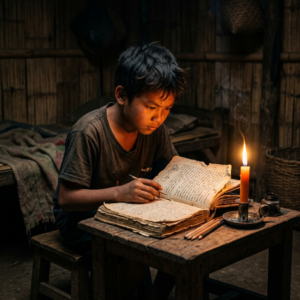
In the heart of a world often obsessed with instant success and material wealth, there exists a quiet, powerful truth that is rarely told. It is a story not of silver spoons, but of wooden floors; not of high-speed internet, but of flickering candles. My name is Aiden, and if you saw me twelve years ago, you would have seen a boy with broken shoes and a plastic bag for a school folder. But inside that boy was a fire that no rain could extinguish. Today, I want to invite you into my village, into my struggle, and into the moment I realized that failing a big exam was the best thing that ever happened to me. This is a journey for anyone who has ever felt “not good enough” or “too poor to dream.”
THE ARCHITECTURE OF A QUIET STRUGGLE
My world began in a village so quiet you could hear the rhythm of the seasons. It is a landscape defined by rolling green hills and emerald rice fields, where small wooden houses stand like humble sentinels against the sky. My home was built of wood and bamboo—simple, honest materials that offered shelter but could not always keep out the elements. I remember the distinct sound of raindrops hitting our roof; when the storms were heavy, the water would find its way through the cracks, dripping onto our floor. We did not have much, but our house was filled with a wealth that cannot be stored in a bank: the profound love of my family.
My father is a man of the earth. Every single day, he is out in the fields, his skin bronzed and weathered under the relentless heat of the sun. My mother is the heartbeat of our survival, rising long before the birds to prepare vegetables she sells at the market. At twelve years old, I already understood the weight of a dollar. I looked at my old, faded clothes and my shoes that had seen better days, and sometimes, a cold shiver of shyness would wash over me at school. While other children had leather bags and polished loafers, I clutched my books in a plastic bag. I never complained. To complain would be to disrespect the sweat on my father’s brow and the callouses on my mother’s hands.
THE FIVE-KILOMETER SANCTUARY
Every morning, I woke up in the gray light before dawn. My first task was not to open a book, but to open the earth. I helped my father in the fields—pulling weeds, carrying heavy buckets of water, and planting the young rice. My hands were small, and the work was exhausting, but it taught me the most important lesson of my life: things grow only if you tend to them.
Then came the walk. Five kilometers. Every day. The road was a living thing—sometimes dusty and baking, other times a treacherous river of thick, brown mud. I remember the feeling of my shoes sinking into the earth, the physical effort of pulling my feet out of the muck, and the occasional fall that left my clothes stained. But I never turned back. School was my sanctuary, and English was my magic. There was something about the sound of English words—the way they rolled off the tongue, the music of the vowels—that made me feel like the world was bigger than my village. I would stand in front of a cracked mirror and mimic the voices I heard on the old radio, practicing until the candle burned down to a stub. I knew I wasn’t good yet, but I knew I would be.
THE DARKNESS OF THE BOARD: THE DAY I FAILED
I had a dream that kept me awake at night: I wanted to be a teacher. I wanted to return to villages like mine and tell children that their circumstances were not their destiny. The key to this dream was a scholarship exam at the end of the year. If I passed, I could go to the town school—a place with computers, libraries, and real English teachers. I studied until my eyes burned. I used a single candle for light, ignoring the ache in my back and the heaviness in my limbs. My parents watched me with quiet pride. “We are proud of you,” my mother would whisper, her hand resting on my shoulder.
The day of the results is etched into my memory like a scar. I walked to the school board, my heart drumming against my ribs. I looked for my name. I scanned the top, the middle, the bottom. I looked again. And again. My name was not there. I had failed.
The walk home that day felt like fifty kilometers, not five. I felt empty, as if the dream had been ripped out of my chest. That night, for the first time in years, I did not open my books. I lay in the dark, staring at the bamboo ceiling, listening to the silence. “Maybe I’m just a village boy,” I thought. “Maybe they were right to laugh.” The next morning, I didn’t want to get up. I was ashamed. But then, I felt a small hand on my arm. My little sister was standing there, holding her tattered books, a wide smile on her face. “Will you help me study today?” she asked. Looking into her eyes, I realized my failure wasn’t just mine—it was a threat to her hope, too. I couldn’t quit. Failure wasn’t the end; it was the beginning of a much harder, more honest fight.
THE LABOR OF THE CANDLELIGHT
I made a promise to the flickering flame of my candle that night: I would work harder than everyone who laughed. I didn’t just return to my routine; I transformed it. I moved my seat to the very front of the classroom, absorbing every syllable from the teacher. When classmates jeered, “Why try? You already failed,” I didn’t get angry. I used their laughter as fuel. I began asking questions—dozens of them. I learned that asking for help isn’t a sign of weakness; it is the ultimate sign of strength.
My weekends were spent in the market helping my mother or at the temple reading old, dusty books with missing pages. If I found a word I didn’t know, I treated it like a diamond, recording it in my notebook to ask about on Monday. Slowly, the world began to notice. My teacher pulled me aside: “Aiden, you are improving very fast.” Then, a young, kind teacher arrived at our school. She saw the boy in the plastic bag and didn’t see a “poor student”—she saw a future colleague. She offered to teach me after school. In those quiet afternoons, as the sun dipped below the hills, she taught me more than grammar. She taught me that success is about being ready when the door finally opens.
BEYOND THE VILLAGE: THE SPEECH THAT CHANGED EVERYTHING
The opportunity came in the form of a town-wide English speech competition. I was terrified. A village boy, speaking English on a stage? The doubt tried to crawl back in. But my teacher gave me the best advice I’ve ever received: “You don’t need to be perfect. You just need to be brave.”
I chose my topic: My Dream. I practiced in the fields, I practiced for my sister, and I practiced until the words were a part of my soul. On the day of the competition, I felt small in the big town school. But when I stepped onto that stage, I didn’t see the judges or the fancy students. I saw my father’s tired hands and my mother’s market stall. I spoke from my heart about the mud, the candle, and the plastic bag. I didn’t win first place. But I won the “Most Inspiring Speech” award. Holding that certificate, I realized that winning isn’t about being Number One; it’s about believing in yourself when you have every reason not to.
DEEP REFLECTION: THE LESSON OF THE RICE FIELD
Months later, another exam came. This time, there was no panic, only peace. I had already done the work in the dark, so the light didn’t scare me. When the results came, my name wasn’t just on the list—it was at the top. I had won the scholarship.
My journey from the wooden house to the scholarship school taught me a universal truth: Success is not a destination; it is the act of standing up one more time than you were knocked down. It is not about the shoes on your feet, but the fire in your heart. If you are struggling today, if you have failed an exam, or if you feel like the world is laughing at your big dreams—look at my plastic bag. Let it remind you that small steps, taken every single day, eventually move mountains.
CALL TO ACTION
What is the “plastic bag” in your life right now? What is the dream you are afraid to chase because someone laughed? We are a global community of dreamers here. Share your story in the comments. Tell us one thing you are working for, and let’s encourage each other. Remember, your English, your career, and your life will improve step by step. Just don’t stop walking.
Disclaimer : This content may be created by AI for entertainment purposes. Any resemblance to real persons, events, or places is coincidental.






