A Story of the Miracles Hidden in Plain Sight
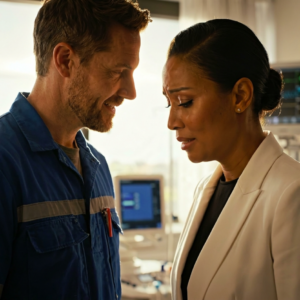
The world is constructed upon a fragile illusion of control. We build towering monuments of glass and steel, we amass fortunes that span continents, and we wrap ourselves in the comforting belief that power can insulate us from the chaotic, unpredictable forces of mortality. But there are moments—shattering, agonizing, crystalline moments—when the universe strips away all our meticulously crafted armor, leaving us standing naked before the absolute fragility of human existence. In these profoundly terrifying instances, the currency of the world shifts. Bank accounts become worthless paper, corporate titles evaporate into meaningless echoes, and the only thing that holds any true value is the desperate, fragile rhythm of a single human heartbeat. This is not merely a story about a medical emergency. This is an epic chronicle of a collision between two vastly different universes, a profound exploration of grief and redemption, and a testament to the quiet, invisible miracles that walk among us every single day, disguised in the most unassuming of uniforms.
Chapter I: The Architecture of Absolute Powerlessness
Elena Hart, at forty-five years of age, was a name that commanded immediate, unquestioning respect across the city. She was a woman who had meticulously built a global empire from absolutely nothing, carving her path through cutthroat boardrooms and dominating industries with an iron will. Her presence was a force of nature; she carried a confidence so dense and palpable that it seemed to alter the gravitational pull of any room she entered. She was the architect of her own destiny, a billionaire who controlled the flow of immense capital and directed the fates of thousands. Yet, as she stood in the sterile, aggressively bright corridor of the city’s most elite hospital, that legendary strength looked visibly shaken, fractured for the very first time in years.
The harsh, unrelenting fluorescent lights overhead cast a pale, sickly glow on the polished linoleum floors, illuminating a scene of sheer, unadulterated terror. On the pristine, white hospital bed lay Noah Reed, her ten-year-old son. He was a small boy, possessing pale, almost translucent skin, and eyes that carried a profound, heavy exhaustion far beyond his tender decade of life. His was a fragile body that had already fought too many silent, agonizing battles for a child his age. Just moments prior, the evening had been an orchestration of elegance and philanthropy. Elena had been attending a private, high-society charity gathering at this very hospital, surrounded by the elite, when the unthinkable occurred. Noah had collapsed, his small frame giving way in a sudden, terrifying descent into medical chaos.
Now, inside the intensive care unit, the atmosphere was suffocatingly tense. The medical team, a collection of the most brilliant and highly compensated minds in the city, stood frozen in a tableau of defeat. Dr. Patel, fifty-two years old and a veteran of countless crises, stared at the monitors with a grim, hollow expression. Dr. Morgan, forty-seven years old and renowned for his surgical precision, stood paralyzed beside him. Two young, brilliant medical residents hovered in the background, their eyes wide, having just witnessed a sequence of physiological failures they could not rationally explain. The monitors in the room were stable now, but only moments ago, they had been screaming in a cacophony of alarms, signaling a catastrophic, multi-system failure.
Elena Hart’s voice, a voice that had flawlessly commanded global summits and ruthlessly negotiated billion-dollar acquisitions, broke into a fragile, desperate tremor as she looked at her son. She had flown through life controlling every variable, orchestrating every outcome. Yet, staring at the small, motionless chest of her boy, she realized the horrifying truth: she could not control this moment. Top doctors had tried everything within the vast, encyclopedic parameters of modern medicine. They had administered the drugs, followed the rigorous protocols, and consulted the advanced algorithms. And then, they had stopped. They said there was nothing more to do. For Elena, those words did not feel like a medical diagnosis; they felt like a heavy, iron door slamming shut on the only thing in the universe that truly mattered to her.
Chapter II: The Invisible Observer in the Hallway
Just beyond the glass partition of that room of despair stood Marcus Reed. At thirty-eight years old, Marcus was the complete antithesis of the powerful figures inside. He stood quietly, holding a stethoscope in his calloused hand—an instrument that absolutely did not belong to him. He was not a famous doctor. He was not a rich, highly sought-after specialist with framed degrees lining a mahogany office. He was, by all societal definitions, an invisible man. He was simply a man who had spent his hard years working grueling construction jobs, laboring under the unforgiving sun, and learning raw, practical first aid from old, battle-hardened field medics who had seen the darkest sides of human injury.
Marcus was not even supposed to be anywhere near the intensive care unit. He was currently employed in temporary maintenance at the hospital, his days filled with fixing broken pipes, replacing flickering bulbs, and sweeping the forgotten corners of the massive medical complex. He was explicitly instructed never to enter patient care areas. But as he had been walking down the corridor, pushing his utility cart, the chaotic commotion of Noah’s collapse had seized his attention. He had stopped, looking through the thick observation glass into the room where the brilliant doctors were failing.
As Marcus looked at the fragile, unconscious boy on the bed, something shifted deep within the tectonic plates of his own soul. He saw Noah, but the image overlaid with a haunting, devastating memory. The boy on the bed looked agonizingly like his own son—a son who had passed away years ago in a desperate, underfunded rural clinic when professional help had arrived far too late. The phantom weight of that old, insurmountable grief crashed over Marcus. In that split second, the strict hospital rules, the boundaries of his temporary job, and the social hierarchy that separated a maintenance worker from a billionaire CEO dissolved into utter irrelevance. Something inside Marcus broke wide open. His feet moved with a primal, unstoppable instinct before his conscious thoughts could ever hope to stop him.
Chapter III: The Intersection of Instinct and Protocol
Without asking for permission, without swiping a security badge, Marcus stepped inside the sterile sanctuary of the intensive care room. The sudden intrusion of a man in maintenance clothes shattered the paralyzed silence of the medical staff. Dr. Patel immediately shouted at him to stop, his voice sharp with the protective arrogance of established medical authority. Elena turned, her tear-streaked face contorting into an expression of profound shock and protective fury at the sight of a complete stranger daring to touch her dying child.
But Marcus was completely deaf to their protests. The billionaire’s fury, the doctors’ outrage, the beeping machines—all of it faded into a distant, muted hum. He was already entirely, singularly focused on the pale boy. He moved with a quiet, deliberate grace that commanded a strange, undeniable authority. He reached out and placed his rough, working-class hands gently upon Noah’s small chest and neck, seeking the specific, anatomical landmarks where he had once been taught that precise, manual pressure could miraculously aid circulation in dire emergencies.
He leaned down, his face inches from the boy’s, and spoke softly, his voice carrying a deep, resonant vibration of absolute conviction, even though the child was entirely unconscious.
“You are not leaving yet,” Marcus whispered, the words carrying the heavy, emotional gravity of a father who had once begged the universe for the exact same miracle. “Not today.”
The room instantly filled with an atmosphere of unbearable, electric tension. The advanced medical machines beeped irregularly, a chaotic soundtrack to the bizarre scene unfolding. A panicked nurse, adhering to strict hospital protocol, immediately grabbed the wall phone and called security to remove the intruder. But then, in the span of a single, breathless heartbeat, something fundamental in the room changed.
Noah took a breath. It was shallow, fragile, and infinitesimal, but it was undeniably a breath.
Dr. Patel froze mid-sentence, his jaw dropping as he stared at the monitor. His medical training screamed that this should not have been possible. The boy’s systems had been cascading toward an irreversible shutdown.
Marcus did not celebrate; he merely adjusted his stance. He repositioned the boy slightly, his hands moving with instinctual precision, and began to check Noah’s breathing patterns exactly the way he had learned in gritty, hands-on emergency workshops years ago—during the hard chapters of his life when he could not afford the luxury of medical school. As Marcus observed the subtle rise and fall of the boy’s chest, he noticed something crucial, something the entire team of elite specialists had completely missed.
It was a blocked airway reaction, a catastrophic event triggered by a rare, delayed complication that was simply not fully visible in the advanced, high-resolution digital scans the doctors had relied upon. The situation was not textbook simple. It was entirely subtle, hiding in the shadows of the boy’s physiology, and it was lethally dangerous precisely because everyone in the room had confidently assumed that Noah’s primary, known illness was the sole problem causing the collapse. They had suffered from the tunnel vision of expertise.
Marcus acted swiftly, bypassing the million-dollar machines. He employed a basic, hands-on manual technique he had learned decades ago from a retired, grizzled army medic who had once lived in his impoverished neighborhood. It required no electricity, no algorithms, only human connection and mechanical understanding. Marcus applied slow, steady, calculated pressure. He focused on careful, precise anatomical alignment. He began patient, rhythmic breathing guidance, coaxing the boy’s lungs to remember their purpose.
Minutes passed, stretching out like agonizing hours in the silent room. Elena stood perfectly still, her breath caught in her throat, watching this uncredentialed stranger work on her child with a desperate, hypnotic focus. He worked as if he understood a secret language of the human body that the entire, multi-billion-dollar hospital system had completely overlooked. As she watched his rough, gentle hands save her son, her initial, fiery anger slowly melted, transforming into profound confusion, which then gave way to a chilling fear, and finally, miraculously, evolved into something much closer to pure, unadulterated hope.
Suddenly, the suffocating silence of the room was shattered. Noah coughed.
It was a sharp, harsh, wet sound, but it was the most beautiful symphony Elena had ever heard. Following the cough, the erratic, jagged lines on the medical monitors stabilized further, transitioning into a steady, rhythmic green pulse of life.
Dr. Morgan stepped forward, the absolute disbelief written across every line of his face. “This should not be happening,” the surgeon said quietly, his voice a whisper of professional shock. “But it was happening.”
Noah’s eyelids fluttered, heavy with exhaustion, and opened slightly. His tired eyes found Marcus’s face hovering above him. With the last ounce of his remaining strength, the ten-year-old boy whispered a faint, breathy “thank you.”
Elena brought both hands to her face, covering her mouth as a torrent of hot, heavy tears formed and spilled over her cheeks without her permission. The impenetrable armor of the billionaire CEO completely dissolved, leaving only a weeping, infinitely grateful mother.
At that exact moment, the heavy doors of the ICU swung open, and the hospital security guards finally rushed into the room, their hands resting on their radios, ready to physically remove the intruder. But Marcus did not fight. Having accomplished his singular goal, he stepped back immediately, retreating from the sterile bed. He raised his hands calmly, offering no resistance.
“I am not staff,” Marcus said simply, his voice devoid of ego or pride. “I just saw something wrong.”
The guards hesitated, stopping in their tracks because the atmosphere in the room did not match a security breach. The child, who had been dying minutes ago, was now visibly stable and breathing.
Dr. Patel rushed to the bedside, examining the new physiological results with frantic, wide eyes. As he processed the data, a crushing realization dawned on him. The truth hit the veteran doctor like a physical blow. The subtle, delayed blockage had indeed been completely missed. Even their advanced, highly trained, elite medical team had overlooked the subtle mechanical failure, blinded by the complexity of the primary illness.
A new, profound silence spread through the intensive care unit, feeling heavier and far more significant than the silence of despair from before. It was the silence of humbled expertise.
Elena turned slowly away from the medical staff and looked toward the man in the maintenance uniform. The fury was entirely gone from her eyes. “Who are you?” she asked softly. She was no longer angry, but deeply, fundamentally shaken to her core.
Marcus lowered his hands. He looked at the powerful billionaire, and then his gaze drifted back to the small, breathing boy on the bed. “Just someone who could not walk away,” he said.
In that fleeting, deeply poignant moment, something massive and tectonic shifted within Elena Hart’s worldview. She had spent her entire adult life navigating a world that demanded and rewarded credentials. She had trusted titles, prestigious university degrees, and the undeniable power of immense wealth. Yet, standing right here in front of her was a man who possessed absolutely none of those things, a man society had deemed invisible, who had effortlessly done what the best, most expensive medical system in the entire city had completely failed to do.
Chapter IV: Echoes in the Quiet Corridor
Later that night, the immediate crisis having passed, Noah was carefully moved from the intensive care unit to a private, quiet recovery room. The hospital slowly transitioned into its nocturnal rhythm. Marcus, having avoided the security reprimand due to the doctors’ stunned silence, quietly returned to his mundane maintenance duties, picking up his tools and trying desperately to disappear back into the comfortable anonymity of his normal life.
But Elena Hart could not let him go. The image of his rough hands saving her son’s life was burned permanently into her consciousness.
She left the plush, comfortable chairs of her son’s VIP recovery suite and wandered the labyrinthine, sterile hallways of the hospital until she found him. Marcus was sitting completely alone in a dimly lit, deserted corridor, slumped slightly in a cheap plastic chair, drinking bitter, artificial coffee from a humming vending machine. The harsh hospital lights were set to their dim, nocturnal setting, creating softer, longer shadows. The frantic, life-and-death noise of the day had entirely faded away, replaced by the quiet, rhythmic echoes of distant footsteps and the hum of the air conditioning.
Elena approached him slowly, her high heels clicking softly against the linoleum. She stood before him, the billionaire and the janitor, separated by a vast chasm of socioeconomic reality, yet intimately connected by the breath of a child.
“You saved my son,” she said, her voice echoing softly in the empty hall.
Marcus looked down at the steaming brown liquid in his paper cup and slowly shook his head, rejecting the mantle of a savior. “I only saw something others missed,” he replied with genuine humility.
Ignoring the dust on the adjacent plastic chair, Elena sat down opposite him, completely disregarding the massive, insurmountable difference in their worlds. For a long time, the two of them just sat there. Neither spoke. Outside the large, reinforced glass window at the end of the corridor, the massive city moved with its usual, relentless rhythm. Cars passed in blurs of red and white light, distant sirens wailed into the night, and the quiet, indifferent hum of life continued without pause, completely unaware of the miracle that had just occurred within these walls.
Elena finally broke the silence, her voice carrying a tone of deep, vulnerable confession. “I built companies worth billions,” she said, staring out at the city lights. “I thought I understood value.”
Marcus looked up from his coffee, his eyes studying her carefully, seeing the exhaustion and the shifting paradigms behind her sharp features. “And now?” he asked.
She turned to him and smiled faintly, a genuine, unguarded expression shining through her profoundly tired eyes. “Now, I think I was wrong about many things.”
There was silence again, but this time, it was not tense or heavy. It was deeply peaceful, a shared space of mutual understanding. In the quiet intimacy of that midnight corridor, Elena asked him about his life. She didn’t ask for a resume; she asked about his human journey.
Marcus opened up. He told her about the grueling, backbreaking years working construction, the physical toll of building the very city she ruled. He spoke softly about the terrifying, beautiful journey of raising his son entirely alone. He described the long, sleepless nights sitting at a small kitchen table, when the stack of overdue bills felt heavier than any remaining hope. And finally, with a voice that carried the permanent, unhealing scar of a parent’s worst nightmare, he told her about the day he lost everything that mattered—the day his own son passed away in a quiet rural clinic because the medical help had arrived too late.
His voice never trembled with victimhood, and he never once asked for her pity. His words only carried the raw, undeniable weight of absolute truth.
Elena listened, truly listened, without interruption, without thinking of her next meeting or calculating a response. For the first time in years, she felt the thick, protective ice around her heart crack and melt. She felt something she had long forgotten in the cutthroat world of billionaire empires: a pure, human connection without transaction.
Chapter V: The Currency of Recognition
Days passed, blurring into a week. Under the careful, attentive watch of the medical staff, Noah recovered slowly but steadily. The color returned to his pale cheeks, and his energy began to replenish. Yet, each morning when he woke up, before asking for his toys or his mother, the ten-year-old boy asked if the “kind man” would come to visit him again.
Marcus, true to his nature, did not want the attention. He tried to remain in the background, fulfilling his maintenance shifts, but Elena absolutely insisted.
Behind closed doors, the hospital administration had conducted a rigorous, ego-bruising internal review. The medical board eventually, and somewhat reluctantly, confirmed exactly what had happened on that fateful evening. A rare, heavily obscured, and entirely overlooked physiological condition had been expertly corrected by immediate, manual intervention, mere seconds before permanent brain damage or death would have occurred.
The powerful board of the hospital demanded to know who this Marcus Reed was. They wanted to interrogate him, to understand how a janitor had outsmarted their finest physicians. But Elena, wielding her immense financial influence and fierce protective instinct, flatly refused to let them summon him and treat him like a medical curiosity or an anomaly to be studied.
Instead, she bypassed the medical bureaucracy entirely. She invited Marcus into a private meeting. It was held in a lavish, oak-paneled boardroom—a room usually reserved exclusively for high-level executives, wealthy donors, and the making of decisions that moved massive sums of money across continents.
Marcus entered the room, visibly uncomfortable in his simple, worn maintenance clothes, standing amidst the leather chairs and polished wood. But Elena did not sit at the head of the table. She stood up and approached him, addressing him not as a businessman, not as an employee, but as a profound human being who had altered the course of her universe.
“You saved my son,” she said again, the weight of the truth still staggering to her. “And I cannot repay that with money alone.”
Marcus looked at her, his expression calm and unwavering. He replied softly, “Then do not try.”
That simple, four-word answer surprised her immensely. For most of her adult life, in the high-stakes world of global finance, every single problem, every favor, and every crisis had a calculable price tag. But this man, and the gift he had given her, did not. It existed outside the realm of commerce.
However, Elena was not a woman who left debts unpaid, especially debts of the soul. She did not offer him a check. Instead, she offered him a platform. She presented him with a position leading a newly established, highly funded emergency response training program across her entire, massive hospital network. She made it incredibly clear: this was not an act of charity to assuage her guilt. It was a formal, institutional recognition of the profound, life-saving awareness she had personally witnessed in that ICU room.
Marcus hesitated. He looked around the opulent boardroom. He had never been inside this polished, sanitized world of corporate medicine. He was a man of dirt, sweat, and manual labor. But as he stood there, his mind drifted away from his own insecurities. He thought of young Noah. He thought of his own lost son. He thought of all the other children lying in hospital beds, and of the terrifying, fragile moments where a small piece of practical, hands-on knowledge could mean the difference between everything and nothing.
Taking a deep breath, he finally agreed.
The impact of that decision rippled through the medical community over the following months. The hospital culture fundamentally changed. The training protocols improved dramatically, integrating Marcus’s practical, street-level observational techniques with high-end medical science. The statistics showed that emergency diagnostic mistakes noticeably decreased, and lives were quietly, anonymously saved because of the rapid-response systems Marcus helped design and implement.
But the most important, tectonic change was not recorded in the hospital’s statistical data or financial ledgers. It was a change in the people. The elite doctors, humbled by the incident with Noah, began to step back from their monitors and listen more carefully to the subtle physical cues of their patients. The nurses began to trust their raw, human instincts again, rather than relying solely on the digital readouts.
And Elena Hart, the billionaire architect of empires, began to view the very definition of success through an entirely different, infinitely more compassionate lens.
Chapter VI: The Golden Hour of Understanding
One warm, beautiful evening, months after the terrifying collapse, Elena walked out to visit Noah in the lush, manicured garden outside the hospital recovery wing. As she approached, she saw Marcus already there. He was sitting on a wooden bench beside her son, patiently and quietly teaching the ten-year-old boy how to identify the local birds hidden in the trees simply by listening to their distinct, melodic sounds.
Noah threw his head back and laughed—a bright, pure, unburdened sound that he had not expressed freely in weeks.
Elena stopped a few feet away and watched them quietly, her heart swelling with an indescribable peace. Marcus heard her footsteps, noticed her standing there, and offered a respectful, silent nod. She walked over and sat down beside them on the bench.
The sun was setting softly over the city skyline, casting long, peaceful shadows and turning the leaves, the grass, and the faces of the people golden. The frantic energy of the day was dissolving into a serene dusk.
Elena looked at the man who had traded his mop for a curriculum, and spoke quietly, her voice blending with the evening breeze. “I used to think that strength meant absolute control,” she confessed, her eyes reflecting the golden light. “I thought it meant holding all the cards. Now… now I think it means knowing when to stop and just listen.”
Marcus nodded slowly, his eyes tracking a bird taking flight across the courtyard. “Strength is also knowing when to stop walking away,” he replied gently, a subtle reference to the day he chose to cross the threshold into the ICU despite the rules.
A comfortable, profound silence followed his words. It was a silence filled with mutual respect and healing.
Noah, tired from the day’s excitement, leaned heavily against Marcus—the single father who carried the ghost of his own son, and who had seamlessly stepped into the role of a quiet, steady protector for the boy whose life he had saved. Then, Noah turned his head and looked up at his mother.
“Are you happy now?” the boy asked, his voice ringing with the pure, unfiltered innocence of childhood.
Elena paused. She looked at her massive hospital, her expensive clothes, and then down at the two figures beside her. “Not because of the money or the success,” she said softly, reaching out to brush a stray lock of hair from Noah’s forehead. “But because I finally understand something I forgot for a very, very long time.”
The boy smiled, satisfied with the answer. “That is good.”
Marcus looked at both of them, his calloused hands resting on his knees. “Sometimes,” he said, his voice a low, comforting rumble, “life breaks us down to our foundations, just to show us what actually matters.”
Elena nodded slowly in agreement. In that golden, suspended moment in the garden, the societal labels that defined them vanished completely. None of them were the billionaire CEO, the grieving single dad, or the fragile medical patient. Stripped of their titles and their tragedies, they were simply three human beings, sharing a quiet, beautiful piece of life together under the setting sun. And for the first time in all their lives, they realized that sometimes, that simple connection is more than enough.
Deep Reflection: The Miracles Hidden in the Mundane
Days later, the transformation was complete. Marcus Reed stood confidently at the front of a brightly lit training auditorium inside the hospital. He was no longer the invisible man pushing a broom in the shadows of the corridors. He was a respected instructor, guiding a room full of attentive, highly educated medical professionals.
Yet, despite his elevated position, he still spoke with the exact same calm, unpretentious, and grounded voice he had always possessed. He looked at the doctors and nurses, his eyes conveying a lifetime of hard-earned wisdom.
“You do not need to be the smartest person in the room,” Marcus told the assembled crowd, his words echoing off the walls. “You just need to be willing to open your eyes, slow down, and see what everyone else is missing.”
Elena Hart stood quietly at the very back of the training room, her arms crossed, watching him with a profound sense of gratitude and awe. She remembered the first moment she had truly seen him—a nameless stranger in a maintenance uniform who had bravely stepped into a whirlwind of medical chaos without permission, and in doing so, had changed the trajectory of her entire universe.
He hadn’t saved her son with corporate power. He hadn’t reversed death with billions of dollars. He had done it with the purest form of human presence, a desperate intuition, and a willingness to simply care when the system had given up.
In a modern, hyper-accelerated world that relentlessly chases prestige, worships technology, and so often completely forgets the quiet, saving grace of simple humanity, that was the most shocking, magnificent miracle of all. It is a profound reminder that the heroes we desperately need are rarely the ones standing on the pedestals; more often than not, they are the ones quietly sweeping the floors, waiting for the moment the world needs them to step out of the shadows.
Has there ever been a moment in your life where an unexpected stranger stepped in to help you when you needed it most? Do you agree with Marcus that true strength is knowing when to stop walking away? Please share your own stories of hidden miracles, your thoughts on this emotional journey, and your reflections in the comments below. Let us celebrate the invisible heroes among us.
Disclaimer : This content may be created by AI for entertainment purposes. Any resemblance to real persons, events, or places is coincidental.






