Why Some Silences Are Louder Than Words
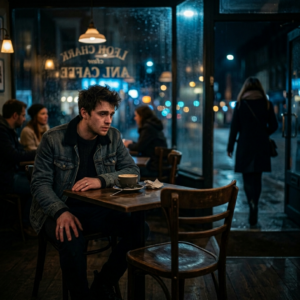
This is not a cinematic explosion. There are no dramatic car chases, no rain-soaked shouting matches on a busy street corner, and no grand betrayals that make the evening news. Instead, this is a chronicle of the quietest kind of devastation—the kind that happens in the microscopic spaces between text messages and the cold air of a half-empty coffee shop. My name is Lucas, and for a long time, I walked through life under the impression that I understood the anatomy of pain. I thought pain was a sudden fracture, a sharp noise, a moment of impact.
But I was wrong. True pain, the kind that reconfigures the very DNA of your daily life, is a slow, silent erosion. It is the steady accumulation of empty chairs, unread notifications, and the heavy realization that someone who was once your “peace” has become a phantom. This is a story for anyone who has ever sat in a crowded room and felt the sudden, sharp sting of a memory. It is a story about Olivia, about university halls that felt like cathedrals, and about the brutal, beautiful lesson that love—even when it leaves—is the only thing that truly makes us human.
CHAPTER 1: THE ACCIDENTAL GEOGRAPHY OF LOVE
The world didn’t change with a thunderclap. It began in the most mundane setting imaginable: a lecture hall at our university. I remember the specific quality of the light that day—dust motes dancing in the afternoon sun that filtered through high windows. I was at my usual station, a solitary desk in the back, hunched over my phone as a shield against the world. I was the observer, the quiet one, the man who preferred the safety of the sidelines to the vulnerability of the game.
Then, there was Olivia.
She didn’t just enter the room; she seemed to bring the vitality of the outside world with her. I heard her laughter before I really saw her—a sound that was soft yet impossibly vibrant. She was surrounded by friends, but she possessed an gravitational pull that made my heart, usually so disciplined, do something entirely unauthorized. When she eventually approached and asked, “Is this seat free?” it was a simple mechanical question. I said, “Yes.” It was one syllable, a tiny exhaled breath, but in the grand architecture of my life, it was the cornerstone of everything that followed.
CHAPTER 2: THE CONVERSATION THAT NEVER ENDS
We moved from “Is this seat free?” to the deep, late-night excavations of the soul. At first, our bridge was built of homework and lecture notes, the safe currency of university students. But slowly, the currency changed. We began trading dreams for fears. We spent hours walking after class, our footsteps synchronized on the pavement, discovering that the most profound intimacy isn’t always found in grand gestures, but in the “warm, safe” silence between two people who no longer feel the need to perform.
I never said it out loud back then, but Olivia became my peace. In a world of noise and academic pressure, her presence was a sanctuary. I remember sitting in a small, dimly lit cafe—the smell of roasted beans and the hiss of the espresso machine forming a sensory cocoon around us. She was stirring her drink, lost in the swirl of the liquid, when she asked if I believed in love. I told her the truth: love is a double-edged sword. It is the highest peak and the deepest valley. She smiled that soft, quiet smile and agreed. We were two people standing on the edge of a cliff, admiring the view, completely unaware that the wind was about to change.
CHAPTER 3: THE HIGH SUMMER OF FOREVER
There is a specific kind of bravery required to say “I like you” for the first time. My heart was a frantic drum against my ribs when I finally confessed. I expected the world to stop, but instead, Olivia just looked at me with those eyes that seemed to see everything and said, “I like you, too.”
What followed was the “perfect” season. We became a collective “we.” We shared food, we shared movies, we shared the ridiculous, tiny jokes that only make sense to two people in love. We took photos that we thought would be the archive of our old age. Olivia once whispered, “I hope this never ends,” and with the naive arrogance of the happy, I promised her it wouldn’t. We used the word “forever” as if we owned it, as if “forever” wasn’t a vast, terrifying ocean that we hadn’t yet learned to navigate.
CHAPTER 4: THE GRADUAL COOLING OF THE UNIVERSE
The end didn’t start with a fight. It started with a delay.
A text message that used to take seconds to return now took hours. A voice that used to be full of warmth became “quiet” and “distant.” I felt the temperature of our relationship dropping, but I tried to heat it with my own denial. I told myself she was busy. I told myself I was being paranoid. But the soul knows when it is being evicted long before the mind accepts the notice.
The night I called and she didn’t answer was the first time the silence felt aggressive. My mind became a courtroom where I was both the prosecutor and the defendant—What did I do wrong? Is she okay? Why is the world turning gray? When her reply finally came the next day—”I’m sorry. I was busy.”—it was a single, cold sentence that felt like a wall of ice. We still talked, but the “warmth” was a ghost. We were going through the motions of a dance, but the music had stopped playing.
CHAPTER 5: THE CALM BEFORE THE VOID
We returned to that same cafe, the place that had once been our sanctuary. But the geography had changed. The air felt heavy, and the chairs felt further apart. I looked across the table at Olivia, searching for the girl who used to laugh at my bad jokes, but I found a stranger wearing her face.
“Lucas, I think we need to talk,” she said. My heart dropped. It’s a cliché because it’s a physical reality—the feeling of the floor vanishing beneath your feet. She took a breath and delivered the sentence that broke the world: “I don’t feel the same anymore.”
There was no anger. There was no third party. There was just the terrifying, calm reality that feelings can simply… fade. I asked her if I had failed in some way. She shook her head and told me I had done everything right. That was the cruelest part. In that moment, I realized that you can do everything “right” and still lose. You can be the perfect partner and still find yourself standing alone in a cafe, watching the person you love walk out the door without a “big goodbye.” Just gone.
CHAPTER 6: THE SILENCE OF THE PHONE
Walking home that night, the city felt like a foreign planet. I got home and checked my phone—a reflex I couldn’t break. No messages. No “good night.” Just a screen reflecting my own tired face. That silence was louder than a scream. It was a vacuum that sucked the air out of the room.
The next few days were a masterclass in performative normalcy. I went to class. I smiled. I spoke to people. But inside, I was obsessively re-reading our old messages, from the first “hi” to the final “I’m sorry.” The tears didn’t come immediately; they waited until the weight of the “future that would never happen” became too heavy to carry. I cried for the routines we had built—the morning texts, the late-night calls—the tiny threads that, when woven together, make up the fabric of a life. Why did she change? Why wasn’t I enough? The silence gave no answers.
CHAPTER 7: THE LONG ROAD TO THE PARK
Healing is not a straight line; it is a jagged, exhausting climb. I tried to delete her. I tried to erase the photos and the messages, thinking that if I cleared the digital space, the mental space would follow. But memories don’t live in silicon; they live in the heart.
I eventually learned that running away from the pain only makes it chase you harder. I had to sit with it. I had to accept that I wasn’t okay. One day, I found myself back at the park, sitting on the very bench where we once sat together. For the first time, I didn’t feel broken. I saw the world moving on—people laughing, dogs running, life continuing its indifferent, beautiful march. I realized that my world had ended, but the world had not. And if the world was still moving, perhaps I could, too.
CHAPTER 8: THE LESSON IN THE LINT
I am not the same Lucas who sat in the back of that lecture hall. That Lucas thought love was a destination. Now I know that love is a teacher, and its most important lessons are often found in its absence. I don’t hate Olivia. I don’t blame her for the way her heart changed, because the heart is not a machine we can control.
What we had was real. It mattered because it proved I could love truly and deeply. The pain made me stronger, more empathetic, and more human. It taught me that while “forever” is a beautiful idea, the “now” is all we ever truly possess. If you are reading this and you are in the middle of your own silence, please know this: Your story is not over. The pain you feel is just the measure of how much you were brave enough to care.
A CALL TO THE GLOBAL COMMUNITY
Love is the universal language, and heartbreak is its most difficult dialect. We want to hear from you. Have you ever experienced a “quiet” ending? How did you find the strength to walk past the places that held your memories? Share your story in the comments below. Let us remind each other that while love can break us, it is also the only thing that can put us back together, differently and stronger than before.
Disclaimer : This content may be created by AI for entertainment purposes. Any resemblance to real persons, events, or places is coincidental.






