The 600-Dollar Death Sentence: How a Borrowed Dime and a Pipe Wrench Shattered an Ohio Town
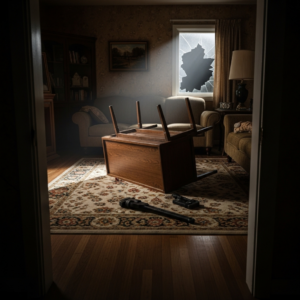
The quiet hum of an Ohio evening was violently interrupted by a chilling discovery. It wasn’t the sound of breaking glass or a frantic scream that alerted the authorities; it was the eerie, unnatural silence of a home that should have been peaceful. The air inside the house felt thick, metallic, and heavy with the unmistakable scent of a tragedy that had just unfolded.
“Oh my God, is this… is this a murder?” a first responder whispered, his voice trembling as his flashlight cut through the gloom. The front door had been forced, the wood splintered around the lock, but the real horror lay just beyond the threshold.
An 81-year-old man, Howard Berman, lay brutalized on the floor of his own home. He was a grandfather, a recent cancer survivor, a man who occasionally forgot his way home but always remembered to be kind. Now, he was the victim of a savagery so extreme it defied logic. The house was turned upside down, yet his guns and valuables remained untouched. This wasn’t a burglary gone wrong. This was a targeted execution.
Why would anyone harbor such venom for an 81-year-old man? The answer lay buried in a timeline of a missing $600, a neighbor living in a tent, and a chilling interrogation room confession that would shake the very foundations of this tight-knit community.
Chapter I: The Blood on the Floorboards and the Missing $600
At approximately 7:00 PM on a Wednesday evening, Kayla Berman arrived at her father-in-law’s house. She carried his post-surgery medication, expecting to find Howard resting. Instead, she found a scene straight out of a nightmare. Howard was unresponsive, his body battered, his face bruised, and a sticky pool of syrup splattered across the living room like a chaotic abstract painting.
When the police arrived, the disorientation was palpable. “There’s so much that could have happened to him,” an officer muttered, surveying the chaotic room. It looked as though Howard had been beaten in one spot, dragged across the floor, and violently propped up in another. The brutality was staggering, especially considering the victim’s frailty.
As detectives scoured the scene, they recalled a welfare check they had conducted just weeks prior. Howard had wandered off, lost in the fog of advancing dementia. His family had noted that he carried cash and occasionally lent money to neighbors, making him a walking target. The tension in the air thickened as the police linked this to another unsolved local murder—a 68-year-old man shot on his porch just eight kilometers away. Was a serial killer targeting the elderly?
The first real crack in the case came from Kayla. Her voice trembled as she recounted a bizarre phone call from Howard just two days prior.
“Dad called me,” she explained, her eyes wide with lingering confusion. “He said he needed help. He said his money was all gone. And then he told me the bank had printed something for him… he said he needed $600.”
Kayla had asked him why, but the old man’s mind was slipping, and his answers were vague. He only mentioned one name: Jackie Miller.
Chapter II: The Tent in the Shadows
Jackie Miller was a ghost of a neighbor. She was a woman known around the block for borrowing sugar, running errands, and occasionally bringing Howard food. But recently, the dynamic had shifted. Neighbors whispered that Jackie was a thief, a woman who scavenged from anyone kind enough to open their door.
Howard had confided in his son, Mike, that he had lent Jackie money to stop her bank from foreclosing on her. But Jackie had never paid it back, and Howard had recently decided to cut her off. The financial lifeline had snapped.
The police learned that Jackie was no longer living in her house; she was squatting in a makeshift tent nearby, driven to the fringes of society by a crushing methamphetamine addiction. The most damning detail came from a neighbor, Ronda Clark, who casually mentioned seeing Jackie walk into Howard’s house at 4:00 PM on the day of the murder—and never walk out.
Armed with a warrant, the police breached Jackie’s dilapidated home. “Police Department Search Warrant! If you are inside, speak up!” an officer yelled, his gun drawn. The house was a squalid ruin, unfit for human habitation. But Jackie was nowhere to be found. She had vanished into the Ohio twilight.
Chapter III: The Capture and the Chemistry of Deception
Hours later, a tip led the police to a friend’s house where Jackie was hiding in a bedroom. When she emerged, she was a portrait of frantic denial. As the officers searched her, they found hundreds of dollars in cash and a substantial stash of crystal meth.
“Can I… can I get my things?” Jackie stammered, her eyes darting nervously. “My money on the floor…”
“Where did you get this money?” an officer demanded.
“I borrowed it! From a friend!” she insisted, her voice shrill. But the friend she named had already tipped off the police, horrified because Jackie had casually mentioned earlier that day that she “might have killed someone.”
The detectives knew they had a tiger by the tail. If Jackie, fueled by narcotics and desperation, realized she was being cornered for murder, she would shut down completely. They needed a psychological crowbar.
Chapter IV: The Interrogation Masterclass
In the sterile, claustrophobic interrogation room, the detectives initiated a masterclass in psychological manipulation. They did not mention murder. They kept the atmosphere disarmingly casual, allowing Jackie to believe she was only in custody for drug possession.
“What did they tell you when they brought you in?” the detective asked, his tone almost friendly.
“Nothing!” Jackie complained. “That’s why I kept asking what I did. I mean, what are the charges? I know it’s drug-related.”
“It’s a felony,” the detective confirmed, smoothly avoiding the ‘M’ word.
He asked her to recount her day. Jackie, feeling a false sense of security, wove a fabricated timeline. She claimed she visited Howard’s house around 2:00 PM just to use the phone, and that as she left, an unknown man approached the porch. It was a classic deflection, blaming a phantom suspect.
But the detective noticed something she had overlooked.
“Do you mind standing up for me?” he asked suddenly. “Why?” she hesitated. “Show me this,” he pointed to her jeans. “What is that?” “I think it’s rust. From my bike,” she stammered. “And on your shoe?” “That’s paint. Polyurethane.”
The detective leaned in, the casual facade melting away into a cold, hard stare. “Listen to me. That is blood on your shoe.”
The air in the room evaporated. The physical evidence—the rust-colored stains that were actually the lifeblood of an 81-year-old man—had trapped her.
Chapter V: The “Self-Defense” Illusion
For the next two hours, Jackie vehemently denied the allegations. The detectives realized they needed to offer her a psychological exit route. They shifted their strategy, suggesting that perhaps Howard had provoked her, that perhaps she had acted in self-defense. They needed her to place herself in the room with a weapon in her hand.
“We know you killed him,” a detective said, his voice dropping to a sympathetic murmur. “The only question is why. Was he trying to be a sugar daddy? Did he want something from you?”
Jackie grabbed the lifeline. “Yes,” she whispered, her narrative morphing instantly. She claimed Howard had made unwanted sexual advances, reaching for her chest, refusing to let her go.
“Did this make you angry?” the detective prompted. “Did you hit him with something to get away?”
“I don’t even know what it was,” Jackie cried. “Something weird… like vise grips. On his coffee table.” “How many times did you hit him?” “Three or four times. I don’t know.”
She admitted to taking a meager $20 from his pocket and “wiping down” the murder weapon before fleeing. The confession was secured.
Chapter VI: The Brutal Truth and the Final Verdict
The autopsy dismantled Jackie’s fabricated tale of self-defense. There was no evidence of a sexual assault struggle. What the medical examiner found was pure, unadulterated savagery: Howard had been struck 18 times, including 14 devastating blows directly to the top of his head with a heavy pipe wrench.
When arrested, Jackie had hundreds of dollars and a large quantity of meth, a stark contrast to the $20 she claimed to have stolen. The police pieced together the real, harrowing story: Jackie, deep in the throes of a brutal meth withdrawal, had demanded the $600 Howard had recently withdrawn. When the elderly man, tired of being her ATM, finally said no, her mind fractured. She bludgeoned him to death for the price of a drug bindle.
In December 2017, 52-year-old Jackie Miller was convicted of murder and aggravated robbery. Under Ohio law, she was sentenced to life in prison, with the possibility of parole after serving a minimum of 15 years.
Deep Reflection: The Monster of Addiction
The tragedy of Howard Berman is a stark, agonizing reminder of how addiction destroys not only the afflicted but also the innocent bystanders in its path. For $600 and a momentary chemical high, an 81-year-old man—who had survived cancer and the ravages of time—was slaughtered on his own living room floor by a woman he had previously tried to help.
Is 15 years enough for a crime of such calculated brutality? The justice system offers a window for parole, but the family of Howard Berman faces a life sentence of grief. Methamphetamine doesn’t just alter brain chemistry; it strips away humanity, turning neighbors into monsters and living rooms into slaughterhouses.
What are your thoughts on this tragic case? Do you believe the possibility of parole after 15 years is justice for an 81-year-old victim? How can communities better protect their vulnerable elderly populations from the collateral damage of the addiction crisis? Please share your emotions and opinions in the comments below.
Disclaimer : This content may be created by AI for entertainment purposes. Any resemblance to real persons, events, or places is coincidental.






