The 10 Percent Shadow: When a Security Camera Exposes a Fiancée’s Lie and the Justice System Fails
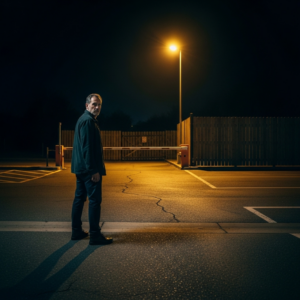
The darkness enveloping Mobile, Alabama, on the late evening of May 17, 2020, was deceptive in its stillness. The air was thick with the humid weight of the impending summer, and the only sound was the distant, muffled hum of city traffic. At 10:09 PM, a seemingly mundane moment was unfolding in a dim parking lot. Maurice Timons, a forty-eight-year-old high-pressure water technician, stood quietly beside his vehicle, preparing to leave. The security camera footage captured him pausing, his body language shifting as a subtle, almost imperceptible vibration shook the wooden gate behind him. Most would have ignored it, but Maurice turned. He took a slow, deliberate step toward the shadow, his eyes narrowing, attempting to decipher whether the sound was just the wind or something far more sinister.
That single decision to turn around sealed his fate.
From the pitch-black void behind the gate, a figure wearing a dark ski mask lunged forward, raising a high-powered rifle. There was no demand for money, no shouted warning, no hesitation. The deafening crack of a gunshot ripped through the silent night. Maurice instinctively turned and ran, his body fueled by a desperate, primal surge of adrenaline, but the bullet was faster. He collapsed onto the cold, unforgiving pavement in front of his car, his life spilling out onto the concrete. The masked assassin vanished back into the darkness as seamlessly as a phantom, every footstep perfectly calculated. This was not a random robbery gone wrong; it was a methodical execution. And the true horror was only just beginning to unfold.
The Chilling Silence Inside the Car
The first 911 call pierced the dispatch center with the frantic, terrified voice of Maurice’s fiancée. She, along with a friend, had been at the scene. Through her panicked sobs, she painted a picture of sudden tragedy, claiming she had been backing her car out of the driveway when she heard the shots. She swore to the operators that she had not seen the shooter, crying out that she only realized Maurice was bleeding when she eventually stepped out of the vehicle to check on him. Her voice trembled with what sounded like pure heartbreak, a woman shattered by the sudden loss of the man she was supposed to marry.
But the cold, unblinking eye of the security camera told a profoundly different, terrifying story.
When seasoned investigators reviewed the CCTV footage, a spine-chilling secret was exposed. Immediately after the gunshot echoed, as Maurice fell to the ground and the killer fled, a car slowly and quietly backed out of the driveway. Inside that vehicle sat Maurice’s fiancée and her friend. Neither woman opened a door. Neither woman screamed out of the window. Neither woman rushed to the bleeding man lying mere feet away. They sat in the suffocating silence of the cabin, making no immediate reaction that mirrored the shock of witnessing a loved one being gunned down.
This revelation struck the detectives with a wave of deep, unsettling confusion. How could a woman sit paralyzed in a vehicle, watching her future husband collapse from a rifle shot, and then calmly tell the police she had seen absolutely nothing? The sharp contrast between her hysterical 911 call and the cold, motionless reality on the video created a psychological shockwave. If the camera captured the absolute truth, what dark secret was she so desperately trying to hide?
The Interrogation Room and the Simmering Resentment
The detectives brought the fiancée back into the interrogation room. The atmosphere had shifted; the initial sympathy offered to a grieving widow was replaced by the intense, suffocating pressure of a criminal investigation. They placed the video evidence on the table, their voices heavy with accusation. They demanded she drop the act, stating clearly that the camera had captured everything and there was no way she had missed the execution happening right before her eyes.
Despite the blinding glare of the interrogation lights and the relentless psychological pressure, she maintained her innocence. She swore she saw no one. However, as the detectives probed deeper into the final 24 hours of Maurice’s life, the pristine facade of their relationship began to crack, revealing a foundation built on domestic volatility and deep-seated resentment.
She revealed that Maurice, a man who cared for his elderly mother and was a part of a massive family of thirteen siblings, was on probation for drug-related charges. Earlier that day, he had failed a drug test. The tension had spiraled out of control when they returned to their apartment. She described his escalating paranoia, how he paced the floor, claiming that the “white cops” were targeting him and refusing to ever go back to the probation office. The stress ignited a furious argument. She admitted to staring him down, telling him to take his garbage and leave. Maurice had walked out, and she claimed she simply lay in bed watching television. This seemingly mundane argument laid bare a profound exhaustion in her voice. The detectives began to wonder: could this simmering domestic hostility be the catalyst? Had this exhausted, resentful woman orchestrated a hit to rid herself of a chaotic life?
The Friend’s Confession and the Phantom Named Marco
When the fiancée’s narrative yielded no direct confession, investigators employed a different tactic. They asked her who she believed could have pulled the trigger. Without hesitating, she shifted the spotlight, suggesting that her friend—the woman who had been in the car with her—might have called someone to deal with Maurice.
The detectives immediately brought the friend into the glaring light of the interrogation room. The psychological pressure mounted as they cornered her with the inconsistencies in their timelines. Finally, the friend’s resolve shattered. Her voice trembled as she confessed that Maurice had been violently banging on the door earlier that night, in a drunken, aggressive rage. Terrified and exhausted by the constant cycle of abuse her friend endured, she admitted to pulling out her phone. She hadn’t called the police; she had called a man named Marco.
She insisted through her tears that she only wanted Marco to come over and scare Maurice away. She never intended for a gun to be drawn. The investigative picture suddenly crystallized. This was not a random encounter. The killer had been summoned. Marco had lurked in the shadows, waiting for the perfect moment to strike. The friend’s desperate plea for protection had morphed into a horrific, calculated assassination.
The Alibi Game and the Ten Percent Gap
With the target now identified, investigators dug into the archives and pulled the file on Marco Carson, a man with a violent history involving firearms and stolen property. When brought into the interrogation room, Marco was a fortress of calm defiance. He presented a practiced, vague alibi, claiming he had spent the entire night with a woman in Chickasaw, roughly ten miles away from the crime scene.
Detectives raced to verify his story, interviewing the woman he claimed to be with. She confirmed he had been at her home, but her memory of the timeline was terrifyingly imprecise. She believed he was there between eight and ten in the evening, right before she left for work. In a murder investigation, minutes are the difference between life and death, freedom and incarceration. Her inability to pinpoint his exact location at 10:09 PM left a massive, gaping hole in his defense.
The digital breadcrumbs, however, painted a damning picture. Marco’s cell phone data pinged a tower on Virginia Street, less than half a mile from the murder scene, a mere ten minutes before the fatal shot was fired. He had lied to the detectives about his location. To the investigators, the puzzle was complete. They had the motive, the witness testimony of the phone call, the flawed alibi, and the digital footprint placing him at the scene. They arrested Marco Carson for the first-degree murder of Maurice Timons.
The Fall of the Gavel and the Reversal of Justice
After thousands of hours of painstaking police work, the case finally arrived in the Mobile County Circuit Court in May 2023. The prosecution was confident. They believed the cellular data, combined with the timeline of the frantic phone call, formed an inescapable net around Marco Carson.
But justice is a blind, often clinical machine. Before the defense even had to summon a single witness, Judge J. York delivered a ruling that sent shockwaves through the courtroom. He dismissed the murder charges entirely.
The judge’s reasoning was a devastating blow to the prosecution. The cell phone data, while placing Marco’s phone in the general vicinity, only proved that the device pinged a central tower. It could not pinpoint his exact, physical coordinates in the parking lot at the precise second the trigger was pulled. The defense argued successfully that there was simply no physical evidence tying Marco to the rifle or the driveway.
For the family of Maurice Timons, the drop of the gavel was not a sound of closure, but a devastating echo of failure. A man had been ambushed and slaughtered, and the accused was walking away without a jury ever deliberating his fate.
Deep Reflection: The Cruel Mathematics of the Law
The tragedy of Maurice Timons exposes a harrowing reality about the nature of our legal system. To an outside observer, the narrative feels ninety percent complete. We have the toxic arguments, the desperate phone call for a protector, the masked assassin, and the cell phone pinging in the dark just blocks away. Common sense screams that the puzzle is solved.
But the law does not operate on common sense; it operates on absolute, undeniable proof. The system requires one hundred percent certainty to strip a man of his freedom. And that missing ten percent—that tiny margin of digital ambiguity—was enough to allow a suspected killer to walk out of a courtroom unpunished. It is a cruel, agonizing truth that justice in reality does not align with the moral compass of our hearts. The truth of what happened that humid night in Alabama is clear to everyone involved, yet it remains legally unspoken.
What are your thoughts on this agonizing outcome? Does a 90% complete picture justify a conviction, or must the law demand absolute perfection, even if it means a killer goes free? Share your emotions and perspectives in the comments below. Let us know where you draw the line between moral truth and legal proof.
Disclaimer : This content may be created by AI for entertainment purposes. Any resemblance to real persons, events, or places is coincidental.






