The Night a CEO Found His “Cleaning Lady” Rewriting $200 Million Worth of Code
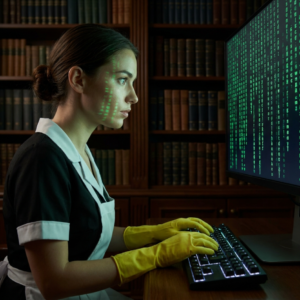
The silence of a corporate headquarters at midnight has a specific, heavy quality. It is the sound of dormant ambition, of empty hallways that usually buzz with the frantic energy of the world’s brightest minds. In the executive library of Morrison Technologies, the air was cool and smelled faintly of floor wax and old paper. Eleanor Hayes stood in the center of this stillness, a duster poised mid-air like a conductor’s baton. But she wasn’t looking at the dust. She was staring at the wall-mounted screen where cascading lines of neon-green code pulsed like a failing heartbeat.
For eight months, Eleanor had been a ghost in these halls. At twenty-six, she had mastered the art of being invisible. To the world, she was just the night-shift housekeeping girl, draped in a black dress with white lace trim, her blonde hair tucked neatly under a headband. No one looked her in the eye. No one asked her name. To the high-powered tech executives, she was merely the person who emptied trash bins filled with crumpled printouts and abandoned energy drink cans. They saw a maid’s uniform; they didn’t see the Master’s degree in Computer Science from MIT. They saw a cleaning cart; they didn’t see the woman who had been a rising star at a rival firm until a male colleague stole her soul’s work and buried her career.
The Crashing Heart of Prometheus
The screen in front of Eleanor displayed the “Prometheus Project”—Morrison Technologies’ most ambitious, $200 million machine learning algorithm. It was designed to revolutionize financial modeling, to change the world. But Eleanor knew, with the cold certainty of a mathematician, that it was fatally, catastrophically broken.
For months, she had been piecing the puzzle together from the fragments of discarded notes she found in the trash. She had watched from the shadows as the company’s elite programmers grew gray with exhaustion, unable to see what was staring them in the face. The system kept crashing at critical intervals, producing results that were nonsensical, jagged, and wrong.
Eleanor’s fingers itched. The logic of the code was singing to her, a discordant tune she knew how to harmonize. It was a fundamental architectural flaw—the neural networks were being forced into a linear framework that couldn’t handle the multidimensional data sets being fed into them. It was, as she would later describe it, like trying to force a majestic, sprawling tree through a narrow paper shredder.
The Midnight Encounter
Before she could talk herself out of it, Eleanor set down her duster. The transition from cleaning lady to architect happened in a heartbeat. She sat in the plush executive chair, her yellow rubber cleaning gloves feeling alien and clumsy against the high-end mechanical keyboard. Despite the latex barrier, her fingers began to fly with a practiced, rhythmic precision she hadn’t allowed herself to feel in nearly a year.
“There you are,” she whispered to the monitor. She navigated through thousands of lines of programming, highlighting the problematic function. Her heart raced as she began to refactor the core algorithm, sketching out a dynamic memory allocation system that would finally allow the neural networks to breathe.
“What the hell are you doing?”
The voice was like a physical blow. Eleanor jumped, her heart hammering against her ribs so hard it hurt. Standing in the doorway was James Morrison—the founder, the CEO, the man known for an intensity that could wither a seasoned developer. At 35, he was the king of this castle, and his expression was a terrifying mix of shock and mounting fury.
The Truth Behind the Mask
“I… I’m so sorry, Mr. Morrison,” Eleanor stammered, standing so quickly her chair nearly toppled. She backed away, trying to hide her gloved hands behind her back. “I was just cleaning and I saw the screen and I—”
“You were typing,” James interrupted, his strides long and predatory as he moved toward the desk. His eyes darted from the maid in front of him to the screen, taking in the Security Level 5 information she had just modified. “That’s classified. What were you trying to do?”
Eleanor had a choice. She could lie, play the “clumsy girl” card, and lose her job quietly. Or she could reclaim her voice. She chose the latter.
“The algorithm has a fundamental flaw,” she said, her voice trembling but gaining strength. “You’re feeding recursive data structures through a pipeline that can’t handle them. It won’t work no matter how many times you try.”
James stared at her, the silence in the library becoming absolute. “How would you know that?”
“Because I’ve been watching you fail for eight months,” Eleanor replied, her chin lifting. “I see the error logs in the trash. I read the notes your programmers leave behind. And… I have a Master’s from MIT in machine learning.”
The Ghost in the Machine
The revelation was a tectonic shift. James looked at the yellow rubber gloves, then at the girl, then at the whiteboard where Eleanor began to draw complex diagrams of neural network architecture. For the next two hours, the CEO didn’t see a maid; he saw a peer. He challenged her, pushed her, and watched in awe as she dismantled a problem that had stumped his entire $200 million team.
“My team has been trying to fix this for six months,” James said, his voice dropping to a whisper. “And you just solved it in two hours while wearing cleaning gloves.”
But the question remained: Why was an MIT graduate emptying trash cans?
The story spilled out of her—the stolen work, the gaslighting, the labels of being “difficult” and a “troublemaker” when she tried to defend her intellectual property. The tech industry had crushed her, and the cleaning job was her sanctuary, the only place where she could exist without fighting. James listened with an intensity that was almost unnerving. His own mother had been a programmer in the 1970s, a woman who watched men take credit for her work until the day she died.
“I built this company promising I’d create something different,” James said, his voice rough with suppressed anger—not at her, but at the system. “And I just realized I’ve been walking past brilliance every night, watching it empty my trash cans because the system is so broken.”
A New Architecture of Respect
Six months later, the transformation was complete. The “Prometheus Project” didn’t just work; it thrived, generating hundreds of millions in revenue. But the real change wasn’t in the code—it was in the company. Eleanor Hayes was no longer a ghost; she was the Lead Architect, her name emblazoned at the top of the project files.
The Morrison Technologies board of directors gave her a standing ovation, but Eleanor’s eyes were on the development floor. Because of her, four more women had been hired into senior roles. Because of her, a new system of code attribution was in place, ensuring that brilliance was recognized, no matter who it came from.
Two years later, Eleanor stood on a stage at a global tech conference. She wasn’t wearing a maid’s uniform; she was wearing a suit of confidence. She told her story—the story of the yellow rubber gloves—to hundreds of young women who looked like they were tired of hiding.
“Sometimes,” Eleanor told the crowd, “we have to hide to survive. There is no shame in survival. But if you’re lucky, someone will see you anyway. Someone will look past the uniform and recognize what you’re capable of. And when that happens, take the chance. Stop hiding.”
Deep Reflection: The Brilliance in Plain Sight
Eleanor’s story is a powerful reminder that the person who can solve your biggest problem isn’t always the one in the corner office. Sometimes, she’s the one cleaning it. This isn’t just a story about a “lucky break”; it’s a story about the structural failures that force extraordinary talent into the shadows.
It asks us a difficult question: Who are we overlooking in our own lives? Whose brilliance are we ignoring because they don’t “look the part”? Morrison Technologies didn’t just gain a great architect that night; they gained a soul.
Have you ever felt like you had to hide your true talents just to survive? Or have you ever been the one to “see” someone whom everyone else was ignoring? We want to hear your stories of resilience and recognition in the comments below. Let’s celebrate the brilliance that refuses to stay hidden.
Disclaimer : This content may be created by AI for entertainment purposes. Any resemblance to real persons, events, or places is coincidental.






