How a Day of Chaos Led Sophia to Her Real-Life Hero
The city of London is often a blur of steam from espresso machines and the relentless rhythm of Jack’s Cafe, where Sophia Reynolds had spent her days serving coffee and dreaming of a world framed in 35mm. We often believe that our lives are destined for the grand stage—that our happiness is tied to the glamour of fame and the proximity to stars like Fabio Fatelli. But as Sophia was about to discover, the universe has a funny way of tearing up your script and replacing it with something far more grounded, far more chaotic, and ultimately, far more beautiful. This is the story of a woman who traveled to Norwich to be in a movie, only to find that the most important role she would ever play was simply being herself in the eyes of a man who didn’t need a camera to see her worth.
CHAPTER 1: THE FAREWELL TO THE FRYPAN
For six long days, Sophia Reynolds had been living in a state of electric anticipation. She had said her goodbyes to the clatter of Jack’s Cafe, leaving behind the smell of burnt toast and the demanding regulars of London. Her destination was Norwich; her mission was cinematic glory. She was to be an extra in a major motion picture starring the one and only Fabio Fatelli. To Sophia, Fabio was more than an actor; he was a god of the silver screen, a man whose films she had devoured with a heart full of yearning.
As she stepped off the train in Norwich, the air felt different—crisp, full of possibility. She wanted to laugh, to shout, to grab strangers by the shoulders and tell them, “I am going to be in a film with Fabio Fatelli!” Of course, she was only an extra. She had no lines. She would be a face in a crowd. But in her mind, she was stepping into a dream.
It was 8:00 a.m. The production at Chapel Field Park wasn’t scheduled until 10:00 a.m. Sophia had two hours—an eternity for a woman whose heart was racing at a hundred miles an hour. She decided to drop her bags at her hotel first. She adjusted the strap of her bag, took a deep breath of the Norfolk air, and began to walk. She was a woman on the verge of a new life, unaware that the first act of her day was about to take a very strange turn.
CHAPTER 2: THE WIND, THE MAP, AND THE MISTAKE
The geography of Norwich is a labyrinth of historic streets, and Sophia, despite her excitement, was hopelessly lost. When a woman stopped her to ask for directions to Bank Street, Sophia smiled warmly. “I don’t know Norwich,” she admitted, “but I’ve got a map.”
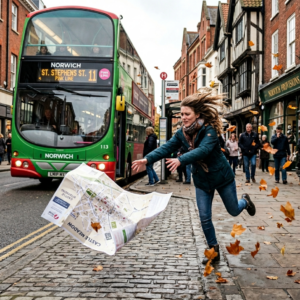
The map was massive, a sprawling sheet of paper that seemed to have a mind of its own. As Sophia unfolded it, a sudden, violent gust of wind swept through the street. In an instant, her carefully styled hair was whipped across her face, blinding her. She fought with the paper, but the wind was a mischievous thief. It snatched the map from her hands and sent it dancing down the pavement.
“Come back here!” Sophia shouted, her laughter bubbling up despite the frustration. She chased the map as it somersaulted past shops and pedestrians, finally watching it disappear under the belly of a stationary bus. She waited for the vehicle to groan to a halt before retrieving the crumpled paper.
Panting and triumphant, she walked back to where the woman had been waiting. But the street was empty. The woman was gone. Sophia looked up and down the road, confused. That’s funny, she thought. She shrugged, tucked the map into her bag, and continued her journey. But as she walked, something felt… different. The weight of the bag on her shoulder wasn’t quite right. She peered inside and gasped. The items were unfamiliar. A different purse, different keys, a different life.
The realization hit her like a physical blow: in the chaos of the wind, they had swapped bags. The woman had Sophia’s things—her money, her hotel information, her identity. And Sophia was left with the belongings of a stranger.
CHAPTER 3: THE POLICEMAN WITH THE BEAUTIFUL EYES
Panic is a cold, sharp thing. Sophia ran. She saw the blue lamp of a police station and burst through the doors, her voice cracking with urgency. “My bag!” she shouted at the officer behind the desk. “She’s got my bag! You must help me!”
The policeman didn’t look up immediately. He was focused on a ledger, his pen moving with a calm, bureaucratic rhythm that infuriated her. “Sit down please, miss,” he said, his voice a steady anchor in her storm of anxiety.
Sophia didn’t want to sit. She wanted action. She wanted sirens and a high-speed chase. “You don’t understand,” she pleaded. “That bag has everything in it!”
Finally, the officer looked up. Sophia froze. He had dark, deep eyes—not like Fabio’s, which were engineered for the camera—but eyes that held a quiet, genuine beauty. Why am I thinking about a policeman’s eyes right now? she scolded herself.
The station was crowded. Three or four people sat on the hard benches, each waiting for their own small dramas to be resolved. Sophia looked at the clock. The minutes were ticking toward 10:00 a.m. If she didn’t leave soon, she would miss her call time. She would miss Fabio.
“Please, miss,” the officer insisted. Sophia slumped into a chair, her legs bouncing with nervous energy. It took thirty minutes of agonizing waiting before she was called to the desk. She gave her name—Sophia Reynolds—and explained the bag swap. The officer opened the stranger’s bag, but it was a dead end. No name, no ID.
“You must leave it here,” he told her, his tone kind but firm. He took her number and handed her a slip of paper with the station’s contact info. “Come back this afternoon or phone us.”
“Thank you,” Sophia said, turning to leave. As she walked away, she heard him call out, “Next please! Sit down please, Mr… sit down.” Sophia smiled to herself. Mr. Sit Down, she thought. That’s a perfect name for him.
CHAPTER 4: A CRYING BOY AND MR. SIT DOWN
Back on the street, Sophia consulted her map. Chapel Field Park was close. She could still make it. But as she hurried along, a small tug on her coat stopped her. A little boy, no more than three or four years old, stood beside her. His face was red, his cheeks tracked with tears.
“Hello,” Sophia said, kneeling to his level. “Where’s your mother?”
The boy only sobbed harder. Sophia looked around the bustling street, but no frantic mother appeared. She knew she was risking her career, her dream, her one chance at the film, but she couldn’t leave him. She took his small, sticky hand in hers. “Don’t cry,” she whispered. “Come on. Come and see Mr. Sit Down with me. He’s a policeman.”
They entered the station again, the boy’s wails echoing off the high ceilings. Sophia marched straight back to her officer’s desk. He was speaking to a woman, but he paused when he saw Sophia and the crying child. “Miss Reynolds?”
“This boy can’t find his mother,” she said breathlessly.
The officer stood up, and Sophia noticed for the first time how tall he was. He leaned over the desk, his expression softening into something incredibly gentle. “What’s your name?” he asked.
The boy stopped crying, mesmerized by the officer’s uniform. “Peter,” he sniffled. Then, looking up at the man, he asked, “Are you Mr. Sit Down?”
Sophia felt a flush of heat climb her neck. Oh, help. The policeman looked at her, his dark eyes dancing with amusement. “I’m PC George Cooper,” he told the boy.
At that moment, a woman burst into the station, screaming Peter’s name. The reunion was a chaotic mess of hugs and renewed tears. George smiled at Sophia, a real, warm smile that made her stomach flip in a way Fabio Fatelli never had.
“Thank you for your help, Miss Reynolds,” George said.
“I must go!” Sophia realized, her eyes wide. “Work! The film! See you this afternoon!” And she ran.
CHAPTER 5: CRASHING INTO THE DREAM
Sophia reached Chapel Field Park at 9:59 a.m. She was disheveled, her hair a bird’s nest from the wind, but she was on time. Within thirty minutes, she was transformed. The film, Beautiful Young Things, was set in the 1960s. Sophia was fitted with a massive, beehive hairpiece. From “bad hair day” to “big hair day,” she joked to herself.
The scene was simple: Fabio Fatelli, playing a singer named Ricky Burns, would walk out and the crowd of extras would go wild. The director shouted instructions: “You love Ricky Burns! Shout for him!”
The crowd began to roar. “Ricky! Ricky!”
Then, he appeared. Fabio Fatelli. He was tall, his hair perfectly coiffed, his eyes dark and striking. Sophia found herself caught up in the moment. “Fabio!” she screamed, forgetting the script. “Fabio!”
“Stop!” the director yelled. “Shout for Ricky, not Fabio!”
Sophia shrunk back, embarrassed. Fabio looked over at her. In his films, his eyes always looked warm and inviting. But standing there in the park, they looked cold. Arrogant. He looked at the extras as if they were obstacles rather than people.
During a break, Sophia went to check her phone. She had a text from George Cooper—he had found her bag. In her excitement, she turned to run back to the set and—crash.
She slammed into a man, nearly knocking him over. It was Fabio.
“Why don’t you look where you’re going?” Fabio spat, his face twisted in a sneer. “Look at my trousers!”
“I’m so sorry—” Sophia started, but he didn’t even wait for her apology. He turned and walked away, grumbling to his assistant. Sophia watched him go, the pedestal she had built for him crumbling into dust. You have beautiful eyes, she thought, but you are not a beautiful man.
Instinctively, her mind drifted back to the police station. To dark eyes that didn’t need a lighting crew to look kind. To PC George Cooper.
CHAPTER 6: THE REAL LIFE PROTAGONIST
The day wrapped at 5:00 p.m. Sophia was exhausted, her head aching from the heavy 1960s hairpiece. She walked slowly back to the police station to reclaim her life. Just as she approached, a man on a large, black motorbike pulled up. He took off his helmet, and Sophia’s heart skipped a beat. It was George.
He looked incredible in his black gear, his hair slightly tousled from the helmet. “Miss Reynolds? Is that you?”
Sophia smiled, a genuine, tired smile. “Thank you for your text.”
George looked at her, his eyes lingering on her massive, towering hair. He began to chuckle. “I’m just doing my job, Miss Reynolds… but your hair is very big this evening.”
Sophia laughed, the tension of the day finally breaking. “I’m having a big hair day. I’m an extra in the film at the park.”
“You’re going to be famous then?” George asked.
Sophia thought about Fabio’s cold eyes and the hollow glamour of the set. “No,” she said softly. “I’m not going to be famous.”
George looked at her, his expression serious for a moment. He didn’t seem to care about the movie or the fame. He just saw Sophia. “Are you going to get your bag?” he asked.
“Yes,” Sophia replied, but she found she didn’t want to move. She didn’t want the day to end.
“Do you want to go for a drink?” George asked, his voice a bit shy. “Get your bag first. I can wait for you.”
Sophia’s smile was the biggest it had been all day. “Yes. Yes, please.”
They didn’t just have a drink. They talked about London, about Norwich, about lost maps and crying children. They laughed until the sun went down. And when he kissed her, it felt more cinematic than any scene she had filmed that morning.
In the movies, the girl always falls for the star. But in Sophia Reynolds’ story, she fell for the man who caught her when the wind blew her world away. It wasn’t a Fabio Fatelli film; it was a George Cooper film. And those, Sophia decided, were much, much better.
Disclaimer : This content may be created by AI for entertainment purposes. Any resemblance to real persons, events, or places is coincidental.






