The Price of Pride and the Awakening of a Stolen Heart
The air inside the ascending elevator of the opulent Botticelli Hotel and Resorts was heavy with the sharp, synthetic scent of expensive air freshener and the palpable anxiety radiating from Madeline Miller. Cradled protectively in her hands was a meticulously frosted cake, a labor of love intended for her boyfriend of three years. Her smartphone, pressed awkwardly against her ear, crackled with the static-laced voice of her mother, probing with uncomfortable intimacy about her relationship. As the silver doors glided open, the weak cellular signal died entirely, leaving Madeline to rush into the gleaming, marble-floored lobby. In her frantic haste, the world violently collided.
A sharp impact knocked the breath from her lungs. The pristine, ivory-colored cuff of a bespoke suit was suddenly marred by an ugly, dark stain. The man wearing the suit, Arthur Kingsley, stood with the terrifying, statuesque stillness of a predator whose territory had just been breached. His dark eyes, inscrutable and freezing, locked onto her. The ambient lighting of the grand lobby seemed to dim as the silence stretched, thick and suffocating. Yet, Madeline did not crumble. With practiced, graceful efficiency, she produced a stain remover pen, her hands moving with steady precision as she pressed a tissue against the ruined fabric.
“I work in Botticelli’s sales department. I did what I felt I needed to do,” she stated, her voice a calm melody against the unspoken tension. When Arthur offered a tip, she refused with quiet dignity, her eyes meeting his without a trace of subservience. She bowed slightly, welcoming him to the hotel, entirely unaware that the man whose sleeve she had just cleaned was about to orchestrate the most devastating, transformative chapter of her entire existence.
The Velvet Guillotine and the Desperate Pedal
The atmosphere within the executive conference room was a suffocating pressure cooker. The staff scurried like terrified mice, desperately attempting to arrange fruit plates and project presentations before the arrival of their newly appointed Operations Director, a man who had just returned from a formidable tenure abroad. In the chaos of missing refreshments, a colleague had recklessly placed Madeline’s personal cake—the very cake she had baked for her boyfriend—in the center of the massive mahogany table.
When Arthur Kingsley walked into the room, the temperature plummeted. His reputation for ruthless efficiency preceded him. His gaze swept over the trembling executives, finally landing on the incongruous, handmade cake. He turned to Madeline, his expression devoid of mercy.
“You placed a cake you baked yourself on the conference table. Have you thought about whether the guests mind?”
The accusation hung in the sterile air. Madeline could have easily deflected the blame, pointing her finger at the frantic colleagues who had hijacked her belongings. But her moral compass, forged by years of quiet resilience, forbade it. She looked at the man whose cuff she had cleaned just an hour prior, her heart hammering a frantic, terrifying rhythm against her ribs. She swallowed her fear and accepted the blame.
Arthur’s response was a guillotine dropping on her seven-year career. “Okay, go to HR. You are fired.”
Her direct manager, Mr. Bates, attempted a desperate defense, praising her flawless record, but Arthur was an architect of absolute accountability. In his world, those who could not defend themselves were unworthy of sympathy. The dismissal was a catastrophic blow. That evening, seeking refuge in the arms of her boyfriend, Julian Sterling, Madeline was met with a hollow, fragile promise. “I’ll support you financially,” he offered. But Madeline looked at the man she believed was a struggling designer and saw the terrifying reality of dependency. “This ‘I’ll support you’ may sound touching,” she whispered, her eyes heavy with unshed tears, “but if it persists for a decade, it becomes a nightmare.” She refused to be a kept woman. She was a warrior.
The following morning, armed with a desperate, unyielding resolve, she ambushed Arthur Kingsley at an elite fishing tackle shop. She presented him with a carefully selected set of fishing lines, a calculated olive branch. Arthur, amused by her sheer audacity, issued an impossible ultimatum: he needed to be in the distant district of Songjiang in precisely one hour. A failure meant her permanent termination.
Madeline’s mind raced. She charted a chaotic, brilliant path through the suffocating city traffic, utilizing a forty-minute subway ride followed by a frantic, breathless dash on rented bicycles. When they arrived with fifteen minutes to spare, Arthur stood panting, his bespoke suit slightly ruffled, his icy facade cracking to reveal a sliver of genuine, reluctant admiration. “You’re not so useless after all,” he conceded, granting her a miraculous, hard-won second chance.
A Castle of Glass and the Thousand-Day Lie
The reprieve, however, was merely a prelude to a betrayal that would cut far deeper than corporate termination. Arthur tasked Madeline with a critical mission: apologizing to a key supplier, the Sterling Corporation, on his behalf. As Madeline stepped into the opulent, private dining room, representing the prestigious Botticelli brand, the air rushed from her lungs.
Sitting across the polished table, cloaked in the casual, untouchable arrogance of inherited wealth, was Julian. Her Julian. The man who had claimed his parents were poor retirees in a distant province. The man for whom she had stayed up endless nights, drafting job summaries and buying shoes she could barely afford.
“Is Mr. Kingsley too busy to see me, or does he plan to utilize your special relationship?” sneered Charles Sterling, Julian’s father, weaponizing her pure love against her professional integrity.
Madeline stood frozen, the blood draining from her face, her knuckles turning white as she gripped her portfolio. For over a thousand days, she had loved a phantom. She maintained her composure through sheer, agonizing willpower, delivering Arthur’s apologies with mechanical perfection before fleeing into the blinding, unforgiving sunlight.
Julian chased her into the street, his apologies tasting like ash in the polluted city air. Madeline turned to him, the tears she had fought so hard to suppress finally breaking free, tracing hot, devastating lines down her cheeks.
“In the over one thousand days, you’ve been fooling me… Xin Jialiang, do you treat me as a fool?”
She recounted her sacrifices—the hometown recipes she had painstakingly learned to cure his fabricated homesickness, the nights she sacrificed sleep out of agonizing worry for his fictional career struggles. Her heart was not just broken; it was humiliated, trampled by a man treating poverty like a romantic costume. She walked away, leaving him standing in the absolute wreckage of his own monumental deception.
The Drunken Negotiation and the Waterbed Fiasco
Arthur Kingsley, a man who observed human nature with clinical detachment, tested Madeline’s integrity the very next day. He assigned her to negotiate a massive discount with the Sterling Corporation, explicitly leaving the door open for her to leverage her relationship with Julian. It was a cruel, necessary crucible.
Madeline refused instantly. “If you expect me to leverage my relationship with my boyfriend to get the lowest price… then I must withdraw from this project,” she declared, her moral compass remaining unshakeably true. Arthur’s respect for her deepened into something profound; she was an incorruptible anomaly in a city built on favors and shadows.
Instead of utilizing Julian, Madeline took Arthur’s assistant, Dylan, straight into the lion’s den. She sat across from Mr. Walsh, a notorious executive at Sterling Corporation, armed with meticulous cost-analysis spreadsheets and an iron liver. The restaurant was loud, smelling of rich, roasted meats and potent liquor. As the executives attempted to intimidate her with endless toasts, Madeline matched them drink for drink, her mind remaining razor-sharp as she systematically dismantled their profit margins. She secured a staggering twenty percent discount through sheer brilliance and unyielding stamina.
The victory, however, was quickly overshadowed by the comedic disaster of her chaperone. Dylan, attempting to shield her, had become catastrophically intoxicated. Dragging a fully grown, unconscious man through the dim, carpeted corridors of the hotel was a Herculean task. Madeline procured a luggage cart, hauling the babbling assistant toward his room. In a moment of sheer, drunken absurdity, Dylan began stripping off his clothes, crying out about wanting to go swimming.
Madeline wrestled him onto a bizarre, sloshing waterbed, throwing a towel over his face to preserve whatever dignity he had left. When Arthur confronted them the next morning, demanding explanations, Madeline simply presented the signed, discounted contract. She had survived the emotional apocalypse of her breakup and delivered a corporate miracle, all without sacrificing an ounce of her soul.
The Knight of Mockery and the Banquet of Scorn
Despite the monumental betrayal, the tangled roots of a three-year relationship are difficult to sever cleanly. Julian, desperate to reclaim his “perfect” girlfriend, orchestrated a chaotic, suffocating public spectacle during the hotel’s May 20th parental love campaign. He hijacked the event, bursting into the hall clad in a ridiculous knight’s armor, dropping to one knee before a crowd of flashing smartphone cameras.
The ambient lighting of the ballroom felt blinding. The collective, expectant gaze of the audience pressed down upon Madeline, crushing the air from her lungs. Julian was not proposing to her; he was holding her hostage with public opinion. She refused to say yes, demanding they speak privately, effectively shutting down the theatrical manipulation. Yet, pressured by her mother, who was desperately clinging to the prospect of a wealthy son-in-law, Madeline agreed to a formal dinner between the two families.
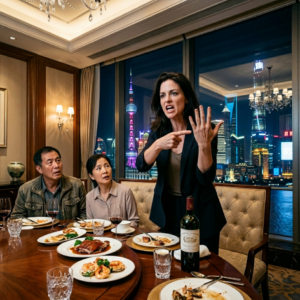
The private dining room was a gilded arena designed for psychological warfare. The Sterling family sat draped in designer clothing, their expressions radiating a suffocating condescension. Madeline’s parents, the Millers, arrived with the humble, earnest joy of working-class people, entirely unaware they were walking into an execution.
Caroline Sterling, Julian’s mother, wielded passive-aggression like a finely honed blade. She subtly mocked Mr. Miller’s enthusiastic drinking of the fine wine, elevating the tension in the room to a suffocating level. But the absolute breaking point arrived with the serving of the Steamed Large Yellow Croaker.
Chloe Sterling, Julian’s pregnant and viciously elitist sister, sneered at the Millers, implying that the fish tail—the scraps of the meal—was the only part suited for their kind. The cultural insult was devastating, a blatant declaration of their perceived superiority.
Madeline’s mother, fiercely protective, finally erupted. The room devolved into a chaotic screaming match. When Chloe dared to ask what the status of the Miller family was, Madeline stood up, her entire body vibrating with an explosive, righteous fury. She looked at her parents’ calloused, aging hands, the hands that had scrubbed floors and carried heavy burdens to give her a life.
“Let me clarify! We are the working class. We use our own efforts to make a living. Look closely at my hands. They are the hands of the hardworking people. I don’t even want to eat with you.”
She turned to Julian, the man who stood by silently as his family humiliated her blood. “From now on, our relationship is over,” she declared, her voice ringing with absolute, terrifying clarity. She grabbed her parents and walked out into the torrential, cleansing rain, severing the toxic, suffocating ties forever.
The Mountain Air and the Vulnerability of Titans
In the devastating aftermath of the dinner, Madeline found quiet, profound solace in the company of Grandma Eleanor, an elderly, elegant resident of the hotel who possessed a timeless, piercing wisdom. Grandma Eleanor listened to Madeline’s heartbreak, her eyes soft with understanding. She pressed a priceless jade bracelet into Madeline’s hands, offering advice that transcended generations: “You may regret whether you get married or not… But you must figure out what you really want.”
The true, shocking nature of this bond was soon revealed. Arthur Kingsley was Grandma Eleanor’s biological grandson. The terrifying, icy operations director was tethered by blood to the sweet woman who had become Madeline’s emotional sanctuary.
To bridge the growing complexities, Grandma Eleanor orchestrated a hiking trip to a remote, luxurious mountain resort owned by the company. The physical environment was a stark contrast to the concrete jungle of Shanghai—the air was crisp, scented with pine and damp earth. As they hiked, Madeline and Arthur clashed in a profound philosophical debate. Arthur viewed the hotel staff—mostly local villagers—as expendable assets failing to meet luxury standards. Madeline, possessing a deep, empathetic understanding of the working class, fiercely defended them, arguing for training and compassion over ruthless termination.
The debate was violently interrupted by the frailty of the human body. Arthur, the invincible titan of industry, suddenly collapsed on the mountain trail, his face ashen, his body seized by the agonizing, blinding pain of a kidney stone.
The irony was staggering. The man who had just advocated for the firing of the local staff was now entirely dependent on them. As night fell, cloaking the treacherous mountain roads in absolute darkness, the very employees Arthur had deemed useless mobilized. They carried him down the mountain, navigating the dangerous terrain with local expertise, rushing him to the hospital when an ambulance could not reach them.
Lying in the sterile hospital bed, hooked up to an IV, the impenetrable walls around Arthur’s heart began to crumble. Madeline stayed by his side, adjusting his pillows, pouring his water, her presence a quiet, unwavering comfort. When she urged him to call his family, Arthur’s voice cracked, revealing a soul hollowed by abandonment. His father was in prison; his mother had abandoned him. “I’m alone. My grandma is my only relative,” he confessed, the vulnerability in his dark eyes terrifying and profound. Madeline looked at the formidable CEO and saw, for the very first time, the deeply wounded, lonely child within.
The Edge of Life and the Taste of Authentic Gratitude
The chaotic universe of the Sterlings was not finished with Madeline. Weeks later, she received a frantic, tearful phone call from Beatrice, a woman she barely knew. Beatrice was Charles Sterling’s long-term mistress. Charles had suffered a massive, catastrophic stroke during an argument with her and was bleeding into his brain.
Madeline rushed to the hospital, her moral compass overriding her deep-seated disdain for the Sterling family. The surgical ward was a nightmare of blinding white lights and the smell of fear. The doctor emerged, his face grim, demanding an immediate signature for emergency, life-saving mechanical thrombectomy surgery. Beatrice, terrified of the financial burden and the wrath of the legitimate Sterling family, fled the hospital like a coward in the night.
The legitimate family was thirty minutes away. Charles Sterling had minutes left to live.
Madeline did not hesitate. Despite the fact that this man had looked down upon her, despite his son breaking her heart, she grabbed the pen and signed the consent form, legally binding herself to the terrifying risks of the operation. “Right now, a life is at stake. I can’t just stand by,” she told Arthur, who had followed her to the hospital, watching her heroic, selfless act with profound, silent awe.
When the Sterling family finally arrived, they did not offer gratitude. Chloe, heavy with pregnancy and blinded by malice, screamed through the corridors, accusing Madeline of conspiring with the mistress to destroy their family. Madeline stood her ground, her posture straight, her voice dripping with absolute, freezing contempt. She reached into her bag and produced the bank card Charles had previously tried to bribe her with. She threw it back at them, a final, definitive rejection of their toxic, polluted wealth.
“Please don’t involve me with your family affairs in the future,” she commanded, walking away from the wreckage of the Sterling dynasty forever.
Arthur followed her out into the cool evening air. He did not offer empty platitudes. Instead, he drove her through the labyrinthine streets of Shanghai to a tiny, obscure restaurant tucked away in a quiet alley. The air inside was rich with the scent of simmering broth and aged soy sauce.
He ordered two bowls of authentic, hand-pulled shrimp noodles, a dish requiring meticulous, agonizingly slow preparation using rare ingredients from Taihu Lake. As he carefully showed her how to mix the noodles to absorb the rich flavors, the chaotic noise of her recent traumas faded away.
“You have to savor the gratitude I put into this,” Arthur murmured, his dark eyes locking onto hers, the walls between them completely eradicated. It was not a grand, theatrical gesture. It was a quiet, profound act of nourishment, a silent promise that he saw her worth, her exhaustion, and her unparalleled bravery. As Madeline took her first bite, the warmth spreading through her chest, she realized that she had not just survived the storm; she had emerged utterly, beautifully reborn.
Deep Reflection: The Alchemy of True Worth
The extraordinary, agonizing journey of Madeline Miller is a profound testament to the terrifying, beautiful alchemy of self-worth. In a society that relentlessly equates human value with financial portfolios and elite bloodlines, Madeline’s story is a revolutionary act of defiance. She teaches us that true dignity cannot be purchased in a high-end boutique, nor can it be stripped away by the condescending sneers of the wealthy. Her power lay in her calloused, hardworking hands and her unwavering, fierce devotion to her family’s honor.
Arthur Kingsley’s transformation is the perfect counter-melody to Madeline’s rise. A man who had built his life on the icy foundations of absolute logic and ruthless efficiency, he learned that the most vital infrastructure in the world is human compassion. Through Madeline, he discovered that a luxury hotel is nothing without the soul of the people who run it, and that a man is nothing without the vulnerability to admit he needs care. Their evolving bond reminds us that profound love is not a fairy tale of knights in shining armor; it is the quiet, consistent act of showing up. It is offering a bowl of hot noodles after a devastating battle, standing in the sterile light of a hospital corridor, and recognizing the breathtaking beauty of a partner who refuses to let the world turn their heart cold.
A Call to Action
To our global family reading this today: Have you ever found yourself in a room where you were made to feel small, only to discover the immense, terrifying courage to stand up and walk away? Have you ever realized that the true wealth in your life is not in your bank account, but in the calloused, loving hands of the people who raised you?
We want to hear your stories of resilience, of breaking free from toxic expectations, and of discovering your own unshakeable worth. Drop your thoughts, your experiences, and your reflections in the comments below. Let us build a community that celebrates the messy, breathtaking reality of standing tall, fighting for our dignity, and never, ever settling for anything less than absolute respect!
Disclaimer : This content may be created by AI for entertainment purposes. Any resemblance to real persons, events, or places is coincidental.






