THE VELVET NOOSE: A WIDOW’S VIGIL AND THE ARCHITECTURE OF DECEPTION
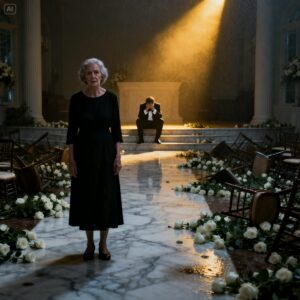
The air in my small cottage on the outskirts of Savannah always smelled of lemon wax and old paper—the scent of a life lived in the quiet margins of other people’s stories. For thirty-four years, I had existed as a shadow defined by a void. At sixty-six, my reflection in the hallway mirror felt like a stranger’s; the lines around my eyes were roadmaps of exhaustion, etched there by the decades I spent working two jobs to keep the world from swallowing my son whole. When my husband, Daniel, was torn from this earth in a tangle of screaming metal and shattered glass, I was thirty-two. I was a girl playing at being a woman, suddenly thrust into a lead role I never auditioned for.
Michael was eight then. I remember the weight of the air in the days following the funeral—it was thick, humid, and smelled of lilies and cloying sympathy. He would sit at the kitchen table, his small legs dangling, asking why Daddy’s car couldn’t be fixed like his Tonka trucks. I had no answers. I only had the raw, blistering grit of survival. I worked at the local library by day, submerged in the hushed silence of books, and by night, I scrubbed the floors of corporate offices until my knuckles bled and my back felt like it was fused into a permanent curve.
My emotional state during those years was a state of “Functional Numbness.” I didn’t feel; I performed. I performed the role of the resilient widow. I performed the role of the tireless mother. I came home at midnight, the taste of industrial cleaner still coating my tongue, to find Michael asleep over his fractions. That was my fuel. I promised him a life of honesty, a life where he wouldn’t have to count pennies or scrub away someone else’s filth.
As Michael grew, he became the living monument to my sacrifice. He was an engineer—precise, logical, kind. He called every Sunday. He was my anchor in a world that had tried to drift me out to sea. So, when he introduced me to Olivia Bennett, my initial emotional state was a desperate, clawing hunger for joy. I wanted to believe he had found the reward for all our shared suffering. Olivia was twenty-nine, golden-haired, and possessed a laugh that sounded like wind chimes in a summer breeze. She claimed to be a pediatric nurse, a volunteer at shelters—a resume written by a committee of angels. When she cried and told me I was the mother she never had, I didn’t see the predator. I saw a daughter. I saw a chance to finally stop being the widow and start being a part of something beautiful. I poured every cent Daniel had left us, $45,000 of blood-earned savings, into her “dream” wedding at the Ashton Estate. I thought I was buying his happiness. I didn’t realize I was financing his execution.
The Ashton Estate in Savannah is a place where history is painted over with expensive white lacquer. On the day of the wedding, the sky was a bruised purple, heavy with the threat of a Georgia thunderstorm that refused to break. The air was so humid it felt like breathing through a damp wool blanket. Inside the grand ballroom, the scent was overwhelming—2,000 roses flown in from Ecuador, their fragrance competing with the metallic tang of expensive champagne and the cloying sweetness of vanilla candles.
The lighting was designed to be “ethereal”—low, golden, and deceptive. It cast long, dancing shadows against the marble columns, making the satin and sequins of the 300 guests shimmer like a school of tropical fish. I stood at the back of the room, a jarring blot of ink in my simple black dress. I felt the velvet of the curtains against my arm, a texture too soft for a day so sharp. The background noise was a low, buzzing hive of social chatter—the clink of heavy silver against fine china, the artificial trill of laughter from people who didn’t know the man at the altar as anything more than a groom in a tuxedo.
Michael stood there, bathed in a spotlight of anticipation. He looked so much like Daniel in that moment—the same set of the shoulders, the same hopeful tilt of the head. But the room felt wrong to me. It felt like a stage set that was about to be struck. The grandeur of the estate, with its sweeping oak staircases and gilded mirrors, felt like a cage. I could hear the distant, rhythmic thud of the caterers in the kitchen, a heartbeat for a corpse. Every time a guest looked at me, I felt their silent judgment—the uninvited mother, the villain in the black dress. They saw a bitter woman. They didn’t see the woman who had spent two weeks in a basement office with a private detective named Patricia Moore, staring at police records and mugshots of a woman named Samantha Reed. They didn’t see the woman who was holding a phone in her trembling hand, waiting to signal the man standing just outside the heavy oak doors.
The organ music began, a swelling, pompous sound that vibrated in my chest. Samantha—I refuse to call her Olivia anymore—appeared at the entrance. She was a vision of ivory smoke, her $12,000 Vera Wang gown trailing behind her like a captured cloud. She walked with a regal confidence that made my stomach turn. As she reached the midpoint of the aisle, I stepped out from behind the column.
“Stop,” I said.
My voice wasn’t a scream. It was a low, serrated edge that sliced through the “Canon in D.” The silence that followed was instantaneous and deafening. Three hundred heads turned in a mechanical unison, their faces masks of shock. Michael’s face didn’t just drop; it disintegrated.
“Mom? What are you doing?” he asked. His voice was small, the voice of the eight-year-old boy waiting for me at the kitchen table.
I didn’t look at him yet. I looked at her. I saw the micro-tremor in her hand as she gripped her bouquet. I saw the way her eyes darted to the exits. She wasn’t a bride; she was a cornered animal.
“The wedding is over, Michael,” I said, stepping forward. I could feel the heat of the candles on my skin, the weight of the pearls Daniel had given me—the ones Samantha had sneered about on the phone—pressing against my throat.
The confrontation was a physical thing. Samantha tried to play her final card. She stepped toward Michael, her face twisting into a mask of wounded innocence. “Michael, please, your mother… she’s not well. She’s been confused lately. Mrs. Jennings, please, let’s go sit down.”
The gall of it—the sheer, icy calculation of her trying to gaslight my son in front of his entire world—it burned away my fear. I pulled out my phone and sent the text: Now.
The heavy wooden doors at the back of the chapel swung open with a crash that echoed like a gunshot. Victor Cruz walked in. He wasn’t dressed for a wedding. He wore a cheap, wrinkled suit and a look of pure, unadulterated vengeance. Samantha’s bouquet hit the marble with a dull thud, white roses scattering like teeth.
Watching my son’s world break was the hardest thing I have ever done. It was “La Fractura Interna”—the internal fracture of a soul. I watched the color drain from Michael’s face, leaving him a ghastly, translucent gray. His eyes moved from me to the stranger in the aisle, then finally to the woman he thought he loved.
“Sarah Collins?” Victor Cruz’s voice boomed, filling every corner of the estate. “Or is it Samantha Reed today? Did you think I wouldn’t find you after you took my fifteen grand and left me for dead in Tampa?”
Michael’s hand went to the altar rail, his knuckles white. “Sir, you’re mistaken. This is Olivia. She’s a nurse.”
Victor laughed—a harsh, barking sound that felt like glass breaking. “She’s a con artist, kid. She’s been arrested three times for fraud. I was her partner until she decided she didn’t want to share the take.”
In that moment, I saw Michael’s brain trying to reject the data. He looked at Samantha, pleading with his eyes for a lie he could believe. But Samantha was gone. In her place was a woman with a hard, flat stare and a mouth set in a thin line of hatred. She didn’t look like an angel anymore. She looked like a predator who had just realized the cage was locked from the outside.
My inner monologue was a screaming chorus of I’m sorry, I’m sorry, I’m sorry. I had raised him to be honest, to be trusting, and that very upbringing had made him the perfect mark. I felt the weight of my own guilt—the $45,000 I had handed over to her, the house I had mortgaged. I had practically hand-delivered my son to a wolf. I watched him physically sag, his shoulders dropping as if the air in the room had suddenly gained ten times its normal gravity. He looked at me, and for a split second, I saw a flicker of raw, unbridled hatred. He hated me for being right. He hated me for destroying the fairy tale. And I had to stand there and take it, because a mother’s love isn’t about being liked; it’s about being the wall between her child and the abyss.
The “Weight of Silence” is a peculiar thing. It’s not just about what isn’t said; it’s about the pressure of the truth building up behind the dam. I had kept the secret of Samantha’s phone call for three weeks. Three weeks of watching my son kiss her, of watching him talk about their future children, of watching him sign contracts for the estate.
I kept the silence because I knew that if I spoke too soon, he would choose her. I knew the architecture of his heart—he was loyal to a fault. If I had walked in with just my suspicions, she would have woven a story of a jealous, overbearing mother-in-law, and he would have walked away from me. I needed the weight of the state behind me. I needed Patricia Moore. I needed the FBI. I needed Victor Cruz.
The secrets were a survival mechanism. I remembered the night I stood in the hallway of their apartment, clutching the spare key, hearing her voice—that cold, sharp, calculating tone—talking to Victor on the phone. “The old woman has already given us more than 40 grand,” she had hissed. “Once we’re married, I’ll have access to his accounts. This one could be worth 200,000.”
I had stayed silent as I walked back to my car, gasping for air, clutching the steering wheel until my hands went numb. I stayed silent while I watched her try on that $12,000 dress. Every day of silence was a pound of lead in my pockets. Why? Because I was playing a game of high-stakes poker with a professional, and I couldn’t show my hand until the river card was dealt. I was protecting the boy who used to wait for me at the kitchen table. I was protecting the legacy of Daniel’s hard-earned life. I was the silent guardian of our family’s honor, and that silence was the only thing that gave me the power to strike when it mattered most.
The days leading up to the wedding were a blur of clandestine meetings and coded messages. I felt like a spy in my own life. I met Patricia Moore in a dingy cafe downtown, a place where the air smelled of burnt toast and desperation. She handed me the folder—the “Olivia Bennett” file.
“She’s a pro, Clara,” Patricia had said, her eyes hard as flint. “She targets men with stable careers and aging parents. She uses the ‘mother I never had’ routine to get into the family’s pockets. She’s careful, but she’s greedy. That’s how we got her.”
I spent my nights rehearsing the confrontation. I would pace my living room, the moonlight casting long, skeletal shadows of the trees against my walls. I practiced my tone—steady, calm, undeniable. I reached out to Victor Cruz. Our first phone call was a study in mutual distrust.
“Why should I help you?” he had asked, his voice rough as sandpaper.
“Because she’s about to do to my son what she did to you,” I replied. “And because I know where she’ll be at 2 PM on Saturday.”
The coordination was a masterpiece of timing. I had to ensure the FBI agents were positioned outside. I had to make sure Victor didn’t blow his cover too early. Every Sunday call with Michael during those weeks was a torture session. He would talk about the Ecuadorian roses, and I would have to swallow the truth like a mouthful of ash. I watched the weather reports, watching the storm front move toward Savannah, feeling the atmospheric pressure drop in tandem with my own spirits. We were building a trap, and I was the bait. I had to look like the doting, slightly overwhelmed mother of the groom while I was actually the commander of a small, vengeful army.
The moment Victor held up his phone and played the recording, the ballroom at the Ashton Estate became a courtroom. Samantha’s own voice, cold and sneering, filled the gilded space.
“The son is just a mama’s boy… once I marry him, the accounts are mine.”
The sound of her voice in that setting was obscene. It was a violation of the sanctity of the room. Michael looked like he was being physically struck by the sound waves. He turned to her, his hands trembling. “Is that you? Olivia… Samantha… is that you?”
She didn’t even bother to deny it anymore. The mask had fallen, and underneath was something jagged and ugly. “You were so easy, Michael,” she said, her voice dropping the honeyed Southern lilt she had affected for months. “You and your pathetic, clingy mother. You wanted a fairy tale? Well, fairy tales have villains.”
That was when the doors opened for the last time. Two men in dark suits, their badges catching the golden light of the chandeliers.
“Samantha Reed,” one of them announced. “You’re under arrest for fraud, identity theft, and federal banking violations.”
The arrest was a grotesque spectacle. They handcuffed her in her $12,000 gown. The ivory satin bunched up around the steel manacles, a visual metaphor for the death of the dream. The guests, who had been shimmering in sequins, were now a frantic, whispering mob, their phones out, recording the downfall.
I watched Michael. He didn’t move. He stood at the altar, the center of a storm he couldn’t control. I watched as they led her down the aisle—the same aisle she had floated down moments before. She looked at me as she passed. She didn’t look afraid; she looked murderous. And I stood my ground. I held my chin high, the library clerk and office cleaner facing down the predator. I had spent $45,000 to buy this moment, and as she was led out into the grey Savannah rain, I knew it was the best investment I had ever made.
After the agents led Samantha away, a terrible, vibrating silence settled over the chapel. The minister stood at the altar, his face the color of the communion wafers, clutching his book of service as if it were a life raft. The 300 guests sat like statues in a museum of failed expectations. Nobody knew if they should leave or if they should wait for a reboot of the reality they had just witnessed.
I walked toward the front of the room. Every step on the marble felt like a hammer blow. My black dress felt heavy, soaked with the residual humidity and the sweat of my own terror. Michael hadn’t moved. He was staring at the floor, at the place where the white roses lay crushed under the boots of the federal agents.
“Michael,” I whispered.
He didn’t look up. “You knew,” he said. His voice was a flat, dead thing. “How long did you know?”
“Three weeks,” I said.
He finally looked at me. His eyes were red-rimmed, bloodshot, and filled with a pain so deep I felt it in my own chest. “You let me walk down that aisle. You let me stand here. You let everyone see… this.” He gestured to the room, to the whispering guests and the abandoned flowers.
“I had to, Michael,” I said, my voice steady despite the trembling in my knees. “If I had told you before, she would have convinced you I was the enemy. I needed you to see her for who she was. I needed the world to see her. I couldn’t just save your money; I had to save your soul.”
The guests began to filter out, a slow, awkward exodus of satin and sequins. They didn’t look at us. They hurried toward their cars, eager to get away from the stench of a ruined life. The organist had long since fled. The only sound was the distant roll of thunder, finally breaking over the Savannah River. We were alone in the grand ballroom of the Ashton Estate—a widow and her son, surrounded by $12,000 worth of Ecuadorian roses and a $45,000 bill for a lie.
We sat on the front pew for an hour. The caterers were quietly clearing the champagne flutes in the distance, their movements ghostly and efficient. Michael had taken off his tuxedo jacket. He looked small in his white shirt, his head in his hands.
“She called you a lonely old woman,” he said. “She laughed about the money you gave her. And I let her say those things. I agreed with her when she said you were being overbearing.”
I reached out and took his hand. His skin was cold. “She was a professional, Michael. She didn’t just steal money; she stole your perspective. That’s what people like her do. They find the best parts of you—your capacity for love, your loyalty—and they turn them into weapons.”
“I don’t know how to move forward,” he said. “Everyone saw. The whole town… it’ll be in the papers tomorrow.”
“Let them talk,” I said. “Shame is a weight you choose to carry. You have nothing to be ashamed of for wanting to love someone. The shame belongs to her. She’s the one in handcuffs. You’re just a man who had a narrow escape.”
I reached into my purse and pulled out a small velvet box. Inside was the pearl necklace that had belonged to my mother, and her mother before her. Samantha had demanded it for the wedding “ensemble.” I had refused, and she had mocked me for it. I pressed it into Michael’s hand.
“Keep these,” I said. “Give them to the woman who deserves you. The woman who doesn’t need Ecuadorian roses or an estate to love you. She exists, Michael. But first, you have to heal.”
He closed his hand around the box, and for the first time that day, his shoulders relaxed. He leaned his head against my shoulder, and I held him, just as I had when he was eight years old and asking about his father. We were survivors. We had survived the car accident, the poverty, the library shifts, and the office cleaning. We would survive Samantha Reed.
The “Final Sentence” of this story is not one of legal judgment, though Samantha Reed is currently serving seven years in a federal penitentiary. The real sentence is the long-term emotional consequence of the truth. Truth is a surgery—it is brutal, it is bloody, and it leaves a scar that never quite fades.
The price of the truth was $45,000 of my life’s savings. It was the mortgage on my house. It was the public humiliation of my only son. But when I look at Michael now, a year later, I see a man who walks with his eyes open. He’s moved back to Savannah. He works at a firm downtown. He doesn’t date much, and when he does, he’s cautious. But he calls me every Sunday, and the silence on the other end of the line isn’t heavy anymore. It’s a clean silence.
I still work at the library. I like the quiet. I like the way the books don’t lie to you. Every now and then, I walk past the Ashton Estate. It’s still there, hosting more fairy tales, more Ecuadorian roses, more satin and sequins. I don’t feel bitter when I look at it. I feel a strange sense of ownership. I am the woman who broke the Ashton Estate. I am the villain in the black dress who turned a wedding into an unmasking.
The truth is, I would do it again. I would spend every cent, I would endure every whisper, I would wear that black dress into a thousand ballrooms if it meant saving my son from a life built on quicksand. Mothers are the architects of their children’s safety, and sometimes, that means you have to be the one to pull the trigger on the demolition. Love isn’t the grand ballroom; it’s the black dress. It’s the silent vigil. It’s the willingness to be the villain in the story to ensure your child lives to see the sequel.
My name is Clara Jennings. I am sixty-six years old. I am a widow, a mother, and a survivor. And I have learned that the most beautiful weddings are the ones that never happen—because they are the ones that set you free.
Disclaimer : This content may be created by AI for entertainment purposes. Any resemblance to real persons, events, or places is coincidental.






