The Glass Fortress And The Willow: A Billionaire’s Journey From Greed To Grace
The following story explores the profound invisibility of those who serve the world’s elite. We often measure success by the height of our skyscrapers and the weight of our bank accounts, yet we fail to notice the crumbling foundations of human connection right beneath our feet. This is a tale of Alistair Thorne, a man who built an empire of steel but forgot the strength of a beating heart, and Elena, a woman whose silence held more dignity than all the gold in his vaults. Through a chance encounter in a torrential storm, a hidden tragedy is unearthed, proving that true wealth is not what we accumulate, but what we are willing to give back to those we have unknowingly wronged.
The rain in Silverwood did not fall; it conquered. It lashed against the reinforced glass of the Thorne Estate with a rhythmic ferocity that sounded like a thousand tiny hammers trying to break into Alistair Thorne’s sanctuary. Inside, the air was filtered, climate-controlled to a perfect 72 degrees, and smelled faintly of expensive cedar and ancient books.
Alistair Thorne, the “Steel Titan” of the Pacific Northwest, stood by his floor-to-ceiling window. At forty-five, he was a man of sharp angles—sharp jaw, sharp suit, and an even sharper tongue. His life was a series of spreadsheets, dividends, and acquisitions. He lived by a singular, cold philosophy: Efficiency is the only true virtue.
He was about to turn away to review a merger proposal when a splash of faded blue caught his eye.
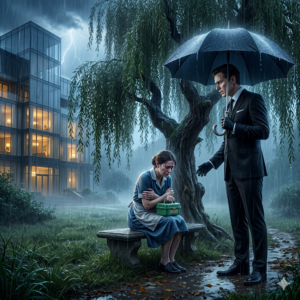
Down in the gardens, past the marble statues of Roman gods, stood an ancient, weeping willow. Beneath its sagging branches, a figure was huddled. It was Elena, the woman who had cleaned his floors for three years, a woman whose last name he didn’t even know. She was sitting on a cold stone bench, her uniform soaked through, a small plastic container in her lap.
Alistair watched, mesmerized by the sheer illogical nature of the sight. “Why?” he muttered to the empty room.
He watched her lift a trembling hand to her mouth, trying to shield her food from the wind. She wasn’t just eating; she was enduring. She looked like a ghost haunting her own life. A flicker of something long-buried stirred in Alistair’s chest—not quite pity, but a nagging curiosity that disrupted his sense of order.
He grabbed a black umbrella and stepped out. The moment he left the threshold of the mansion, the heat of his ego was extinguished by the biting cold of the storm. He marched across the lawn, his five-hundred-dollar leather shoes sinking into the mud.
As he approached the tree, Elena didn’t see him. She was staring at a soggy piece of bread as if it were a holy relic. When his shadow finally fell over her, she jumped so violently that her lunch container clattered to the grass, spilling grains of greyish rice into the dirt.
“Mr. Thorne!” she gasped, her voice a thin reed in the wind. She scrambled to her feet, her hands flying to her hair, trying to smooth the wet strands. “I’m so sorry. I’ll clean it up. I’ll be back inside in a moment.”
“Elena,” he said, his voice unusually soft against the roar of the rain. “It’s forty degrees out here. There are four dining areas in that house. Why are you sitting in the mud like a stray animal?”
She looked at her shoes—old, cracked sneakers that were never meant for a billionaire’s garden. “I don’t want to cause trouble, sir. Mrs. Sterling… she said the smell of my lunch was ‘unrefined’ for the staff kitchen. And your sister, when she visited last month… she told me that seeing someone like me in the hallway spoiled the ‘aesthetic’ of the morning.”
Alistair felt a sudden, sharp coldness that had nothing to do with the weather. He remembered his sister’s visit. He remembered the haughty laughs and the way they spoke about “the help” as if they were furniture. He had stayed silent then, buried in his phone.
“Go inside,” Alistair commanded. “Now.”
She hesitated, looking at her spilled rice.
“Leave it,” he snapped, though not with malice. “Go to the laundry room. Dry yourself. That is an order.”
As she hurried away, Alistair looked down at the spilled food. It wasn’t just rice. There was a small, laminated photograph that had fallen out of her pocket into the mud. He picked it up. It showed Elena, younger and radiant, standing next to a man in an engineering vest. Between them was a toddler.
The man in the photo looked familiar. Hauntingly familiar.
Alistair returned to his office, but the merger proposal remained unread. He opened his private archives—the records of Thorne International’s early days. He searched through the casualty reports of the “Thorne Bridge Collapse” twelve years ago—the disaster that had nearly bankrupted him, the one he had legally maneuvered his way out of by blaming “minor structural oversights.”
There it was. David Vance. Lead Site Engineer. Deceased.
The air in the room suddenly felt too thin. He looked at the photo again. The man was David Vance. Elena was his widow.
Alistair had built his “Steel Empire” on the ruins of a project that had killed Elena’s husband. While Alistair was buying his first private jet with the insurance settlement, the woman who had lost everything was scrubbing his toilets just to keep a roof over her head.
The “Steel Titan” felt his foundation crack.
The next day, Alistair didn’t go to the office. He drove a modest car to the address listed in Elena’s employee file—a neighborhood where the streetlights were broken and the air tasted of exhaust.
He found the apartment building. It was a place of peeling paint and narrow stairs. He stood outside her door, hearing the murmur of a television and the scratch of a pencil on paper. He knocked.
The door opened to reveal a young man, perhaps fourteen, with the same steady eyes as the man in the photograph. “Can I help you?” the boy asked.
“I’m a friend of your mother’s,” Alistair lied, his voice thick.
He looked past the boy into the room. It was tiny, but every surface was covered in drawings. Not just any drawings—intricate, masterful architectural blueprints. One caught Alistair’s eye: a bridge. But it wasn’t a bridge of steel; it was a bridge of light and greenery, designed with a structural integrity that Alistair’s own engineers would envy.
“You drew these?” Alistair asked.
“My dad was an engineer,” the boy said proudly. “Mom says I have his hands. I’m going to build things that never fall down. That’s why she works three jobs—so I can get into the Academy.”
Alistair looked at the boy’s desk. It was an old crate. His “lamp” was a flickering bulb taped to the wall.
“What’s your name, son?”
“Leo, sir.”
“Leo,” Alistair said, looking at a drawing of a woman in a blue uniform standing atop a mountain of clouds. “Your mother is the strongest person I have ever met.”
That evening, a dramatic shift occurred at the Thorne Estate. Alistair called a mandatory meeting of all household staff, including the formidable Mrs. Sterling.
“From this moment forward,” Alistair announced, standing in the grand dining hall where he usually ate alone, “the distinction between ‘family’ and ‘staff’ areas is abolished. If I find any member of this household—guest or employee—treating another human being as an ‘aesthetic’ blemish, they will find their belongings on the sidewalk within the hour.”
He turned to Elena, who stood at the back, her eyes wide with confusion.
“Elena Vance,” he said, using her full name for the first time. “I have spent my life building things upward. But I realized today that I forgot how to look down at what I was standing on. I owe you a debt that a thousand lifetimes of salary could not repay.”
He handed her a heavy, wax-sealed envelope.
“This isn’t a gift,” he whispered as she took it. “It’s a restitution.”
Inside was the deed to a house—a real house, with a garden and a room with a proper drafting table. And beneath that, a trust fund for Leo, titled The Vance Legacy Scholarship.
The “Plot Twist” that the gossip columns would later whisper about wasn’t Alistair’s sudden charity. It was his resignation. A month later, Alistair Thorne stepped down as CEO of Thorne International. He sold his majority shares and founded The Foundation of the Fallen, an organization dedicated to the families of industrial accident victims.
Years passed. The rain still fell in Silverwood, but it no longer felt like a conquest.
Alistair sat on a bench in a public park—a park he had funded, designed by a brilliant young architect named Leo Vance. The centerpiece of the park was a massive weeping willow, preserved in bronze.
A woman sat down next to him. She wasn’t wearing a blue uniform anymore. She wore a soft wool coat and carried a book.
“He’s winning an award tonight, you know,” Elena said, smiling at the bronze tree. “The Global Award for Ethical Architecture.”
Alistair nodded, his sharp angles softened by age and a quiet peace. “He deserves it. He builds things that last.”
“We both know why he does,” Elena said, reaching out to pat Alistair’s hand. “Because someone decided to step out of the dry and into the rain.”
Alistair looked up at the grey sky. He wasn’t the “Steel Titan” anymore. He was just a man. And as the first droplets of a new storm began to fall, he didn’t move. He simply closed his eyes and felt the rain, grateful at last to be wet, to be cold, and to finally be alive.
Disclaimer : This content may be created by AI for entertainment purposes. Any resemblance to real persons, events, or places is coincidental.






