For three grueling years, Mandy lived on the brink of homelessness, drowning in debt and working three dead-end jobs. Her parents convinced her she was ‘mentally unstable’ and a failure. But at a tense Thanksgiving dinner, her grandmother returns with a devastating question: ‘Why is a stranger living in the million-dollar mansion I bought for you?’ The veil of deception is ripped away, revealing a calculated plot of forgery, stolen inheritance, and a family that sacrificed their own daughter for a rent check. Now, it’s time for the final audit.
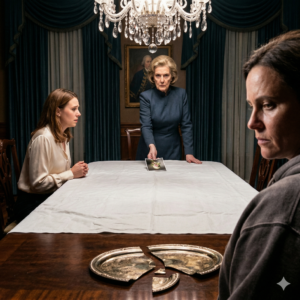
The air in the dining room was thick with the scent of roasted turkey, sage, and the metallic, underlying tang of expensive silver polish. It was a smell that should have meant safety, a homecoming, but to me, it felt like the humid pressure before a cyclone. I was thirty-one years old, and my current emotional state was one of “Chronic Erasure.” For three years, I had lived in the margins of my own existence. My name is Mandy, and as I sat at that Thanksgiving table, I was a ghost at my own feast.
I looked down at my plate, but I wasn’t seeing the food. I was seeing the balance on my phone screen from that morning: $12.50. That was the sum total of my worth after juggling three part-time jobs—stocking shelves at a 24-hour pharmacy, transcribing medical records until my eyes blurred, and waitressing at a diner where the tips were as cold as the customers. I had graduated at the top of my class, fueled by the promise of a future my grandmother Dorothy had always whispered about. But then, the world had turned jagged. Rejection letters from top-tier firms arrived with a terrifying, unexplained frequency. Anonymous rumors about my “mental instability” trailed me like a shadow I couldn’t outrun.
I felt hollowed out, a brittle shell of the woman I used to be. My sister, Ashley, sat beside me, radiant in a silk blouse that cost more than my monthly rent, her laughter tinkling like ice in a glass. Our parents, George and Sandra, presided over the table with a forced, manic cheer that felt like a performance for an audience of one: Grandmother Dorothy. She had just returned from years overseas, and she was the only one in the room who didn’t look like they were lying. Her presence was a cold, clarifying wind in a room full of stagnant air. I felt a desperate, clawing need to reach out to her, to tell her I was drowning, but the “Family Script” was already written: Mandy is the failure. Mandy is the unstable one. Mandy is the burden. I was prepared to spend another holiday being the silent victim, never imagining that the architecture of my misery was about to be dismantled by a single, sharp question.
The Hansen family dining room was a masterpiece of “Enforced Prosperity.” The lighting came from a heavy crystal chandelier that cast sharp, prismatic shards of light across the mahogany table. It wasn’t warm light; it was an interrogative glare. The walls were lined with portraits of ancestors who looked down with judgmental eyes, and the heavy velvet curtains seemed to swallow any sound that wasn’t a rehearsed pleasantry.
The table was a landscape of curated abundance. Fine bone china, gold-rimmed wine glasses, and a turkey that looked like it had been staged for a magazine. But beneath the surface, the room was a pressure cooker. The background noise was the rhythmic clink-clink of silverware—a sound that, to me, felt like the ticking of a countdown clock. The temperature was slightly too high, the heat from the kitchen mingling with the collective fever of my family’s secrets.
My grandmother sat at the head, her back a rigid line of old-world discipline. She didn’t eat; she observed. She moved with an aura of “Lethal Precision.” When she finally spoke, the air in the room seemed to flash-freeze. “Mandy, answer me. Why is there an elderly couple I don’t recognize living in the million-dollar lakeside house I bought for you?”
The clink of my father’s knife hitting his plate was the only sound for a heartbeat. It was a hollow, jarring noise that signaled the first crack in the foundation. I stopped my fork halfway to my mouth. The pumpkin pie, once a symbol of holiday comfort, now looked like a lump of cold clay. I looked up, and the world slowed down. I saw the beads of sweat forming on my mother’s forehead. I saw Ashley’s hand tighten around her wine glass until her knuckles were white. The sensory details of the room—the smell of the turkey, the glitter of the crystal—suddenly felt like the trappings of a crime scene. Grandmother’s gaze was a scalpel, peeling back the layers of the “Happy Family” performance to reveal the rot underneath.
“Grandma, what did you just say?” My voice was a thin, reedy thing, barely recognizable as my own. It trembled with the vibration of a decade of suppressed trauma.
Grandmother didn’t blink. “I’m talking about the lakeside vacation home. The house I bought for you three years ago for your future. I went there to surprise you, Mandy. But instead, I found Kevin’s parents. Ashley’s in-laws.”
The psychological aftermath of those words was a total “System Reboot.” A million-dollar house. Three years ago. The timeline matched perfectly with the moment my life began to derail—the moment the job offers dried up, the moment my credit score plummeted for “unpaid loans” I thought I was servicing, the moment my parents started telling me I was “unstable.”
“Isn’t there a mistake?” I summoned every ounce of my remaining dignity. “I don’t own a house. I’m… I’m basically homeless. I was kicked out of my apartment last month. I’ve been sleeping on couches.”
I watched my mother, Sandra, lunge for the narrative like a drowning woman grabbing a life jacket. “It’s just jet lag, Mom! Your memories are mixed up. The turkey’s getting cold!” Her voice was too high, a frantic vibrato of desperation.
“Be quiet!” Grandmother’s shout was a physical blow. It silenced the room with the finality of a gavel. She reached into her handbag, pulled out a photograph, and slid it across the table like a card in a high-stakes poker game. “Kevin’s parents said they were staying in a home owned by their son’s wife, Ashley.”
I leaned forward. The photo was a “Psychological Noir” masterpiece. There was the mansion—the one Ashley had posted on social media with the hashtag #mynewvacationhome—and there was Ashley, smiling, standing in front of it with her husband and his parents. In that second, the 100 thoughts crossing my mind were a blizzard: They stole my future. They watched me work three jobs while they collected rent on my house. They told everyone I was crazy so they could play at being rich. My own blood turned me into a beggar so they could live like queens. —
The “Fractura Interna”—the moment the soul snaps and realigns—happened as I stared at the photograph. It was the realization that my poverty wasn’t a failure of my effort; it was a “Calculated Extraction.” I looked at my father, George. He was looking at the ceiling, his jaw working as he searched for a new lie.
“Dad,” I said, and my voice was no longer trembling. It was cold. “What does this mean? Why am I homeless while Ashley is a landlord with my house?”
His response was the ultimate act of gaslighting. “Uh, Mandy, it’s complicated. Today’s Thanksgiving. Talking about money at a family dinner isn’t appropriate, is it? Tomorrow we can talk.”
That was the break. The absurdity of his “appropriateness” while I was counting coins for my next meal was the final needle that popped the balloon of my filial loyalty. I realized that my father wasn’t a protector; he was a “Manager of Toxic Assets.” He viewed me as a liability to be liquidated for Ashley’s benefit.
Grandmother rose then, her cane tapping the floor with a sound like a heartbeat. “No. We’re clearing this up now. George, Sandra, you told me Mandy was mentally unstable and incapable of managing money. You told me you would act as her guardians.”
“Mom, Mandy is worked up!” my mother hissed. “See? This is exactly what I mean by unstable.”
“Don’t you dare!” I sprang to my feet, my chair toppling over with a crash that felt like the first shot of a war. “I am perfectly normal. You’re the ones who are sick. You told me I wasn’t trying hard enough while you handed my name and my house to Ashley!”
The psychological aftermath was a sudden, violent shedding of my “Victim Persona.” I felt a visceral heat rising in my chest—a mixture of rage and a terrifying, exhilarating clarity. I looked at Ashley, who finally screamed, “A plain, boring woman like you doesn’t deserve a house like that! We were putting it to good use!” In that scream, the mask of the “Perfect Sister” shattered, revealing the predatory hyena beneath.
The “Weight of Silence” in the Hansen family had been a structural element, a series of walls built to isolate me from my only ally. I analyzed the years of missed letters—the ones Grandmother sent every month, asking how I liked the house.
“I never got a single letter,” I whispered.
“Of course not,” Grandmother said, her voice a low growl of fury. “They were sent here. George told me you were too unstable to write back. He cut off all contact, claiming he was ‘protecting’ you from my expectations.”
The secrets weren’t just about the house; they were about the “Architecture of My Failure.” Attorney Watson, Grandmother’s lawyer, stepped into the room then, letting in a gust of cold night air. He laid out the documents: bank statements showing my student loan payments being redirected to a hidden account in my mother’s name. IP addresses proving the anonymous “mental health” emails to my potential employers came from my father’s study.
The silence I had lived in was a “Cage of Deception.” My parents didn’t just steal a house; they stole my reputation, my credit, and my sanity. They needed me to be a “Delinquent Borrower” so I would never have the legal or financial standing to question them. They had turned my success into their “Unjust Enrichment.”
My inner monologue was a rapid-fire audit of every “bad luck” moment of the last three years. Every rejected job, every declined apartment application, every lecture from my mother about my “lack of effort.” It was all a lie. I wasn’t failing; I was being sabotaged by the people who had given me life. The “Price of Truth” was the realization that I was an orphan with two living parents.
The lighting in the room changed as Attorney Watson opened his tablet, the blue light reflecting off the wine glasses like a digital storm. “Lakeside Manor,” he began, “was purchased in Mandy’s name. But the current registered owner is Ashley Thompson. The sale price? One dollar.”
“A gift!” Ashley shouted, her face slick with sweat.
The sensory prologue to this moment was the sound of my own pulse in my ears—a rhythmic thrumming that matched the flashing of the tablet screen. Watson produced a magnified image of the “Transfer Agreement.”
“This document,” Watson said, his voice as dry as parchment, “was supposedly signed three years ago. But forensic analysis of the printer identification dots proves it was printed exactly six months ago.”
The room spun. “Six months ago,” I said, my voice cutting through Ashley’s whimpering. “That’s when Grandmother told you she might be coming home. You panicked.”
The psychological aftermath of this revelation was a sense of “Forensic Triumph.” I watched my father clutch his head. I watched Ashley’s eyes dart toward the door. They hadn’t just been greedy; they had been sloppy. Their panic was my weapon. They had backdated the forgery, counting on my “instability” to prevent me from ever looking at a deed.
“You copied my handwriting,” I said, looking at Ashley. “You backdated the lie to cover the theft. You weren’t just ‘putting the house to good use.’ You were erasing me from the world.”
My mother’s face was ashen. She had watched my sister forge my signature and smiled, likely thinking about the next $5,000 rent check from Kevin’s parents. They had turned my existence into a “Fiduciary Game,” and they had just lost.
The background noise shifted from the clinking of silver to the heavy, rhythmic thumping of a knock on the front door. Two officers with sheriff’s badges entered the dining room, their presence a cold, blue-and-black contrast to the warm mahogany.
“Ashley Thompson, you are under arrest for forgery and embezzlement,” the officer said.
The sensory details of the arrest were visceral: the click-click of handcuffs, the sharp, hysterical scream from my sister, the way her silk blouse wrinkled as she was pulled from her chair. “Dad told me to do it! He said Mandy was stupid! I only did what I was told!”
My father roared, “Shut your mouth!” But the “Family Bond” had disintegrated into a pile of mutual accusations. My mother was lunging at Ashley, her pearls tangling with the officer’s arm. It was a “Carnival of the Rotten.”
Grandmother stood in the middle of the chaos, her cane held like a scepter. “Mr. Watson, the will?”
“Revised, Mrs. Hansen,” Watson replied. ” inheritance rights for George, Sandra, and Ashley are revoked. Mandy is the sole heir.”
“Mom, please! Anything but that!” My father was on his knees now, a “Crumbling Statue of Entitlement.” He wasn’t crying for me; he was crying for the loss of his “Resource.”
The inner monologue during this collapse was one of “Frozen Satisfaction.” I didn’t feel the urge to comfort them. I didn’t feel the “Mercy of the Family.” I felt the cold, hard weight of an invoice.
“You wanted to build character through hardship, Dad?” I said, looking down at him. “Consider this your masterclass. You have twenty-four hours to vacate my house. Sell your cars. Sell your jewelry. You owe me two million dollars in damages, and I don’t do charity cases.”
The price of the truth was the absolute destruction of the Hansen family as I knew it. But the “Long-Term Emotional Consequence” was a rebirth.
One year later, the air on the deck of Lakeside Manor is different. It smells of pine, cold water, and the sharp, clean scent of independence. I am standing on the wooden deck, the silver watch Grandmother gave me ticking against my wrist.
The long-term aftermath of the “Thanksgiving Massacre” was a clearing of the ledger. Ashley is serving three years for fraud. My parents are living in a cramped apartment, their social credibility evaporated. They are no longer part of my “Logistics.”
I have built a business here—financial planning and victim support. I use my “Top of the Class” education to ensure other “Mandys” aren’t erased by their families. My income is dozens of times what I made at the pharmacy or the diner. I no longer live in fear of the “Anonymous Email.”
The “Price of the Truth” was the loss of a lie, and the gain of a life. I am no longer unstable. I am “Architecturally Sound.” As the sun sets over the lake, turning the water into a sheet of liquid gold, Grandmother joins me on the deck.
“You built an even brighter future,” she says.
“I’m happy, Grandma,” I reply. And for the first time in thirty-one years, the words are not a script. They are the truth.
Disclaimer : This content may be created by AI for entertainment purposes. Any resemblance to real persons, events, or places is coincidental.






