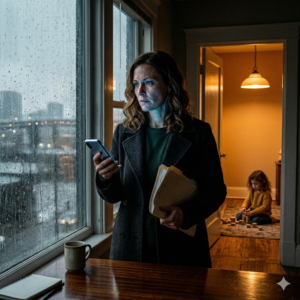
Elena Harper, a freelance illustrator in Portland, has her world detonated by a single text from her husband, Christopher. He has drained their $145,000 savings and fled to Spain with his mistress, leaving Elena with $412 and four days to pay rent. However, Christopher made a fatal mistake: he underestimated the “Audit of Souls” a mother performs when her child is threatened.
In my profession as an illustrator, I deal in “Visual Narrative.” I know that a single line, a specific shade of blue, or a shift in lighting can change the entire meaning of a scene. I had spent nine years illustrating a life with Christopher Caldwell that I thought was a masterpiece of domestic stability. I was wrong. It was a forgery.
The rain in northeast Portland was relentless that Tuesday. It hammered against the windshield of my old Subaru like it was trying to break through. My five-year-old, Mia, was inside her daycare, likely finishing a drawing of a rainbow. My phone pinged in the cup holder—a sound that usually meant Christopher was asking about dinner.
Instead, the screen read: “Moving to Barcelona with Clare. Transferred savings to my account. Good luck with rent. — C.”
The world didn’t just stop; it inverted. My breath hitched. $145,000—every cent we had scraped together, every skipped vacation, every late-night freelance gig I’d taken while Mia slept—was gone. The checking account held exactly $412. Rent was $2,400. And it was due in four days.
I sat in that parking lot, the rhythm of the wipers sounding like a countdown. I was Elena Harper, 38, and I had just been audited by the man I loved. He had found me insolvent and decided to liquidate our life.
I brought Mia home, pasting on a smile that felt like a surgical mask. I fed her pizza and watched her laugh at cartoons, while inside, I was performing a forensic reconstruction of my marriage.
Christopher had been a marketing director, a man with a smile that could sell a drought to a drowning man. I had ignored the warning signs: the locked phone, the “client dinners” that ran until 2:00 AM, the way he stopped looking at me when we talked about the future. I had blamed it on my own postpartum depression—a dark fog that had settled over me after Mia was born. Christopher had been so “supportive” then, urging me to see a therapist, bringing me coffee, and telling me to “rest.”
Now I realized he wasn’t shoring up my health; he was documenting my “instability.”
My phone rang at midnight. It was Margaret, Christopher’s mother. Margaret was a woman made of expensive silk and sharp edges, a pillar of Seattle society who viewed my paint-stained jeans as a personal affront.
“Elena,” she hissed, her voice like ice sliding over glass. “What have you done to my son? Christopher says you’re holding Mia hostage for more money.”
“Margaret,” I said, my voice trembling with a cold clarity. “Christopher took our life savings and fled to Spain with his assistant. He left us with nothing.”
“Don’t play the victim, Elena. I’ve seen the texts you sent him—threatening to cut him off from his daughter. Christopher needs a clean break. Clare makes him happy. You? You’re just… a burden.”
The line went dead. I stared at the phone. Christopher wasn’t just leaving; he was spinning a narrative. He was using my history of depression as ammunition to paint me as the villain. He wanted the money, and eventually, he wanted Mia.
The next morning, after the bank confirmed that the $145,000 transfer was “perfectly legal” because it was a joint account, I went to Christopher’s office. He had resigned two weeks prior. He had been planning this exit while I was planning Mia’s birthday party.
I returned home and did the only thing I knew how to do: I started to draw a map of his lies.
I opened our shared laptop. Christopher was a man of habit. His passwords were predictable—Mia’s birthday, our wedding date. I bypassed his cloud storage security in ten minutes.
What I found wasn’t just evidence of an affair; it was a “Possession Manifest.”
Folders were meticulously labeled: “Custody Plan,” “Spain Logistics,” “The Exit.” Inside were emails to Margaret. She hadn’t just known; she had bankrolled the move. She had paid the deposit on his Barcelona penthouse three months ago.
But the “hitch” in his plan was Clare.
Christopher had a draft email addressed to his new firm, Horizon Global, in Barcelona. Attached was his resume and a “Relocation Summary.” He had listed a secondary bank account in Liechtenstein—an account I never knew existed—holding over $200,000.
He hadn’t just taken our savings; he had been skimming from his bonuses for years. He had built a fortress while I was building a home.
I hired Anna Gwyn, a divorce attorney who looked like a librarian but thought like a predator. I handed her the photos of the Liechtenstein accounts and the emails from Margaret.
“Elena,” Anna said, her eyes narrowing as she reviewed the documents. “This isn’t just a divorce. This is a coordinated conspiracy to commit identity fraud and asset concealment. He’s trying to use your medical history to bypass the Hague Convention on child abduction.”
“I don’t want his money, Anna. I want him to feel the ‘Good Luck’ he sent me.”
We moved with the precision of a structural audit. While Christopher was in the air, thinking he was free, we filed an Emergency Motion for Assets Freeze. Because the Liechtenstein account was linked to his primary identity, and he had used a Portland-based IP address to access it last week, we had jurisdiction.
Then came the Plot Twist.
Clare called me.
She wasn’t in Barcelona. She was at a hotel in Lisbon, terrified.
“Elena, he’s unhinged,” she sobbed. “He told me he had $300,000 in the Liechtenstein account, but when we landed, he told me the account was ‘locked’ and that I had to pay for the first month’s rent. He’s been using me to funnel Margaret’s money so it wouldn’t be traced to him. He’s not in love with me; he’s in love with the escape.”
“I don’t care about your problems, Clare.”
“I have the login for the Cayman account, Elena. The one with $45,000 that he told you was ‘invested’ in a failed startup. It wasn’t. It’s sitting there, and I have the wire transfer logs proving Margaret was the one who authorized the initial deposit.”
I made a deal. Immunity from the civil suit in exchange for the forensic keys to Christopher’s global footprint.
The day of the emergency hearing arrived. Portland was gray, but inside the courtroom, the lighting was high-contrast.
Christopher appeared via video link from a dark room in Barcelona. He looked tired. The “marketing smile” was gone. He thought he was untouchable behind an ocean.
Anna Gwyn rose. She didn’t lead with the affair. She led with the “Custody Plan” document.
“Your Honor,” Anna said, her voice like steel. “Mr. Caldwell didn’t just leave. He orchestrated a plan to kidnap a five-year-old child by fabricating a narrative of mental instability against his wife. He used his mother, Margaret Caldwell, to facilitate identity fraud to hide over a quarter-million dollars in offshore accounts.”
The judge’s face went cold. “Mr. Caldwell, can you explain the Liechtenstein account?”
Christopher stammered. “It… it was a business venture.”
“A business venture funded by skimmings from your joint household earnings?” the judge asked. “And the email to your mother about the ‘Barcelona Exit’? It seems you didn’t just move; you committed a forensic erasure of your family.”
The ruling was a “Controlled Demolition.”
The judge granted an immediate freeze on all domestic and international assets linked to Christopher’s name. I was awarded Temporary Full Custody with zero visitation rights until a psych evaluation could be performed on Christopher.
But we weren’t done.
I sent the evidence of the Liechtenstein and Cayman accounts to the IRS and the Spanish Tax Authority. Christopher hadn’t declared any of it. He was a man who lived on appearances, and I was about to strip him down to the studs.
Horizon Global terminated his contract within forty-eight hours of receiving a subpoena from my lawyer. He was a “PR risk.”
Margaret tried to intervene. She came to my door in Portland, her designer heels clicking with a desperation I had never seen.
“Elena, let’s be reasonable. I’ll give you the $145,000 back if you drop the fraud charges against me.”
“It’s not $145,000 anymore, Margaret,” I said, standing in my doorway, Mia playing happily in the background. “It’s the interest on nine years of betrayal. It’s the $200,000 in Liechtenstein. It’s the $45,000 in the Caymans. And it’s the house in Seattle you put in Christopher’s name last year to avoid taxes.”
“You wouldn’t.”
“I’ve already filed the ‘Lis Pendens’ on the Seattle property. You tried to audit my life, Margaret. Now, I’m auditing yours.”
It took eighteen months for the dust to settle.
Christopher was deported back to the U.S. to face charges of wire fraud and grand larceny. He’s currently working in a call center in Idaho, living in a studio apartment that smells of damp wool. He has no visitation rights. Mia doesn’t even remember his face.
Margaret’s social standing in Seattle evaporated overnight. The “Matriarch” was forced to sell her estate to pay the legal fees and back taxes.
I bought a small, sun-drenched house in the Alberta Arts District. I went back to full-time design work, but this time, I’m the one signing the checks. My walls are covered in Mia’s paintings—rainbows that aren’t forgeries.
Last week, I received a final text from an unknown number. It was Christopher.
“I’m sorry, Elena. I made a mistake.”
I didn’t reply. I simply blocked the number.
In my world, the narrative is finally correct. The lighting is bright, the lines are clean, and the foundation is made of the only thing that doesn’t fail under stress: Sovereignty.
Disclaimer : This content may be created by AI for entertainment purposes. Any resemblance to real persons, events, or places is coincidental.






