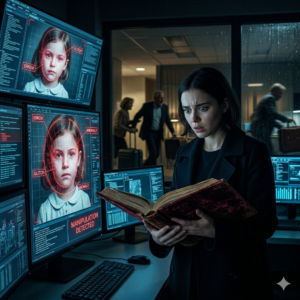
I grew up as Elara, the miracle child of a wealthy architect and a doting mother in a secluded cliffside estate. My past was a blur of “childhood illnesses” and “private tutoring,” explained away by my parents as a period of fragile health. But when my fiancé, Julian—a forensic digital analyst—uncovers a recurring digital artifact in my family albums, the facade shatters.
The Henderson estate always smelled of expensive sandalwood and the salt-heavy air of the Oregon coast. It was a house built on glass and steel, designed by my father, Arthur, to be a fortress of transparency. But glass, I would soon learn, is the easiest thing to hide behind.
It was our “Engagement Christmas.” My fiancé, Julian, sat on the leather sofa, looking slightly overwhelmed by the sheer opulence of my upbringing. My mother, Evelyn, was in her element. She moved with a grace that felt choreographed, serving vintage Bordeaux and humming carols as if she were auditioning for a role as the World’s Most Perfect Matriarch.
“Show him the albums, Evelyn,” Arthur said, his voice a deep, comforting rumble from his wingback chair.
I rolled my eyes playfully. “Dad, don’t bore him. He sees enough pixels at work.”
“Nonsense,” Evelyn chirped, pulling a heavy, velvet-bound book from the shelf. “Julian needs to see the girl he’s marrying.”
Julian smiled. He was a man of details. His job involved analyzing digital evidence for high-stakes litigation. He noticed things others missed: the slight blur in a forged document, the mismatched metadata in a “leaked” photo. He opened the first album with professional curiosity.
The evening progressed with the usual nostalgia. Photos of me at age six, pale and thin, sitting in a sunlit garden. Photos of me at eight, wearing a heavy knit sweater on a boat.
“You were so frail then,” Evelyn sighed, stroking my hair. “Those respiratory issues kept you indoors so much. It broke our hearts.”
I leaned into her touch. I remembered the feeling of those rooms—the hum of the air purifiers, the taste of bitter medicine, the way the world outside looked like a distant, unreachable dream. My memories before age seven were fragmented, like a puzzle missing its center.
I noticed Julian had stopped flipping pages. He was staring at a photo of me on a swing set. He touched the edge of the image, his brow furrowed.
“Julian?” I asked.
“The light,” he whispered, almost to himself. “It’s wrong.”
“What do you mean?” Evelyn asked, her voice hitching just a fraction of a second.
“The chromatic aberration,” Julian said, his eyes narrowing. “In this 1998 photo, the light is hitting Elara from the left, but the shadows on the swing set are falling toward the camera. And there’s a ghosting effect on the hair… it looks like a manual mask.”
Arthur laughed, a dry, hollow sound. “It was an old film camera, son. Light leaks were common.”
Julian didn’t look up. He flipped back to a photo from two years later. “In this one, too. The pixel density on Elara’s face doesn’t match the background noise. It’s as if… as if someone took a high-resolution portrait and layered it onto a lower-quality landscape.”
The room went cold. The fireplace crackled, but the warmth didn’t reach us. Evelyn stood up abruptly. “I think that’s enough for one night. Julian is clearly overworked.”
We left that night under a shroud of fog. Julian was silent in the car until we were miles away from the estate. Then, he pulled over. He reached into his laptop bag and pulled out his phone. He had surreptitiously snapped high-res photos of the album pages.
“Elara, listen to me,” he said, his voice trembling. “I ran a quick error level analysis on the drive. Those photos aren’t just ‘bad.’ They are composite images. Every single photo of you before the age of ten is a fake.”
“That’s impossible,” I stammered. “I remember those places. I remember the boat… I think.”
“Do you?” Julian looked at me with deep concern. “Or do you remember the stories they told you about those photos?”
He showed me the screen. He had isolated my face from four different photos. “Look at your eyes. The reflection in your pupils is the same in every shot—a rectangular light source. That’s a studio softbox, Elara. You weren’t in a garden or on a boat. You were in a photography studio. They took a series of ‘stock’ photos of you and spent years pasting them into a fake life.”
My stomach did a slow, agonizing flip. If the photos were fake, the memories they anchored were lies.
“I called a contact at the state registry while you were in the bathroom,” Julian continued. “There is no birth certificate for an Elara Henderson born in 1992. But there is a missing person’s report from 1997.”
Five hours later, we weren’t at a hotel. We were at a 24-hour diner, staring at a printout from a cold case database.
MISSING: SOPHIA VANCE. Age 5. Disappeared from a playground in Seattle, August 12, 1997.
The girl in the photo didn’t look like the frail, sick Elara I had been told I was. She was vibrant, with a defiant spark in her eyes. But she had the same distinctive birthmark—a tiny, star-shaped speck on her left earlobe.
I touched my ear. My breath hitched.
I remembered the “babysitter.” A woman named Sarah who smelled of lavender. I remembered a man in a white van who told me we were going to a special hospital to help my “tired heart.”
I didn’t call the police immediately. I called the number listed at the bottom of the Vance case file. It belonged to a private investigator who had been working for Sophia’s mother for twenty years.
The woman who answered the phone didn’t sound like a detective. She sounded like a woman who had been waiting by the phone in a dark room for half a lifetime. Her name was Mary Vance.
“I’m looking for Sophia,” I said, my voice barely a whisper.
There was a long, jagged silence on the other end. “Who is this?”
“I think… I think I’m wearing her skin,” I replied.
We met at the precinct the next morning. The police were already moving. But I couldn’t wait. I needed to see Arthur and Evelyn. I needed to know why.
When we arrived back at the Henderson estate, the gates were open. A black SUV was idling in the driveway. Arthur and Evelyn were throwing suitcases into the trunk.
“Where are you going?” I shouted, stepping out of the car.
Evelyn froze. She looked at me, and for the first time, I didn’t see a mother. I saw a captor.
“We were protecting you, Elara!” she screamed, her composure finally shattering. “You were part of something bigger! We gave you everything! A life, an education, a future!”
“You stole me!” I yelled back. “You photoshopped me into a family that didn’t exist!”
Arthur stepped forward, his face a mask of cold pragmatism. “Your father—your real father—was a whistle-blower, Sophia. He had information that would have destroyed my firm. Taking you wasn’t just about a child. It was about leverage. But then… he died. And we realized we couldn’t just get rid of you. So we made you ours.”
“Leverage?” I felt sick. “I was a hostage for twenty years?”
“You were a Henderson!” Evelyn pleaded, reaching for me. “The ‘illness’ kept the world away so no one could recognize you until you were old enough to look different. The photos were just to give you a history. To make you believe.”
The sirens sounded in the distance, a low wail echoing off the cliffs. Arthur grabbed Evelyn’s arm. “We have to go. Now.”
But as they backed the car out, Julian blocked the driveway with our vehicle.
The arrest was swift. The Hendersons were charged with kidnapping, conspiracy, and a litany of fraud charges. But as I sat in the interrogation room, waiting to meet Mary Vance, a detective named Miller walked in with a strange expression.
“We got the DNA results back, Sophia,” he said.
“And?” I asked, my heart hammering. “Am I Mary’s daughter?”
Miller sat down and slid a file across the table. “Yes. You are Sophia Vance. But there’s something the Hendersons didn’t even know. Something they missed because they were so focused on the leverage.”
I opened the file.
“The man they kidnapped you from—the ‘whistle-blower’—wasn’t just a random employee,” Miller said. “He was Arthur’s secret half-brother. Your father and Arthur shared the same father. This wasn’t just a corporate kidnapping. It was a fratricide.”
I felt the room tilt.
“But that’s not the twist,” Miller continued. “Look at the medical records we recovered from the Hendersons’ private vault.”
I scanned the pages. They were dated before I was kidnapped.
“You actually did have a respiratory condition as a child, Sophia,” Miller said. “But it wasn’t a random illness. It was a genetic marker. One that only appears in the Sterling-Henderson bloodline. Arthur and Evelyn thought they were faking a history to hide you, but they inadvertently documented the truth.”
Then came the final blow.
“Arthur knew you were his niece,” I whispered.
“No,” Miller said, leaning in. “Arthur didn’t know his half-brother had a daughter. But Evelyn did. Evelyn was the one who spotted you at the playground. She realized who you were. She didn’t kidnap you for Arthur’s firm. She kidnapped you because she couldn’t have children of her own, and she wanted the only piece of Arthur’s bloodline she could find. She manipulated Arthur into thinking it was a business move.”
Evelyn wasn’t a co-conspirator. She was the architect of the entire lie, using Arthur’s corporate greed as a cover for her own obsession.
Mary Vance walked into the room ten minutes later. She didn’t look like a stranger. She looked like the beginning of a story I was finally allowed to read.
We didn’t hug immediately. We just looked at each other—two women who had been robbed of twenty-five years by a woman who thought she could design a family like a skyscraper.
The Hendersons are in federal prison now. The estate was seized. Julian and I got married, but we didn’t take any photos. Not yet. We’re waiting until we feel like we’re actually standing in the frame.
I kept one photo from the old album, though. The one of me on the swing set. If you look closely at the very edge, in the unedited blur of the background, you can see a woman’s hand reaching out from the shadows.
It wasn’t Evelyn’s hand. It was the camera lens, reflecting a woman in a lavender dress standing across the street, watching her daughter disappear.
I’m not a Henderson. I’m not a miracle. I am Sophia Vance. And for the first time in my life, I am not a collage. I am a person.
Disclaimer : This content may be created by AI for entertainment purposes. Any resemblance to real persons, events, or places is coincidental.






