My Eight-Year-Old Kept Telling Me Her Bed Felt “Too Tight.” At 2:00 a.m., The Camera Finally Showed Me Why
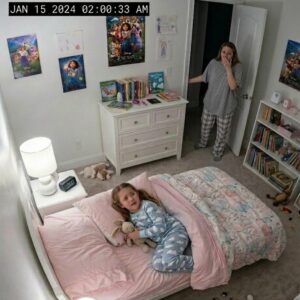
For three consecutive weeks, my daughter Mia had anchored her nightly routine with a peculiar, unsettling complaint. It wasn’t the usual childhood avoidance of the dark or the imaginative fear of ghosts in the closet. Instead, it was a physical sensation she couldn’t quite articulate, yet couldn’t ignore.
Every night, just as the moon began to cast long, skeletal shadows across her lavender-painted walls, she would look up at me with wide, troubled eyes and whisper the same four words: “Mom… my bed feels too tight.”
At the onset of these complaints, I dismissed them with the casual ease of a mother who had heard it all. Mia was eight years old—an age defined by a vivid, sometimes overactive imagination and a budding flair for the dramatic.
I assumed “tight” was simply the best word her young mind could find to describe a bunching bedsheet, a stray crumb, or perhaps the psychological weight of a looming math test. To an eight-year-old, discomfort is often a vague, amorphous thing, and I figured she was simply projecting some internal restlessness onto her physical surroundings.
“What do you mean by ‘tight,’ sweetheart?” I asked her one rainy Tuesday evening. I was tucking the floral duvet around her shoulders, ensuring the edges were neat, trying to provide the physical security she seemed to be craving. She didn’t respond with a typical complaint about the blankets being too heavy or the pillows being too firm.
Instead, she shrugged, her small frame looking even smaller amidst the plush stuffed animals that guarded her sleep. “It just feels like something is squeezing it,” she said, her voice small and certain. “Like the bed is getting smaller while I’m in it.”
I remember laughing softly, a sound meant to soothe but one that I would later regret as a dismissal of her reality. I pressed my palms into the mattress, feeling the familiar resistance of the memory foam.
It felt perfectly normal—resilient, cool to the touch, and stationary. I checked the wooden slats of the frame, tightened a few bolts that didn’t even need tightening, and smoothed out every microscopic wrinkle in the Egyptian cotton sheets.
“You’re probably just having a growth spurt,” I told her, kissing her forehead. “Your body is stretching out, and that makes everything else feel a little bit more cramped. It’s a good sign—it means you’re becoming a big girl.”
She didn’t look convinced. She looked, in fact, like someone who was being told the sky was green when she could clearly see it was blue. She stayed quiet, but that night, the silence of the house was broken at exactly 12:14 a.m.
I heard the soft thud-thud-thud of her bare feet on the hardwood floor of the hallway. She didn’t knock; she simply pushed open my bedroom door and stood there, a tiny silhouette in her nightgown. “Mom, my bed is tight again. It’s pushing on me.”
I got out of bed, rubbed the sleep from my eyes, and followed her back to her room. I performed a forensic inspection of that furniture. I stripped the bed down to the mattress protector. I crawled underneath with a flashlight, seeing nothing but a few stray dust bunnies and a forgotten Lego brick. Everything appeared completely ordinary.
When I discussed the matter with my husband, Eric, the next morning over coffee, he offered the classic fatherly interpretation. “She’s just going through a phase,” he said, scrolling through his emails.
“She’s realized that if she complains about the bed, she gets an extra twenty minutes of your attention and a late-night trip to our room. She doesn’t want to sleep alone, and ‘tight bed’ is a lot more creative than ‘I’m scared of the dark.’”
But as the second week began, Mia’s persistence turned from a nuisance into a haunting. She wasn’t playing a game. She grew pale, and dark circles began to form under her eyes. She started resisting bedtime with a ferocity we hadn’t seen since she was a toddler. The phrase “it feels tight” became a mantra of distress.
Desperate for a solution, I convinced myself that perhaps the mattress was the culprit. Maybe a structural failure in the inner springs was creating a localized pressure point that only a child’s lighter frame could detect. I spent nearly a thousand dollars on a top-of-the-line hypoallergenic mattress, thinking I was buying our way back to peace.
The new mattress arrived on a Thursday. For exactly one night, the house was silent. Mia slept for ten hours straight, and I breathed a sigh of relief, thinking the “tightness” had been nothing more than a manufacturing defect. But on Saturday night, the nightmare returned with a vengeance. “Mom… it’s happening again. It’s worse now. It’s moving.”
That was the turning point. The mention of movement chilled me in a way the word tightness hadn’t. I decided right then to install a small, high-definition security camera in the corner of her room. I told myself it was for her benefit—if I could show her a recording of her bed remaining perfectly still, perhaps the psychological wall she’d built would crumble.
I needed proof, either to validate her fears or to debunk them. The camera was a small, unobtrusive black cube that linked directly to an app on my phone, equipped with high-sensitivity motion sensors and infrared night vision.
For the first three nights of the recording, I saw exactly what I expected: a young girl tossing and turning in her sleep. I saw her kick the duvet off, I saw her talk in her sleep, and I saw her stare at the ceiling with an expression of profound unease. But the bed itself? It remained a static object of wood and fabric. Then came the tenth night.
I woke up at 2:00 a.m. without knowing why. My internal clock seemed to have synced with the rising tension in the house. A second later, my phone, resting on the nightstand, vibrated with a sharp, insistent buzz.
A notification appeared on the darkened screen: Motion detected – Mia’s Room. My heart did a slow, heavy roll in my chest. I swiped the notification and opened the live feed.
The grainy, monochrome world of the night vision showed Mia lying on her side, her back to the camera. She was a motionless lump under the covers. The room was deathly still. I stared at the screen, my eyes straining to make sense of the shadows. Then, the mattress moved.
It wasn’t a sudden jolt. It was a subtle, rhythmic undulation, as if a large muscle were tensing and relaxing deep within the padding. I felt a wave of nausea. Mia’s bed was a platform style; it sat on solid wooden slats. There were no drawers, no hollow base—just a few inches of clearance above the floor.
There was physically no room for a person or even a large animal to hide. Yet, on the screen, the mattress was clearly being displaced from below.
I watched, paralyzed, as a localized pressure point formed directly beneath Mia’s shoulder. The mattress lifted an inch, then settled. Then, another pressure point formed near her hips. It looked as though something was trying to mold itself to her silhouette from the underside of the bed. This was the “tightness” she had described—the sensation of being squeezed, of the bed closing in on her.
My mind, desperate to protect my sanity, began throwing out increasingly ridiculous explanations. Seismic activity? A freak occurrence of static electricity affecting the memory foam? A rodent infestation of monstrous proportions? But then the blanket near Mia’s legs lifted. It wasn’t Mia moving her legs; she was dead still, likely frozen in that terrifying half-sleep where you know something is wrong but cannot wake up. Something beneath the mattress was pushing upward with enough force to tent the heavy duvet.
I didn’t wait to see more. I lunged out of bed, grabbed a heavy flashlight from the drawer, and ran down the hallway. I didn’t care about being quiet anymore. I burst into Mia’s room, the light from the hallway spilling across the carpet. Mia jolted awake, her eyes wide with terror. “Mom?”
“Out. Now. Go to the living room and wake your father,” I commanded. My voice was tight, vibrating with a primal protective instinct. She didn’t ask questions; she saw the look on my face and bolted.
I stood alone in the room, the camera still silently recording from the corner. I approached the bed like it was a live bomb. I crouched down, the joints in my knees popping in the silence. I lifted the hanging edge of the comforter, expecting to see a monster, a man, or a nightmare. Instead, I saw a subtle misalignment. The mattress was sitting at a slight angle, no longer flush with the frame.
I reached my hand into the narrow gap between the mattress and the wooden slats. My fingers brushed against something cold, hard, and smooth. It wasn’t the texture of wood or fabric. It was the unmistakable feel of industrial plastic. I recoiled as if I’d been burned, then gathered my courage and heaved the corner of the mattress upward.
Taped to the underside of the bed frame was a sophisticated array of hardware. There was a narrow black tube, a series of pneumatic actuators, and a small, humming mechanical motor. A thin ribbon of cabling ran down the leg of the bed, hidden behind a strip of matching wood-grain tape, leading to a small recording device and a wireless transmitter tucked into a hollowed-out section of the headboard.
The “tightness” Mia had felt was the physical pressure of the pneumatic bladders inflating. The “movement” was the mechanical motor shifting the sensors. It was a bespoke, high-tech surveillance suite designed not just to listen or watch, but to track every movement, every breath, and every vibration of the person lying above it.
The police arrived within twenty minutes. They didn’t laugh. The lead officer, a man who had seen too much of the world’s darkness, handled the equipment with a grim reverence. As they dismantled the apparatus, the technical reality of the violation began to sink in. This wasn’t a generic piece of spy gear bought off the internet. It was a custom-modified haptic recording system, likely used in high-end medical or industrial research, repurposed for a predatory obsession.
“Mom?” Mia’s voice came from the doorway. She was wrapped in a blanket, looking smaller than ever. “The cable man…”
The officer stopped what he was doing and looked at her. “What about the cable man, honey?”
“Last week,” she whispered. “When you were at work and Grandma was here. He said he had to fix the internet in my room. He was in here a long time. He told me he was installing a ‘booster’ so my tablet would work faster.”
A cold, sharp clarity washed over me. I remembered the service call. I had been stuck in a meeting, and my mother had let the technician in. I had checked the app later that day and saw that the “work order” was completed. I had even left a five-star review for the “efficient service.”
The investigation that followed was a descent into a digital underworld. The technician wasn’t just a rogue employee; he was a highly skilled predator who had used his position to gain access to dozens of homes. He didn’t just want to watch; he wanted to feel. The device under Mia’s bed was designed to transmit the haptic data—the literal vibrations and movements of her sleep—to a remote interface. He was trying to synchronize his own environment with hers. The “tightness” she felt was the activation of the system as it calibrated itself to her body.
The legal proceedings were a blur of depositions, evidence bags, and the agonizing realization of how close the danger had been. The company faced a massive class-action lawsuit, but no amount of money could fix the silence of our home. We moved houses three months later. We couldn’t stay in a place where the floorboards felt like they were keeping secrets.
Mia is older now. She sleeps in a bed with a simple metal frame—no slats, no base, just a thin mattress on a clear, open structure where every inch of space is visible. She still checks under her bed every night, not for monsters, but for cables. And I still wake up at 2:00 a.m., my hand instinctively reaching for my phone, searching for a notification that I hope I never see again.
The physical equipment is gone, destroyed by the police or locked away in an evidence locker, but the “tightness” remains in our lives. It’s the tightness in my chest when a stranger knocks on the door. It’s the tightness in Mia’s voice when she asks if we remembered to lock the windows. We learned the hard way that the most terrifying things aren’t the ones that go bump in the night—they are the ones that hum quietly beneath you, recording the very rhythm of your life.
If she hadn’t complained—if I hadn’t listened to the “dramatic” eight-year-old—the recording would have continued. The “cable man” would have kept his five-star rating. And the device would have kept squeezing, tighter and tighter, until the intrusion was no longer just digital. We live in a world that is more connected than ever, but that night, I learned that every connection is a two-way street, and some people are just waiting for an invitation to drive straight into the heart of your home.
The trauma of such a violation ripples outward like a stone thrown into a still pond. In the months following the discovery, our family dynamic shifted. Eric, who had initially laughed off Mia’s complaints, was consumed by a protective guilt that manifested as an obsession with home security. Our new house was transformed into a fortress, with motion-activated lights, reinforced locks, and an encrypted network that required multiple layers of authentication. Yet, even with all the hardware in the world, the sense of safety—that fragile, invisible shield we take for granted—had been shattered.
For Mia, the recovery was slower. She transitioned from a child who was “dramatic” to a child who was hyper-vigilant. She began to study the technicians who came to the house, the delivery drivers, even the mailman, with a level of scrutiny that no child should possess. She learned the technical names of surveillance equipment. She became an expert in the very thing that had victimized her, a defense mechanism designed to ensure she was never “squeezed” again.
The “cable man” was eventually caught, linked to a network of similar crimes across three states. The trial was a grueling experience, forcing us to hear the technical details of how he had monitored our lives. He had sat in his car, blocks away, watching the feed and feeling the vibrations of our home as if he were a ghost sitting at our dinner table. The judge gave him the maximum sentence, but as the gavel fell, it didn’t feel like a victory. It felt like the closing of a chapter in a book that we never wanted to read.
As I sit in Mia’s new room now, watching her sleep, I realize that the “tightness” she felt was actually a gift. It was her body’s way of rejecting an alien presence. It was a primal, biological alarm system that was more sophisticated than any camera I could buy. I no longer dismiss the odd expressions of children. I listen to the metaphors they use to describe the world, because sometimes, “tight” is the only word for a violation that is too big to name.
The bed in her new room is open and airy. There are no hidden spaces, no strips of wood-grain tape, no ribbon cables. But every now and then, when the house is quiet and the wind rattles the windowpanes, I see her stir in her sleep. She reaches out, feeling the edge of the mattress, ensuring that the boundaries of her world are still where they should be. And I stay there, a silent guardian in the doorway, knowing that the most important thing I can provide isn’t a new mattress or a security system—it’s the knowledge that when she speaks, I will listen.
In the end, the story of the tight bed isn’t just about a crime or a predator. It’s about the sanctity of the home and the vigilance required to protect it in an age where the walls have ears and the beds have sensors. It’s a reminder that our children are often the most sensitive barometers of the environment around them, and their “imaginary” fears are sometimes the most real things in the world. Mia saved herself that night, and in doing so, she saved us all from a darkness we didn’t even know was beneath our feet.
The legacy of that event stays with us, a quiet hum in the background of our daily lives. We are more careful now, more skeptical, perhaps a little less open to the world. But we are also closer. We share a secret language born of that night, a shared understanding of the value of privacy and the weight of a promise kept. The bed doesn’t feel tight anymore, but our family—our bond—has never been tighter. And that, perhaps, is the only positive thing to come from the shadows that once moved beneath the mattress at 2:00 a.m.
Disclaimer : This content may be created by AI for entertainment purposes. Any resemblance to real persons, events, or places is coincidental.






