I’ve Spent 20 Years In A Wheelchair, Thinking I Was A Burden. Yesterday, I Came Home Early From Work And Heard My Mother Laughing, Saying, “She Still Doesn’t Know.”
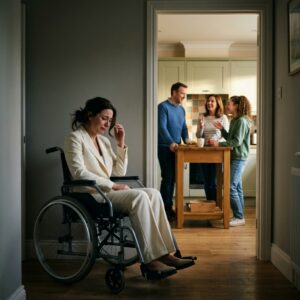
The sound of rubber wheels gliding across the parquet floor had become the soundtrack of my life. A constant, monotonous hum that had accompanied me since I was eight years old. Sometimes, in the silence of the night, I dreamed I was running. I dreamed of the feel of fresh grass beneath my bare feet, of the sharp impact of my heels against the asphalt as I chased a bus, of the simple and wonderful verticality of standing upright. But I always woke up the same way: staring at the ceiling, my legs limp under the covers, that old chair waiting for me beside the bed like a metal guardian.
My name is Amelia. I’m twenty-eight years old, and according to my medical records, I’m a paraplegic due to a severe spinal cord injury I suffered in a car accident when I was a child. That day, my life was split in two. I went from being the girl who climbed trees to “poor Amelia,” the kid who needed help with everything.
However, if there’s one thing I’ve learned in these two decades, it’s to live with guilt. Not the guilt of having done something wrong, but the guilt of being. My existence, since that accident, has become a black hole that absorbs the energy, money, and dreams of my family.
My parents, Linda and Michael, were saints in the eyes of our community. I remember Sundays at church, when people would approach my mother and stroke her arm with that look of admiring pity. “You’re a courageous mother, Linda,” they would say. “God has given you a difficult trial, but look how you take care of that girl.”
She smiled, lowered her gaze humbly, and squeezed my shoulder. “She’s my daughter. I would do anything for her.”
And they did. Oh, how they did. My father worked overtime at the warehouse to pay for my therapies, those painful and exhausting sessions that, according to the private doctors my parents hired, were “crucial to maintaining my muscle tone,” even though they never restored feeling to me. And my older sister, Emily… she sacrificed the most. Emily had a talent for art, she wanted to study in Europe, but she stayed. She stayed to help Mom bathe me, to take me to doctor’s appointments, to be the shadow of her disabled sister.
“Don’t worry, Amelia,” Emily would say when she saw me crying in frustration because I couldn’t reach a book on the high shelf. “My life is here, with you. I wouldn’t miss a thing by being in Paris.”
I believed them. I loved them with a blind and painful devotion. I tried my best not to be a burden. I studied programming from home, got a remote job, and recently landed a part-time, in-office position at a tech-savvy company. I wanted to repay them, penny by penny, for everything they had invested in me.
My routine was sacred. I left at 8:00 AM, the adapted transport picked me up, I worked until 2:00 PM, and I returned home around 3:00 PM, when the house was usually empty or quiet. My parents would usually go out to run errands, and Emily taught painting classes in the afternoons.
But life, with its strange sense of humor, sometimes breaks the mold to show us the truth.
Yesterday was that day. The office computer system crashed at noon, and my boss sent us home early. I didn’t call anyone. I wanted to surprise them, maybe order pizza for dinner and celebrate the small performance bonus I’d received. The shuttle dropped me off at the door at 12:30.
The house seemed quiet. My parents’ car was in the driveway, which surprised me, but I assumed they’d gone back for lunch. I went up the ramp my father had built himself—always reminding me how expensive the wood had been—and opened the front door.
I didn’t make a sound. My wheels, well-oiled thanks to my obsessive maintenance, barely whispered as I pulled inside. I was about to shout, “I’m here!” but a laugh stopped me.
It was a laugh I didn’t recognize. It wasn’t my mother’s soft, self-sacrificing laugh in church. It was a loud, raw, almost vulgar laugh. It was coming from the kitchen.
I stopped in the hallway, hidden by the shadow of the staircase.
“Please, Michael, pour another drink!” It was my mother’s voice. She sounded euphoric. “Relax, woman, it’s only midday,” my father replied, in a jovial tone he rarely used with me. “But you’re right, we have to celebrate! The check arrived this morning.”
A check? I thought maybe my father had received an early retirement or some kind of refund. I felt a pang of joy for them.
“Fifty thousand dollars more, clean and dry,” said my sister Emily’s voice. I froze. Emily should be in her classes. What were they all doing there?
“It’s incredible that the insurance company is still paying out after all this time without asking any questions,” my father said. The sound of clinking glasses echoed in the air. “To the family’s ‘great tragedy.’”
My heart began to pound, pounding against my ribs like a caged bird. Insurance? I knew we received assistance because of my disability, but I’d always been told it barely covered the cost of my medications and special therapies.
“Hey, but are you sure the new doctor won’t suspect anything?” Emily asked, her voice tinged with a cynicism she hadn’t known she possessed. “Dr. Harris is retiring, and the new one seems more… nosy.”
There was a brief silence. Then, my mother let out that laugh again. That laugh that chilled me to the bone.
“Oh, honey, don’t worry. I’ve got everything under control. As long as Amelia keeps taking her special ‘vitamins’ every morning and night, her legs will stay as weak as cooked noodles. The poor girl is so naive… she’ll swallow anything we tell her if we say it’s for her own good.”
The world stopped. The hallway narrowed. I felt a deafening ringing in my ears.
“That’s true,” my father added, chuckling. “The other day she thanked me, crying. She said, ‘Dad, thank you for not abandoning me.’ I almost burst out laughing right then and there. If she only knew that the only reason we haven’t ‘abandoned’ her is because she’s our cash cow…”
“Amelia still doesn’t know she could have walked ten years ago!” exclaimed my mother, and the kitchen erupted in joint laughter.
I froze, my hands gripping the metal hoops of my chair until my knuckles turned white. Every word I heard next was like a dagger plunging into my chest, shattering my reality, my past, and my identity.
—
The air in the hallway grew thick, suffocating. I felt nauseous, a bitter bile rising in my throat. My mind tried to deny what I had just heard. It couldn’t be. My parents, my heroes. Emily, my confidante.
“Do you remember when she had that ‘spasm’ last year?” Emily continued. “She moved her foot. I was so scared.” “That’s why we increased the dose of the muscle relaxant,” my mother interjected with clinical detachment. “I told her they were cramps from the atrophy and that she needed an extra injection. She fell asleep like a baby, and when she woke up, she couldn’t feel a thing from the waist down. Problem solved.”
Hot, silent tears began to roll down my cheeks. I remembered that day. I remembered the fleeting “hope” of feeling a tingle in my big toe, and how Mom, with a worried expression, injected that clear liquid, telling me it was to “calm the nerve pain.” I had been drugged. I had been drugged for years to keep me disabled.
The conversation in the kitchen continued, oblivious to the destruction it was causing on the other side of the wall. “With this payment, we can book the Mediterranean cruise for next month,” my father said. “We’ll tell Amelia we’re going on a caregivers’ retreat or some nonsense like that. The neighbor can come and feed her.”
Rage began to replace the pain. A dark, volcanic rage. My whole life had been a performance. My “disability” was their business. My suffering, their bank account.
I looked at my legs. They were thin, yes, from lack of use. But were they useless? Or were they simply dormant, numbed by years of chemicals and lies?
I tried to wiggle my right toe. I concentrated with furious intensity, closing my eyes, visualizing the connection between my brain and that tiny appendage. Nothing. Just the usual emptiness. No, I thought. They said the “vitamins” keep me weak. If I stop taking them…
At that moment, I heard footsteps approaching the kitchen door. “I’m going to the bathroom,” Emily said.
Panic gripped me. If they saw me there, they’d know I knew. And if they were capable of drugging their own daughter for twenty years for money, what else would they be capable of to protect their secret? I couldn’t confront them now. Not from this chair. Not when they held the power.
I spun the chair around with a speed I didn’t know I possessed. My hands flew over the wheels. I glided to the front door, opened it carefully, and stepped out. The afternoon sun beat down on my face, indifferent to my misery. I closed the door just as I heard the bathroom doorknob turn inside the house.
I sped down the ramp, nearly flipping over on the curve. I sped away along the sidewalk, my heart pounding in my throat, until I reached the corner, out of sight of the house. I stopped, panting, trembling uncontrollably.
I pulled out my phone. My hands were shaking so badly I almost dropped it. Who should I call? The police? What proof did I have? Just a conversation I’d overheard. They’d say I’m crazy, that it’s a side effect of my medication. They were the perfect parents; I, the confused cripple.
I needed a plan. I needed to know the truth about my body.
I called an adapted taxi and asked to be taken to the general hospital, on the other side of the city, far away from the doctors who were “friends” of my parents.
During the journey, my mind replayed every memory. Every time I felt a little stronger and “mysteriously” fell ill the next day. Every time I suggested trying a new, modern therapy I saw online and they dissuaded me, saying it was “dangerous” or “a scam.” They had stolen my youth. They had stolen my legs.
When I arrived at the emergency room, I asked for a full blood test. “What’s the reason?” the triage nurse asked, looking at me curiously. “I think… I think I’ve been poisoned,” I whispered. I didn’t dare say “my parents.” It sounded too unreal.
I spent the next four hours alone in a cubicle, staring at the IV drip they’d put in to “cleanse my system” while they waited for the results. When the doctor, a serious-looking young man, came in with the paperwork, I knew I wasn’t crazy.
“Ms. Amelia,” he said, adjusting his glasses, “we’ve found alarming levels of potent muscle relaxants and sedatives in your blood. Levels that would keep a horse lying down. Who prescribed these?” “My parents… they say they’re vitamins,” I replied, my voice cracking. The doctor pressed his lips together. “These aren’t vitamins. This is a crime. And there’s something else. We’ve done a quick MRI of your spine, since you mentioned your history. Your injury… the scar is there, yes, from your childhood accident. But there’s no complete spinal cord severing. Physiologically, with proper rehabilitation, you should have mobility. Maybe not perfect, but you should be able to walk.”
Upon hearing those words, I burst into tears. It wasn’t a cry of relief, but of grief. Grief for the twenty years lost. Grief for the child who believed she was worthless. But in the midst of that weeping, an iron will was born.
“Don’t call the police yet,” I told the doctor, wiping away my tears. “I need to go home.” “I can’t let you go back to that environment; it’s dangerous.” “They don’t understand. If I report them now, they’ll get lawyers, hide the money, play the victim. I need them to confess. I need them to see me.”
I returned home at dusk. My parents and Emily were in the living room watching television, that image of a happy family they so liked to project. “Amelia!” my mother exclaimed when she saw me come in. “We were worried sick! Where were you? We called your work and they said you left at noon.”
I went into the room. I hadn’t taken my afternoon pills. The IV drip at the hospital had helped a little. I felt a sharp pain in my legs, a pain that I’d once been told was “bad,” but that I now knew was life returning to my muscles.
“I went for a walk,” I said, my voice sounding strangely calm. “I needed to think.” “Think about what, honey?” my father asked, turning off the TV. “About the future. About us.”
I approached them. I stopped right in the center of the rug, in front of the three of them. “Mom, Dad, Emily… I had a really strange dream today. I dreamt I could walk. I dreamt that all of this”—I pointed to my chair—”was a lie.”
I saw them tense up. Emily exchanged a quick glance with my mother. “Oh, honey, you know those dreams are normal,” my mother said in her sweet, venomous tone. “It’s your subconscious wishing for impossible things. Take your medicine and go get some rest; you’re agitated.”
My father took the bottle of pills from his pocket. He always carried it with him. “Here,” he said, handing out two blue capsules. “They’ll help you sleep.”
I looked at the pills. Then I looked at them. At the people who gave me life and then took it away. “No,” I said. “What?” my mother asked, her smile faltering. “I said no. I don’t want to sleep. I want to walk.”
I placed my hands on the armrests of the chair. I felt the trembling in my arms, the weakness in my legs, but I also felt the fury. Fury is a powerful fuel. “Amelia, what are you doing?” my father asked, standing up, alarmed. “You’re going to hurt yourself!”
I pushed myself up. My legs were shaking violently, like jelly during an earthquake. The pain was excruciating, like a thousand needles piercing my thighs. But I gritted my teeth. I groaned. “Sit down right now!” Emily shouted, losing her composure.
I pushed myself up. I stood up. It was only a few inches at first. Then I straightened up. My knees threatened to buckle, but I held on to my willpower. I was standing. Unsteady, sweating, but standing.
My mother’s face changed. It went from shock to pure terror. Not terror for my health, but terror of being found out. “Impossible!” she whispered. “I gave you the double dose this morning!”
The silence that followed her confession was deafening. She covered her mouth with her hand, realizing her mistake. My father slumped onto the sofa, pale.
“I know,” I said, standing tall, looking down at them from my new height. It was the first time I’d looked them in the eye without having to raise my gaze. “I know everything. I know about the money. I know about the insurance. I know you’ve stolen my life.”
“Sweetheart, let us explain…” my father stammered. “I’m not your sweetheart!” I shouted, my voice echoing off the walls. “I’m your victim.”
At that moment, I pulled my phone out of my pocket. The screen was lit up. “I’ve been live-streaming on Facebook since I walked in the door,” I told them, showing them the screen. “Everyone heard it. Our neighbors, the church, your friends, Mom. Everyone heard you admit to drugging me.”
My sister’s face fell. My mother let out a shriek and lunged at me to take the phone away, but her legs gave way in panic and she tripped over the coffee table.
“It’s over,” I said. My legs gave out and I fell to the ground, but I didn’t care. I fell like a free woman.
The police arrived ten minutes later. Apparently, the broadcast had alerted half the town. Seeing my parents and sister being led away in handcuffs, trying to hide their faces from the neighbors’ cameras, was the most painful and liberating moment of my life.
A year has passed since then. Recovery is hell. It hurts every day. My atrophied muscles scream with every physical therapy session. But every step I take, however small and clumsy, is mine.
I live alone now, in an adapted apartment that I pay for with the money I recovered after the lawsuit, although most of it went to lawyers and their fines. I don’t care about the money. What matters to me is that yesterday, for the first time in twenty years, I went to the kitchen, poured myself a glass of water, and walked back to the living room. It took me five minutes. I was sweating buckets. But I did it standing up.
Sometimes I wake up at night thinking I’m still in that house, hearing my family’s fake laughter. But then I look at my sneakers by the bed, worn from use, and I smile. They wanted me to sit around forever, but they didn’t know that, even with broken legs, I was always stronger than them. Because they needed lies to hold on, and I only needed the truth to stand up.
Today I’m going for a walk. Maybe I’ll only make it to the corner, but it will be the most beautiful walk in the world.
Disclaimer : This content may be created by AI for entertainment purposes. Any resemblance to real persons, events, or places is coincidental.






