The Radical Invitation: How One Man’s Embrace of the Outsider Shook an Empire and Echoes Through Eternity
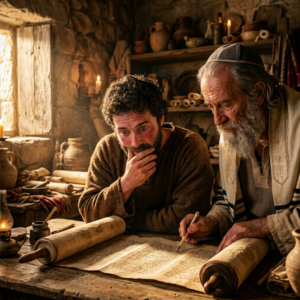
The air in the room holds a stillness that feels infinitely heavier than mere silence. It is a quiet pregnant with the ghosts of millennia, a space where the distant past reaches out to brush against the present. When the voice finally breaks the stillness, saying, “I’ve never stayed in a place like this,” it is not merely a comment on the physical accommodations. It is a profound, almost breathless realization of standing at the very epicenter of human history. The speaker gazes around, their eyes tracing the architectural lines that seem to hold secrets within the mortar. It becomes immediately apparent that the majesty of this place is not anchored in its square footage or the superficial beauty of its design. The true uniqueness, the overwhelming gravity of the location, emanates from the story it whispers from the stones themselves. This is Jerusalem. It is a living, breathing testament to the relentless, often beautiful, and frequently agonizing collision of people, faith, and culture.
To understand this space is to look upon something akin to Phoebe’s collection of artifacts, gathered meticulously from the far-flung corners of the world. Imagine running your hands over the smooth, time-worn curves of clay pottery, or feeling the cold, oxidized edge of a foreign coin. Each object in Phoebe’s collection carries the distinct fingerprint of its maker, the scent of the soil from which it was unearthed, and the silent narratives of the hands it passed through over centuries. Jerusalem, in the first century, was the living embodiment of such a collection. It was an astonishing, chaotic melting pot of cultures and religions, a place where the scent of exotic spices mingled with the smoke of temple sacrifices, and where a dozen different dialects could be heard in the span of a single marketplace alleyway. But beneath the vibrant surface of this pluralism lay a profound tension. What was it truly like for Jesus of Nazareth and his tight-knit band of disciples to navigate this intricate labyrinth of competing worldviews, to live and breathe among such overwhelming, multifaceted pluralism?
The Scroll, the Scholar, and the Stolen Stories of the Ancients
The answer begins to unfold in the quiet, dusty intimacy of a study room, where the golden afternoon light filters through a narrow window, illuminating dancing motes of dust suspended in the air. Two figures lean over an ancient text, their faces bathed in the warm, reflective glow of parchment. “So tell me,” one voice asks, probing the depths of the historical record, “What’s this one about?” The response is laden with a complex mixture of historical defensiveness and weary resignation. “Actually, this one, they sort of stole from us, at least the beginning part.” The word “stole” hangs in the air, heavy with the generational grievance of a people whose very identity is constantly under threat of erasure.
The conversation drifts backward into the shadowy period of the judges, settling on the harrowing narrative of Jephthah. As the tragic vow of Jephthah is recounted—a vow that would cost him everything he held dear in a desperate bid for military victory—the details of ancient warfare blur. “Well, he was about to fight the Hittites,” the speaker ventures, only to be met with the gentle, deeply knowledgeable chuckle of the Rabbi. “Ammonites,” the Rabbi corrects, his voice a soothing balm of absolute certainty. “Yes. Thank you, Rabbi,” the speaker concedes, a humble acknowledgment of the immense, almost crushing weight of perfectly preserving the oral and written histories of their ancestors. “No problem,” the Rabbi replies, a fleeting moment of grace in a world governed by strict adherence to the law.
This subtle exchange reveals a staggering truth about the world they inhabited. Long before the iron-clad sandals of the Roman Empire marched across the known world, the cultures deeply rooted in this arid, contested landscape had been bleeding into one another, influencing, shaping, and reshaping each other for hundreds of years. The borders between nations were porous, not just to merchants and armies, but to ideas, philosophies, and myths. The evidence is undeniably etched into the very overlap of their cultural stories, narratives that span across vast geographies to teach strikingly similar moral lessons and recount parallel histories. When John and Jesus engage in a deep, theological discussion about how the tragic, blood-soaked Greek myth of Orestes perfectly parallels the devastating plot of the Hebrew story of Jephthah, the air in the room grows thick with realization. The rustle of the opening scroll sounds like a sudden intake of breath. It is a stark, unavoidable reminder that none of these cultures—not the Greeks, not the Romans, and certainly not the Israelites—exist in a pristine, uncontaminated vacuum.
Yet, as the parallels between the Greek and Hebrew tragedies are laid bare, a sudden, palpable discomfort washes over John. The realization that he is intimately familiar with a pagan, Greek narrative brings a hot flush of embarrassment to his cheeks. He averts his eyes, his posture stiffening. Why does John, a devout follower of the God of Abraham, feel such profound shame at his knowledge of a foreign myth? His embarrassment is not merely academic; it is intensely psychological. It is the deep-seated terror of the colonized realizing how deeply the colonizer’s culture has infiltrated their own mind. It is the fear that in knowing their stories too well, he might be losing a piece of his own soul.
Shadows of the Empire Imposed on the Dust of Galilee
John’s internal conflict was a microcosm of a much larger, darker reality that suffocated the land. The Roman influences were not just whispered in stories; they were violently thrust into the physical world, everywhere the eye could see. Even the quiet, rural tranquility of Jesus’s hometown of Galilee, a place defined by its rolling hills and humble fishermen, was suddenly and jarringly peppered with the imposing, cold marble of Roman architecture. Newly built amphitheaters rose like arrogant monuments to foreign gods, their perfect geometry standing in stark, defiant contrast to the organic, weathered stones of the Jewish settlements. Every pillar, every archway was a psychological weapon, a constant, inescapable reminder to the local populace that they were a conquered people, living under the absolute dominion of Caesar.
But the threat to their identity was not exclusively Greco-Roman. The empire was a sprawling, insatiable beast that stretched its tentacles across multiple continents, and Jerusalem was its beating, multicultural heart. The Holy City drew endless streams of pilgrims, merchants, and wanderers from all around the known world. The marketplaces were a chaotic symphony of foreign commerce. Beautiful, strange objects crafted in the shadow of the pyramids of Egypt, vibrant textiles woven on the shores of the Mediterranean, and heavy, unfamiliar tools forged in the dense forests of Europe all found their way right here, into the dusty streets of Jerusalem, carried on the relentless tides of trade and the bloody currents of conquest.
For the Jewish people, navigating this daily sensory overload was an exercise in existential survival. Much like any marginalized group that suddenly finds itself drowning in the overwhelming currents of a massive, multicultural metropolis, the profound instinct was to pull inward, to build walls, to protect what was theirs. The Jewish elders, the deeply devout men and women of the community, harbored a desperate, burning desire to preserve their ancient culture, to fiercely guard the purity of their religion, and to maintain their sacred way of life against the rising floodwaters of globalism. There was a terrifying, unspoken calculus in their minds: if their own people, their sons and daughters, became too comfortable with the foreigners, if they became too Romanized in their dress, their speech, and their thoughts, then the unique, covenantal way of life handed down by Moses might be permanently threatened. The fear was a suffocating blanket, turning every foreign face into a potential threat, and every new idea into an act of treason against God.
The Weary Pilgrimage of the Gentile Outsider
It is against this backdrop of immense cultural anxiety and rigid, defensive exclusion that a solitary figure emerges from the crowd, entirely shifting the spiritual gravity of the narrative. “See? A woman follower of Jesus and a Gentile.” The words are spoken with a mix of astonishment and profound vindication. Tamar stands before them, the very dust of the road clinging to the hem of her garments, her face lined with a weariness that goes far deeper than physical exhaustion. When she speaks, her voice carries the defensive, almost pleading edge of someone who has spent her entire life having her sanity and her worth questioned by those around her. “I told you I wasn’t crazy,” she says, her eyes searching the faces of the disciples for a flicker of acceptance.
Her journey is a testament to an invisible, undeniable magnetic pull. “We came all the way from the Decapolis,” she explains, gesturing to the vast, culturally alien territory beyond the Jordan River. To make such a journey was to subject oneself to the harsh elements, to the dangers of the road, and to the biting scorn of the devout who guarded the city gates. Yet, she came. She came to worship him, to observe this sacred pilgrimage holiday in a city that historically viewed her very existence as a contamination. The hesitation in her voice is heartbreaking. “That’s permitted, right? I mean, she’s here, so I guess?” She points to another outsider, desperate for a precedent, desperate for a loophole in the rigid laws of exclusion that might allow her to simply exist in the presence of the Divine.
The response she receives is a quiet revolution. “There are Gentiles here. You’re not alone.” Those words, though simple, carry the explosive power of a shattered paradigm. In an instant, the crushing weight of her isolation is lifted. To be told “you are not alone” in a city that was specifically designed by its religious elite to keep you out is to experience a radical, life-altering grace. It is the moment the heavy, iron doors of religious exclusivity are pried open, letting in the terrifying, beautiful light of universal inclusion.
The Radical Table and the Slander of the Elite
This miraculous inclusion was entirely the design of Jesus. While the religious establishment trembled under the paralyzing weight of preserving their cultural purity, Jesus walked through the bustling, diverse streets completely unburdened. Jesus didn’t have this spirit of fear. Where the Pharisees saw contamination, Jesus saw humanity. Where the elders saw a threat to their traditions, Jesus saw children desperately wandering in the dark. He was entirely fine, completely at peace, to not just stand on a distant hilltop and preach lofty sermons to the Gentiles, but to actually engage in the most dangerously intimate act known to the ancient world: he shared meals with them.
To sit at a table, to break bread, to pass the cup, and to look into the eyes of a Gentile was a scandalous, earth-shattering defiance of the established social order. By doing so, Jesus was not just teaching; he was actively dismantling the towering walls of hostility. He was choosing to befriend them, to weave his life into the messy, unapproved fabric of theirs. This created a jarring, irreconcilable contrast within the spiritual landscape of Jerusalem. While the powerful, deeply entrenched religious leaders of the Sanhedrin were desperately using every tool of shame, law, and intimidation to push the “others” out, Jesus was standing at the threshold, throwing the doors wide open, and actively inviting the outsiders in.
The psychological terror this inflicted upon the Sanhedrin cannot be overstated. Jesus was unraveling the very fabric of their authority. He was rendering their intricate systems of purity completely irrelevant by offering a direct, unmediated connection to God that required no ethnic pedigree. No wonder why they wanted to kill him. His death was not just desired; to the religious elite, it was an absolute necessity for the survival of their enclosed, heavily guarded world. To let him live was to let the walls fall, and to let the walls fall was, in their minds, to invite the destruction of everything they held sacred.
The Transcendent Joy of the Stranger in a Strange Land
Yet, it was precisely this terrifying, boundary-breaking openness that drew the brokenhearted to him. This radical, fearless inclusivity was the very core of the reason why Tamar, despite all the social risks, despite the exhausting journey, was so irrevocably drawn to Christ. Jesus deliberately crossed the deep, historically entrenched cultural and religious lines that every other rabbi, priest, and scholar absolutely would not. He waded into the murky, uncomfortable waters of pluralism for one singular, beautiful purpose: in order to truly see them. He did not look at the crowds and see Romans, Greeks, or Judeans. He stripped away the political labels and the ethnic divisions, choosing instead to see them fundamentally as people, as infinitely valuable children of God.
He looked at the outcasts, the foreigners, and the marginalized, and he bestowed upon them a title that had been fiercely guarded for millennia: he saw them as The Chosen. The absolute staggering weight of this grace falls upon Tamar. Even a Gentile woman, entirely outside the covenant of Abraham, entirely devoid of the “correct” lineage, was suddenly pulled into the center of the divine narrative.
As Tamar stands before Jesus, the emotional dam that has held back a lifetime of rejection finally breaks. Her voice trembles, laden with the profound sorrow of her reality, yet fiercely illuminated by a newfound, unshakeable peace. She articulates the agonizing human condition of being the eternal outsider. “Tamar,” she says, almost as if reminding herself of her own name, her own identity, “to be a stranger in a strange land and a stranger among strange people.” She speaks of the constant, invisible armor she has had to wear every single day. She speaks of the deep, psychological scarring that comes from being constantly subject to the vicious slander by the self-appointed arbiters of the faith, the holy men who looked down their noses and declared her inherently unclean.
But as she looks into the eyes of the man who invited her to the table, the pain of her past dissolves into the blinding light of the present. The corners of her mouth lift, her eyes shining with unshed tears of absolute liberation. The rejection, the slander, the exhausting journey from the Decapolis, the fear of the Sanhedrin—all of it fades into insignificance. “You know,” she breathes, her voice steadying into a declaration of absolute, unwavering devotion, “it has been nothing compared to the joy of following you.” The silence in the room is total, echoing with the finality and the immense power of her truth. She takes a breath, the dust of the world falling away from her spirit. “I wouldn’t trade it for the world.”
A Reflection on the Walls We Build and the Tables We Set
When the dust settles on the ancient streets of Jerusalem and the echoes of Tamar’s profound declaration fade into the annals of history, we are left staring into the mirror of our own modern existence. The fear that gripped the Sanhedrin, the desperate desire to build walls to protect our own culture, our own comfort, and our own deeply held beliefs from the “other,” is not a relic of the first century. It is the beating heart of our current societal divides. We still live in a world that meticulously categorizes who is “in” and who is “out,” who is clean and who is unclean, who is chosen and who is forgotten.
Yet, the radical invitation of Jesus continues to slice through the centuries, demanding that we look at the strangers in our own strange lands not as threats to be mitigated, but as divine image-bearers to be welcomed. To follow the narrative of Christ is to walk directly into the uncomfortable, messy, beautiful reality of pluralism without a spirit of fear. It is to intentionally seek out those who have been subjected to the slander of the modern arbiters of faith and society, and to pull up a chair for them at the table. Tamar’s story is the ultimate testament that when the heavy, suffocating burden of exclusion is finally replaced by the transcendent joy of radical acceptance, the human spirit is liberated. It is a joy so profound, so deeply anchoring, that once experienced, no one would ever trade it for all the safety and walled-off security in the world.
Where do you find yourself in this ancient, echoing narrative? Have you ever felt the exhausting, heavy burden of being the “stranger in a strange land,” desperately hoping to hear the words, “You are not alone”? Or perhaps, have you ever experienced the terrifying, yet profoundly beautiful moment of extending a radical invitation to someone the rest of the world told you to fear? Drop into the comments below and share your story. Let’s create our own table of radical inclusion right here, and remind each other that in the grand, chaotic melting pot of life, none of us are truly meant to walk alone.
Disclaimer : This content may be created by AI for entertainment purposes. Any resemblance to real persons, events, or places is coincidental.






