The Honeymoon Ransom: How 31 Texts at Heathrow Airport Shattered a Nineteen-Year Family Illusion
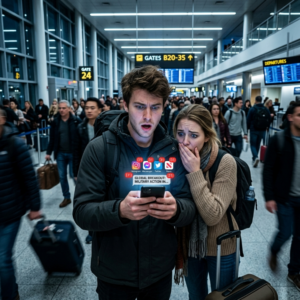
A mobile phone should not vibrate thirty-one times in the span of a single breath. When it does, the human body does not interpret the sensation as a digital notification; it registers it as a physical threat. The rhythmic, unrelenting buzz against the fabric of my pocket cut through the dull, fluorescent hum of Heathrow Airport like a siren. It was 6:41 a.m. in London. The air in the customs queue smelled of stale jet fuel, expensive duty-free perfume, and the collective exhaustion of hundreds of transatlantic travelers. Beside me stood my wife, Harper. We had been married for precisely twenty-one hours. Her head was resting lightly against my shoulder, a portrait of drowsy, newlywed satisfaction, her fingers laced securely through mine. We had survived the wedding planning, the chaotic joy of the reception, and the grueling overnight flight from Los Angeles. We had arrived. We were standing on the precipice of a dream we had spent nine months and $12,750 meticulously building—a thirteen-day immersion into the misty, ancient magic of the Scottish Highlands, the peaty warmth of remote distilleries, and the heavy stone silence of castle accommodations.
Then, I pulled the phone from my pocket.
The lock screen was a cascade of digital panic, a waterfall of messages that obscured Harper’s smiling face on my background wallpaper. I tapped the screen. The very first three words to catch my eye were from my mother. Emergency family gathering. I felt the blood drain from my face, a cold rush rushing downward until my knees literally buckled beneath my own weight. I stumbled forward a fraction of an inch, catching myself on the edge of our luggage cart. Harper felt the sudden shift in my gravity. I watched her countenance morph in real-time. The drowsy, peaceful satisfaction evaporated from her eyes, replaced instantly by a sharp, clinical anxiety, and then, as she read the screen over my shoulder, a dark, hardening recognition.
Before my brain could even process the adrenaline, the next message materialized, shoving the first one down. Your sister Madison fractured her leg. Someone has to babysit the kids. You must return home today. There was no preamble. There was no Can you return home? There was no Is there any way you could possibly help? It was a summons. It was the crack of a whip across an ocean. It was an order delivered from a manager to a subordinate employee whose time, resources, and very existence were considered company property. I stood there, twenty-nine years old, a grown man with a degree, a career, and a wife, yet in the span of three text messages, I was violently yanked back through time. I was no longer a husband on his honeymoon. I was the unpaid, unappreciated third parent of a broken household, and my masters were demanding my immediate return.
To understand the profound, paralyzing terror of those text messages, you have to peer into the kitchen of my childhood. You have to see the ten-year-old boy standing on a step stool, wielding a wooden spoon like a scepter over a boiling pot of water. I am the oldest of five children. But in our household, being the eldest was not a matter of birth order; it was a binding contract of indentured servitude.
The paradigm shifted irreversibly when I was ten years old. My mother, driven by an ambition that left no room for the messy reality of the family she had created, returned to school to pursue her master’s degree in educational administration. Her life became a rigid grid of evening classes three nights a week and marathon weekend study sessions that consumed entire Saturdays. My father, the owner of a local sporting goods store, vanished into the retail grind, surrendering his weekends and holidays to inventory counts and Christmas season rushes. They were two adults chasing their own survival and status, and in their wake, they left a vacuum of care.
Someone had to monitor Madison, who was a fragile seven years old. Someone had to corral the wildly energetic five-year-old twins, Carter and Dylan. Someone had to hold baby Sienna, who was merely three, a tiny, breathing weight that required constant, terrifying vigilance. That someone became me.
I did not have a childhood; I had a management position. I mastered the precise, gooey alchemy of macaroni and cheese long before my teachers introduced me to the concept of long division. I learned the tight, secure fold of a disposable diaper while the boys in my neighborhood were outside trading baseball cards and joining Little League teams. While my peers were having sleepovers, eating junk food until midnight, and watching movies in the dark, I was sitting on the edge of a toddler’s bed, modulating my voice to read bedtime stories, and getting down on my hands and knees to assure a weeping three-year-old that there were absolutely no monsters lurking beneath her mattress.
By the time I reached thirteen, the illusion of me being a “helper” had completely dissolved. I was the executive director of the household. I remember the physical weight of the grocery lists my mother would casually abandon on the kitchen counter, accompanied by a stark white envelope scrawled with the words Food Money. I would walk down the fluorescent aisles of the supermarket, a young teenager doing the mental math of a weary mother, calculating the cost of bread and milk. I orchestrated supper on most evenings. It was nothing that required culinary brilliance—just the mechanical assembly of spaghetti, the browning of ground beef for tacos, the endless trays of frozen chicken nuggets. It was survival food, the kind of meal a child could successfully prepare without burning the house down.
I became the arbiter of justice in sibling disputes. I dispensed bandages for scraped knees and measured out exact doses of children’s Tylenol for midnight fevers. My brain became a vast, categorized filing cabinet of my siblings’ intricate needs. I knew, without thinking, which youngster would break out in hives from strawberries. I knew which twin would absolutely refuse to consume a sandwich unless the crusts were amputated and the bread sliced into perfect, symmetrical triangles.
And for this monumental theft of my youth, I received the most insidious reward of all: praise. My parents constantly commended me for being “mature,” for being “reliable,” for being “dependable.” The teachers at my middle school would look at my tired eyes and call me an “ancient soul.” The neighbors would watch me herd four small children into the house and whisper to each other that I was “wise beyond my age.” No one—not a single adult in my orbit—ever stopped to ask the horrifying question: Why is a thirteen-year-old boy performing the grueling, relentless labor of two grown adults? Why are these parents perfectly content to abdicate their most sacred responsibilities and place them squarely onto the narrow shoulders of their firstborn child?
The machine ran with ruthless efficiency throughout my high school years. I loved basketball, but I could never join the team because practice stretched until 5:45 p.m., and the school bus deposited my younger siblings at the corner at exactly 3:05 p.m. Someone had to be there. I attended precisely one high school party in four years because leaving the kids alone after dark was never an option. My parents’ definition of “family time” was a grotesque mockery: it consisted of me acting as a free, captive babysitter so they could go out to a nice dinner and catch a movie in peace.
The final, crushing blow to my independence came wrapped in an acceptance letter from Berkeley. It was my dream school, a beacon of intellectual freedom, and I had earned a half-scholarship. I remember sitting at the kitchen table, my heart hammering against my ribs with hope, presenting the letter to my mother. She didn’t smile. She didn’t pull me into a proud embrace. She simply picked up her spoon, stirred her coffee with a chilling, rhythmic clink against the ceramic mug, and looked at me as if I had suggested relocating to Mars.
“We need you here,” she stated, her voice as flat and casual as if she were discussing a slight chance of afternoon rain. “The children rely on you. Berkeley is really far away.”
The guilt was instantaneous and suffocating. I folded the letter. I went to the local state college. I lived at home. I commuted thirty-five minutes each way, worked a part-time job at the campus bookstore to scrape together my own money, and raced back home every single afternoon to ensure the children were fed and their homework was initiated.
Even when my mother finally secured her master’s degree and took a prestigious position as a vice principal, her hours conveniently never aligned with the needs of her own children. My father remained an elusive phantom at the sporting goods store. When I graduated at twenty-three with a degree in civil engineering and landed a phenomenal job designing municipal water systems, I finally moved out. But the invisible leash remained tight around my neck. I rented an apartment precisely seven miles from my parents’ house. Seven miles. It was the absolute maximum geographical distance I could psychologically rationalize, because, in my deeply conditioned mind, I still had to be immediately accessible for “the kids.”
The dismantling of my matrix began with a plate of Pad Thai. I had been dating Harper for four weeks. She was a revelation—sharp, unapologetically humorous, and armed with a deep, piercing insight that, frankly, terrified me at first. We were sitting in a small, dimly lit restaurant, the air thick with the scent of peanut sauce and basil. I was casually, defensively explaining why I had been forced to cancel our dinner plans the previous evening. My mother had “needed” me to watch the kids so she could attend a colleague’s retirement celebration.
Harper put down her fork. She looked at me, her eyes tracking the subtle, anxious tics in my posture. “So,” she asked, her voice dangerously gentle, “how frequently do your parents truly parent their own children?”
The question struck me with the blunt force of a physical blow. The air rushed out of my lungs. I immediately went on the defensive, the dutiful soldier protecting the regime. “They parent them,” I insisted, my voice tight. “They’re simply busy. It’s easy for me to help.”
Harper didn’t blink. She held me in a long, probing gaze that seemed to bypass my words and look straight into the exhausted marrow of my bones. “You did not ‘help out’ last night, Logan. You were a parent. There is a profound distinction.”
I opened my mouth, but no sound came out. I had absolutely no response. The fortress of my rationalization had been breached. Harper didn’t push the issue that night; she just watched, absorbing the data of my deeply dysfunctional existence. She watched as I routinely canceled our dates because my mother would summon me with a fabricated “emergency.” She watched me spend my precious, hard-earned weekends acting as a chauffeur, driving my siblings to soccer games and chaotic birthday parties while my parents gleefully skipped off to their own adult social events.
She saw my phone screen light up at all hours of the day and night. Dylan needs poster board for an assignment due tomorrow. Can you pick up Sienna after gymnastics? I am running late. Carter left his trumpet at home. Can you bring it to the school? They were always punctuated with question marks, presented as polite queries, but we both knew they were absolute mandates. If I ever dared to type the word “no,” the unspoken consequence was that my siblings—children I loved with a fierce, protective, almost unhealthy parental devotion—would be the ones to suffer.
When I finally asked Harper to marry me after three years of navigating this minefield, she said yes without hesitation. But her acceptance came with an immediate, non-negotiable condition. She looked at the ring on her finger, then looked up at me, her expression dead serious. “We need to talk about boundaries before we walk down any aisle, Logan. Because I will not spend the rest of our marriage coming second to your parents’ convenience.”
That ultimatum led us to the quiet, neutral office of Dr. Elise Thornton, a licensed marriage and family therapist who specialized in the complex, toxic webbing of family systems. Sitting on Dr. Thornton’s plush couch, I was forced to face the brutal reality of my existence.
“When was the last time you said no to your parents?” Dr. Thornton asked, her pen hovering over a yellow legal pad. “Never,” I whispered, the word tasting like ash in my mouth. “Did you get paid for this child care?” “No.” “Have they ever genuinely thanked you?” “Not really.” Dr. Thornton leaned forward, her eyes locking onto mine. “Do you recognize this dynamic as exploitation?”
The word hit me like a bucket of freezing water. Exploitation. It wasn’t “helping out.” It wasn’t “being a good son.” It wasn’t “familial support.” It was the systematic, unapologetic extraction of my youth, my energy, and my autonomy. It was exploitation.
Armed with the psychological vocabulary to understand my own abuse, we set the boundaries five months before the wedding. I sat in my parents’ living room, my heart pounding a frantic rhythm against my ribs, and delivered the manifesto. I informed them, in a voice that shook only slightly, that I was stepping down. I would no longer be available for regular, routine child care. I would be happy to assist in genuine, life-or-death emergencies, but Saturday morning soccer games and forgotten high school lunchboxes no longer qualified.
The reaction was a masterclass in emotional manipulation. My mother’s face crumpled. She produced real, glistening tears, dabbing at her eyes with a crumpled tissue as if I had just read her a terminal medical diagnosis.
“After everything we’ve done for you,” she murmured, her voice cracking with perfectly calibrated theatrical agony. “We reared you. We made sacrifices for you, and now… now you are abandoning your family.”
It was a flawless guilt trip, a weapon refined over nineteen years of absolute power. I felt the old conditioning rising up, threatening to choke me. But Dr. Thornton’s voice echoed in my head as an anchor. You are not abandoning anyone. You are creating age-appropriate boundaries. You are an adult son getting married, not an unpaid babysitter.
My father’s reaction was entirely different. There were no tears, only a cold, caustic venom. He stared at me from his recliner, his eyes hard and flat. “Okay,” he said, the word clipping the air. “But don’t expect us to bend over sideways if you ever need something someday.”
The horrific, underlying truth of our entire family dynamic was laid bare in that single sentence. Our relationships were purely transactional. I offered them thousands of hours of free labor, the total surrender of my personal life. And in return, what did they offer? Conditional affection. A reluctant, heavily taxed approval that could be revoked the moment I ceased to be useful. I walked out of their house that night feeling a sickening mix of liberation and profound grief.
We married in April in a small, sunlit ceremony surrounded by eighty-five guests in Harper’s favorite botanical park. My parents attended. They put on their public faces, smiling warmly for the photographer, raising glasses of champagne, and delivering a toast about how delighted they were to welcome Harper to the family. My mother sobbed loudly during the vow exchange. I stood at the altar, looking at her tears, desperately wanting to believe they were born of a mother’s genuine, bittersweet joy. But deep down, the cynical, damaged part of my soul knew it was performance art, a public display intended to make me feel terrible for leaving her.
We had scheduled the honeymoon for late August, waiting patiently for Harper’s grueling hospital schedule to clear and for me to accumulate enough paid time off. It was to be the trip of a lifetime. Harper had been captivated by the mythos of Scotland since she was a little girl, obsessed with ancient history and the sweeping romance of Outlander. We planned it like a military campaign. Flights from LAX to London, connecting to Edinburgh. Rental cars mapped out for the winding roads. Small, intimate lodgings tucked into the rugged landscape.
We financed the dream with sheer, unrelenting discipline. We stopped eating out. We bypassed movie theaters and concerts. I worked grueling overtime hours, and we funneled every single birthday check and wedding gift directly into a high-yield savings account labeled “Highlands.” The final tally was an astronomical $12,750.
I gave my parents exactly eight months’ notice. Eight full months. Two hundred and forty days to conceptualize, plan, and execute alternative child care arrangements. Two hundred and forty days to process the reality that my life no longer revolved around their immediate convenience. When I presented the dates to my mother, she looked up from her iPad, blinked blankly, and said, “That’s nice, honey.” It was the exact tone she would use if I had announced I was switching from drip coffee to espresso. There were no questions about the itinerary. There was no excitement for my first major international journey. There was only a cold, dismissive indifference. It should have been a screaming, neon red flag. But I was intoxicated by the illusion of my newfound boundaries. I foolishly believed that five months of therapy had permanently reprogrammed nineteen years of intense, cult-like brainwashing.
The facade cracked exactly four weeks before takeoff.
It was a quiet Sunday morning. Harper and I were in our kitchen, making pancakes, the smell of butter and maple syrup filling the air. My phone rang. It was my mother. I answered on speakerphone, wiping flour from my hands.
“I need to talk to you about something,” she announced, her voice dropping into her serious, vice-principal register. “Your father and I have received an invitation to a wedding in Portland on September 4th. We hoped you could watch the kids that weekend.”
September 4th. The exact midpoint of our $12,750 honeymoon. The day we were scheduled to stand on the shores of Loch Ness and explore the crumbling ruins of Urquhart Castle.
“I can’t,” I said immediately, my heart giving a familiar, anxious flutter. “I will be in Scotland, Mom. I informed you about this months ago.”
A long, heavy pause hung on the line, thick with entitlement.
“So… couldn’t you postpone?” she asked, the audacity dripping from every syllable. “Only for a few days. We simply cannot miss this wedding. It is your father’s cousin’s daughter, and it would be incredibly impolite not to go.”
I stared at the phone, completely paralyzed by the sheer scale of her narcissism. She honestly believed it was more logical for me to dismantle a heavily financed, international honeymoon with my new wife than for her to decline an invitation to the wedding of a distant relative I had met twice in my entire life.
“Mom,” I said, my voice hardening, the therapy kicking in. “We paid $12,750 for this vacation. The flights alone were $4,200, and they are strictly non-refundable. The hotels are booked and paid for. I am not postponing my honeymoon.”
Instantly, her voice shifted gears, slipping effortlessly into the wounded, trembling tone that had controlled me for two decades. “I just assumed family would come first. I had no idea we were such a massive hassle to you now that you are married.”
There it was. The ancient spell. Family comes first. In her twisted lexicon, that phrase meant only one thing: Our demands are absolute; your existence is irrelevant. I gripped the edge of the kitchen counter. “I told you months ago,” I said, forcing the words through a tight jaw. “You will need to hire a babysitter or find another option. Harper and I are traveling to Scotland as scheduled.”
She hung up on me. No goodbye. Just the harsh, digital click of a severed connection.
Thus began the silent treatment. For six agonizing days, there were no calls, no passive-aggressive text messages, no responses to my attempts to check in on my siblings. Finally, on the seventh day, a terse text arrived. We discovered someone, a neighbor’s daughter. She is charging us $240 for the weekend. I hope you have a wonderful trip. The passive-aggressive jab about the $240 expense was classic. This was a woman who routinely dropped three times that amount on weekend wine-tasting trips, but the concept of paying for the care of her own children was an offensive outrage. The financial math of our family only balanced if my grueling labor was valued at exactly zero dollars.
We boarded the overnight flight from LAX on August 28th, exhausted to our marrow but thrumming with the electric anticipation of escape. I had sent my parents one final email containing our precise flight numbers, hotel addresses, and a clear warning that cell service in the deep Highlands would be spotty at best. My mother had replied with a single, brutal word: Fine. My father had not replied at all.
As the plane lifted off the tarmac, tearing us away from the West Coast, the silence felt less like a punishment and more like a massive, collective exhalation. For nine hours, soaring over the dark, frozen expanse of Greenland, we were untouchable. Harper fell asleep on my shoulder. I watched a movie, drank terrible airplane coffee, and allowed myself to feel the strange, terrifying lightness of being responsible only for myself.
We touched down at London Heathrow at 3:52 p.m. local time on August 29th. We had a two-hour layover before our short hopper flight to Edinburgh. We stretched our cramped legs, breathed in the recirculated terminal air, and I blindly, habitually reached into my pocket to turn off airplane mode.
It took exactly forty-five seconds for the phone to locate the international network. And then, the vibration began.
Standing in the terminal, reading the words You must return home today, the physical reality of the terminal around me began to dissolve. My hands started to shake violently.
I looked at the timestamps. 31 messages. 16 from my mother, 9 from my father, 4 from my sister Madison, and 3 from random family friends. All of them had been launched into the ether while I was thirty thousand feet in the air.
Madison shattered her leg this morning… tumbled down the stairs… currently in surgery… This is serious… Where are you?… We need you home right now… I can’t believe you aren’t responding amid a family emergency… Your sister may have died, leaving you unreachable.
My breath hitched in my throat. Madison was twenty-two years old, living at home while grinding through her nursing degree. She was still one of my kids. The image of her tumbling down the basement stairs, the thought of bones breaking, the terrifying word surgery—it bypassed all my boundaries and struck directly at the core of the ten-year-old caretaker inside me.
“Oh no,” Harper gasped, her fingers digging into my arm. “Is she okay?”
“I don’t know,” I choked out. We found a quiet alcove near a shuttered duty-free kiosk. I dialed my mother’s number. My heart was hammering a bruised rhythm against my ribs.
She answered on the first ring. She didn’t say hello. She didn’t acknowledge the fact that I had just crossed an ocean. She just snapped, her voice vibrating with a dark, piercing fury.
“Where have you been?”
It wasn’t the voice of a mother consumed by the terror of a child in surgery. It was the voice of a warden whose prisoner had missed roll call.
“We were on an aircraft, Mom,” I said, desperately trying to modulate my tone, to keep the panic out of my voice. “What happened? Is Madison all right? What sort of surgery?”
A deep, highly theatrical sigh echoed through the phone. “She slipped down the basement stairs this morning while hauling clothes down. The doctor stated she shattered her tibia in three places. They had to put a rod in. She’ll be non-weight-bearing for at least seven weeks, possibly nine.”
I pulled my phone slightly away from my ear, ready to dial the hospital’s main switchboard. “Okay, that’s incredibly serious. I’m so sorry she’s going through that. Is she out of surgery? Can I speak to her?”
My mother made a sharp sound of profound disappointment. “She’s in rehab and extremely drugged. She is not available for phone calls.”
And then, the trap was sprung. The emotional snare pulled tight.
“We need you to come home, Logan. Someone needs to keep the kids while we take care of Madison. Your father and I cannot handle anything alone. You need to cut your trip short and return today.”
I closed my eyes. The bustling noise of Heathrow Airport faded to a dull, rushing static. The truth of the situation crystallized with horrifying clarity. This wasn’t about Madison wanting her older brother to hold her hand in recovery. This wasn’t about a family rallying together in a crisis. This was about logistics.
Carter and Dylan were nineteen years old. They were adult men who had just completed their sophomore year of college. Sienna was seventeen, a high school senior. They were not toddlers requiring constant supervision. They did not need to be fed, bathed, or monitored for swallowed Legos. They were grown.
“Mom,” I said, my voice dropping an octave, finding a cold, hard anchor. “The twins are nineteen. They are legally adults. They are more than old enough to care for themselves and assist Sienna. I’m not sure why you are demanding I travel home from Scotland on the first day of my honeymoon to babysit grown adults.”
The silence on the line was long, heavy, and terrifying. When she finally spoke, her voice dripped with a venom I had never fully heard before.
“I can’t believe you’ve gotten so utterly selfish. Your sister just underwent traumatic surgery, and you are concerned about your little vacation.”
Vacation. Not honeymoon. A vacation was frivolous. A vacation was an optional luxury that could be discarded the moment she snapped her fingers.
“This isn’t a vacation,” I said, my voice rising despite my best attempts to keep it level. “This is my honeymoon. We saved for nine months. We paid twelve thousand, seven hundred and fifty dollars for this. The flights are non-refundable. We just arrived five hours ago. Madison is going to be okay. A fractured leg is horrible, but it is not life-threatening. The kids don’t need me there.”
The air in the phone line seemed to freeze. “If you don’t come home,” my mother said, her words dropping like stones into a bottomless well, “you shouldn’t bother ever returning to this household. You’ve chosen a vacation above your sister. You’ve chosen yourself above the siblings who rely on you. I will make certain that everyone understands exactly who you’ve become.”
It was the nuclear option. Emotional blackmail refined over decades, deployed to utterly annihilate my resistance. My hands were shaking so violently I almost dropped the phone.
“I hope Madison heals quickly,” I murmured, the words barely making it past the lump in my throat. “We’ll check in tomorrow. But we won’t be coming home early.”
I hit end. I looked at Harper. Her eyes were wide, taking in the pale, shattered expression on my face.
“She threatened to disown you,” Harper said, her voice slow, testing the sheer insanity of the words. “She threatened to disown you because we refuse to cancel a thirteen-thousand-dollar honeymoon… to babysit teenagers.”
Said out loud, under the fluorescent lights of London, it sounded like sheer madness. But to me, it was just Tuesday. It was the exact same dynamic I had been drowning in for nineteen years. My existence was completely irrelevant unless it was being actively consumed by my parents.
We survived the hopper flight to Edinburgh. We picked up our rental car—a little Nissan hatchback with the steering wheel on the right side, an orientation that made my exhausted, stressed brain throb with a dull ache. We drove through the gathering dark to our first hotel, a stunningly renovated Victorian mansion tucked into the ancient, uneven cobblestones of the old town. A fire was crackling in our room. It was the exact, perfect beginning we had spent nine months dreaming about.
Instead of opening champagne, I sat on the edge of the antique bed, staring at the floorboards, and dialed Madison’s direct number. I had to hear her voice. I had to know the truth of the medical “emergency.”
She answered on the fourth ring. Her voice was fuzzy, thick with narcotics, and distant. “Hey,” she mumbled. “Mom claimed you weren’t coming home.”
“I’m in Scotland, Maddie,” I said gently, leaning forward, resting my elbows on my knees. “I’m on my honeymoon. I am so incredibly sorry about your leg. How do you feel?”
I could hear the rhythmic, electronic beep of a hospital monitor in the background. “It sucks,” she sighed. “The surgery hurt like hell, and the painkillers are making the room spin. But I’m fine, Logan. The doctor said it was a remarkably clean break. I’ll be on crutches for a couple of months, but I’ll recover completely.”
A massive, crashing wave of relief washed over me, immediately followed by a dark, surging anger. Clean break. Good prognosis. Not the life-threatening catastrophe my mother had painted to force me onto a return flight.
“So,” I asked carefully, “why is Mom claiming this is a five-alarm family emergency that requires me to fly home immediately?”
Madison let out a long, exhausted sigh that sounded far too old for a twenty-two-year-old. “Because she’s freaking out. Someone actually has to help me get around the house, make me food, help me to the bathroom. And it appears she simply cannot handle doing that, let alone managing a household where Carter and Dylan are entirely self-sufficient and Sienna is almost eighteen. I don’t know why she’s acting like they are seven years old again.”
There it was. The ugly, unvarnished truth lying bare on the bed between Harper and me. My mother simply did not wish to parent. She was entirely unwilling to endure the inconvenience of caring for her own injured daughter. She wanted her unpaid manager to fly across the Atlantic and resume his post so she could go back to her life unbothered.
“I’m not flying home, Maddie,” I said softly.
“I know,” she replied, sounding infinitely tired but entirely understanding. “I told Mom the twins could help me. I told her you didn’t need to fly home. But she’s on a rampage about ‘family obligations’ and how you’ve changed since you got married. It’s just exhausting. Enjoy your trip, Logan. Ignore her dramatics.”
I hung up the phone. Madison was safe. My siblings did not need me. But the war had just begun.
Over the next three days, my phone became an instrument of psychological torture. My parents deployed what Dr. Thornton had warned me about: the “Flying Monkeys.” It is a horrific phenomenon where a toxic family system recruits extended relatives to act as a unified mob, swarming the target with guilt and abuse to force them back into compliance.
Aunt Marjorie: I can’t believe you would abandon your family like this. What is wrong with you? Uncle Raymond: Your mother is crying uncontrollably. Come home and fix this immediately. Cousins I hadn’t spoken to since middle school were suddenly surfacing in my text messages and Facebook DMs, offering vicious, unsolicited critiques of my selfishness, my cruelty, and my utter lack of family values. Dozens of messages a day, a relentless, deafening drumbeat of shame. Bad son. Bad brother. Selfish husband. Family destroyer.
By the third day in Edinburgh, the city was a blur to me. We were supposed to be touring Edinburgh Castle, walking the historic Royal Mile, and ducking into cozy, fire-lit pubs to taste local whiskies. Instead, I was a hostage in my hotel room, glued to the glowing screen of my phone, my anxiety spiking into a physical nausea with every single ping.
Harper finally snapped. She walked over, physically pried the phone out of my white-knuckled grip, and looked me dead in the eye. “This stops right now,” she stated, her voice carrying the absolute, non-negotiable authority of a medical professional triage. “They are ruining our honeymoon. You are letting them ruin our honeymoon. We need help.”
Within two hours, Harper had scoured an online directory and booked an emergency telehealth session with Dr. Marin Whitaker, a clinical specialist based in Portland with sixteen years of deep-trench experience dealing with emotional abuse, parentification, and toxic family systems.
I sat in front of the laptop screen, the majestic, sweeping view of the Edinburgh skyline mocked by the tears of sheer frustration in my eyes. I talked for forty-five uninterrupted minutes. I poured out nineteen years of exploitation, the macular details of the current “crisis,” the threats, the flying monkeys, the $12,750 price tag of my rebellion.
Dr. Whitaker listened. She typed quietly. When I finally ran out of breath, she looked at the camera, her face a mask of profound, validating clinical detachment.
“Logan,” she said softly, “what your parents have subjected you to is known in clinical terms as parentification. It is not a quirky family dynamic. It is a documented, devastating form of emotional abuse. You have been systematically exploited since you were ten years old. You sacrificed your childhood and your adolescence to raise children that did not belong to you. And what you are experiencing right now is an extinction burst.”
She leaned closer to the camera. “This manufactured emergency—demanding you cancel a major life event to care for young adults who do not require intensive care—is a pure control tactic. They are applying maximum pressure to see if your new boundaries will shatter. The deployment of the extended family to harass you is deliberate, orchestrated psychological abuse.”
Hearing a licensed professional, a stranger with credentials, look me in the eye and name my reality “abuse” rewired my brain in a matter of seconds. I wasn’t crazy. I wasn’t overly sensitive. I wasn’t a terrible, selfish son. I was a survivor of a toxic system that was violently resisting its own collapse.
Dr. Whitaker gave me explicit homework. “Do not reply. But document every single interaction. Take screenshots of every text, save every voicemail, log the dates and times. If your parents escalate this further—and given their current trajectory, they will—you are going to need a bulletproof paper trail. You may require legal representation.”
I thought she was being overly paranoid. I had no idea how profoundly correct she was.
We left Edinburgh and drove north into the true Highlands. The physical landscape was staggering—rolling hills of impossibly vibrant green, ancient stone castles clinging violently to the edges of jagged cliffs, lochs whose surfaces were as flat and reflective as black glass. We walked through the haunting beauty of Glencoe. We stood in the copper-scented warmth of small distilleries. But the digital ghost of my mother stalked me through the glens.
My phone vibrated up to sixty times a day. My mother’s messages deteriorated from theatrical hurt to aggressive, open threats. You’re destroying the family. Everyone knows exactly what you did. There will be severe consequences for this betrayal.
On September 4th, five days into the trip, the threat materialized. The text message made the blood in my veins run cold.
Because you have completely abandoned your responsibilities, we are filing a formal complaint with Adult Protective Services. The twins and Sienna are being actively neglected because you are not present to care for them properly. Enjoy Scotland while you can.
I stared at the screen, my mouth suddenly dry as ash. I handed the phone to Harper, my hands trembling violently. “Can she actually do that?” I whispered. “Can she call the government on me for refusing to babysit?”
Harper, who navigated the labyrinthine bureaucracy of pediatric medicine every single day, read the text with a look of pure, cynical disbelief. “Logan, Adult Protective Services exists to protect elderly or severely disabled adults from abuse. Your siblings are healthy, neurotypical teenagers. You have zero legal custody of them. There is absolutely no legal mechanism for that complaint to even stick to you.”
That evening, we had a follow-up session with Dr. Whitaker from a small inn near Inverness. She was even more direct. “Your mother is bluffing to terrify you into compliance,” she stated flatly. “But in doing so, she is making a catastrophic tactical error. By attempting to create a paper trail against you, she is formally, legally documenting her own utter inability to parent her minor children without relying on the unpaid labor of an adult sibling who lives outside the home. If an agency actually looks into this, it will backfire spectacularly.”
Three days later, the backfire arrived.
I was standing near a window, watching a cold Scottish rain lash against the glass, when my phone rang. It was an unknown number with an Oregon area code. Assuming it was another flying monkey, I answered wearily.
“Is this Logan Pierce?” a calm, highly professional male voice asked. “Speaking.” “Mr. Pierce, my name is Troy Haldane. I am an investigator with Child Protective Services. I am contacting you because we received a deeply concerning hotline report regarding minors in your household.”
My brain short-circuited. “I’m sorry,” I stammered. “There are no minors in my household. I live with my wife. We are currently on our honeymoon in Scotland. Are you certain you have the right file?”
Troy Haldane sounded genuinely perplexed, the rustle of paperwork echoing over the line. “The report we received explicitly identifies you as the primary, essential caregiver for three minor siblings: Carter, Dylan, and Sienna Pierce. The reporter claims that you abruptly and maliciously abandoned the home, ceasing all care without making alternative arrangements, placing the children in imminent danger of neglect.”
The pieces slammed together with a sickening, metallic precision. My mother hadn’t called Adult Protective Services. She had called CPS. She had weaponized the state against her own son.
“Mr. Haldane,” I said, my voice dropping into a register of terrifying calm. “My mother filed that report. And she lied to a state agency. Carter and Dylan are nineteen years old. They are legal adults in their junior year of college. Sienna is seventeen, but she resides entirely with my parents, who are her legal, custodial guardians. I am their twenty-nine-year-old brother. I do not live with them. I hold zero custody, guardianship, or legal responsibility for their welfare. I am standing in a hotel in Scotland on my honeymoon.”
There was a profound, heavy silence on the line. I could almost hear the gears shifting in the investigator’s mind. “Mr. Pierce,” Troy asked cautiously, “could you please describe, in detail, your relationship with your siblings and your historical role in that household?”
So, I told him. I stood looking at the Scottish rain and unspooled nineteen years of indentured servitude to an agent of the state. I told him about the macaroni and cheese. The food envelope. The missed high school parties. The boundaries set in therapy. The $12,750 honeymoon. The demands to return. The escalating threats. I spoke for twenty minutes. Troy Haldane did not interrupt once; the only sound was the rapid, furious clacking of his keyboard.
When I finally finished, Troy let out a breath. “Mr. Pierce, I want to be extremely clear with you right now. You are in absolutely no legal jeopardy. You are an adult sibling. The claim that you ‘abandoned’ children is factually and legally baseless. However…” He paused, the weight of his office suddenly bearing down on his words. “The report your mother filed, in her attempt to frame you, contains several massive, concerning admissions about her own baseline parental capacity. Her admission that she cannot ensure the safety and care of her seventeen-year-old daughter without your constant, physical presence is a massive red flag. We will be conducting an unannounced home evaluation within seventy-two hours.”
I hung up the phone and fell back onto the hotel bed, staring at the ceiling. I had spent nineteen years acting as the human shield for my parents’ profound incompetence. I had been the band-aid holding a decaying structure together. And the moment I stepped away, the moment they tried to use the system to force me back, the system looked past me and saw the rot underneath.
Two days later, Troy Haldane called me back. The clinical detachment in his voice could not entirely mask his shock.
They had executed the unannounced visit at 9:40 a.m. on a Thursday. They found a house in squalid disarray—dishes piled high, laundry rotting in the halls, a refrigerator devoid of fresh food. Nineteen-year-old Dylan had answered the door because my mother and father were still asleep. Sienna, the seventeen-year-old, had missed four consecutive days of high school, and my parents hadn’t even noticed, let alone contacted the attendance office.
“We interviewed the children individually,” Troy reported. “They uniformly confirmed your account. They stated you managed the household. Without you there, the twins reported feeling overwhelmed because they lack basic life skills your parents never bothered to teach them. Your sister Sienna explicitly stated she feels entirely abandoned by your parents, who appear completely incapable of functioning without you.”
CPS did not arrest my parents, but they dropped a bureaucratic hammer. They opened a formal case. My parents were mandated to complete exhaustive parenting capacity assessments, attend weekly family counseling, and prove to the state of Oregon that they could meet the baseline survival needs of their daughter without using their adult son as a crutch. If they failed, CPS would seek alternative placement for Sienna.
The irony was staggering. By trying to destroy my honeymoon, my mother had detonated her own life.
The calls from my parents immediately ceased. The silence that fell over my phone was eerie, thick with the unsaid terror of state surveillance. But the flying monkeys—the aunts, uncles, and distant cousins—intensified their assault. Someone called Harper’s hospital, attempting to file a fake complaint to get her fired for “corrupting” me. Someone found my engineering firm’s public Facebook page and left a review claiming I was an abusive monster who abandoned disabled relatives.
My mother had realized she couldn’t control me with CPS, so she launched a scorched-earth public relations campaign to destroy my reputation. As Dr. Whitaker noted, “When dysfunctional people lose control of you, they will rewrite history to make you the villain. Admitting fault requires self-reflection they do not possess.”
On September 11th, sitting in a dark, wood-paneled pub in a tiny Highland village, Harper and I had a video consultation with Daniel Cross, a ruthless, gray-haired family law attorney Dr. Whitaker had recommended.
Daniel reviewed my meticulous documentation. “This is one of the most transparent cases of parental exploitation and retaliatory harassment I have ever seen,” he said, taking a sip of coffee. “Your parents have zero legal standing to demand your labor. The defamation and third-party harassment, however, are actionable.”
We authorized Daniel to draft a formal Cease and Desist letter. It was a brutal, legally binding shock collar. It ordered my parents to cease all contact, halt the deployment of third parties, delete all defamatory social media posts, and abandon any delusion that I owed them financial or physical childcare support. Failure to comply would result in immediate restraining orders and a ruinous civil suit for defamation and harassment.
We flew back to Los Angeles on September 12th. When I turned my phone off airplane mode, there was no barrage of abuse. There was only one message, sent from an untraceable burner phone. It was my brother, Carter.
I called him from baggage claim. His voice crackled over the line, thick with exhaustion. “Logan… Dylan and I are moving out. We signed a lease. We can’t do this anymore. Since you left, it’s been a nightmare. Mom is playing the victim, blaming you for the CPS lady. Dad just stares at the wall. They expect us to step into your shoes, and we won’t do it. We’re done.”
My nineteen-year-old brother sounded like a veteran of a long, brutal war. “You’re making the right choice, Carter,” I told him, tears prickling my eyes. “You cannot give up your life to parent your parents.”
The Cease and Desist letter was delivered via courier on September 18th. My mother left one final, three-minute voicemail of pure, unadulterated hysteria—screaming about ungrateful children and lawyers destroying families. My father called an hour later. His voice was freezing cold. “So, you’re threatening us with lawyers because we simply asked for help with your own family. If that’s your perspective, we have nothing more to discuss.”
He hung up. That was the last time I heard my father’s voice.
It has been twenty months since the flight to Scotland. The CPS case stretched on for five grueling months before closing when Sienna finally aged out. My parents failed their emotional availability assessments. They quit mandatory therapy, claiming the counselor was “biased.”
But the collapse of the system set my siblings free. Madison moved to Seattle, thriving in a new hospital. The twins are living together, successfully navigating college. And Sienna—the baby I used to check for monsters—graduated high school, secured a full-ride academic scholarship, and moved into the college dorms. She raised herself her senior year. She survived.
Harper and I recently spent our third anniversary in a small inn in Cannon Beach, watching the Pacific ocean crash against the rocks. The air was quiet. There were no fabricated emergencies. There were no guilt trips.
“You lost your parents,” Harper said softly, holding my hand as the sun began to dip below the horizon. “Do you ever wish you had handled it differently?”
I thought about the $12,750. I thought about the 31 text messages at Heathrow. I thought about the nineteen years of stolen youth, and the absolute panic in Carter’s voice when he realized he was next in line for the slaughter.
“I don’t regret it,” I said, the truth settling deep into my bones. “I regret that my parents chose their pride and their need for control over having a relationship with their son. But I do not regret choosing you. I do not regret choosing myself. Because if I had flown home from Scotland… they would have owned me until the day I died.”
I lost the people who gave me life. But in exchange, I bought my freedom, I protected my marriage, and I showed my siblings the one thing our parents never could: how to escape.
Disclaimer : This content may be created by AI for entertainment purposes. Any resemblance to real persons, events, or places is coincidental.






