The Echoes of Thundering Hooves and the Silence of History
Humanity has always harbored a dark, intoxicating romance with power. If you trace the long, scarred timeline of human existence, you will find that the ink used to write our history is predominantly the blood of the vanquished. History, in its cold and calculating nature, usually remembers only the conquerors. It builds towering monuments of marble and bronze to those who wielded the sword, while the meek, the poor, and the marginalized are swept away like dust in the desert wind. We are conditioned, from the very dawn of civilization, to associate greatness with the capacity to dominate, to crush, and to force the world to kneel.
Consider the sheer weight of this historical reality. From the ancient plains where empires clashed to the vast libraries where scholars meticulously recorded the lineages of emperors, the narrative has always been the same. Power is violence. Power is noise. Power is the terrifying roar of an advancing army. The archives of humanity are so obsessed with this specific brand of earthly dominance that even the beasts of burden utilized in the theater of war are granted the immortality of historical record. We remember the names of animals better than we remember the names of the innocent peasants they trampled. From the legendary Berthenes to the mighty Bucephalus, the massive, fearsome companion of Alexander the Great, the names of these warhorses are revered. They are spoken of with a hushed, reverent awe alongside the kings who rode them into the slaughter.
Imagine the scene: Alexander, the young conqueror, draped in the finest armor, sitting astride a beast of magnificent, terrifying power. The sunlight catches the polished metal, blinding the enemy lines. The earth physically trembles beneath the thundering hooves of the Macedonian cavalry. This is the image of salvation the world understands. Fast forward through the centuries, and we find the Roman warhorses—disciplined, relentless, carrying heavily armored legionnaires across Europe and the Middle East, their hoofbeats serving as the terrifying metronome of imperial expansion. These creatures became the very symbols of unstoppable, suffocating military might. They were the engines of empire. This is what the world knew of conquest. This is what the world expected of a king.
The Suffocating Weight of Iron and the Cry for a Sword
It is within this brutal, iron-fisted reality that we must locate the deeply wounded psyche of the children of Israel. For them, history was not a grand tale of conquest; it was a suffocating, unending nightmare of subjugation. Try to feel the texture of their daily existence. It was a life lived under the shadow of the Roman eagle, a life punctuated by the metallic clink of a centurion’s armor passing through the narrow, dusty streets of Jerusalem. Every tax collected, every indignity suffered, was a brutal reminder that they were not free. They were a people chained to the whim of a foreign, pagan overlord.
Yet, beneath the despair, there burned a fierce, inextinguishable flame of hope, fueled by words written on ancient, fragile parchments. After centuries of prophecies, centuries of waiting in the dark, the children of Israel were holding their collective breath. Generations had lived and died, whispering into the ears of their children the promises of the prophets. They were expecting a coming king. But given their brutal reality, and given the only vocabulary of power the world had ever known, what kind of king could they possibly envision?
Naturally, they expected their own great Messiah to be the ultimate conqueror. They combed through the sacred scrolls, their eyes landing hungrily on the words of Isaiah. They read the magnificent promises that this anointed one would reign on David’s throne and over his kingdom, establishing and upholding it with absolute justice and righteousness. They read these words through the lens of their trauma and their desire for retribution. With this prophecy blazing in their minds, it is no wonder at all that the Jewish people were expecting an earthly king. They wanted a liberator with a sharp, iron sword in his hands, a general who would mount a towering warhorse, rally the tribes, and wash the streets of Jerusalem clean of Roman influence. They wanted fire. They wanted military vindication. They wanted the oppressor to finally feel the crushing weight of defeat.
The Great Subversion and the War on the Grave
But stepping into the blinding sun of this tense, volatile historical moment is a figure who entirely shatters the paradigm. Jesus is an altogether different kind of conqueror. He steps onto the world stage not to play by the rules of empire, but to fundamentally rewrite the very definition of power.
The atmosphere around him is thick with misunderstanding. The crowds look at his hands, searching for the hilt of a weapon, but find only the calloused skin of a carpenter. They look for the armor, but find only the simple tunic of a wandering teacher. Jesus did not come to wage war on earthly powers. He did not come to trade one oppressive human regime for another, knowing that the cycle of violence only begets more violence. His vision was terrifyingly grander, reaching far beyond the temporary borders of Rome or Judea. He came to wage war on the ultimate, undefeated enemy of mankind: death itself.
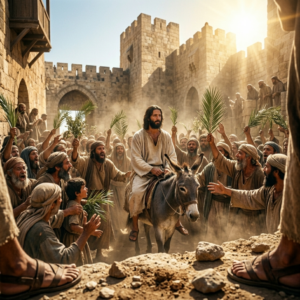
To wage a war against the grave requires a completely different strategy than waging a war against a Roman garrison. And his warhorse? The vehicle upon which this cosmic conqueror chooses to ride into his defining battle? Well, it is different too. Radically, almost comically different. In a deliberate, deeply profound mockery of Roman military triumphs, where generals paraded through cities on massive stallions draped in gold, this king chooses a creature of burden, a creature of the poor. He chooses a donkey.
The Agony of the Paradox and the Lamb for the Slaughter
The confusion among the people, and particularly the religious elite, was not born of mere ignorance; it was born of a profound cognitive dissonance. For every glorious prophecy about the Messiah’s triumphant reign on the throne of David, there were two more prophecies hiding in the shadows of the scriptures—prophecies about his absolute lowliness, his agonizing suffering, and his shocking humility.
The prophet Zechariah had screamed across the centuries: “Rejoice greatly, oh, daughter of Zion! Shout aloud, oh daughter of Jerusalem! Your king is coming to you. Righteous and having salvation is he, humble, and mounted on a donkey.”
How does the human mind hold these two realities together? These two sides of the prophetic tradition were deeply, painfully confusing for the Jews. The psychological tension was almost unbearable. I mean, how can a mind reconcile the image of the Messiah ruling on David’s mighty throne, wielding cosmic justice, with the horrifying image of a man being led like a silent, helpless lamb to the slaughter? A lamb does not roar. A lamb does not conquer. A lamb only bleeds. To ask a people desperate for a lion to instead place their faith in a bleeding lamb was to ask them to step into a void of profound vulnerability.
The Intimate Farewell: Love in the Shadow of the End
This tension reaches its agonizing peak in the quiet, intimate moments shared between Jesus and his closest followers. Imagine the dim, flickering light of the upper room, the heavy silence hanging in the air, the dust dancing in the golden beams of a setting sun. The air is thick with impending doom, a silent terror gripping the hearts of the disciples. They can feel the walls closing in. The religious authorities are circling. The Romans are watching. And in the center of this swirling vortex of anxiety stands Jesus, looking into the eyes of his terrified friends.
“No matter what happens this week,” he tells them, his voice carrying the weight of eternity yet vibrating with a heartbreaking tenderness. “No matter what you see or feel, or think or do, I want you to know that in this world I loved you as my own, and I will love you till the end.”
Listen to the desperate, unspoken questions echoing in the minds of his followers. What does he mean, no matter what we see? Are we not going to see him conquer? Are we not going to see Rome fall? The psychological whiplash is profound. The disciples are looking at their leader, the man they believed would tear the heavens open and rain down fire, and instead, he is speaking the language of a final farewell. He is speaking of an enduring love in the face of an incoming catastrophe. In the minds of the disciples, the paradox threatens to tear their faith apart: Is he liberating us, or does he need liberating himself? If he is the conqueror, why does he sound like a man preparing for his own execution?
Jesus was forcing them, moment by agonizing moment, to consider one paradox after another after another. He looked at a world obsessed with climbing to the top, a world that worshipped power and prestige, and he calmly inverted it. “The first shall be the last,” he told them, challenging the very bedrock of human ambition. “To live, you must die.” These were not just poetic philosophical musings; they were the hard, unyielding laws of this new, upside-down reality he was introducing. And yet, the most staggering reality of all was that Jesus didn’t just preach this kingdom turned upside down from a safe distance. He embodied it with his very flesh and blood.
The Blindness of the Righteous and the Dust of the Holy City
The sheer audacity of his life was an affront to those who thought they had God completely figured out. He was born in a squalid, smelling barn, completely stripped of earthly dignity, and now, he was intentionally riding a lowly donkey toward the center of religious and political power.
The religious leaders, men who had spent their entire lives pouring over the texts, men dressed in fine robes who held the keys to societal morality, are simply not ready for this kind of Messiah. Their minds are too rigid, their hearts too hardened by their own preconceived notions of how divine power should manifest. So, they do exactly what so many of us do when the infinite, mysterious answers of God do not align with what we want them to be. They selectively edit the divine. They willfully ignore the scriptures they don’t like—the ones whispering of suffering, of humility, of the lamb led to slaughter—and they hyper-focus entirely on the ones that suit their own desires for dominance and earthly vindication. Their theology becomes a mirror, reflecting only their own craving for power.
And so, the greatest tragedy in the history of the world begins to unfold in the blinding sunlight of the Holy City. The real Messiah, the cosmic conqueror of death, is being ushered into Jerusalem. The air is filled with the frantic waving of green palm fronds, the dust kicking up into the suffocating heat as the crowds surge forward. The air rings with desperate, impassioned shouts of “Hosanna, save us!”
Yet, amidst the deafening noise and the chaotic celebration, the heartbreaking truth remains: Many in that crowd, and especially the religious elite watching from the balconies with sneering disdain, don’t even truly recognize him. They are cheering for a phantom. They are cheering for the violent king of their own imagination, completely blind to the agonizingly beautiful reality of the suffering servant riding right in front of them.
The Unrecognized Salvation
But here lies the ultimate, breathtaking grace of the story. The misunderstanding of the crowds, the blindness of the leaders, the terror of the disciples—none of it stops the procession. This king is here to save us all the same. He rides forward, embracing the paradox, carrying the weight of their misconceptions, moving steadily toward the slaughter because he knows it is the only way to conquer the grave. He offers a liberation far deeper than political freedom; he offers the liberation of the soul. He wasn’t what anyone was expecting. He was entirely too humble, entirely too vulnerable, entirely too willing to bleed.
Yet, in his lowliness, he achieved what no thundering warhorse or iron sword ever could. He conquered our deepest darkness by letting it consume him, turning the world upside down, and proving that the greatest power in the universe is not the power to take life, but the willing sacrifice to lay it down.
Disclaimer : This content may be created by AI for entertainment purposes. Any resemblance to real persons, events, or places is coincidental.






