The Edge of Eternity: When Human Ambition Met Divine Stillness in the Shadows of Jerusalem
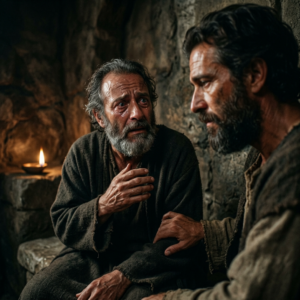
The heavy, unvarnished wooden door creaked, a slow, agonizing groan that seemed to slice through the profound and absolute stillness of the dimly lit room. Outside these thick walls, the air was undoubtedly thick with the dust of thousands of feet, alive with the murmurs of a restless, eager population, but inside, the atmosphere hung suspended, heavy with an almost suffocating peace. A shadow hesitated at the threshold, the silhouette of a man visibly burdened by the sheer weight of urgency and unsaid things. He stepped inward, his sandals scuffing softly against the ancient, uneven stones of the floor. Every grain of dust dancing in the single shaft of golden late-afternoon sunlight seemed to pause as the intruder gathered the breath in his lungs.
“Am I interrupting anything?” the voice asked, wavering on the precipice between a necessary apology and a desperate, burning need to speak. It was a voice tight with a tension that vibrated in the very air of the room. “Is this a bad time?” he pressed, his eyes darting through the muted shadows to find the figure seated quietly within. He had not expected to find him here, isolated, separated from the swelling crowds that chanted his name in the streets below. “I didn’t know you were here,” the man admitted, the confession slipping from his lips before he could catch it, revealing a vulnerability that he usually kept hidden behind a mask of pragmatic confidence.
Yet, beneath the surprise, there was a profound relief. “But I… I’ve been hoping to speak to you,” he continued, the words tumbling out as he crossed the threshold fully. The air between them shifted, charged with the sudden intimacy of a private revelation. “John has kept my secret,” he whispered, a statement that carried the weight of clandestine arrangements, of quiet maneuvers performed in the background while the world watched the main stage. The seated figure did not startle. There was no sudden movement, no flash of irritation at the intrusion. Instead, a serene, unshakeable calm radiated outward, meeting the frantic energy of the newcomer with an ocean of patience. The invitation came not just in words, but in the welcoming gesture of a hand, the shifting of a robe, the softening of a gaze that seemed to see straight through the flesh and into the marrow of the soul. “Would you like to sit?” the calm voice offered, transforming the stone chamber from a place of isolation into a sanctuary of audience. The relief in the standing man’s posture was immediate, a visible collapsing of defensive walls. “Yes, very much, thank you,” he exhaled, the sound of his breath carrying a profound exhaustion. “Please.” And as he lowered himself onto the simple wooden furniture, the scrape of the wood echoing against the stone, the true magnitude of the moment began to unfold.
The Crushing Weight of the Critical Moment
A profound silence descended upon the room once more, stretching on until the quiet itself felt like a physical pressure against the eardrums. It was not an empty silence, but one brimming with the frantic calculations of a mind racing against an invisible clock. The seated man waited, an embodiment of eternal patience, allowing his companion to gather the chaotic fragments of his thoughts. Finally, the words broke the stillness, carrying the gravity of a world teetering on the brink.
“Well,” the man began, his voice dropping an octave, settling into a tone of serious, urgent business. “So we’ve arrived at the critical moment.” He leaned forward, his hands clasping together as if trying to physically hold the fracturing pieces of his grand strategy intact. The ambient light caught the sheen of nervous perspiration on his forehead. He spoke of the masses, of the sheer, terrifying scale of what was happening just beyond the quiet refuge of this room. “There have been so many,” he breathed, his eyes widening as he visualized the sea of humanity. “All of Israel has gathered in one place.” He let the magnitude of that statement hang in the air, a heavy, undeniable truth. This was not a localized phenomenon anymore; it was a national awakening. And the purpose of this gathering, in his eyes, was singular and explosive: “Ready to Crown you King.”
He watched the face of the man opposite him, searching for a spark of reciprocal ambition, a flicker of the fire that consumed his own chest. “The popularity amongst them has never been greater,” he pressed, his voice rising slightly, infused with the intoxicating adrenaline of a political zenith. He painted a picture of a delicate, almost miraculous geopolitical stalemate. “And Rome is sitting on its hands,” he noted, a sharp, calculating gleam entering his eyes. The terrifying, iron-fisted empire that crushed dissent without a second thought was inexplicably paralyzed. “Hoping this will all blow over,” he mused, analyzing the enemy’s inaction. He even found a glimmer of strategic advantage in the recent, dangerous public discourses. “And they may even be delighted by what you said about taxes.” The political maneuvering was complex, a delicate dance of appeasing the oppressors while maintaining the fervor of the oppressed.
But the triumph in his voice was fragile, inherently laced with a creeping, suffocating dread. His expression hardened, the lines around his mouth pulling taut as he addressed the looming threat. “I see,” he stated, transitioning from the hope of the crowds to the venom of the corridors of power. “But it’s going to be easy for your adversaries in the temple to weaponize what you said about the taxes.” He understood the ruthless nature of their enemies. He knew that sacred halls often harbored the most profane intentions. He could already see the twisting of words, the deliberate misinterpretations designed to erode the foundation of their movement. They would “spread ill will amongst the people like a disease,” he warned, his voice a harsh whisper, the metaphor hanging in the stale air—a contagion of doubt and fear meant to poison the minds of the desperate masses. He saw the fragility of their current position. “And everything will deteriorate rapidly.” The vision of a crumbling empire, built on the shifting sands of public opinion, haunted him. He leaned closer, his eyes pleading, desperate to impart the absolute, unyielding urgency of the situation. “The window of opportunity is closing even as we speak.” It was a plea from a man who saw the world purely in terms of momentum, a man terrified of watching the greatest tide in history recede before they could ride it to the shore.
The Architecture of Persuasion and the Knife’s Edge
The passionate, breathless analysis hung in the heavy air of the stone chamber. The dust motes continued their slow, indifferent dance in the shaft of light, utterly unmoved by the political crisis being laid bare. The figure opposite him absorbed the torrential outpouring of anxiety and strategic calculation without a flicker of panic. When he finally spoke, his voice was maddeningly calm, a tranquil surface that offered no reflection of the other man’s storm. “Sounds like you have some ideas,” he observed softly, the slight inflection turning a statement into a mirror, reflecting the ambition right back at the strategist.
This was the opening the man had been waiting for, the slight crack in the door through which he could force his entire philosophy of action. He seized upon it with the desperate energy of a drowning man grasping a lifeline. “You called us for a reason,” he asserted, a sudden defensiveness spiking in his tone. He needed to validate his presence, to prove the absolute necessity of his worldly mindset in this spiritual endeavor. He pulled backward, physically and mentally, retreating into the fortress of his past identity. “I’ve been a successful businessman in the past,” he declared, the words carrying the polished, hard-edged pride of a life spent in the marketplaces, negotiating, bargaining, and manipulating the levers of human desire. He was bringing secular armor to a divine war, convinced of its superior strength.
“And I have experience with human persuasion,” he continued, his hands moving now, painting invisible charts and graphs of human behavior in the empty air between them. He believed he possessed the secret code to unlock the masses, a formula forged in the fires of commerce. This experience, he argued, gave him a unique, vital sight. “So I can tell when a deal is on the verge of closing or losing.” The sacred mission had been utterly reduced, in his frantic mind, to a transaction. It was a negotiation with history, a bargain with destiny. The spiritual revolution was merely a magnificent enterprise, and it was currently floundering in the final stages of the acquisition. He paused, his breath catching in his throat as he searched for the ultimate metaphor to convey the precariousness of their reality. “It is,” he stammered slightly, overwhelmed by the terrifying clarity of his own vision, “it is a knife’s edge.” He stared at the calm face before him, willing the man to feel the cold, sharp steel of that metaphorical blade pressing against their collective throats, urging him to understand that one wrong move, one moment of hesitation, would result in total ruin.
The calm figure absorbed the abrasive language of commerce, the transactional framing of a divine calling. There was no anger in his eyes, only a deep, penetrating sorrow that seemed to understand the heavy chains of the businessman’s worldview. To reach him, to truly communicate, he chose to step into that confined, transactional space. “And so,” the serene voice began, deliberately adopting the cadence of the marketplace, “to… um… adopt your language for a moment.” He leaned in slightly, his gaze locking onto the frantic eyes of his strategist, cutting through the panic to the core of the issue. “What is the deal you’re proposing I close?” It was a masterstroke of engagement, challenging the man to articulate his ultimate, worldly desire, forcing him to lay bare the exact nature of the crown he was trying to place upon a head meant for something entirely different.
The Collision of Birthright and the Fragility of Usefulness
The challenge hung suspended, echoing off the bare stone walls. The businessman’s eyes flared with a mixture of vindication and profound urgency. He had been asked for the bottom line, and he was ready to deliver it with the force of a hammer striking an anvil. “They claimed your Birthright,” he stated, his voice trembling with the magnitude of the assertion. He was no longer just speaking of political maneuvers; he was invoking ancient, ancestral promises. He looked at the calm figure, projecting onto him the colossal weight of centuries of prophecy and waiting. “You are the Messiah, son of David,” he pronounced, the title rolling off his tongue with a heavy, intoxicating reverence. He was laying the ultimate claim upon the table, the trump card of all human history.
He reinforced this monumental claim with the undeniable reality of the streets outside. “And the people are so convinced they’re singing songs in your name.” He could almost hear the melodies bleeding through the thick walls, a chorus of thousands begging for a leader, a conqueror, a king in the flesh. The time for subtlety had vanished. The time for teaching in parables was over. He struck the table with an invisible force. “It’s time.” It was a demand masquerading as advice, an order wrapped in the guise of ultimate loyalty.
But the response he received shattered the very foundation of his argument. The serene figure did not rise to the call of the crowds. He did not puff up with the pride of the title ‘Messiah’. Instead, he bypassed the politics, the crowds, and the history, and drove a question straight into the bleeding, terrified heart of his strategist. “And if I don’t do whatever big thing you’ve imagined I should do at this time,” the calm voice asked, the words falling slowly, deliberately, like drops of water on a parched stone, “will you still believe?”
The question was a physical blow. It ripped away the grand illusions of the movement and exposed the raw, vulnerable core of their relationship. The air in the room seemed to vanish. The businessman blinked, his mouth opening and closing as the sheer, terrifying depth of the question registered. It was a test of loyalty that had nothing to do with success, nothing to do with crowns or deals closed. It was a demand for unconditional surrender to the unknown. He scrambled to assemble his defenses, to offer the expected, righteous answer. “Of course I will,” he replied hastily, the words emerging perhaps a fraction too quickly, ringing hollow against the profound depth of the inquiry.
But the defense was brittle, and the frustration beneath it immediately boiled over. If belief was assured, then why the resistance? “Then why are you suggesting that you know better than I do what should be the next best course of action?” the calm voice pressed, relentless in its gentle probing. The businessman felt cornered, his vast experience and strategic brilliance suddenly feeling like useless trinkets. “Look, I trust you,” he pleaded, his voice rising, cracking under the emotional strain. He threw the question back, a desperate plea for validation. “Do you trust me?”
When the response came back as a quiet, slightly bewildered “What sort of question is that?”, the businessman’s carefully constructed world began to collapse. He clung to his utility as his only source of worth. “You believe I have something to offer this group,” he insisted, demanding an acknowledgment of his value. “Yes, I do,” came the gentle confirmation. “Then why won’t you take my advice?” he cried out, the pain of rejection sharp and agonizing. “Am I not here to help you?”
The defining, devastating blow landed with absolute softness. “I’ve never asked you for your advice.”
The words echoed in the silent room, stripping the businessman of his armor, his identity, and his perceived purpose. If he was not the grand strategist, if his worldly wisdom was not required to secure the kingdom, then what was his place in this divine narrative? He stared into the shadows, a profound, chilling emptiness opening up within him. “Then what am I here for?” he whispered, the question devoid of its former arrogance, replaced by a hollow, terrifying despair. The realization struck him with the force of a physical collapse. He spoke the ultimate fear of a man who measures love by transaction. “If I am no use to your kingdom, then I am nothing.”
The Ultimate Ultimatum of the Heart
The tragedy of the moment hung thick and suffocating in the small stone room. Here was a man entirely willing to give his life for a cause, provided he could engineer its victory. Here was a man who loved his leader, but loved his vision of the leader more. The silence that followed his declaration of worthlessness was not an empty void, but a profound, aching sorrow radiating from the seated figure. The man known as the Messiah did not rush to comfort the broken pride of his strategist. He did not offer empty reassurances of utility. Instead, he recognized the precipice upon which the businessman stood—the terrifying edge between control and surrender.
He leaned forward, the ambient light catching the deep, unfathomable wells of his eyes. When he spoke, he used the man’s name, anchoring the cosmic struggle to this single, specific soul. “You have a choice to make, Judas.”
The utterance of the name shifted the atmosphere entirely. It was no longer a debate about Rome, or taxes, or the Temple authorities. It was a confrontation of the deepest, most intimate nature. Judas, hollowed out by the rejection of his grand strategies, looked up, his eyes wide and trembling. “I’m listening,” he breathed, his voice stripped of all its former, booming confidence. He was a man drowning, waiting for a lifeline that didn’t look like the ropes he was used to grasping.
The choice presented to him was terrifying in its simplicity, entirely devoid of the complex, multi-layered negotiations he favored. It bypassed the intellect entirely and struck directly at the core of human existence. “Who you belong to,” the calm, piercing voice demanded softly. “Who has your heart.”
There was no talk of closing deals, no mention of navigating the treacherous waters of public opinion. The divine kingdom, it appeared, was not built on strategic alliances or the weaponization of crowds. It was built, agonizingly, on absolute surrender. The Messiah was not asking for Judas’s mind, his business acumen, or his ability to manipulate the masses. He was asking for the one thing Judas had kept fiercely guarded behind his walls of pragmatic utility: his vulnerable, unprotected core.
“I want it,” the figure stated, the words carrying an intensity that bordered on a gentle violence—the tearing down of internal strongholds. He reminded Judas of a time before the crushing anxiety of the ‘critical moment’ had taken over. “And I’ve had it before. You followed me willingly.” He was calling back to the pure, uncalculated devotion that had initially sparked the journey, before the dust of ambition had clouded the vision.
The plea was final, laying bare the ultimate desire of the divine for the human. It was not a demand for service, but a yearning for connection. “I want to continue,” the Messiah whispered, the vulnerability in his own voice echoing the raw state of the man before him.
Judas sat frozen, the war raging behind his eyes violently apparent. All his life, he had earned his place at the table. He had proved his worth through action, through results, through the closing of the deal. To be told that his worth was inherent, that his heart alone was the prize, felt like stepping off a cliff into an absolute abyss. He looked at the man he called King, a king who refused to wear the crown he had so carefully forged for him. His chest heaved, a sob caught in the tight constriction of his throat. He understood, in that terrifying, illuminating moment, the excruciating cost of true devotion. He had wanted to manage the divine, to guide it safely to a worldly victory. But the divine only wanted him.
“There’s nothing more than I want than that,” Judas managed to choke out, the words a fractured reflection of the Messiah’s own desire. But the air remained thick with the unyielding tension of a choice yet to be fully realized, a soul vibrating intensely on the absolute, razor-thin edge of eternity.
Reflections on the Architecture of Surrender
The profound encounter in that shadowed room in Jerusalem echoes across the centuries, a mirror held up to the universal human condition. We are, so often, architects of our own anxiety, desperately trying to manage the unmanageable, attempting to negotiate with the divine forces of our lives. Like the frantic strategist, we bring our earthly tools—our logic, our business acumen, our desperate need for control—and try to apply them to matters of the soul. We demand to know the ‘next best course of action,’ terrified of the silence that asks us to simply trust.
The tragedy of this narrative lies in the agonizing confusion between usefulness and worth. When we tie our identity entirely to our ability to fix, to manage, and to strategize, we render ourselves utterly vulnerable to despair the moment our ‘advice’ is not taken. We cry out in the darkness, believing that if we are not actively engineering the outcome, we are nothing. This story gently but firmly corrects that catastrophic misconception. It strips away the illusion that love, or divine acceptance, is a transaction to be closed. It reveals that the ultimate calling is not to be a manager of outcomes, but a custodian of one’s own surrendered heart.
Disclaimer : This content may be created by AI for entertainment purposes. Any resemblance to real persons, events, or places is coincidental.






