The 2:00 A.M. Ghost: Why I Finally Nuked My Family’s Sacred Silence
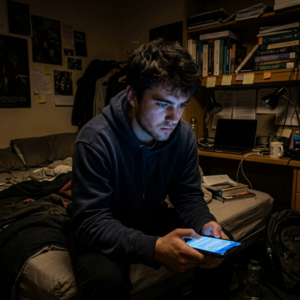
The air in the room was thick, the kind of heavy, stagnant heat that only settles after a day of forced smiles and swallowed pride. It was 2:00 a.m. The rest of the world—the “virtuous” world of elders and tradition—was fast asleep, draped in the comfort of their undisputed authority. But in the blue light of a smartphone screen, a 21-year-old man sat on the edge of his bed, his thumbs hovering over a keyboard like a detonator.
In his culture, what he was about to do wasn’t just a social faux pas; it was a spiritual assassination. To speak back to an elder is to break a link in a thousand-year-old chain. But that chain had been wrapped around his neck for too long, and tonight, the metal had finally snapped.
The day had begun under the guise of “celebration.” A major family holiday gathering—a sea of aunts, uncles, cousins, and the matriarchal shadow of his grandmother. The house smelled of heavy spices and old wood, a sensory reminder of the “untouchable god” status bestowed upon the elders.
He stood there, a successful university student with his life ahead of him, unaware that his very success was a silent insult to his aunt. She carried an inferiority complex like a concealed weapon, sharpened by years of her own failures. Then, it happened. In the middle of the crowded room, under the bright, unforgiving lights of the living room, she walked up to him.
Without a word, she raised her foot and kicked him.
The physical shock was secondary to the verbal venom that followed. She turned to his father, her eyes gleaming with a twisted, petty triumph, and asked the question that would echo in the young man’s mind for hours: “Did you pick him up from the trash?”
Silence. Not the silence of peace, but the suffocating silence of complicity. His brain froze. The biological imperative to respect the elder overrode the instinct for self-defense. He stood there, humiliated, a “trash-picked” son in a room full of blood relatives who saw everything and said nothing.
Hours passed. The party ended. The “peace” was maintained. But as he lay in the darkness of his room, the adrenaline finally began to circulate. He wasn’t just angry; he was awake for the first time in 21 years. He realized that the “respect” his culture demanded was actually a one-way street leading to his own destruction.
He didn’t act on a whim. This wasn’t a “drunk text” or a moment of temporary insanity. It was a calculated strike. He opened the core family WhatsApp group—the digital altar where the family’s public image was meticulously polished.
“Greetings everyone,” he began. The politeness was a razor-thin veil. He proceeded to methodically dismantle his aunt’s facade. He called out the kick. He called out the “trash” comment. He diagnosed her bitter jealousy for exactly what it was: a pathetic reaction to his bright future at a top university.
Then came the “unforgivable sin.” He used language that shattered the religious and cultural decorum of the group. He told her to fix her own life instead of bothering him. He didn’t just defend himself; he “nuked” the status quo. He hit ‘Send’ and watched the two gray checkmarks turn blue. Then, he went to sleep.
When he woke up, he expected a storm. What he found was a revolution.
While he had slept the deep, peaceful sleep of the liberated, his mother had taken up the mantle. Having seen the message, she didn’t scold him—at least, not at first. Instead, she used her own phone to fire a massive volley into the maternal family chat. She listed years of the aunt’s bullying, the subtle jibes at his education, and the name-calling. She declared she was done with the “good person” label.
The group chat was a “raging war zone.” Uncles began lecturing him on religion, conveniently ignoring the physical assault he had endured to focus on the “abusive language” he had used. One uncle demanded an apology because the aunt was “like a mother.”
The hypocrisy was breathtaking. To the elders, a physical kick was a minor detail, but a swear word was a spiritual crisis. They wanted the “fake peace” back. They wanted him to bow his head again so they could feel comfortable at the next dinner table.
The most poignant moment of the entire saga happened away from the digital battlefield. His father—the man who had stood silent as his son was kicked and called trash—approached him.
The father was a man of his generation, his spine curved by decades of cultural indoctrination and the pressure to “keep the peace.” But in private, the mask slipped. He congratulated his son. He was tired of the aunt’s behavior too. He had been a prisoner of the culture for longer than his son had been alive, and he saw in his son’s rebellion the freedom he had never dared to claim for himself.
Yet, even this support was bittersweet. The young man felt a deep, cold disappointment. “They should have supported me in the moment,” he realized. The “mid” communication from his parents—supporting him in private but acting embarrassed by his language in public—was a reminder that he was truly on his own. He had done their job for them. He had become the villain they needed but didn’t want to be.
The fallout continues. The aunt is in “damage control,” weaving a web of lies about apologies that never happened. Cousins are sending “trashy” texts to his mother. The grandmother remains a ghost of silence.
But the young man has stopped caring. He has a “brutal university schedule” and a future to build. He has realized that “respect” is earned, not inherited through a birth certificate. He has accepted his role as the “Black Sheep” and the “Family Villain.”
There is a terrifying beauty in being the one who breaks the cycle. He is no longer the boy who froze in the living room; he is the man who spoke his truth at 2:00 a.m. and didn’t look back.
This story isn’t just about a family feud; it’s about the moment an individual decides that their soul is worth more than a community’s comfort. We are taught that family is everything, but we are rarely taught what to do when family becomes the primary source of our degradation.
The “fake peace” of a toxic family is a house built on sand. It requires the constant sacrifice of the youngest and the most vulnerable. Standing up doesn’t just change your status; it changes the air you breathe.
Disclaimer : This content may be created by AI for entertainment purposes. Any resemblance to real persons, events, or places is coincidental.






