THE ARCHITECTURE OF SILENCE AND THE WEIGHT OF A BREAD BASKET
ACT I: THE PHANTOM KING AND THE INVISIBLE MAIDEN
There is a specific, suffocating atmosphere unique to places where immense wealth attempts to hide from the world. It smells of imported floor wax, perfectly seared beef, and the metallic tang of secrets kept under high pressure. The restaurant did not possess a name. It had no sign, no listing, no welcoming facade. It was simply a heavy, black-lacquered door recessed two steps below street level on the corner of West Erie and North Franklin in Chicago. If you belonged there, you knew. If you didn’t, you walked past it every day, completely blind to the fortress of influence humming just behind the brass handle.
Elena Vasquez had been a ghost in this fortress for two years and four months. She was twenty-seven, possessing the quiet, hyper-vigilant intelligence of a woman who had learned early that survival in America often meant making yourself small. Her internal world was a constant, exhausting calculus of observation. She noticed everything: the tremor in a CEO’s hand, the forced laughter of a politician’s wife, the way power flowed around the fourteen tables like an invisible, toxic gas. Her job demanded absolute discretion. She was paid to remember complex orders without a notepad, to refill crystal water glasses without making a sound, and above all, to never, ever hold the gaze of the man at Table One.
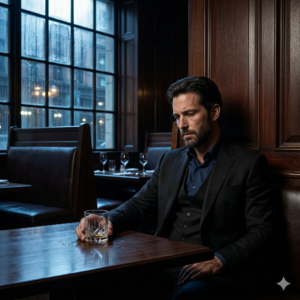
Table One was an elevated booth framed by dark mahogany paneling and surgical, low lighting. It was the throne of Garrett Weston.
Garrett was thirty-two, the architect of this hidden empire. He arrived at eight o’clock, six nights a week, dressed in custom black suits that fit him with the menacing precision of a weapon. He possessed ice-blue eyes that moved without urgency, and a faint, pale scar tracking along his left cheekbone. His internal monologue was a fortress of isolation. He had built this place at twenty, inheriting a vast, crushing family trust, and had spent the last decade constructing emotional bulkheads. He believed that control was synonymous with safety. He watched the room with the stillness of a predator, entirely unaware that while he was watching the world, the invisible waitress was watching him.
In two years, he had spoken to Elena exactly seven times. Once, on a rainy Tuesday, he had murmured, “You have a good memory.” She had replied with a polite “Thank you,” returning to her cramped apartment to dissect the syllables, searching for a meaning that wasn’t there. She was a phantom serving a king made of ice.
But kings are notoriously blind to the rot festering inside their own castles.
ACT II: THE ARRIVAL OF THE WEATHER SYSTEM
The tectonic plates of Table One began to shift eight months ago. Garrett’s mother, Margaret Weston, started attending the Friday services. She was sixty-eight, her silver hair immaculate, relying heavily on a polished wooden cane due to a shattered hip. Margaret possessed the careful, fragile dignity of a matriarch who realized her empire was slowly slipping from her grasp. She learned the staff’s names. She looked Elena in the eye. “You have patient hands,” Margaret had told her softly.
Then, six weeks later, the weather system arrived.
Madison Cole descended upon Table One. She possessed dark hair, pale, assessing eyes, and draped herself in garments that cost more than Elena’s annual salary. Madison was Garrett’s fiancé. She produced a smile engineered in a laboratory to simulate warmth, but it never reached her irises. She spent the dinners with her manicured hand resting possessively over Garrett’s. He didn’t pull away, but he didn’t look at her with the frantic heat of a lover; he looked at her with the resigned acceptance of a man who had made a strategic merger.
Elena poured the sparkling water. She became a silent witness to a masterclass in psychological warfare.
It started with the bread basket. Margaret always took two pieces, breaking the second into small, deliberate fractions—the ritual of a woman whose appetite had been replaced by anxiety. On Madison’s first Friday, the fiancé subtly, almost imperceptibly, slid the basket two inches across the linen. It was a microscopic repositioning, placing the bread just beyond the comfortable reach of a woman with a trembling hand and a bad hip. Margaret paused, withdrew her hand, and spent the remainder of the meal with her fingers tightly knitted in her lap.
Elena’s internal alarms screamed. It was a surgical eraser, a calculated cruelty designed to leave no visible bruises. On her next pass, Elena smoothly, wordlessly, nudged the basket back into Margaret’s territory. The old woman’s eyes darted up, catching Elena’s for exactly one second. An unspoken alliance was forged in the silence.
For six consecutive weeks, the silent war escalated. Madison would move the water glass slightly out of reach. If Margaret began a sentence, Madison would launch a loud, targeted question at Garrett, suffocating the older woman’s voice before it could draw breath. Elena watched the matriarch shrink, retreating into a shell of forced composure.
Elena drove home to her empty apartment, her knuckles white on the steering wheel. She called her grandmother in Guadalajara, listening to the static on the line, feeling the heavy, crushing weight of her own history. When she was sixteen, she had watched someone she loved suffer in silence, and she had lacked the courage to speak.
She hung up the phone. She made a terrifying promise to the dark room. She was done being invisible.
ACT III: THE GEOMETRY OF BRUISES
The silent war shifted from psychological to physical on the seventh Friday.
Elena was leaning across the table to collect the dessert plate—Margaret always ordered the crème brûlée, always leaving half—when the older woman’s silk sleeve rode up. Elena’s breath hitched in her throat. There, stark against the pale, fragile skin of Margaret’s wrist, was a violent mosaic of purple and sickly green. It was a bruise, four or five days old. It wasn’t the chaotic bloom of a fall against furniture. It was the distinct, terrifying geometry of three fingers pressed brutally into flesh. It was the shape of a grip held far too long by someone demanding absolute compliance.
Elena took the porcelain plate and retreated to the kitchen. She pressed both hands flat against the freezing stainless-steel prep counter, her chest heaving, the blood roaring in her ears.
Danny, the head waiter, pushed through the swinging doors with an order slip. He took one look at her pale face. “You okay?”
“Yes,” Elena lied, her voice trembling.
Danny set the slip down. He didn’t look at her. “Don’t,” he warned quietly. “Whatever you’re thinking, don’t. You know whose table that is. You know who she is engaged to.”
“I know,” Elena whispered.
“Then you know,” he replied, pushing back out into the dining room.
The following Tuesday, the restaurant was closed for a private corporate event. Elena found Margaret sitting alone in the dimly lit front lounge, her cane resting against a velvet armchair, a book lying unread in her lap. She was staring blankly at her own hands, the bruised wrist carefully hidden beneath a long sleeve.
Elena approached with a silver tea service. “The crème brûlée isn’t on the event menu, but I can speak to Chef Reyes,” she offered softly.
Margaret didn’t look up immediately. “There’s no need to trouble him.”
“It’s no trouble,” Elena insisted gently.
A heavy, pregnant pause filled the lounge. Margaret finally lifted her head, looking at Elena’s hands as she poured the tea. “Where are you from?”
“Guadalajara. I came here for school.”
“Do you miss it?”
“Every Tuesday,” Elena replied truthfully.
Margaret offered a faint, ghostly smile. “My husband was from a small town in Ohio. He said the exact same thing about it every Tuesday of his life. Somehow, that made the rest of the week bearable.” Her eyes dropped back to her covered wrist. “He’s been gone nine years.”
“I’m sorry.”
“Don’t be. He had a good life.” Margaret’s voice wavered, the carefully constructed dam of her dignity threatening to break. “I don’t know why I’m telling you these things.”
“Because it’s Tuesday,” Elena said softly.
Margaret looked at her. It wasn’t gratitude, and it wasn’t grief. It was the profound, overwhelming relief of a hostage realizing that someone on the outside knows they are trapped. “I think you’re right,” Margaret whispered.
Elena brought the dessert. Margaret ate the entire portion. As Elena drove home that night, the cold Chicago wind whipping through her open windows, she knew the countdown had begun. The bruises were escalating. The psychological warfare was crystallizing into physical abuse. She didn’t know the exact mechanism of Madison’s endgame, but she knew she had to detonate it before the matriarch was completely erased.
ACT IV: THE EXPLOSION AT TABLE ONE
The eighth Friday arrived with the heavy, oppressive atmospheric pressure that precedes a violent storm.
Garrett, Madison, and Margaret were seated at Table One. Elena worked her section, moving with her usual fluid invisibility, but every nerve ending was vibrating. At 8:35 PM, a man in a gray suit appeared at the restaurant’s discreet entrance. A brief, hushed exchange occurred, and Garrett excused himself, disappearing down the back corridor.
The moment the heavy door clicked shut, Madison set her linen napkin on the table with a terrifying, mechanical precision. Elena immediately stopped polishing a wine glass. She stepped one table closer, melting into the shadows of a structural pillar.
Madison leaned across the table. The syrupy warmth was entirely gone, replaced by a flat, dead-eyed menace. “A facility in Evanston,” Madison murmured, her voice a lethal hiss. “Very clean. Good staff. You’ll have your books, Margaret.”
“I don’t want a facility,” Margaret replied, her voice trembling.
“You don’t have a choice. The paperwork is in motion. Dr. Rhor has completed his assessment. Once the process completes, the transfer executes automatically.”
“What transfer?”
“The Weston Family Trust,” Madison stated, the greed finally unmasked. “The controlling shares pass to Garrett upon your legal incapacitation. Incapacitation under Illinois estate law can be established by medical declaration. Dr. Rhor has been very thorough.”
Elena stopped breathing. Her internal world shattered. Garrett wouldn’t. “Garrett sees what I show him,” Madison sneered, answering the unspoken thought. “I’ve been managing that for over a year. I made it efficient for him to believe you forget things. That you’ve become confused. That you’ve become… difficult.” Madison let the word hang in the air like a blade. “Please don’t tell me you’ll fail to cooperate with Dr. Rhor’s follow-up.”
“Please,” Margaret begged, a tiny, broken sound.
“Tell me,” Madison demanded, the patience in her voice a terrifying, quiet violence.
Elena set the glass down. She was done with angles. She was done being a ghost.
She walked directly to Table One. “I’d like to take that plate,” Elena announced, her voice ringing out in the hushed room.
Madison snapped her head up, her eyes flashing with venomous disregard. “The plate is fine.”
Elena ignored her, locking eyes with Margaret. “Would you like the dessert menu, ma’am?”
“Yes, thank you,” Margaret whispered, finding a sudden, desperate strength in the waitress’s defiance.
Madison shifted in her chair, leaning back. Her voice dropped to a register meant only for Elena. “If you bring that menu, you’re done in this room tonight, and you are done in this city by Friday. You know who I’m engaged to. Do you understand what I am telling you?”
Elena stood frozen for exactly one second. Two years of invisible servitude flashed through her mind. The memory of her grandmother. The memory of her own past cowardice.
She turned around. As she did, Madison rose from her chair and clamped her hand down hard onto Margaret’s shoulder. Elena saw the angle of the grip—the exact pressure points that would leave a bruise.
Elena crossed the floor in four violent strides. She didn’t shout. She didn’t hesitate. She grabbed Madison’s wrist and physically ripped the woman’s hand off the matriarch’s shoulder with an absolute, terrifying steadiness. She inserted her own body between the abuser and the victim.
“Don’t touch her,” Elena commanded.
Madison’s face contorted into a mask of pure, ugly rage. “Get your hands off me!” she shrieked, violently yanking her arm back. The momentum threw Madison off balance. Her hip crashed heavily into the edge of the mahogany table.
A crystal water glass toppled over, shattering against the marble floor.
The sound silenced the entire restaurant. Dozens of powerful men and women turned to stare. Madison instantly recalibrated. The rage vanished, replaced by a masterful, theatrical display of victimhood. She clutched her dress, looked around the room, and produced a whimpering sob.
“She attacked me!” Madison cried out.
The door from the back corridor opened. Garrett Weston walked in. He stopped dead. He looked at his weeping fiancé. He looked at his mother, sitting perfectly still. And he looked at Elena, standing over the broken glass, her jaw set, her eyes locked onto his with absolute, unyielding defiance.
Garrett, the king of ice, stood in his own doorway with fifteen seconds to decide which reality was true.
“Everyone back to work,” Garrett boomed, his voice echoing off the paneled walls.
He walked to the table. He looked at Madison’s managed tears. He looked at his mother’s resigned, defeated posture. Finally, he looked at Elena.
“Go home for the night,” Garrett ordered, his face a completely unreadable mask. “We’ll speak tomorrow.”
“Yes, sir,” Elena replied. She picked up her tray and walked to the kitchen, entirely certain she had just destroyed her own life.
ACT V: THE AUTOPSY OF A BETRAYAL
The restaurant emptied. The staff cleaned the floors and faded into the Chicago night. Garrett sat alone at Table One, a glass of untouched bourbon sweating onto the mahogany. His internal world was a chaotic, terrifying void. He had built his life on the absolute certainty of his own observation, yet he felt as though the floorboards had suddenly rotted away beneath his feet.
He thought about the split second before he had spoken—the moment he looked at his mother. Margaret hadn’t looked afraid of the waitress. She had looked terrified for her. That tiny, subtle distinction gnawed at Garrett’s sanity.
He stood up, abandoning the bourbon, and walked to the back of the restaurant, unlocking the heavy steel door to the server room. The security system had been installed eighteen months ago for liability; he had never actively used it. He sat in the glowing, humming darkness, firing up the monitors. He told himself he was going to watch thirty minutes of footage to justify firing Elena.
He was still sitting in the freezing server room at 4:17 AM.
He watched the six months of Fridays. He watched the agonizing, microscopic torture of the bread basket. He watched Madison physically block his mother from speaking. He pulled the audio. He heard the venomous, whispered threats. He heard the words facility, incapacitation, and medical declaration. He heard his mother beg.
Garrett’s chest heaved. He was suffocating on his own profound, catastrophic blindness.
He pulled up the footage of the Tuesday lounge session. He watched a waitress he had barely acknowledged pour tea for a broken woman, bringing a genuine, resurrected smile to his mother’s face. He called his estate attorney at 1:00 AM, his voice vibrating with a barely contained, homicidal rage.
The attorney confirmed his worst fears. The preliminary estate filing was real. Madison’s legal team had initiated it four months ago. Garrett had signed the initial psychiatric referral without reading it, trusting the woman sharing his bed. One more signature, and his mother would have been locked in an asylum, the entire Weston Trust transferred to his control—and by extension, through marriage, to Madison.
Then, he fast-forwarded to the eighth Friday. He watched Elena. He watched her physically interpose herself between a predator and her prey. He watched the waitress sacrifice her livelihood to protect a woman he had failed. He paused the footage on his own face as he walked into the dining room. He saw a fool. A blind, arrogant king ruling over a kingdom of lies.
He closed the laptop. The silence in the server room was absolute. The king was dead.
The following afternoon, Madison arrived at the restaurant, summoned by a tone Garrett reserved for corporate executions. She sat at Table One, wearing a cream jacket, projecting her usual, calculated warmth.
Garrett didn’t speak. He slid a tablet across the table and pressed play.
He watched her watch her own monstrosity. He saw the precise moment the performance failed. The warmth evaporated, replaced by the cold, reptilian flatness of a predator caught in a snare.
“That audio is out of context,” Madison stated, her voice devoid of emotion.
“The estate attorney received the referral I signed six weeks ago,” Garrett replied, his voice a lethal, quiet storm. “One more signature and my mother would have been declared legally incapacitated. The filing originated from your legal team.”
“I was trying to protect her,” Madison lied smoothly. “She’s been declining. You don’t see it because you don’t want to.”
“I watched forty hours of footage,” Garrett said, leaning forward. “She is not declining. She has been managed. There is a difference, and you know exactly what it is. I want you to leave. The engagement is over. If you ever approach my mother again, I will utilize every fraction of my wealth to ensure you cease to exist in polite society.”
Madison looked at him, realizing the vault was permanently sealed. She stood up, grabbed her designer bag, and walked out of the restaurant without a backward glance. Her heels clicked against the marble, the sound fading into the roar of the city.
Garrett sat alone at Table One. The room felt immense, cavernous, and fundamentally cleansed.
ACT VI: THE VISIBLE WOMAN
The Chicago night had settled over the city, biting and cold, when Elena’s cheap flip phone buzzed on her kitchen counter. She stared at the caller ID, her stomach twisting into a knot. She answered it, expecting the final execution of her employment.
“I’d like you to come back,” Garrett Weston’s voice came through the speaker. It was stripped of its usual icy command. It sounded exhausted, raw, and profoundly human.
“I need to know what happened,” Elena demanded, her voice shaking but resolute.
Garrett told her. He confessed to the footage, the attorney, the horrific realization of the medical coup. He confessed to the four months of his own blindness, the agonizing failure to protect his own blood. He spoke of the bread basket, acknowledging the silent war Elena had fought on his behalf.
Silence stretched across the cellular network.
“Your mother needs someone with her tonight,” Elena finally said softly.
“I know,” Garrett replied.
“I’ll go now, if that’s all right.”
“It is. Good night, Mr. Weston.”
“Garrett.” The correction hung in the air, heavy with the dismantling of the old world.
“Good night, Garrett.”
Garrett drove to the restaurant. He didn’t turn on the dining room lights. He sat at Table One in the heavy, brooding darkness, illuminated only by the faint glow of the streetlamps filtering through the high windows. His internal world was entirely rearranged. The fortress of isolation he had built was a smoking ruin, but for the first time in his adult life, he didn’t feel the desperate need to rebuild the walls.
He thought about the woman who had shoved a predator against a wall in a room full of powerful people. He thought about a woman who had chosen to step directly into the line of fire when remaining invisible would have guaranteed her safety.
Garrett turned his empty glass on the mahogany table. He wasn’t the man he had been a week ago, and he wasn’t entirely sure who he was going to become. But he knew, with the absolute, vibrating certainty of a man waking from a long, terrible fever dream, that the woman who had held his gaze with pure, unapologetic defiance was the most visible, vital force he had ever encountered.
She had never been a ghost. He had just been too blind to see the fire.
Garrett leaned back in the booth, the leather creaking softly in the silent room. The era of the ice king was over. The last sunset of his isolation had finally fallen. He looked out at the empty restaurant, ready for the dawn.
Disclaimer : This content may be created by AI for entertainment purposes. Any resemblance to real persons, events, or places is coincidental.






