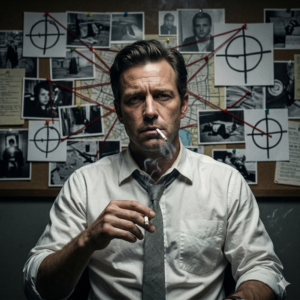
The air in 1966 tasted different. It was heavy with the scent of unfiltered Lucky Strikes, leaded gasoline, and a distinct, simmering paranoia that had yet to boil over.
When I first opened my eyes in this era, I was staring at a stained linoleum ceiling, the badge of San Francisco Police Inspector Thomas Vance sitting heavy on the nightstand next to a rotary phone. I didn’t know how a modern criminal profiler from the 21st century had been thrust back into the body of a 1960s detective, but I knew exactly when I was. The calendar on the wall read October 1966.
A cold dread pooled in my stomach. The Zodiac.
I knew the timeline. I had studied the case files in my own time until the pages were worn thin. I knew the dates, the victims, the locations. I thought I had been sent back to be the ultimate savior, the man who would stop the phantom that haunted California.
I was wrong. Knowing the future and changing it are two entirely different things.
My first failure happened almost immediately. October 30, 1966. Riverside, California. I knew the name: Cheri Jo Bates. I knew she would be at the Riverside City College library. I drove south like a madman, pushing my unmarked Ford Galaxie to the absolute limits of its V8 engine. But 1966 was a world without GPS, without cell phones, without instant communication. I navigated by a clumsy paper map under the dim glow of a streetlamp. I got lost twice in the winding, unfamiliar streets.
By the time I skidded into the college parking lot, the fog had already rolled in, thick and suffocating. I sprinted toward the alleyway between two abandoned houses near the library. My lungs burned, my heart hammered against my ribs, but the only sound greeting me was the deafening silence of the night. I found her near her Volkswagen Bug. I was thirty minutes too late. The blood was still wet on the gravel. I fell to my knees, the crushing weight of my failure pressing down on my shoulders. I knew he was coming, and I still let a young girl die. History was stubborn; it fought back.
For two agonizing years, I waited in San Francisco. I worked homicide, building a reputation as a brilliant but deeply unhinged detective. I mapped out jurisdictions—Vallejo, Napa, San Francisco. I alienated my partner, an old-school flatfoot named Miller, who didn’t understand why I was obsessively tracking minor lover’s lane complaints.
Then came December 20, 1968. Lake Herman Road.
I knew this was his official debut. David Faraday and Betty Lou Jensen. I requisitioned a patrol car and drove out to Vallejo, freezing in the bitter California winter air. I parked near the gravel turnout, determined to intercept the killer’s Rambler. I sat in the dark for four hours, my hand resting on the grip of my .38 Special, my eyes burning from staring into the blackness.
But the timeline had shifted. Maybe my presence on the road spooked him. Maybe my memory of the exact hour was flawed. I heard the crack of the gunshots echoing from a different turnout, two miles further down the dark, winding road.
I slammed the car into gear, the tires screaming on the asphalt, but by the time my headlights swept over the gravel, the killer was gone. David was lying near the passenger side of his Rambler. Betty Lou was a few feet away, having tried to run. The smell of copper and freshly burnt cordite hung in the frigid air. I slammed my fists against the steering wheel until my knuckles bled. Twice I had tried to play God. Twice, the Zodiac had slipped through my fingers. The brass thought I was a prophet for being out there, but I felt like an accessory to murder.
By July 1969, the city was descending into a state of sheer terror. The Zodiac had attacked again at Blue Rock Springs, and then, the letters began.
They arrived at the Vallejo Times Herald, the San Francisco Chronicle, and the San Francisco Examiner. He demanded they be printed on the front page, or he would go on a weekend kill rampage. Included in the letters were cryptograms. The infamous crosshair symbol became the logo of our collective nightmare.
Because of my interference—my presence at the crime scenes before the local cops even knew what they were dealing with—the Zodiac of this timeline became fixated on me. He realized there was a hound on his trail that was moving just a little too fast, anticipating his moves. He sent a letter directly to the SFPD, addressed to me.
“This is the Zodiac speaking. To the Inspector who is always one step behind… you think you are clever, but you are playing a game you do not understand. Let us see if you can catch me before the fog bleeds.”
Attached was a brand new cipher. Not the 408-symbol cipher that a local schoolteacher would eventually crack, nor the infamous 340-cipher. This was something entirely different, created specifically to mock me.
I took a leave of absence from the precinct. I locked myself inside my cramped apartment in North Beach. I covered the windows with newspaper. The walls disappeared beneath crime scene photos, maps tied together with red yarn, and blown-up copies of his cryptograms.
The ensuing weeks were a blur of cheap bourbon, stale coffee, and the skipping needle of a record player spinning Beethoven. I lost weight. I lost sleep. I stared at the strange, alien symbols—a mix of Greek letters, weather map symbols, and astrological signs—until they burned themselves onto the back of my eyelids.
In my original time, I had relied on computers and algorithms for decryption. Here, I had nothing but a chalkboard, chalk dust coating my fingers, and my own descending sanity. I knew his psychology. I knew he was an extreme narcissist. He craved attention and believed he was intellectually superior to everyone else. His ciphers were homophonic substitution codes—he used multiple different symbols to represent common letters like ‘E’ and ‘A’ to prevent simple frequency analysis.
For days, the code looked like absolute gibberish. I tried reading it backward, diagonally, splitting it into quadrants. I failed again and again.
But narcissism is a fatal flaw. It makes a man sloppy.
It happened at 3:00 AM on a rainy Tuesday. I was staring at a repeating sequence of symbols that appeared three times in the bottom half of the page. A half-moon, a cross, a delta, an inverted ‘P’. In his previous letters, the Zodiac often misspelled words intentionally to throw off decipherment, but he also had genuine spelling errors. He frequently misspelled ‘paradise’ as ‘paradice’.
I substituted the repeating symbols for the letters in ‘PARADICE’.
Like a key turning in a rusted lock, the cipher began to break. I worked feverishly, my chalk snapping against the board, sweat dripping down my forehead. I mapped the letters, tracing the homophonic substitutions. The message wasn’t a rambling manifesto about collecting slaves for the afterlife like his others. It was a direct, arrogant challenge.
I L I K E T H E S P I N N I N G L I G H T S I W I L L T A K E M Y N E X T S L A V E W H E R E T H E C A B S S T O P U N D E R T H E R E D B R I D G E T O M O R R O W N I G H T A T T E N
The spinning lights. The cab. The red bridge.
He was combining his crimes. In my history, he killed cab driver Paul Stine in Presidio Heights. But he was shifting the location. Where the cabs stop under the red bridge. The Golden Gate Bridge. The toll plaza or the scenic overlook at Fort Point. He was going to take a cab driver there and execute him in the shadow of the bridge.
Tomorrow night at ten. I looked at my watch. It was already October 11, 1969. 8:00 PM.
I didn’t call for backup. The department wouldn’t authorize a strike force based on a frantic detective’s late-night chalkboard translation. I grabbed my trench coat, strapped my .38 to my shoulder holster, and grabbed a 12-gauge pump-action shotgun from my closet.
The drive to Fort Point was a blur. The San Francisco fog was thick, a living, breathing entity that swallowed the headlights of my car. I parked in the shadows beneath the massive steel archways of the Golden Gate Bridge. The water of the bay crashed violently against the seawall. The foghorn groaned in the distance, a mournful, hollow sound.
9:45 PM. I waited in the damp darkness.
9:55 PM. Nothing. Just the wind and the freezing mist. Doubt began to creep into my mind. Had I translated it wrong? Was he playing another game?
10:02 PM. Twin yellow headlights pierced the fog.
A Yellow Cab slowly rolled down the dead-end road toward the Fort Point overlook. It came to a stop near the seawall. I moved silently through the fog, keeping my body pressed against the cold, damp brick of the fort’s exterior wall.
Through the rear window of the cab, I saw two silhouettes. The driver in the front, and a heavyset man in the back. I saw the passenger raise his arm. I saw the glint of blued steel in the dim streetlamp.
I didn’t yell “Police.” I didn’t give him a chance to react. I lunged forward, smashing the butt of my shotgun through the rear passenger window.
The glass shattered inward with a deafening crash. The Zodiac recoiled, dropping his 9mm pistol as a shard of glass sliced across his cheek. The cab driver screamed, diving beneath the dashboard.
“Don’t move! SFPD!” I roared, racking the shotgun. The mechanical clack echoed like thunder under the bridge.
The man in the back seat froze. He was wearing a dark windbreaker and thick, horn-rimmed glasses. He looked exactly like the composite sketch, yet utterly, pathetically ordinary. This was the monster that had terrorized a state. This was the phantom I had chased across time.
He looked at the barrel of the shotgun, then up at me. His arrogant smirk faltered, replaced by genuine, human panic. “You…” he whispered, his voice nasal and reedy. “You broke the code.”
“Paradice is spelled with an S, you son of a bitch,” I sneered.
I dragged him out of the cab through the shattered window, throwing his heavy frame onto the wet asphalt. I jammed my knee into the center of his back, pulling his arms behind him, and clamped the cold steel handcuffs around his wrists. The click of the cuffs ratcheting shut was the sweetest sound I had ever heard.
As the wail of police sirens finally began to cut through the fog in the distance—called in by the terrified cab driver over his radio—I stood up, breathing heavily. The Pacific wind whipped around me, chilling the sweat on my neck.
I looked down at the Zodiac, writhing on the wet ground. He wasn’t a supervillain. He wasn’t an unstoppable phantom. He was just a sad, brutal man who thought he was smarter than the rest of the world.
I had failed in Riverside. I had failed in Vallejo. The guilt of those lives lost would haunt me until the day I died. But beneath the red iron of the Golden Gate Bridge, the timeline finally broke. I had stripped the Zodiac of his mystery, of his reign of terror, and of his freedom.
I didn’t know if I would ever wake up in my own time again. As the flashing red and blue lights of the SFPD cruisers finally pierced the heavy fog, illuminating the arrested monster at my feet, I realized it didn’t matter. I had caught the ghost. And for the first time since 1966, the air in California tasted clean.
Disclaimer : This content may be created by AI for entertainment purposes. Any resemblance to real persons, events, or places is coincidental.






