The heavy wooden door of the church kitchen offered only a sliver of warm light before Mrs. Peabody’s face appeared, tight and unyielding. “We do not need help today, Mara,” she said, her eyes dropping to Mara’s worn dress before darting away.
“I can scrub,” Mara offered quietly, her hands folded at her waist. “I can peel potatoes. I will do it quietly.”
From the shadows behind Mrs. Peabody, another woman’s voice cut sharp like a blade. “Tell her no. We cannot have her here. People talk enough already.” The door shut.
Mara Ellery did not knock again. She stepped back into the bright, unforgiving morning sun of the town that had decided she was too much of a problem to keep. Since her husband had died in a mining cave-in eight months ago, the town’s sympathy had quickly curdled into distance, and then into active disdain. A widow without money or family made people nervous. Nervousness bred gossip, and gossip shut doors.
Walking to the general store, her thin boots felt every stone in the road. Inside, she spent her last two bits on a half-pound of beans. Mr. Dodd, the storekeeper, handed her the small paper bag, avoiding her gaze. Then, he slid a folded piece of paper across the counter. “Sheriff left this for you,” he muttered, washing his hands of the burden.
Outside in the shadows, Mara unfolded the paper. Eviction. She had three days to leave Mrs. Harrow’s boarding house. Three days meant never.
“Mara Ellery.”
Sheriff Klein stood on the boardwalk, thick-chested, the tin star catching the light. He didn’t offer pity. He offered an ultimatum. Mrs. Harrow was done with her. The church was done. There was no credit left. But there was a way out that didn’t end in an alley. Up in the mountains lived Holt Reigns, a widower with two twin boys whose mother had died two years prior. The boys were reputed to be as mean as snakes, having driven off every hired help or mail-order bride the agency sent. Holt Reigns had asked for a wife on paper to run his household.
“You go up there,” the Sheriff said, his voice flat. “You take the work. You take the name if Holt offers it. You stop being a problem in my town. You leave tomorrow morning on the supply wagon.”
Mara did not cry. Crying made a woman’s face swell, and swollen eyes only invited more cruel questions. She packed her carpetbag that night, leaving her late husband’s ring buried at the bottom. A name didn’t protect a woman; sometimes, it only told people what they could take from her.
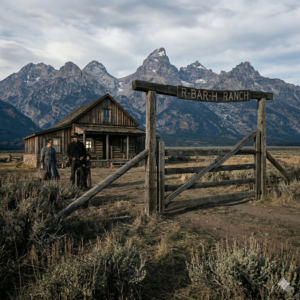
By midday the next day, the supply wagon dropped her at the mountain turnoff. From there, she walked. The air grew thinner and colder, smelling of pine and raw stone. When the ranch finally broke through the tree line, it sat in a wide cut of land, rugged and isolated. A man stood on the porch. He was tall, his face lean and weathered, wearing a dark hat pulled low. He did not step forward to welcome her.
“You’re late,” Holt Reigns said.
“The wagon could only take me to the turnoff,” Mara replied, her breathing heavy but her chin level. She held up the agency paper, not like a blushing bride, but like a laborer presenting a claim.
Holt’s eyes scanned her. “So you’re what they sent. You understand what this is? It is a household that needs keeping, two boys that need raising, a ranch that needs running.”
“I can work.”
“My wife died,” Holt said abruptly, letting the bluntness do the heavy lifting. “The boys have not been right since. They drove the others out, and I did not stop it. You will keep the house. You will have food, a roof, and protection. You’ll have my name if I give it. I’m not offering sweet words. I’m offering a place.”
“A place is enough,” Mara said.
Her trial began the moment the back door banged open. Two boys, Eli and Jonah, burst into the kitchen. They were nearly eight, dark-haired, and wild. They stopped, assessing her not with fear, but with the calculated cruelty of feral things.
“What happened to the last one?” Eli demanded.
“She left,” Holt answered.
“They all leave,” Eli said, a chilling statement of fact. He stepped forward, testing the perimeter. “Daddy said you can’t touch our things. He said you don’t get to tell us anything.”
Holt’s jaw tightened, but he said nothing, waiting to see if Mara would shatter or beg for his intervention. Mara didn’t look at Holt. She looked straight at Eli. “Holt Reigns will tell me what Holt Reigns wants. Until then, the rule is simple. You don’t speak for him, and I don’t pretend you do.”
The lie died instantly. Jonah’s eyes widened slightly. A woman had refused the trap without raising her voice.
That night, the house settled into a cold silence. Mara sat in her small back room when her door crept open. Jonah stood in the shadows, holding his hand behind his back. His chin trembled, but his eyes were hard. Behind him, Eli peered down from the loft ladder.
“What do you want?” Mara asked softly.
Jonah pulled his hand forward. The blade of a pocketknife was open. “I want you to go.”
Mara didn’t flinch. She didn’t gasp. She looked at the blade, then at the boy. “That’s a tool,” she said steadily. “Not a threat.”
“You should be scared!” Jonah insisted, his voice cracking with the strain of his own bluff.
“If you want me gone, you can ask,” Mara replied. “You don’t need steel for that. I can’t go. I don’t want to.” She pointed at the knife. “Close it. You can keep it, but you will not point it at me. Or I will tell Holt, and he will take it, and you will feel smaller, not stronger. I don’t want that for you.”
Jonah stared. Slowly, his thumb moved. The blade clicked shut.
“You kept your pride,” Mara said softly. “I kept my safety. Go to bed.”
The next morning, the battle lines shifted. While Mara mended a shirt at the kitchen table, Eli walked to the pantry, grabbed a large glass jar of flour, looked Mara dead in the eye, and tipped it over. White dust poured across the floorboards in a massive, choking cloud. Eli set the jar down hard, his shoulders bracing for the explosion of rage that always followed his sabotage.
Mara did not yell. She slowly stood up, wiped her hands on a rag, and sat back down, picking up her mending.
“Ain’t you going to clean it?” Eli demanded, entirely derailed.
“No,” Mara said calmly. “You made the mess. You can clean it, or you can leave it, but I will not carry your anger for you.”
Furious that his weapon had been neutralized, Eli kicked the flour pile, sending dust into the air, and ran out the back door, slamming it so hard the windows rattled. Jonah lingered, asking why she didn’t chase him.
“Because if I clean it, he learns he can throw his anger at me and I will make it go away. That does not help him,” Mara said.
The flour remained on the floor all day. Mara cooked around it. She stepped over it. When Holt came home at dusk, he saw the white dust and looked at Mara. She explained simply: Eli spilled it to make her angry. She left it because she wouldn’t play the game. Holt stared at her, seeing a kind of quiet, immovable strength he didn’t know how to navigate. He didn’t rescue Eli from the consequence. The next morning, when Mara handed Eli the broom, he took it. He swept the floor.
The turning point came in the dead of night, heralded by the crack of thunder. A brutal mountain storm shook the cabin timbers. Mara woke to Jonah standing in her doorway. “Eli’s scared,” he whispered.
Mara climbed the ladder to the loft. Eli was curled on his pallet, facing the wall, shaking violently. She didn’t crowd him. She sat on the floor nearby. “I’m not your mother,” she said softly over the thunder. “I won’t pretend I am. But you don’t have to be alone in the dark.”
She pulled a small, worn metal cross on a string from her pocket. “When I was frightened,” she told him, “I held this and counted my breath. I pushed people away because it hurts less than hoping.”
Eli finally turned his head. They counted breaths together until the thunder rolled away and sleep took the boys. When Mara climbed back down, Holt was sitting in the dark kitchen. He admitted he didn’t know how to hold them after his wife died; he thought work would save them, but it only made the house louder.
“You don’t have to be what she was,” Mara told him. “You only have to be their father.”
Days turned into weeks, and the ranch settled into a cautious rhythm. Mara didn’t break the boys; she simply outlasted their fear. But the peace was fragile, and the town below would not let it hold. Word reached the mountain that the Sheriff and the Preacher were asking questions, stirring up the rumor mill. The town folks whispered that Mara was an unfit vagrant and the Reigns boys were wild menaces who needed to be taken away.
When Preacher Collins, Mrs. Collins, and Sheriff Klein finally rode up to the ranch, they came to provoke. Mrs. Collins looked at Mara as if she were dirt on the floorboards. The Sheriff threatened to bring the county down on them. They wanted Mara to snap, or the boys to explode. Instead, Mara calmly ordered the boys inside. When the Sheriff sneered at her, Holt finally stepped up. “She lives here,” Holt declared. “I’d rather my sons live than my reputation stay clean.”
But the town wasn’t finished. A summons arrived. Holt, Mara, and the boys were forced to travel down the mountain to a public hearing at the church hall. The room was packed with eager, hungry faces. A county official named Caldwell sat beside the Sheriff, citing reports of destruction, instability, and Mara’s lack of moral standing. They threatened to remove Mara and put the boys under strict supervision.
Eli couldn’t take it. He sprang from his seat, tears streaming down his face. “She’s not a risk!” he screamed at the panel. “You are! You want us to be bad so you can say you were right! They’re taking her like Mama!”
The room erupted. The Sheriff smiled, smugly pointing out Eli’s outburst as proof of instability.
Mara stood up. She smoothed her skirt, her face a mask of absolute calm. “If you want to judge me, judge what I do, not what you heard about me.”
“You are not invited to address the panel,” Caldwell said stiffly.
“I live with those boys,” Mara replied, her voice cutting through the hall. “You speak of risk. I have been the one wiping their tears and holding their fear when your town was done with them. They have grief. Grief does not look tidy. It does not look polite, but it is not dangerous.”
She challenged them to come to the ranch. Not for an hour, but for a full day. To watch them wake, work, and eat. Holt backed her up, his voice hard as iron. The panel, backed into a corner by their own public procedure, agreed to a one-day observation.
The next morning, Caldwell and the Sheriff arrived at dawn. Mara served breakfast exactly as she always did—plain, hot, and without ceremony. Sheriff Klein, desperate for a reaction, leaned back and casually asked the boys about throwing stones at Mrs. Brandt’s windows, invoking their dead mother to twist the knife. He wanted an explosion. He wanted Eli to throw a punch.
Mara saw the boys’ shoulders tense. She saw the panic. She set her spoon down. “Breathe,” she told them softly. “In. Out.”
The boys listened. The explosion never came.
Furious, the Sheriff turned on Mara. “Would their mother have let them talk back?”
Mara looked at him with eyes colder than the mountain wind. “She’s not answering questions. You said you were here to observe. Not to stir. Ask like you’re here in good faith.”
“You got bold,” the Sheriff hissed.
“No,” Mara said evenly. “I got tired.”
The rest of the day unfolded in a rhythm of unbroken routine. The boys chopped wood, they fed the chickens, they sat by the creek. When Eli got frustrated and kicked the dirt, Mara stepped in, steady and calm, redirecting his energy without yelling. When the sun began to sink, the truth was undeniable. The house was not wild; it was healing.
Caldwell closed his folder on the porch. “The children are not being neglected,” he announced stiffly. “The county will not recommend removal.”
The Sheriff rode away without a word. As the dust settled on the trail, Jonah looked up at Mara, his eyes shining in the fading light. “You didn’t run.”
“Running would teach you the wrong lesson,” Mara said.
That night, after supper, Jonah brought out a small candle and placed it in the center of the table. Eli set a smooth creek stone beside it. Holt reached into his pocket and laid down a dark button from his late wife’s coat. They stood in the warm kitchen, honoring the ghost that had haunted them, finally making peace with her absence.
Later, under the vast, star-swept mountain sky, Mara stepped onto the porch. Holt followed her out, the cold air sharp between them.
“The paper arrangement,” Holt said, his voice rough and low. “It was meant to quiet town mouths. If you want a real name here… I can offer it. Not as a reward. Not as a rescue. As a promise I intend to keep.”
Mara looked at the man who had stood beside her against the whole town. She looked at the warm light spilling from the windows of the home she had fought for.
“I won’t replace her,” Mara said softly.
“I would never ask for it,” Holt replied.
Mara smiled, a small, quiet thing that reached all the way to her eyes. “I’ll stay.”
Holt nodded, the tension finally leaving his broad shoulders. And there on the mountain, far above the cruel whispers of the town, Mara Ellery realized she was no longer a castoff surviving day to day. She was the steady, beating heart of a family that had finally found its way home.
Disclaimer : This content may be created by AI for entertainment purposes. Any resemblance to real persons, events, or places is coincidental.






